
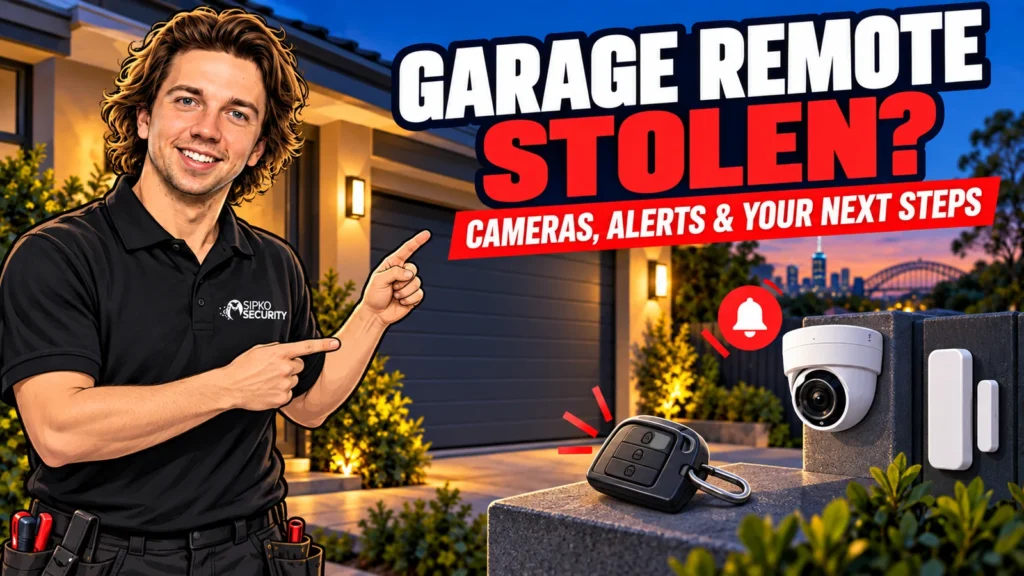
Garage remote theft is an access problem first. A stolen remote may still operate the door until the relevant access is removed using the correct process for that opener. Cameras and an alarm can add valuable awareness and evidence, but they do not revoke the remote. Address both the access credential and the protection around the garage.
The advantage of a well-designed system is that you may learn about activity before somebody reaches the inside of the garage. That depends on the camera or detector covering the approach, being configured to alert and having a working notification path. It is a useful capability to design and test, not a promise that every incident will be detected in advance.
If a remote has been stolen, deal with access first
If there are signs that someone may be inside the garage or home, stay away from the area and contact police. Do not use a camera view as a reason to confront somebody. Preserving personal safety takes priority over recovering property or checking whether the stolen remote still works.
For a missing or stolen remote, identify the opener model and contact the door manufacturer or an authorised garage-door technician. Ask how the unwanted remote’s access is removed and how remaining authorised remotes are checked afterwards. The process varies; do not follow a random button sequence from a video for a different opener.
Tell the technician about every access method, including other remotes, wall controls, keypads and any connected app. Ask which credentials the proposed procedure affects and whether other users need to be set up again. A replacement remote is not evidence that the stolen one has stopped working.
Also review whether house keys, identity documents or account access were lost at the same time. Those may create separate issues that a garage remote change does not resolve. Keep a record of the theft and any relevant footage for police or your insurer, without sharing sensitive access details publicly.
Remove unwanted access
Use the correct authorised process for the exact opener and verify the remaining access methods.
Detect activity
Consider the approach, the garage door and the interior as separate detection locations.
Plan a safe response
Know who receives an alert and what they should do without entering a potentially unsafe area.
Why a working remote can bypass your expectations
A powered garage door is designed to respond to authorised controls. If a stolen remote remains accepted, the opener may treat its use like an ordinary arrival. The fact that the door closes afterwards does not tell you whether the person using it was entitled to be there.
This is why a door-control system and a security alarm need separate consideration. Opening the garage does not necessarily disarm a separate alarm. Equally, some installations have integrations or routines that affect arming. Ask your installer to explain the actual relationship rather than assuming every remote either disables the alarm or always leaves it armed.
Think about the next boundary too. An attached garage may lead to a laundry, hallway or living area. Check that the internal door and its ordinary locking arrangement are sound. The garage should not be treated as an automatically secure extension of the house simply because the main vehicle door is down.
Victoria Police’s car-theft prevention advice includes removing garage remotes from vehicles, including vehicles parked in a locked garage. Treat the remote like an access credential rather than an accessory that permanently belongs on a sun visor or console.
Cameras can help you see the approach and the event
A camera aimed at the relevant approach can give context: who approached, which direction they came from and what happened around the garage. Suitable event detection may also send an alert. The view, detection capability, schedule and notification settings all need to match the task you want it to perform.
An approach view and an identification view are not always the same. A wide camera may show the whole driveway while providing limited detail of a person’s face at the far edge. Ask for a demonstration at the relevant distance, with the garage door both open and closed and with any parked cars in place.
Test after dark as well as in daylight. Headlights, backlighting, deep shadows and reflections can change what the footage shows. Do not assume a crisp daytime live image means the camera will record useful detail during an overnight event. Review an actual saved clip from the tested position.
SIPKO’s CCTV installation service can help turn a general request for a garage camera into a defined coverage plan. Specify whether your priority is an approach alert, an overview, evidence at the doorway or a combination of these tasks.
Can you receive an alert before the garage opens?
Sometimes. A camera with appropriate event detection or a suitable outdoor alarm detector may identify activity in a covered approach area before a person reaches the door. For this to help, the event must satisfy the configured rule, the relevant detection must be active and the alert must reach somebody in time to be useful.
That sequence has limits. A remote might operate the door from outside the covered area. A parked vehicle or planting may obstruct a view. Detection settings, entry delays, network conditions and phone notification behaviour can affect timing. The system cannot reliably infer a person’s intentions simply because they approach the garage.
As a model-specific example, the Ajax MotionProtect Outdoor manual describes an armed detector sending a motion event to its hub, with configured responses and notifications. It also documents different alarm reaction modes and delays. This supports designing an outdoor detection layer, not claiming that every Ajax device or camera always provides advance warning.
Ask for a safe walk test of the exact approach you want covered. Have the installer show where detection begins, what the recipient sees and which conditions can change the result. Include normal household arrivals so the design does not produce so many unwanted alerts that people ignore it.
A garage-door sensor detects a different event
A suitable opening sensor reports the door’s movement or change of state according to its design and configuration. It can help identify that a protected door has opened. It does not normally tell you that a remote has been stolen, who pressed it or what that person intends to do.
Garage doors can require different mounting arrangements from a standard house door. The movement, gaps, metal structure and environment need consideration. Ask the installer for a sensor and installation method suitable for the exact door rather than attaching an ordinary small contact wherever it seems convenient.
Agree the desired behaviour during normal arrivals. A household may need an entry delay, a separate garage area or another supported routine. The useful outcome is a system that gives legitimate users time to enter while keeping the intended protection active. An unexplained bypass that stays enabled can undermine that plan.
Interior detection provides another layer after entry, if the equipment is suitable for the environment and placement. It should be assessed around parked vehicles, storage, pets and changing temperatures. Avoid assuming that an indoor living-room detector is suitable for every garage or outdoor location.
Make the alarm and cameras complement each other
The alarm can identify a configured event; cameras can help you review visual context. You do not always need a fully integrated product ecosystem for those roles to be useful. What matters is that you can recognise the alarm location and quickly find the relevant camera view or recording.
Use clear names such as garage vehicle door or driveway approach rather than leaving every device with a generic number. Synchronised, accurate time settings also make it easier to relate footage to an event. Have the installer demonstrate retrieval so you are not learning the process during a stressful incident.
If you want automatic links between the systems, confirm exact compatibility and behaviour. Do not assume a camera alert activates the alarm, a remote disarms it or an alarm event saves a clip unless that function has been configured and tested. Document any automation that affects the protection of the garage.
SIPKO’s garage, shed and storage security information is relevant when the garage needs its own detection assessment. Ask for a plan that covers both normal use and the specific concern about unauthorised access with a remote.
Check the path from detection to your phone
An event can be detected without the expected phone notification arriving. Check system communications, the app’s event settings and the phone’s notification permissions. Test using the connection you actually use away from home. A notification seen while beside the router does not by itself establish reliable remote use.
Ask what remains operational during a power or home-internet outage. Local recording, local sirens and remote alerts may have different dependencies. Backup batteries or mobile communication can help in suitable designs, but their duration, coverage and service requirements must be checked for the exact equipment.
For self-monitoring, identify a second authorised recipient where appropriate. Consider times when your phone is silent, out of coverage or unavailable. For professional monitoring, confirm the current response agreement and contact details. An alarm signal does not automatically guarantee an immediate police or guard visit.
Arrange tests with any monitoring provider before triggering events. Verify the event name, recipient, recording and expected action together. This is more useful than checking each device separately and assuming the complete chain works.
Build a garage routine that reduces avoidable gaps
Keep remotes with the authorised user and store spares securely. Review access when a remote is lost, a car is sold or a person no longer needs entry. Make it easy for family members to report a missing remote promptly instead of treating it as a minor inconvenience.
Check the door closes properly and the internal connection to the home is secured as intended. Keep camera views clear as storage, bins and landscaping change. When adding a new vehicle or shelving, consider whether it blocks a detector or changes the useful camera view.
Do not alter the opener’s safety features or improvise mechanical restraints that could conflict with powered operation. Door faults belong with a competent garage-door professional. Security improvements should preserve safe operation and emergency access rather than create a new hazard.
- Report stolen access devices and address immediate safety concerns.
- Identify the opener and arrange authorised removal of unwanted access.
- Check other remotes, app users and the internal house door.
- Decide whether you need approach detection, opening detection, footage or all three.
- Test camera detail and detection with cars present and after dark.
- Verify notification delivery and a safe response plan.
- Review access and coverage whenever household arrangements change.
FAQ
Does buying a new remote disable the stolen one?
Do not assume so. Ask the manufacturer or authorised technician how unwanted access is removed for your exact opener. Confirm the procedure has been completed and test the remaining authorised controls afterwards.
Can a camera warn me before someone opens the garage?
It may, if the person enters a covered detection area, the relevant rule is active and notifications arrive in time. It cannot guarantee advance warning, especially if the remote operates the door from outside that area.
Does using a garage remote disarm the house alarm?
That depends on the installation. Separate systems may operate independently, while configured integrations can change the behaviour. Ask for a demonstration of your actual setup rather than assuming either outcome.
Is a door sensor enough on its own?
It may detect the protected door opening, but it does not provide every function of approach detection or video. Choose the layers according to the events you need to know about and the evidence you want to review.
Should I go outside after receiving an alert?
Do not investigate an area where an intruder may be present. Use a safe location to assess available information and contact police when appropriate. Agree a response plan in advance so an alert does not push a household member into confrontation.
Secure the access, then improve awareness
A stolen remote needs a proper access response. Beyond that, cameras and alarm sensors can make the garage less of a blind spot by detecting configured events and providing useful footage. The strongest plan explains which layer does each job and tests the complete notification path.
SIPKO can assess the camera and alarm coverage around a Melbourne garage. Arrange the opener’s access changes with the appropriate door specialist, then use the security assessment to address the approach, doorway and response arrangements that matter to your household.



