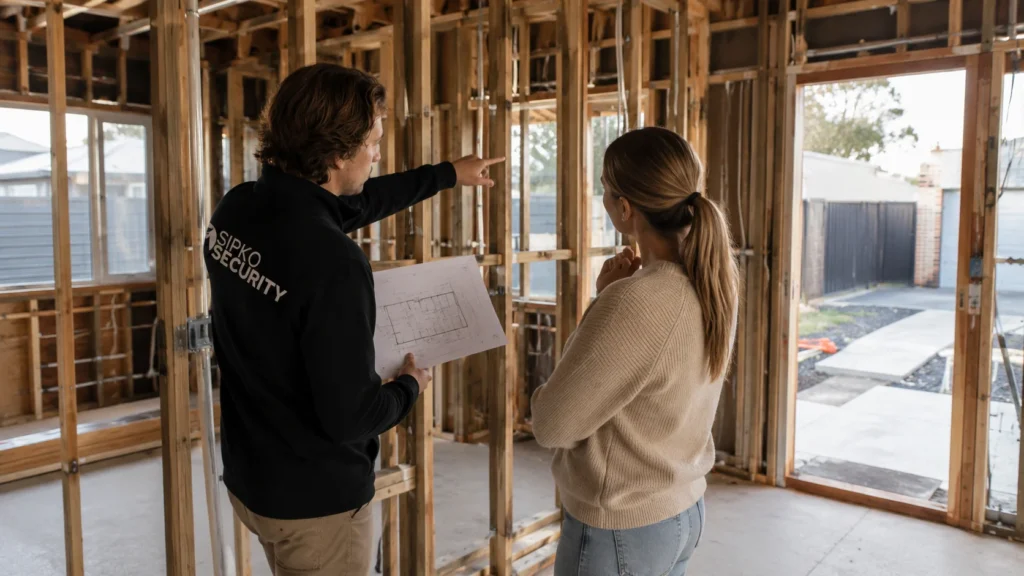
The build is going well. The electrical plan is signed off. Power points and lighting positions are locked in. The builder asks for any last changes before the walls close.
Cameras and the alarm can wait, the homeowner decides — there are months to go before move-in, and choosing security equipment now feels premature.
It’s a reasonable instinct. The problem usually doesn’t show up until the house is finished, when the camera position that made sense on paper needs a cable run that no longer exists, the spot earmarked for the equipment cabinet was never actually left free, and what would have been a straightforward job during construction now means working around finished walls and surfaces.
Which raises the real question: which security decisions actually need to be made before the walls close — and which ones can wait?
Quick Navigation
- You Don’t Need to Choose Every Camera Yet
- The Real Deadline Is When the House Becomes Harder to Change
- Start With What You Need to See, Not Where You Want Cameras
- Alarm Planning Starts With How People Will Move Through the Home
- Don’t Forget the Parts of the Property That Aren’t Walls Yet
- Your Builder, Electrician and Security Installer Are Solving Different Problems
- What Is Worth Pre-Wiring — and What Might Not Be?
- Plan for the House You May Have Five Years From Now
- The Question to Ask Before the Walls Close
- A Few Questions That Tend to Come Up Next
You Don’t Need to Choose Every Camera Yet
It’s easy to assume early security planning means picking the camera models, the alarm panel and the whole kit before the frame is even lined. It doesn’t.
Some decisions can genuinely wait. Others are much harder to unwind once the build moves past a certain point.
Can often wait:
- the exact camera model;
- specific device features;
- final app or interface preferences;
- some equipment upgrade decisions.
Needs earlier consideration:
- what the system needs to cover;
- likely camera and sensor positions;
- cable routes;
- where central equipment will live;
- entry points, gates and alarm zones;
- intercom or access requirements;
- room for future additions.
The distinction matters because it changes what “early planning” actually asks of a homeowner. It isn’t a shopping decision. Plan the system before you necessarily choose every product.
The Real Deadline Is When the House Becomes Harder to Change
“Before the walls close” isn’t a sales line — it describes a genuine shift in what’s involved in making a change.
While the frame is open, a cable route is often just a route. Once walls, insulation and finishes are in, the same change can mean opening up a surface that’s already been completed. That doesn’t make every post-construction change difficult, and it doesn’t mean every decision has to be locked in during the build. Planning cable routes while the relevant parts of the structure are accessible can reduce the need to revisit finished surfaces later — which is a different claim to “pre-wiring always saves money,” and a more honest one.
Start With What You Need to See, Not Where You Want Cameras
It’s tempting to start with positions — a camera here, one over there. It works better the other way around: start with what the system actually needs to make sense of.
- who’s approaching the front entrance;
- what happens on the driveway;
- who’s coming and going through side access;
- activity around the garage;
- which parts of the rear garden actually matter.
Once that’s clear, the positions tend to follow. Coverage should determine camera positions, not the other way around — as a general design principle, not a fixed rule that applies identically to every property.
Alarm Planning Starts With How People Will Move Through the Home
It’s easy for an article like this to turn into a CCTV pre-wire checklist and leave the alarm as an afterthought. It shouldn’t be. Alarm zones are just as much a planning decision as camera positions, and they start from a different question: not which sensors, but how people actually move through the house.
That means thinking about the main entrance and the garage entry, doors that open onto the garden, upstairs and downstairs living, and the routines a household actually has at night — along with anything else specific to how the home will be used, from pets to rooms that serve different purposes at different times of day. The sensor types and zone logic come after that picture is clear, not before it.
Don’t Forget the Parts of the Property That Aren’t Walls Yet
During construction, it’s natural to think about the house that’s physically taking shape. But a chunk of the finished property doesn’t exist yet in any visible form — and it still needs to be part of the plan.
- the driveway;
- the front gate;
- landscaping;
- fencing;
- a side gate;
- a pool or outdoor entertaining area;
- a detached garage;
- a future shed;
- external lighting.
None of this needs to be finalised during the build. It does need to be part of the conversation, because a security plan built only around the current construction site tends to leave gaps around the property it’s actually meant to protect. It’s the same reasoning behind security planning for Toorak properties, where gated entries, long driveways and established landscaping are as much a part of the coverage picture as the house itself — the difference for a new build is that those elements are still on the plan rather than already in the ground.
Your Builder, Electrician and Security Installer Are Solving Different Problems
Coordination matters here, and it’s worth being precise about why — without turning it into a comment on anyone’s competence.
A builder is focused on delivering the build. An electrician is focused on the electrical scope of their work. A security specialist is looking at coverage, system behaviour, equipment requirements, security-specific infrastructure and where the system might expand later. Three different focuses, three different sets of priorities — which is exactly why early coordination between them gives each trade a clearer picture of what needs to be allowed for before those decisions become harder to change.
The useful question for a homeowner to ask isn’t whether their electrician can install cameras. It’s this: can this installer review the plans early enough to coordinate what’s needed with the builder and electrician, rather than working around decisions that have already been made?
What Is Worth Pre-Wiring — and What Might Not Be?
This is where the planning question becomes more practical: what is actually worth pre-wiring?
Wired isn’t automatically better than wireless, and wireless isn’t automatically the easier choice. A more useful principle: where a device is likely to have a predictable position and a genuine infrastructure need — a fixed camera position, an intercom at the entry, a central equipment location — it can be worth allowing for that during construction even if the specific product is chosen later. Where the position and requirements are less certain, or where the technology suits a flexible wireless setup, locking in cabling early can add cost without adding much benefit. That kind of flexibility is relevant to security planning in Brighton, where wireless alarm systems can make sense when the layout doesn’t justify extensive fixed cabling, while CCTV may still require planned cable routes in the areas where cameras will be fixed. What’s right for a given build depends on the layout and the system being planned, not on a blanket rule for wired versus wireless.
The specific cable type and technical specification aren’t something to guess at this stage — that depends on the system being designed and the applicable requirements for the property, and it’s a question for the people planning the electrical work, not something to lock in from a generic list.
Plan for the House You May Have Five Years From Now
A new build won’t stay exactly as it appears on the architectural plans. A gate goes in a year or two later. Landscaping matures or changes direction. An extension opens up a side of the property that never used to need coverage. None of that is unusual — it’s just what happens to most homes over time.
Future-proofing isn’t about predicting every device you’ll ever buy. It’s about avoiding unnecessary dead ends — leaving enough room in the original design that a new gate or a landscaping change doesn’t mean starting the system over from scratch.
The Question to Ask Before the Walls Close
The question this article opened with was which security decisions need to happen now and which can wait. By this point, there’s a better way to frame it.
Not “which security system should I buy” — but what will actually become difficult to change once construction moves to the next stage, and has anyone looked at the finished property’s security requirements before those infrastructure decisions are locked in.
Those two questions do more for a new build than any equipment list could.
A Few Questions That Tend to Come Up Next
When should I speak to a security installer during a new build?
There’s no single stage that fits every project. The principle that matters more than the exact timing is getting the conversation in early enough that decisions affecting the property’s infrastructure can be coordinated before they’re already fixed.
Do I need to choose my CCTV cameras before pre-wiring?
Not necessarily. What often needs to be settled first is the coverage requirements and the infrastructure to support them — the specific camera models can usually be chosen later, closer to when the system is actually being installed.
Should I pre-wire a new home for security cameras?
Not automatically, and not for every camera. It depends on the planned system, the likely camera positions and how much the property is expected to change. Some setups benefit from pre-wiring in specific spots; others are better served by a flexible wireless approach.
Can I install the security system after the house is finished?
Yes. Plenty of systems are installed after handover. The main difference is that some infrastructure decisions — like certain cable routes or equipment locations — can involve more access and rework once construction is complete than they would have during the build.
Should my electrician or security installer plan the CCTV cabling?
It’s less about choosing one or the other and more about coordination between the security design and whoever is responsible for the relevant electrical and cabling work. A plan reviewed early by a security specialist gives the other trades clearer requirements to work from.