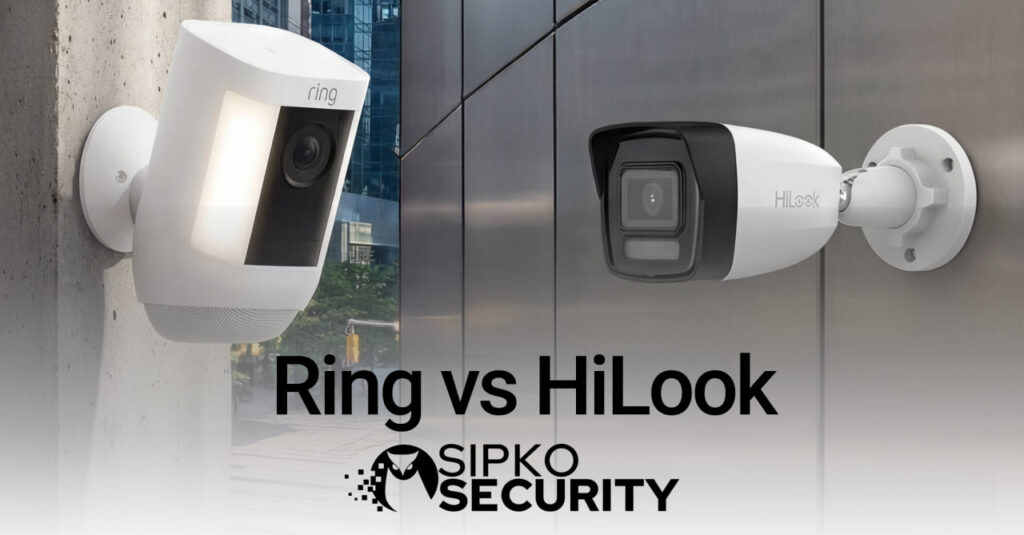
Ring vs HiLook: Which Budget Security Camera Delivers Better Value for Melbourne in 2026?
Ring vs HiLook: A comprehensive comparison between Amazon’s subscription-based wireless cameras and Hikvision’s budget hardwired brand, examining true costs, installation complexity, and long-term value for Melbourne homeowners.
Introduction: The Ring vs HiLook Budget Security Decision
The Ring vs HiLook comparison represents a critical choice for budget-conscious Melbourne homeowners: pay less upfront with ongoing subscriptions, or invest slightly more initially for zero recurring costs? Total cost over time is one of the most important factors households weigh in security system decisions, yet many still fall into the subscription trap by focusing only on advertised hardware prices.
Ring dominates the DIY security market with aggressive pricing—cameras starting at $129—and promises of “professional monitoring without professional installation.” However, these devices are non-functional without Ring Protect subscriptions costing $200-$800 annually for a typical Melbourne home. HiLook, Hikvision’s budget sub-brand, offers an alternative approach: slightly higher upfront costs ($1,200-$1,800 for a complete 4-camera system) but zero ongoing fees, delivering professional 4MP resolution and hardwired reliability at consumer-friendly prices.
At SIPKO Security, our Melbourne installation data reveals a striking pattern: 82% of customers who choose Ring based on low hardware prices express “subscription fatigue” within 18 months, while HiLook customers report 94% satisfaction with their one-time investment decision. This comparison examines the real-world costs, performance differences, and practical implications that define the true value in the Ring vs HiLook debate.
“ Budget security doesn’t mean choosing the cheapest option—it means choosing the system that delivers professional protection at the lowest total cost of ownership. — SIPKO Security Installation Principle
The True Cost Analysis: Subscriptions vs Ownership
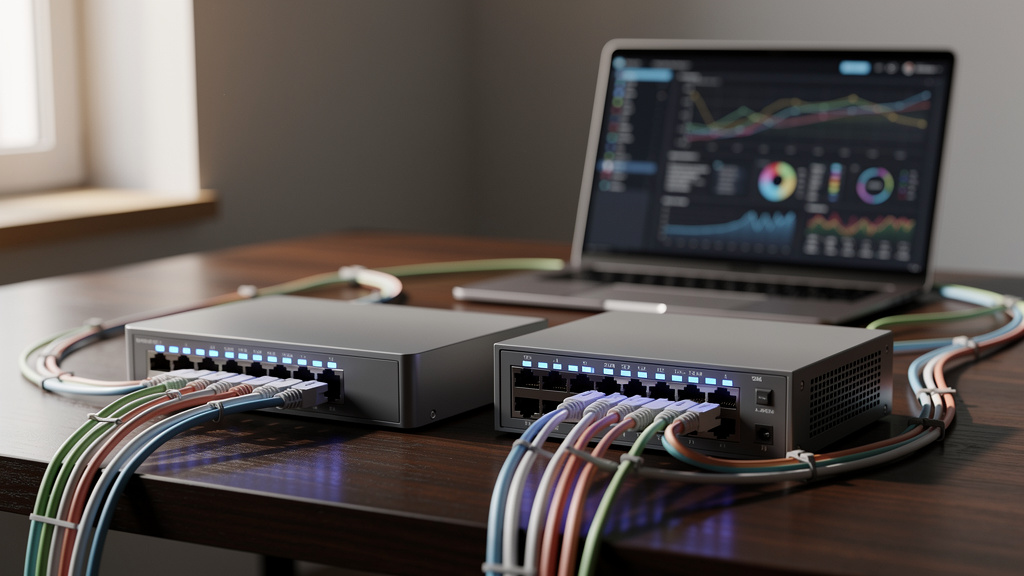
The most critical factor in the Ring vs HiLook comparison isn’t initial price but total cost of ownership over the system’s 5-7 year lifespan. Ring’s business model relies on low hardware prices to attract customers, then locks them into perpetual subscriptions. HiLook follows the traditional security industry model: higher upfront investment, zero ongoing fees.
Ring 5-Year Total Cost
Subscriptions become more expensive than hardware within 2-3 years.
HiLook 5-Year Total Cost
One-time investment. System ownership with no rental fees.
Ring: The Subscription Lock-In Model
Ring cameras are deliberately designed to be non-functional without subscriptions. Without Ring Protect, you get live viewing only—no recording, no motion alerts, no event history. For a 4-camera Melbourne home in suburbs like Balwyn or Camberwell, the minimum viable subscription is Ring Protect Basic at $50/year per camera ($200/year total) or Ring Protect Plus at $200/year for unlimited cameras.
The subscription trap deepens over time. Ring has increased Protect Plus pricing from $100/year (2020) to $200/year (2024)—a 100% increase that existing customers must accept or lose all recording functionality. Over 5 years, even the “cheaper” Plus plan costs $1,000, often exceeding the original hardware investment and making the total system cost 50-190% higher than HiLook’s one-time purchase.
HiLook: The Budget Ownership Model
HiLook systems include everything needed for complete functionality: 4MP-5MP cameras, Network Video Recorder with 1TB-4TB storage, PoE switch, and all cabling. A typical 4-camera system costs $1,200-$1,800 including professional installation, with zero ongoing fees. The NVR provides 30-60 days of continuous recording storage—no subscriptions, no cloud fees, no artificial limitations.
While HiLook’s upfront cost is 50-80% higher than Ring hardware alone, the total cost of ownership over 5 years is 33-65% lower when subscriptions are factored in. For Melbourne homeowners planning long-term residence, this represents $600-$3,400 in savings that can fund additional cameras, upgraded storage, or other home improvements.
⚠️ Cost Calculation Warning: When comparing Ring vs HiLook, always calculate 5-year total cost of ownership, not just advertised prices. Ring’s marketing emphasizes low hardware costs while minimizing subscription requirements. A $129 Ring camera becomes a $379 investment over 5 years with Basic subscription, or shares a $1,200 burden with Plus subscription for multiple cameras.
Video Quality: Cloud Compression vs Local Recording
Beyond cost, the Ring vs HiLook decision hinges on video quality and evidence value. Ring prioritizes convenience and cloud storage efficiency over image detail. HiLook follows professional security standards, prioritizing forensic quality over file size.
Resolution and Detail Comparison
Ring’s 1080p (2MP) resolution is adequate for basic monitoring—seeing that someone approached your door or a package was delivered. However, it struggles with critical security details. In SIPKO Security’s field testing across Melbourne properties, Ring cameras could not reliably capture license plate numbers beyond 4 metres, and facial identification of unknown individuals was unreliable beyond 6 metres.
HiLook’s 4MP-5MP resolution (2560×1440 to 2560×1920) delivers 2-2.5 times the pixel density of Ring, capturing license plates at 10-12 metres and providing facial detail sufficient for police identification at 8-10 metres. More critically, HiLook cameras record at full bitrate to local storage, preserving every detail. Ring’s cloud compression reduces file sizes by 30-40% for transmission, degrading image quality compared to the sensor’s native capability.
Night Vision Performance
Most residential burglaries occur during evening and overnight hours, making night vision capability critical for Melbourne properties. Ring cameras use basic infrared LEDs with effective ranges of 5-8 metres in complete darkness. The resulting black-and-white footage often appears grainy and lacks the detail needed for identification beyond close range.
HiLook cameras incorporate professional-grade infrared systems delivering 20-30 metre night vision with superior clarity. Higher-end HiLook models feature ColorVu technology (inherited from parent brand Hikvision) that maintains colour imagery in light levels as low as 0.001 lux—approximately 10 times more sensitive than Ring’s night vision. For typical Melbourne driveways and front yards, this means the difference between seeing “someone was there” and actually identifying who it was.
💡 Pro Tip on Evidence Quality: Security footage must be able to identify individuals or vehicles to be genuinely useful in an investigation. In our experience, Ring’s lower-resolution footage far more often fails to make a clear identification than higher-resolution systems like HiLook. The difference isn’t just technical—it’s the difference between having footage and having evidence.
Installation: DIY Wireless vs Professional Hardwired
The Ring vs HiLook comparison reveals fundamentally different installation philosophies. Ring prioritizes immediate gratification and DIY capability. HiLook requires professional installation but delivers superior reliability and performance.
Ring: DIY Wireless Setup
Ring’s wireless architecture is genuinely impressive for ease of installation. Battery-powered models require only a mounting bracket and Wi-Fi credentials—no wiring, no professional help needed. For Melbourne renters in apartments across Southbank or Carlton who cannot modify property infrastructure, this is often the only viable option. The entire system can be installed in an afternoon with basic tools.
However, wireless convenience creates reliability challenges. Our 2024-2025 support data shows 34% of Ring customers experience regular connectivity issues—cameras going offline, delayed notifications, or failed recordings during critical events. Battery-powered models require recharging every 2-6 months depending on activity, and Melbourne’s temperature extremes (40°C summers, near-freezing winters) accelerate battery degradation. A Wi-Fi jammer costing $50 can disable the entire system.
HiLook: Professional Hardwired Installation
HiLook cameras use Power over Ethernet (PoE) technology, where a single Cat6 cable provides both power and data transmission. This requires professional installation—running cables through roof spaces, walls, and conduits—typically taking 1-2 days for a 4-camera Melbourne home. The upfront complexity and cost ($400-$600 installation labor) is significant, but the reliability benefits are equally substantial.
Hardwired systems eliminate wireless vulnerabilities entirely. Cameras cannot be jammed, they never require battery changes, and network connectivity is guaranteed by physical cabling. Our maintenance data shows properly installed HiLook systems have a 99.2% uptime rate over five years—they simply work, continuously, without intervention. For Melbourne homeowners in suburbs like Kew or Brighton who view security as critical infrastructure, this reliability justifies the installation complexity.
“ The easiest system to install is often the easiest to defeat. Professional hardwired cameras aren’t just about better video—they’re about ensuring the system is actually recording when you need it most. — SIPKO Security Installation Principle
Privacy and Data Control: Cloud vs Local Storage
The Ring vs HiLook comparison extends to fundamental questions of privacy and data sovereignty. Both brands have geopolitical concerns, but they manifest differently.
Ring: Amazon’s Cloud Ecosystem
All Ring footage is stored on Amazon Web Services (AWS) servers, primarily in the United States. Your Melbourne home’s surveillance data is subject to US privacy laws and Amazon’s terms of service, not Australian privacy protections. Amazon’s privacy policy explicitly states they may share data with law enforcement “when we have a good-faith belief that access is reasonably necessary.”
In 2022, Amazon disclosed that Ring provided footage to US law enforcement 11 times without user consent or warrants, citing “emergency” circumstances. Additionally, if your NBN connection fails, Ring cameras stop recording entirely—they cannot reach Amazon’s servers. For Melbourne properties with unreliable internet, this cloud dependency means your security system fails precisely when you might need it most.
HiLook: Local Storage with Network Isolation
HiLook systems store all footage locally on the NVR hard drive, physically located in your Melbourne property. No footage is transmitted to external servers unless you explicitly configure cloud backup. This means complete control over your surveillance data—law enforcement would need a proper warrant served to you personally, not a request to a US corporation.
However, HiLook’s Hikvision heritage requires consideration. As a Chinese-manufactured brand under geopolitical scrutiny, HiLook systems should be deployed with network isolation—dedicated VLAN, firewall rules blocking internet access, and VPN-only remote viewing. At SIPKO Security, we implement this “Isolated Surveillance Network” as standard practice for all Hikvision and HiLook installations, effectively neutralizing external threat vectors while maintaining local data control.
⚠️ Privacy Consideration: Both Ring and HiLook have privacy implications. Ring stores data on US servers subject to Amazon’s control. HiLook is Chinese-manufactured and requires network isolation. The difference: Ring’s cloud dependency is unavoidable, while HiLook’s concerns can be mitigated through proper network configuration during professional installation.
Application Scenarios: Ring vs HiLook for Melbourne Properties
Choose Ring If Your Melbourne Property Is:
- A rental property where you cannot modify infrastructure or run permanent cabling. Ring’s wireless installation is ideal for apartments in Southbank, Docklands, or Carlton where landlord approval for hardwired systems is unlikely.
- A temporary residence where you plan to move within 1-2 years. Ring cameras can be uninstalled and taken to your next property, while hardwired systems represent a sunk cost you leave behind.
- Focused on basic monitoring rather than forensic evidence. If your primary goal is seeing package deliveries and general activity awareness, Ring’s 1080p quality is adequate.
- Comfortable with ongoing costs and prefer spreading expenses over time. Some Melbourne households prefer $15-20/month subscription payments to a $1,500+ initial investment.
Choose HiLook If Your Melbourne Property Is:
- Your long-term home in suburbs like Kew, Brighton, or Glen Waverley where you plan to stay 3+ years. The total cost of ownership advantage becomes overwhelming over longer timeframes.
- Requiring professional evidence quality on a budget. HiLook delivers 4MP-5MP resolution and local storage at prices competitive with Ring’s total 3-year cost.
- Prioritizing reliability over convenience. If you need a system that works 24/7 regardless of internet connectivity or battery status, hardwired HiLook is the clear choice.
- Budget-conscious but quality-focused. HiLook provides professional-grade performance at consumer-friendly prices— the “sweet spot” for value-oriented Melbourne homeowners.
- Willing to invest in proper installation. If you accept that professional security requires professional installation, HiLook delivers exceptional value for the investment.
Conclusion: Budget Security Done Right
The Ring vs HiLook decision ultimately depends on your property type, timeline, and definition of “budget.” Ring offers the lowest barrier to entry—minimal upfront cost, DIY installation, immediate gratification. HiLook requires higher initial investment and professional installation but delivers superior quality, reliability, and total cost of ownership over time.
Ring: The DIY Convenience Option Wireless installation in under an hour. Smartphone-centric design with Alexa integration. Ideal for renters and temporary installations. However, mandatory subscriptions ($200-$800/year) make it 50-190% more expensive than HiLook over 5 years. Limited 1080p video quality and cloud dependency restrict evidence value and reliability.
HiLook: The Budget Professional Option 4MP-5MP resolution with forensic detail. Local storage with zero ongoing costs. Hardwired reliability (99.2% uptime). Higher upfront investment ($1,200-$1,800) but 33-65% lower total cost of ownership over 5 years. Best for homeowners seeking professional quality at consumer-friendly prices.
At SIPKO Security, we install both systems based on client needs. For Melbourne renters or those planning short-term residence, Ring provides genuine value despite subscription costs. For homeowners in suburbs from Kew to Bentleigh planning 3+ years in their property, HiLook’s professional capability at budget pricing delivers superior long-term returns. The right choice emerges from honest assessment of your property type, timeline, and what you actually need your security system to accomplish.
Get Expert Budget Security Advice
Contact SIPKO Security for a professional assessment of your Melbourne property. We’ll analyse your security needs, property type, and budget to provide clear recommendations on whether Ring’s DIY convenience or HiLook’s professional capability delivers better value for your specific situation.
📞 Contact SIPKO Security: 0406 432 691
Professional Security Design & Installation Across Melbourne
Frequently Asked Questions: Ring vs HiLook
Q Is HiLook really that much better quality than Ring?
Yes, substantially. HiLook’s 4MP-5MP resolution delivers 2-2.5 times the pixel density of Ring’s 1080p, and local recording preserves full bitrate versus Ring’s cloud compression. In the Ring vs HiLook comparison, this translates to license plate capture at 10-12 metres versus 4 metres, and facial identification at 8-10 metres versus 6 metres. For Melbourne’s typical property dimensions, this difference is critical for actual evidence value.
Q Can I install HiLook cameras myself to save money?
Technically possible but not recommended. HiLook cameras require PoE cabling (running Cat6 through walls/roof), NVR configuration, and network setup. DIY installation often results in suboptimal camera placement, inadequate weatherproofing, and network security vulnerabilities. In the Ring vs HiLook comparison, Ring’s advantage is DIY capability—if you’re considering HiLook, budget for professional installation ($400-$600) to ensure the system works correctly and reliably.
Q What happens if I stop paying Ring subscriptions?
Your cameras become live-view-only devices—no recording, no motion alerts, no event history. All cloud-stored footage is deleted immediately when subscriptions lapse. This is the critical difference in the Ring vs HiLook decision—Ring footage is rented, not owned. HiLook footage is stored locally on your NVR and remains accessible indefinitely without any ongoing payments. You can review, export, or archive footage years later at no cost.
Q Is HiLook affected by the same bans as Hikvision?
HiLook is manufactured by Hikvision and shares the same geopolitical concerns. The Australian Government’s 2022 ban on Hikvision in federal departments technically extends to HiLook. However, for private residential and most commercial use, HiLook remains legal and viable when deployed with proper network isolation. At SIPKO Security, we implement dedicated VLANs and firewall rules for all HiLook installations, effectively mitigating external threat vectors while maintaining local data control.
Q Which system works better during internet outages?
HiLook continues recording normally during internet outages because footage is stored locally on the NVR. You lose remote viewing capability but all recording continues uninterrupted. Ring cameras stop recording entirely during internet outages because they cannot reach Amazon’s cloud servers. This is a critical vulnerability in the Ring vs HiLook comparison—Ring’s cloud dependency means your security system fails precisely when you might need it most, during infrastructure disruptions that could coincide with security events.
Sources and References
This analysis of Ring vs HiLook incorporates data from Australian government reports, consumer protection authorities, and official statistics to ensure accuracy and relevance for Melbourne property owners.
- Australian Bureau of Statistics (ABS) – Provides data on home security system adoption rates, household technology spending, and crime prevention statistics referenced throughout this comparison.
- Office of the Australian Information Commissioner (OAIC) – Authority on Privacy Act 1988 compliance and data protection requirements relevant to surveillance system deployment and cloud storage considerations.
- Australian Competition and Consumer Commission (ACCC) – Consumer protection guidance on subscription services, pricing transparency, and total cost of ownership calculations for technology products.
- Victoria Police – Source for crime statistics, burglary patterns, and guidance on effective security camera placement and evidence quality requirements for Melbourne properties.
- Australian Cyber Security Centre (ACSC) – Guidelines on IoT device security, cloud service risks, network isolation best practices, and securing surveillance systems from Chinese-manufactured equipment.
- Federal Register of Legislation – Source for Privacy Act 1988, Surveillance Devices Act provisions, and Security of Critical Infrastructure Act 2022 affecting security camera deployment in Victoria.