
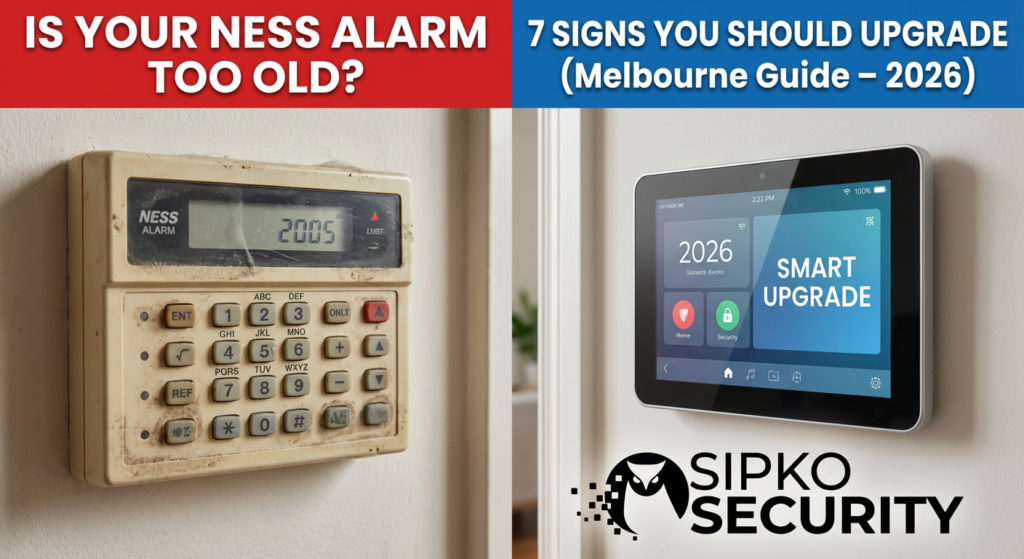
Is Your Ness Alarm Too Old? 7 Signs You Should Upgrade (Melbourne Guide – 2026)
Old doesn’t always mean broken — but it may no longer be secure. Find out if your aging Ness alarm system is putting your home at risk and what the modern 2026 security landscape demands. Let’s delve into the deep details of outdated security technologies and modern solutions for every corner of Melbourne.
Introduction: Many Melbourne Homes Still Run 10–20 Year Old Alarm Systems
Older suburbs like Brighton, Camberwell, and Kew often still have legacy systems guarding multi-million dollar properties. Many of these are wired Ness panels installed in the early 2000s. While they might still beep when you open a door, technology has changed dramatically in the last two decades. Set the tone for 2026: Old doesn’t always mean broken — but it may no longer be secure against modern threats.
The Hidden Dangers of Legacy Infrastructure
A staggering percentage of Melbourne’s luxury housing market is currently protected by aging infrastructure. Consider the fact that many of these Ness systems were installed when the original iPhone was just a rumor. The communication protocols, the sensor designs, and the fundamental philosophy of security have all experienced multiple paradigm shifts since these beige panels were screwed into your mudroom wall.
In 2026, the criminals targeting these suburbs have not stopped evolving. Organized crime syndicates utilize Wi-Fi jammers, cellular interceptors, and drone technology to scout and infiltrate homes. Against a 15-year-old Ness system, these modern tactics encounter virtually zero resistance. Homeowners operate under a dangerous blanket of false security, believing that because the keypad lights up when they enter the house, the system is fully operational. The reality is far more complex and much more precarious.
A functioning keypad does not equal a secure home. We regularly test older Ness systems in the field and find that while the internal circuitry logic is intact, the ability to communicate an alarm event to the outside world has been completely severed due to telecommunications upgrades like the NBN. An alarm that cannot call for help is merely an expensive noisemaker.
How Long Should a Home Alarm System Last?
The typical lifespan of a premium home alarm system is 10–15 years. After this point, several silent failures begin to accumulate, weakening the system from the inside out.
The Anatomy of a Failing System
Security systems are electronic devices, and like all electronics, they are subject to degradation over time. The concept of “mean time between failures” (MTBF) applies heavily here. When a Ness alarm system crosses the 10-year threshold, the risk of critical failure increases exponentially. Here is a breakdown of what happens under the surface:
- Battery degradation: Old backup batteries fail instantly during a power outage. Even if you replace the battery, the charging circuit on a 15-year-old motherboard often struggles to maintain the correct trick-charge voltage.
- Component wear: Keypad buttons become unresponsive and internal relays stick. The mechanical relays that trigger your siren have a finite number of ‘clicks’ before they weld shut or fail to make contact.
- Outdated communication modules: 3G networks are gone, and old analog setups are obsolete. The 4G transition has left many older systems completely stranded without a communication path.
- Capacitor Aging: The electrolytic capacitors on the main control board dry out over time, leading to erratic behavior, random reboots, and false alarms that seem to have no physical cause.
Sign #1 – Your Alarm Still Uses a Landline
If your Ness panel relies on a traditional copper phone line to call a monitoring center or your mobile, you have a critical vulnerability that must be addressed immediately.
The PSTN Phase-Out and Its Consequences
PSTN (Public Switched Telephone Network) monitoring is effectively obsolete. The NBN transition often breaks compatibility with legacy dialers, leaving you with no mobile backup. A landline is extremely easy for a burglar to disable simply by cutting the cable outside the house. In fact, cutting the telecom line is ‘Step 1’ in the modern burglar’s playbook.
When the copper lines were replaced or augmented by the NBN, the voltage and signal characteristics changed. Older Ness dialers, expecting the specific tonal frequencies and voltages of the old Telecom Australia network, often fail to handshake with the modern NBN digital voice services (UNI-V ports). This results in a system that tries to dial out during a break-in but receives a digital busy signal or fails to transmit its Contact ID packets properly.
Modern 2026 systems counter this by using:
- IP + cellular (4G/5G) dual-path backup
- Encrypted wireless communication that cannot be physically cut
- Continuous anti-jamming polling to ensure the connection is always live
Sign #2 – Frequent False Alarms
Nothing reduces trust in a security system faster than frequent false alarms. It trains you, your family, and your neighbors to ignore the siren. If the boy cries wolf too many times, the village stops coming. If your Ness alarm keeps waking you up, contact Sipko Security—we can help you update your old Ness system quickly and affordably.
The Genesis of False Positives
Why do older systems trigger falsely? It is rarely a ghost in the machine; it is usually the physical degradation of the sensors.
- Aging PIR sensors: The Fresnel lenses that focus infrared light onto the pyroelectric sensor cloud over due to UV exposure and environmental factors, reducing their clarity. Internal electronics suffer from sensitivity drift, meaning they trigger at the wrong thresholds.
- Dust buildup: Years of accumulated spiderwebs, dust, and microscopic debris trick the optic sensors into seeing movement where there is none. Insects crawling across the lens are magnified to appear as human-sized heat signatures.
- Wiring degradation: Micro-fractures in old cables trigger tamper alerts. Rodents chewing on cables in the roof cavity can cause intermittent shorts that only occur when the temperature changes and the copper expands or contracts.
In modern systems, ‘Dual-Tech’ sensors combine PIR and Microwave technology, requiring both to be triggered simultaneously before alarming. This virtually eliminates environmental false alarms.
Sign #3 – No Smartphone App Control
We manage our entire lives from our smartphones in 2026. Your home security should be no different.
If your interaction with your alarm system requires you to stand in front of a plastic box and punch in a 4-digit code within 30 seconds of opening your front door, you are living in the past. It is outdated by 2026 standards if you can’t:
- Arm or disarm your system remotely from anywhere in the world.
- Receive instant push notifications with high-resolution photo verification of what triggered the alarm.
- Check precise event logs (e.g., “Cleaner disarmed system at 9:14 AM”).
- Create temporary access codes for tradespeople or guests that expire automatically.
Sign #4 – Limited Zones & Expansion Issues
Older Ness panels often have a hard cap on device capacity. They were designed for the technology footprint of 2005.
The Scalability Problem
If you are renovating, adding an extension, or simply wanting to add modern life-safety devices like connected smoke detectors or water leak sensors, older panels make it incredibly hard to add sensors. Expansion requires messy rewiring, chasing cables into freshly plastered walls, and expensive retrofitting.
Many legacy panels max out at 8 or 16 zones. A modern luxury home can easily require 40+ zones to properly cover perimeter doors, windows, internal motion, environmental hazards, and garage automation. Modern homes need highly scalable, wireless ecosystems like Ajax, which can support up to 200 connected devices on a single hub without running a single new wire.
Sign #5 – No Outdoor Detection
Most older systems were built on an outdated philosophy: protect only internal zones. They offer no perimeter alerts and no driveway or yard monitoring. You only know there’s a problem once the intruder has already smashed your front door or broken a window.
The Paradigm Shift to Perimeter Defense
Luxury homes in Brighton, Toorak, and South Yarra especially benefit from layered security. The goal of a 2026 security system is to stop them at the fence, not in the hallway.
Outdoor dual-technology sensors are designed to operate in harsh weather, ignoring swaying trees, heavy rain, and pets, while immediately detecting human movement on your property. Sirens can be configured to emit a short ‘warning chirp’ if someone enters the driveway at 3 AM. This active deterrence is infinitely more valuable than a passive alarm that only rings after the damage is done.
Sign #6 – No Anti-Jamming or Encryption Protection
Older wireless sensors used basic, unencrypted radio protocols operating on crowded frequencies like 433MHz.
The Cyber-Physical Threat
These legacy systems are highly vulnerable to interference and targeted jamming from modern criminal syndicates. A $30 device bought online can flood the frequency, rendering older wireless sensors deaf to the main panel. Furthermore, they feature no active supervision to tell you if a sensor has secretly died or been blocked.
Modern Grade 2 wireless platforms (like Ajax’s Jeweller protocol) use advanced frequency hopping and AES block encryption. If interference is detected, the system instantly shifts to an alternate clean frequency. If the jamming is broad and sustained, the hub immediately informs you and the monitoring center of the sabotage attempt. Every sensor “polls” the hub multiple times a minute; if a sensor goes offline, you know instantly.
Sign #7 – Spare Parts Are Hard to Find
Are you nursing a dying keypad? Has the LCD screen lost half its pixels, making it impossible to read the system status?
The Sunk Cost Fallacy of Legacy Repairs
Discontinued modules lead to expensive legacy replacements and very limited technician support. You end up paying a premium for refurbished or salvaged parts just to keep an obsolete system limping along for another year.
When parts become rare, full replacement becomes much smarter (and cheaper) than constant repair. Investing $400 in a new 15-year-old keypad makes no financial sense when that money could be applied to a modern, future-proof smart security hub.
Why Upgrading Isn’t Just About Technology — It’s About Risk Mitigation
Property values in Brighton & Bayside have skyrocketed over the past two decades. Luxury renovations feature high-end appliances, designer furniture, extensive art collections, and expensive localized tech ecosystems.
Aligning Security with Asset Value
This massive increase in concentrated wealth makes your home a prime target for sophisticated, organized burglaries. Criminals are aware of the wealth density in these suburbs and they plan their incursions accordingly, often conducting days of reconnaissance.
Your security infrastructure must match your asset value. A $10M home protected by a 1998 Ness keypad is a glaring mismatch and a serious liability. Insurers are also increasingly aware of this discrepancy, and many require proof of a modernized, monitored security system before underwriting policies for high-value properties.
Suburban Deep Dive: Why Legacy Ness Alarms Fail Across Greater Melbourne
The challenges faced by aging security systems have evolved wildly since the early 2000s, especially with the telecommunications shifts in recent years. Let’s look at why it’s imperative to upgrade your Ness alarm across Melbourne’s suburbs.
📍 Outdated Security in Melbourne Suburbs
The real estate landscape has transformed dramatically since the early 2000s. The older Ness systems installed across the city were originally designed for a completely different era of crime and telecommunications technology.
Today, luxury and contemporary properties across Melbourne face sophisticated threats from organized burglary syndicates that easily bypass legacy hardware using advanced signal manipulation.
- Blind to Incursions: The profound lack of smartphone integration and cellular backup mechanisms means that when external NBN lines are compromised or neighborhood power is cut, homeowners are left entirely blind.
- Signal Interference: The architectural nuances of historical and newly-renovated luxury homes often feature internal structural brickwork and thick masonry walls that heavily interfere with older wireless frequencies.
- Delayed Authority Response: Outdated landline infrastructures ensure that the average response time is delayed by crucial minutes. In extreme cases, local authorities are entirely unnotified due to communication failure.
Upgrading to a modern, encrypted wireless system ensures that properties receive the high-grade, enterprise-level protection that their appreciating asset values fundamentally demand. The robust, impenetrable frequency-hopping technology of modern smart systems is an absolute, non-negotiable necessity.
Criminal networks specifically target up-scale Melbourne suburbs due to their notoriously high concentration of transportable wealth and the predictable daily routines of high-net-worth residents. This requires advanced outdoor perimeter detection protocols to physically deter incursions before they ever breach the main structure.
Simply put, relying on a 15-year-old alarm is a massive strategic gamble and a profound financial risk that you simply cannot afford to take, particularly given the straightforward availability of premium, non-invasive wireless upgrades today.
The Problem With Simply “Repairing” an Old Ness System
You are throwing good money at aging infrastructure. Replacing parts solves immediate errors without addressing core limitations like the lack of photo verification or communication redundancy. At Sipko Security, we specialize in helping Melbourne homeowners fully replace and update their old Ness systems with advanced, reliable 2026 technology.
What Modern Alarm Systems Offer in 2026
Immune to wire-cutting and jamming.
Stay connected even when NBN fails.
Pre-empt threats before property damage occurs.
Total control from anywhere in the world.
Add new wings to your house without new cables.
Link your security to lights, gates, and locks.
Subtle positioning: Many Melbourne homeowners upgrading from older wired panels are moving toward advanced wireless ecosystems such as those developed by Ajax Systems, which combine Grade 2 compliance with flawless modern app control.
Can You Upgrade Without Rewiring the Whole House?
Yes. Wireless retrofitting is the future. If you’re wondering how to update your outdated Ness alarm, the team at Sipko Security can help you transition to a wireless system seamlessly. We can secure your home with minimal wall damage and a perfectly clean installation. This is especially ideal for recently renovated Brighton homes where you absolutely do not want new cables chased into fresh plaster.
Upgrade vs Full Replacement: What’s Better?
Minor Fix (Repair)
- Temporary band-aid
- Limited to outdated features
- System remains fundamentally obsolete
Full Upgrade (Replacement)
- Long-term robust solution
- Modern smart features (App, SIM backup)
- Future-proof for the next decade
Often, full replacement is far more cost-effective long term.
Insurance & Compliance Considerations
Some premium insurers prefer (or mandate) monitored or graded systems for high-value properties. Old, non-compliant systems may not meet modern risk expectations, potentially jeopardizing your coverage in the event of a severe break-in.
Signs Your System Is No Longer Secure — Even If It Arms
There is an important distinction to make: “Working” ≠ Secure.
Your keypad might light up, but you still face massive communication vulnerabilities. If someone rips the panel off the wall, does it have anti-tamper alerts? Will you receive a real-time notification before it dies? Usually, the answer is no.
Case Scenario
Case Scenario: Upgrading a 15-Year-Old System in Brighton
The Bayside Transformation
The Property: Large 2-storey home with a detached garage.
The Problem: An old wired Ness panel with failing sensors and no mobile alerts.
The Solution: Upgraded seamlessly to a fully wireless encrypted system. We added outdoor perimeter detection, a dual-SIM card backup, and total app-based control, securing the garage and main house under one unified hub.
Why Professional Design Matters When Upgrading
Simply buying a box of sensors isn’t enough. Professional installation guarantees:
- Comprehensive Risk assessment
- Signal testing for perfect wireless coverage
- Proper zone planning (pet immunity, sleep modes)
- Clean, architecturally respectful installation
Future-Proofing Your Home Security (2026–2030)
When you upgrade now, ensure the platform supports expandability. You want fluid CCTV integration, robust smart home automation scenarios (like turning off water mains if a leak is detected), and monitoring flexibility that can scale with your family’s needs over the coming years.
Final Verdict: Is It Time to Upgrade Your Ness Alarm?
If your system…
- ❌ Uses a landline only
- ❌ Is 10+ years old
- ❌ Has no mobile app alerts
- ❌ Lacks outdoor perimeter protection
- ❌ Frequently triggers false alarms
Then yes — it’s time to seriously consider upgrading.
Call Sipko Security for an Upgrade QuoteReady to Upgrade Your Ness System?
Speak with a specialist about wired and wireless CCTV, Ajax alarms, and same-week installations. We respond quickly during business hours and offer after-hours call-outs for urgent security issues.
Technical Sources
- Victoria Police Private Security Licensing – Official regulatory body for licensed security installers.
- ACMA Cabling Provider Rules – Australian telecommunications compliance standards.
- Consumer Affairs Victoria (Building and Renovating) – Government resources and compliance standards for homeowners upgrading or renovating properties.

