Unbiased Technical Audit
Full Deep-Dive
Licensed Installer Verified
Global Focus
May 2026
Last updated: · SIPKO Security
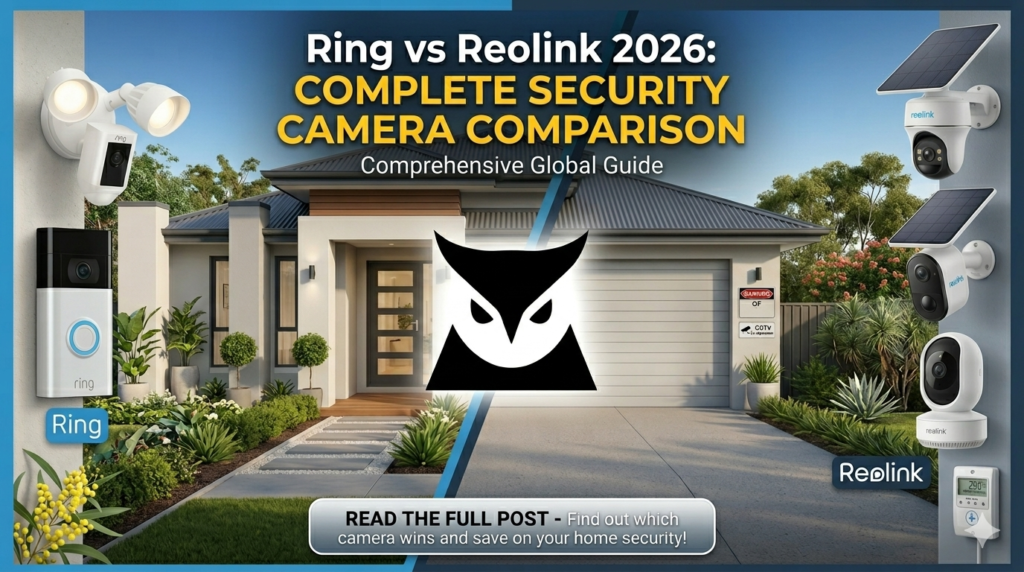
Ring vs Reolink 2026: Complete Security Camera Comparison for Homes & Businesses
You’re shopping for security cameras and you’ve narrowed it down to two options: Ring security cameras or Reolink security cameras. Both have solid reviews. Both work worldwide. Both promise to keep your home safe. But here’s the thing, Ring vs Reolink are built on completely different philosophies, and picking the wrong one could cost you hundreds of dollars over the next few years.
Ring is the household name. Amazon owns it. Most people have heard of it. The app is slick, and it integrates with Alexa. But there’s a catch: you’re paying a monthly subscription to store your footage in the cloud. Reolink is the alternative that’s gaining traction globally. It’s less flashy, but your footage stays on your property, on a local hard drive or microSD card, and there’s no mandatory monthly fee. Over five years, that difference adds up to real money.
We’re security professionals with years of experience installing and troubleshooting both Ring and Reolink systems in hundreds of homes and businesses worldwide. We’ve tested them in real-world conditions, dealt with their failures, upgraded systems when needed, and advised clients on which system actually makes sense for their situation. This Ring vs Reolink comparison isn’t based on marketing copy or spec sheets. It’s based on hands-on experience.
In this guide, we’ll break down the actual differences between Ring and Reolink, pricing, video quality, app experience, reliability, and who each system is actually best for. By the end, you’ll know exactly which one is right for your property.
Ring vs Reolink: Quick Answer
TL;DR: For most homeowners, Reolink wins on cost and privacy. Ring wins on app experience and Alexa integration. Over 5 years, Reolink saves you $600–$1,200 in subscription fees. Ring is better if you’re renting or have Alexa devices.
This Ring vs Reolink comparison covers 19 detailed aspects: pricing, video quality, night vision, app experience, AI detection, reliability, smart home integration, security, privacy, and more. We’ve tested both systems in real-world conditions and provided honest, unbiased analysis.
1. Ring vs Reolink: The Core Difference (Subscription vs Ownership)
The Philosophy
Before we dive into specs and features, you need to understand the fundamental difference between these two systems. It’s not about which one is “better”, it’s about which one aligns with how you want to own your security.
Ring’s model: You buy the camera hardware (relatively cheap), but you’re renting access to your footage. Your videos live on Amazon’s servers in the cloud. To view them remotely, access clips, or get alerts, you need to pay a monthly subscription. Without it, you can only view live footage when you’re on the same WiFi network as the camera. It’s like buying a TV but paying monthly to watch it.
Reolink’s model: You buy the camera hardware and own your footage completely. Videos are stored locally on a microSD card (battery cameras) or a hard drive in an NVR (wired systems). You can access your footage remotely without paying a cent. Cloud storage is optional, but it’s not required. It’s like buying a TV and owning it outright.
This difference affects everything else in the comparison. It affects your privacy (who has access to your footage), your costs (subscription vs one-time purchase), your reliability (what happens when the internet goes down), and even your flexibility (can you expand the system later without vendor lock-in).
Neither approach is “wrong.” Ring’s cloud-first model is convenient if you don’t mind the ongoing cost and you want a polished app experience. Reolink’s local-first model is better if you want to own your data, avoid subscriptions, and have footage that’s accessible even if the internet drops.
Let’s dig into the specifics.
2. Ring Security Cameras: Product Lineup, Features & How It Compares to Reolink
The Market Leader
Ring is owned by Amazon. It’s the security camera brand you see advertised on TV and online worldwide. The company was founded in 2013 and acquired by Amazon in 2018 for over $1 billion. That tells you something about its market position.
Ring’s product lineup includes:
- Ring Doorbell cameras, Battery or wired, with video and two-way audio
- Ring Stick Up Cam, Battery-powered, can be mounted anywhere
- Ring Spotlight Cam, Wired or battery, with built-in spotlight
- Ring Floodlight Cam, Wired, replaces your existing floodlight
- Ring Indoor Cam, WiFi-only, for inside the house
All Ring cameras are cloud-first. They upload footage to Amazon’s servers, and you access it through the Ring app. There’s no local NVR or hard drive option, everything goes to the cloud.
Why people choose Ring: The app is genuinely good. It’s intuitive, fast, and integrates seamlessly with Alexa. If you say “Alexa, show me the front door,” your Echo device displays the live feed. You can arm/disarm the system, get instant notifications, and share access with family members. It’s convenient, and it works well.
The catch: You need a Ring Protect subscription to access any of this. Without it, you can only view live footage when you’re on the same WiFi network. No cloud storage, no remote access, no clips saved. The subscription costs $3–10/month per camera, depending on the plan.
Ring cameras are available worldwide through Amazon, major retailers, and electronics stores. Prices range from $100 for a basic doorbell to $400+ for a wired floodlight cam.
3. Reolink Security Cameras: Product Lineup, Features & How It Compares to Ring
The Privacy-First Alternative
Reolink is a Chinese company founded in 2014. It’s less well-known than Ring globally, but it’s been growing steadily. The company focuses on local storage and privacy, your footage stays on your property, not on someone else’s servers.
Reolink’s product lineup is more diverse than Ring’s:
- Battery cameras, Wireless, record to microSD card, 3–12 month battery life
- PoE cameras, Wired Ethernet, record to NVR, professional-grade
- WiFi cameras, Wireless, record to microSD card or cloud
- Doorbell cameras, Battery or wired, with video and two-way audio
- NVRs (Network Video Recorders), Local storage hub for PoE cameras
- 4G cameras, Cellular-based, no WiFi needed
The key difference: Reolink cameras record locally by default. Your footage is stored on a microSD card in the camera or on a hard drive in an NVR. You own it. Amazon doesn’t have it. The government can’t subpoena it from a cloud server.
Why people choose Reolink: No mandatory subscription. Your footage is yours. The system is more flexible, you can mix and match battery, WiFi, and wired cameras. If you want to expand later, you’re not locked into a single ecosystem. And for tech-savvy users, Reolink offers more control and customization.
The trade-off: The app isn’t as polished as Ring’s. It’s functional, but it feels more technical. There’s no Alexa integration. And if you want remote access, you need to set up port forwarding or use Reolink’s cloud service (optional, $3–5/month).
Reolink cameras are available worldwide through Amazon, the official Reolink store, and specialty retailers. Prices range from $50 for a basic battery camera to $2,000+ for a complete PoE system with NVR.
4. Ring vs Reolink Pricing: 5-Year Cost Breakdown & Comparison
The Real Cost
This is where the comparison gets interesting. On the surface, Ring cameras are cheaper. But when you factor in subscriptions over five years, the picture changes dramatically.
Ring: Hardware + Subscription Costs
Let’s say you want to set up a basic 2-camera Ring system (doorbell + one outdoor camera):
- Ring Video Doorbell Pro: $200–250
- Ring Spotlight Cam (battery): $150–200
- Ring Protect subscription: $5/month per camera (or $10/month for unlimited cameras)
Year 1 cost: $350–450 (hardware) + $120 (subscription) = $470–570
5-year cost: $350–450 (hardware) + $600 (subscription) = $950–1,050
For a 4-camera system (doorbell + 3 outdoor cameras):
- Hardware: $700–900
- Subscription (5 years): $600 ($10/month unlimited plan)
5-year total: $1,300–1,500
Reolink: Hardware Only (or Optional Cloud)
Same 2-camera system with Reolink:
- Reolink Doorbell Camera: $100–150
- Reolink Outdoor Battery Camera (4K): $150–200
- Optional cloud storage: $0 (local storage is free)
Year 1 cost: $250–350 (hardware) + $0 (subscription) = $250–350
5-year cost: $250–350 (hardware) + $0 (subscription) = $250–350
For a 4-camera system:
- Hardware: $500–700
- Subscription (5 years): $0
5-year total: $500–700
The Comparison Table
| System | 2-Camera Setup (5 Years) | 4-Camera Setup (5 Years) | Difference |
|---|---|---|---|
| Ring | $950–1,050 | $1,300–1,500 | Subscription-based |
| Reolink | $250–350 | $500–700 | One-time purchase |
| Savings with Reolink | $600–800 | $800–1,000 | Over 5 years |
But Wait, There’s More to Consider
Ring’s advantage: If a camera breaks, you can replace it for $100–200. Reolink cameras are similar, but if your NVR (the recording hub) fails, you’re looking at $300–500 to replace it.
Reolink’s advantage: Your system doesn’t depend on Amazon’s servers. If Amazon changes their pricing, discontinues Ring, or has a data breach, it doesn’t affect you. Your footage is yours.
Hidden Ring costs: If you want to expand your Ring system later, you’re locked into Ring. You can’t mix Ring with other brands. With Reolink, you can add cameras from different manufacturers (as long as they support ONVIF protocol).
Hidden Reolink costs: If you want professional installation, Reolink PoE systems require running Ethernet cables, which can cost $500–2,000 depending on your property. Ring battery cameras are easier to install yourself.
The Verdict on Pricing
If you want the cheapest upfront cost: Ring wins. You can get a basic doorbell for $100–150.
If you want the lowest total cost of ownership: Reolink wins by a landslide. Over five years, you’ll save $600–1,000.
If you want flexibility: Reolink wins. You’re not locked into a subscription or a single brand.
If you want convenience and don’t mind paying: Ring wins. The app is better, and you don’t have to think about local storage.
5. Ring vs Reolink: Cloud Storage vs Local Storage (Subscription Model Breakdown)
Where Your Footage Lives
This is the fundamental difference between the two systems. Understanding how each one stores your footage will help you decide which is right for you.
Ring: Cloud Storage (Mandatory Subscription)
Ring cameras don’t have local storage. They upload footage to Amazon’s cloud servers in real-time. Here’s what that means:
- Without a subscription: The camera records, but the footage is deleted after 24 hours. You can only view live footage when you’re on the same WiFi network.
- With a subscription ($5–10/month): Footage is stored in the cloud for 30–60 days (depending on your plan). You can access it remotely from anywhere.
The problem: If your internet goes down, you can’t access your footage remotely. If Amazon’s servers go down, you can’t access your footage at all. If you cancel your subscription, your footage is deleted.
The advantage: You don’t have to manage storage. Amazon handles it. You don’t need to buy a hard drive or worry about it failing.
Reolink: Local Storage (Free)
Reolink cameras record to local storage by default. Here’s how it works:
- Battery cameras: Record to a microSD card (up to 512GB). Footage is stored on the camera itself.
- PoE cameras: Record to an NVR (Network Video Recorder) with a hard drive (1TB–8TB). Footage is stored on the NVR.
- WiFi cameras: Record to a microSD card or to the NVR if you have one.
The advantage: Your footage is yours. It’s stored on your property. No subscription required. If the internet goes down, recording continues. If you cancel your subscription (or Reolink goes out of business), your footage is still there.
The disadvantage: You have to manage storage. If your microSD card fills up, old footage is overwritten. If your NVR’s hard drive fails, you lose everything. You need to understand storage capacity and retention periods.
Storage Capacity & Retention
Let’s say you have a 4-camera Reolink PoE system with a 2TB hard drive in the NVR. How long will it record?
- Continuous recording (24/7): About 7–10 days (depending on resolution and bitrate)
- Motion-triggered recording: 30–60 days (depending on activity)
For most homes, motion-triggered recording is enough. You’re not recording every second, just when something moves. A 2TB drive will hold 30–60 days of motion footage for 4 cameras.
With Ring, you get 30–60 days of cloud storage with a subscription. But you’re paying $10/month for that privilege.
Remote Access: How It Works
Ring: You access your footage through the Ring app, which connects to Amazon’s servers. As long as you have internet and a Ring Protect subscription, you can view footage from anywhere in the world.
Reolink: You access your footage through the Reolink app, which connects to your NVR or camera directly. If you’re on the same WiFi network, it’s instant and free. If you’re away from home, you have two options:
- Option 1 (Free): Set up port forwarding on your router. This allows remote access without paying anything, but it requires technical knowledge.
- Option 2 (Paid): Use Reolink’s cloud service ($3–5/month). This is easier but costs money.
Privacy & Data Ownership
This is where the philosophies diverge significantly.
Ring: Your footage is stored on Amazon’s servers. Amazon’s privacy policy allows them to use your footage for “improving their services” and complying with legal requests. Your footage could theoretically be accessed by Amazon employees, law enforcement, or hackers if there’s a breach.
Reolink: Your footage is stored on your property. No one has access to it except you (and anyone you give access to). Reolink can’t access it. Amazon can’t access it. Law enforcement would need a warrant to access it.
For privacy-conscious users, this is a huge advantage. You own your data completely.
What Happens If You Cancel?
Ring: If you cancel your subscription, your cloud footage is deleted. You lose everything. The camera still works, but you can only view live footage on the same WiFi network.
Reolink: If you cancel your cloud subscription (if you have one), your local footage remains. You still have access to everything stored on your NVR or microSD card. Nothing changes.
The Verdict on Storage
If you want simplicity: Ring wins. You don’t have to think about storage management.
If you want privacy and ownership: Reolink wins. Your footage is yours, stored locally, and no one else has access.
If you want reliability when the internet goes down: Reolink wins. Recording continues, and you can access footage via local network.
If you want to avoid subscriptions: Reolink wins. Local storage is free forever.
6. Ring vs Reolink: Video Quality & Resolution (1080p vs 4K vs 12MP)
The Image Quality Showdown
Video quality matters. A blurry camera is useless for identifying faces or license plates. Let’s compare what each system actually delivers.
Ring: Resolution Options
Ring’s camera lineup offers limited resolution options:
- Ring Video Doorbell (standard): 1080p (2MP)
- Ring Video Doorbell Pro: 1536p (3MP)
- Ring Spotlight Cam: 1080p (2MP)
- Ring Floodlight Cam: 1080p (2MP)
- Ring Stick Up Cam Pro: 1080p (2MP)
The reality: Most Ring cameras are 1080p. That’s 1920 x 1080 pixels. It’s decent for general surveillance, but it’s not great for identifying faces or reading license plates from a distance.
Reolink: Resolution Options
Reolink offers a much wider range:
- Basic models: 1080p (2MP)
- Mid-range models: 2K (4MP)
- High-end models: 4K (8MP)
- Premium models: 12MP
The advantage: You can choose the resolution that fits your needs and budget. For a front door, 4K is overkill. For a driveway where you want to read license plates, 4K or 12MP is worth it.
Real-World Comparison: 1080p vs 4K
Let’s say someone walks up to your front door. You want to identify their face.
With 1080p (Ring): You can see that a person is there. You can see they’re wearing a red shirt. But their face is pixelated. You can’t identify them clearly.
With 4K (Reolink): You can see their face clearly. You can see their facial features, scars, tattoos, everything. You could show this footage to police and they could identify the person.
This is the difference between “I know someone was here” and “I can prove who was here.”
Night Vision: IR vs Starlight
Both Ring and Reolink have night vision, but they use different technologies.
Ring: Uses infrared (IR) LEDs. When it gets dark, the camera switches to IR mode and illuminates the scene with invisible infrared light. The image is black and white.
Reolink: Uses infrared (IR) LEDs on basic models, but higher-end models use “Starlight” technology. Starlight cameras are extremely sensitive to low light and can produce color images even in near-total darkness.
The difference: IR night vision is fine for detecting motion and seeing that someone is there. Starlight night vision is better for identifying faces and details in low light.
Field of View (FOV)
Ring: Most Ring cameras have a 160–180° field of view. That’s pretty wide.
Reolink: Varies by model. Battery cameras typically have 160–180°. PoE cameras can have 160–360° (some models have motorized pan/tilt).
The advantage: Reolink’s PoE cameras with pan/tilt can cover a much larger area with a single camera. A Ring camera is fixed.
Frame Rate & Bitrate
Ring: Records at 30fps (frames per second) at 1080p. Bitrate varies but is typically 1–2 Mbps.
Reolink: Records at 30fps for most models, but can go up to 60fps on higher-end models. Bitrate is adjustable (1–6 Mbps depending on resolution).
What this means: Higher frame rates mean smoother video. Higher bitrate means more detail. Reolink gives you more control over these settings.
Lens Quality
Ring: Uses decent lenses, but they’re not exceptional. Some users report lens distortion and poor low-light performance.
Reolink: Uses higher-quality lenses on their PoE cameras. Professional-grade optics. Better low-light performance and less distortion.
The Verdict on Video Quality
For basic surveillance (motion detection, general monitoring): Ring’s 1080p is adequate.
For identifying faces and details: Reolink’s 4K or 12MP is significantly better.
For night vision: Reolink’s Starlight technology is superior to Ring’s IR.
For flexibility: Reolink offers more resolution options and more control over settings.
Overall: If video quality is your priority, Reolink wins. You get higher resolution, better night vision, and more control. Ring is adequate for basic use, but it’s not ideal for serious surveillance.
7. Ring vs Reolink: App Experience & Remote Access (Which App Is Better?)
The User Interface Battle
You’re going to spend a lot of time in the app. You’ll check it when you’re at work, when you’re on holiday, when you hear a noise outside. The app experience matters more than you might think. A clunky app will frustrate you. A polished app will make you actually want to use the system.
Ring App: Polished & Intuitive
The Ring app is genuinely good. It’s one of the reasons people choose Ring over cheaper alternatives.
What you get:
- Live view: Tap the camera and see a live feed instantly. No lag, no buffering.
- Two-way audio: Talk through the camera speaker. “Hey, don’t touch that package!”
- Motion alerts: Get notified instantly when motion is detected. You can customize zones to reduce false alerts.
- Video clips: Access saved clips from the past 30–60 days (with subscription).
- Sharing: Invite family members to view the camera. They get their own login.
- Alexa integration: Say “Alexa, show me the front door” and it displays on your Echo device.
- Automation: Set rules like “Turn on lights when motion is detected after sunset.”
The experience: The app is fast, responsive, and intuitive. Even non-technical users can figure it out. The design is clean. The notifications are timely. It just works.
Reolink App: Functional But Technical
The Reolink app does everything you need, but it feels more technical. It’s not as polished as Ring’s.
What you get:
- Live view: Tap the camera and see a live feed. Slightly more lag than Ring, especially over remote access.
- Two-way audio: Talk through the camera speaker. Works well.
- Motion alerts: Get notified when motion is detected. You can customize sensitivity and detection zones.
- Video playback: Access recorded footage from your local storage. No time limit, you have everything stored locally.
- Sharing: Invite family members, but the sharing interface is less intuitive than Ring’s.
- Smart home integration: Limited. No Alexa integration. Some compatibility with Home Assistant and other open-source platforms.
- Automation: Basic rules available, but not as flexible as Ring.
The experience: The app works, but it feels like it was designed by engineers, not designers. The interface is cluttered. There are more menus and settings. It takes longer to find what you want. But once you learn it, it’s fine.
Remote Access: The Key Difference
This is where the philosophies really diverge.
Ring remote access: You’re always connected to Amazon’s servers. As long as you have internet and a Ring Protect subscription, you can view your cameras from anywhere in the world. It’s seamless and requires no technical setup.
Reolink remote access: You have two options:
- Option 1 (Free but technical): Set up port forwarding on your router. This allows the Reolink app to connect directly to your NVR or camera from outside your home network. It requires understanding IP addresses, ports, and router settings. Takes about 15 minutes if you know what you’re doing. Takes 2 hours if you don’t.
- Option 2 (Easy but costs money): Use Reolink’s cloud relay service ($3–5/month). This is easier, you just enable it in the app, but it costs money.
Speed & Responsiveness
Ring: Live view loads in 1–2 seconds. Very responsive. Two-way audio is clear with minimal delay.
Reolink: Live view loads in 2–4 seconds (local network) or 3–5 seconds (remote access). Slightly slower, but still acceptable. Two-way audio is clear.
The difference: Ring is noticeably faster. If you’re checking your camera frequently, this matters. Reolink is still fast enough for most use cases.
Notifications & Alerts
Ring: Notifications are instant and reliable. You get alerted within seconds of motion detection. You can customize which cameras send notifications and set quiet hours.
Reolink: Notifications are reliable but sometimes delayed by 5–10 seconds. You can customize detection zones and sensitivity to reduce false alerts.
The difference: Ring’s notifications are faster. For a doorbell, this matters, you want to know someone’s there immediately.
Video Playback & Search
Ring: You can search for clips by date and time. The interface is simple. You can download clips to your phone.
Reolink: You can search for footage by date and time. You can also search by event type (motion, person detection, etc.). The interface is more technical but more powerful. You can download footage or export it as a video file.
The advantage: Reolink’s search is more powerful. You can find specific events more easily. Ring’s search is simpler but less flexible.
Multi-Camera Management
Ring: If you have multiple cameras, you can view them all in a grid. Switching between cameras is easy. The app handles multiple cameras smoothly.
Reolink: If you have multiple cameras, you can view them in a grid or one at a time. The interface is less polished, but it works. Switching between cameras is a bit clunky.
Customization & Settings
Ring: Limited customization. You can adjust motion sensitivity and set quiet hours. That’s about it. The app is designed to be simple, not powerful.
Reolink: Extensive customization. You can adjust resolution, bitrate, frame rate, motion detection sensitivity, detection zones, recording schedule, and much more. If you want to tinker, Reolink gives you the tools.
Learning Curve
Ring: Minimal learning curve. Open the app, tap a camera, watch the live feed. Anyone can use it.
Reolink: Moderate learning curve. The app has more features and settings. It takes time to learn where everything is. But once you learn it, it’s fine.
The Verdict on App Experience
If you want the best app experience: Ring wins. It’s polished, fast, and intuitive. You’ll enjoy using it.
If you want more control and customization: Reolink wins. You can adjust more settings and get more detailed information.
If you want the easiest remote access: Ring wins. No technical setup required.
If you want to avoid paying for remote access: Reolink wins. Port forwarding is free (if you can set it up).
Overall: Ring’s app is better for most users. It’s faster, more intuitive, and requires no technical knowledge. Reolink’s app is better for power users who want more control. For the average homeowner, Ring’s app experience is a significant advantage.
8. Ring vs Reolink: AI Detection & Smart Features (Person Detection, Package Detection)
Smart Detection Technology
Motion detection is basic. A leaf blowing past the camera triggers an alert. A car driving by triggers an alert. You get 50 notifications a day and ignore all of them. That’s useless.
Modern security cameras use AI to be smarter. They can tell the difference between a person, a car, a pet, and a leaf. This reduces false alerts and makes the system actually useful.
Ring: Person Detection & Package Detection
Ring uses AI to detect specific objects:
- Person detection: Alerts you only when a person is detected, not when a car or animal passes by.
- Package detection: Alerts you when a package is delivered to your doorstep.
- Vehicle detection: Alerts you when a vehicle is detected (on some models).
- Animal detection: Alerts you when an animal is detected (on some models).
The advantage: These features work well and significantly reduce false alerts. If you enable “person detection only,” you won’t get alerts for every car that drives by.
The limitation: These features require a Ring Protect subscription. Without it, you only get basic motion detection.
Reolink: Person, Vehicle & Pet Detection
Reolink uses AI to detect:
- Person detection: Alerts you when a person is detected.
- Vehicle detection: Alerts you when a vehicle is detected.
- Pet detection: Alerts you when a pet (dog, cat) is detected.
- Package detection: Available on some models.
The advantage: These features are built-in and don’t require a subscription. You get AI detection for free.
The accuracy: Reolink’s AI detection is generally accurate, but it’s not perfect. Occasionally, it misidentifies objects. But it’s good enough to significantly reduce false alerts.
Accuracy Comparison
Ring person detection: Very accurate. False positive rate is low. If it says a person is there, a person is probably there.
Reolink person detection: Accurate, but slightly more false positives than Ring. Occasionally, it detects a person when it’s just a shadow or a tree branch. But it’s still much better than basic motion detection.
The difference: Ring’s AI is slightly more accurate, but Reolink’s is good enough for most users. The difference is marginal.
Familiar Faces (Ring Only)
Ring has a feature called “Familiar Faces.” You can teach the Ring app to recognize specific people (family members, friends, regular delivery drivers). When they appear on camera, the app tells you who they are.
How it works: You upload photos of people you want to recognize. The Ring app uses facial recognition to identify them when they appear on camera.
The advantage: You can distinguish between “my mum arrived” and “a stranger arrived.” Very useful.
The privacy concern: You’re uploading photos to Amazon’s servers for facial recognition. Some people are uncomfortable with this.
Reolink equivalent: Reolink doesn’t have facial recognition. You can’t teach it to recognize specific people.
Activity Zones (Both Systems)
Both Ring and Reolink allow you to draw zones on the camera feed. The camera only alerts you when motion is detected in those zones.
Example: You have a camera pointing at your front door, but the street is in the frame. You can draw a zone around just the door. Now you only get alerts when motion is detected at the door, not when cars drive by on the street.
Ring: Activity zones work well. Easy to set up.
Reolink: Activity zones work well. More granular control available.
Sensitivity Adjustment
Ring: You can adjust motion sensitivity (low, medium, high). That’s it.
Reolink: You can adjust motion sensitivity on a scale of 1–100. Much more granular control.
Recording Schedules
Ring: Records continuously (if you have a subscription). No option to set recording schedules.
Reolink: You can set recording schedules. For example, “Record continuously during the day, motion-triggered at night.” This saves storage space and reduces unnecessary footage.
Cloud AI vs Local AI
Ring: Uses cloud-based AI. The camera sends footage to Amazon’s servers, where AI processes it. This requires internet and a subscription.
Reolink: Uses local AI (on higher-end models). The camera processes AI locally, without sending footage to the cloud. This is faster, more private, and doesn’t require internet.
The advantage: Reolink’s local AI is faster and more private. Ring’s cloud AI is more accurate but requires internet.
The Verdict on AI Detection
If you want the most accurate AI detection: Ring wins. Person detection is very accurate.
If you want AI detection without paying a subscription: Reolink wins. AI detection is built-in and free.
If you want facial recognition: Ring wins. Familiar Faces is a unique feature.
If you want privacy-first AI: Reolink wins. Local AI processing means your footage doesn’t leave your property.
If you want more control over detection settings: Reolink wins. More granular customization available.
Overall: Ring’s AI is slightly better, but Reolink’s is good enough and doesn’t require a subscription. For most users, the difference is minimal.
9. Ring vs Reolink: Night Vision Performance (IR vs Starlight Technology)
Seeing in the Dark
Most break-ins happen at night. Your security camera is useless if it can’t see in the dark. Night vision is critical.
How Night Vision Works
Security cameras use two main technologies for night vision:
- Infrared (IR): The camera emits invisible infrared light and captures it with a special sensor. The image is black and white. It’s like thermal imaging.
- Starlight/Low-Light: The camera is extremely sensitive to available light (moonlight, streetlights, etc.) and produces color images even in near-darkness. No infrared needed.
Ring: Infrared Night Vision
All Ring cameras use infrared night vision. When it gets dark, the camera switches to IR mode automatically.
What you see: Black and white image. The scene is illuminated by the camera’s IR LEDs. You can see people, vehicles, and objects clearly.
Range: About 10–15 meters. Beyond that, the image gets dark and blurry.
Quality: Good for a doorbell camera. You can identify faces and details. But it’s not exceptional.
The problem: IR night vision has a limitation called “IR washout.” If something is very close to the camera (like a spider web or a leaf), the IR light bounces off it and creates a bright white spot that obscures the image. This is a common complaint with Ring cameras.
Reolink: Infrared + Starlight Options
Reolink offers different night vision options depending on the camera model:
- Basic models: Infrared night vision (similar to Ring)
- Mid-range models: Infrared + Starlight hybrid. Uses available light when possible, switches to IR in complete darkness.
- High-end models: Starlight technology. Produces color images even in near-total darkness without relying on IR.
Starlight advantage: Color images at night are much better than black and white. You can see clothing colors, vehicle colors, and other details that help identify people.
Range: 15–25 meters depending on the model. Better than Ring.
Quality: Significantly better than Ring’s IR. Especially on 4K models.
Real-World Comparison: IR vs Starlight
Let’s say someone walks up to your front door at 11 PM.
With Ring (IR): You see a black and white image. The person is clearly visible. You can see their face, but it’s in black and white. You can see they’re wearing a jacket, but you can’t tell if it’s blue or black.
With Reolink Starlight (4K): You see a color image. The person is clearly visible. You can see their face in color. You can see they’re wearing a blue jacket. You can see their tattoos. You can see their facial hair. Much more detail.
If you need to identify someone, Starlight is significantly better.
IR Washout & Reflections
Ring: Susceptible to IR washout. Spider webs, dust, rain, and reflections can cause bright white spots in the image.
Reolink: Less susceptible to IR washout, especially Starlight models which don’t rely on IR as much.
Night Vision Range
Ring: 10–15 meters. Good for a doorbell, but limited for a driveway or backyard.
Reolink: 15–25 meters depending on the model. Better for larger properties.
Automatic IR Cut Filter
Both Ring and Reolink have an automatic IR cut filter. During the day, the filter blocks IR light so you get natural color images. At night, the filter opens and IR light is used.
Ring: Works well. Switches automatically.
Reolink: Works well. You can also manually adjust the sensitivity.
Low-Light Performance (Twilight)
What about dusk and dawn? Not quite dark enough for IR, but not bright enough for normal color imaging.
Ring: Image quality drops. It’s grainy and lacks detail.
Reolink (especially Starlight): Handles twilight much better. Produces clear color images even in low light.
The Verdict on Night Vision
If you want basic night vision: Ring’s IR is adequate for a doorbell.
If you want superior night vision: Reolink’s Starlight technology is significantly better. Color images at night are much more useful for identification.
If you want to avoid IR washout: Reolink wins. Starlight models are less affected by reflections and dust.
If you want better range: Reolink wins. 15–25 meters vs Ring’s 10–15 meters.
Overall: For night vision, Reolink is the clear winner. Especially if you choose a Starlight model. The color images at night are significantly better than Ring’s black and white IR. If night vision quality is important to you, this is a major advantage for Reolink.
10. Ring vs Reolink: Installation & Setup (DIY vs Professional Installation)
Getting It Running
Installation difficulty varies dramatically depending on which system you choose and which cameras you pick. Let’s break it down.
Ring: Battery Cameras (DIY-Friendly)
Ring’s battery cameras are the easiest to install. No wiring, no technical knowledge required.
What you need:
- A drill (to mount the camera)
- A screwdriver
- WiFi network
- Ring app on your phone
Installation steps:
- Mount the camera on your wall or door frame
- Insert batteries
- Open the Ring app and add the camera
- Connect to your WiFi
- Done
Time required: 15–30 minutes for someone with basic DIY skills.
Cost: Free (DIY). $200–400 (professional installation, if you want it).
Ring: Wired Cameras (Requires Electrician)
Ring’s wired cameras (Floodlight Cam, Spotlight Cam wired) require hardwiring to your home’s electrical system.
What you need:
- An electrician (unless you’re qualified)
- Existing power outlet or wiring
- WiFi network
Installation steps:
- Electrician runs wiring from your power source to the camera location
- Electrician connects the camera to the power
- You add the camera to the Ring app
- Done
Time required: 1–2 hours for an electrician.
Cost: $500–1,500 (electrician labor + materials).
Reolink: Battery Cameras (DIY-Friendly)
Reolink’s battery cameras are just as easy to install as Ring’s.
Installation steps:
- Mount the camera
- Insert batteries or microSD card
- Open the Reolink app and add the camera
- Connect to your WiFi
- Done
Time required: 15–30 minutes.
Cost: Free (DIY). $150–300 (professional installation).
Reolink: PoE Cameras (Professional Installation Recommended)
Reolink’s PoE (Power over Ethernet) cameras are more complex. They require running Ethernet cables from an NVR to each camera.
What you need:
- An NVR (Network Video Recorder), the hub that stores footage
- Ethernet cables running from the NVR to each camera location
- A hard drive in the NVR
- WiFi network (optional, for remote access)
Installation steps:
- Decide where to place the NVR (usually in a cupboard or garage)
- Run Ethernet cables from the NVR to each camera location (this is the hard part)
- Mount the cameras
- Connect the NVR to power and your network
- Add cameras to the NVR
- Done
Time required: 4–8 hours for a professional installer (depending on how many cameras and how far the cables need to run).
Cost: $1,500–3,500 (professional installation + materials).
DIY vs Professional Installation
Ring battery cameras: Easy DIY. Most people can install them in 30 minutes.
Ring wired cameras: Requires an electrician. Not DIY-friendly unless you’re qualified.
Reolink battery cameras: Easy DIY. Same as Ring.
Reolink PoE cameras: Possible DIY if you’re comfortable running cables, but professional installation is recommended. Cable routing is the hard part.
WiFi Requirements
Ring: Requires strong WiFi signal. If your WiFi is weak, the camera will disconnect frequently.
Reolink battery/WiFi: Same as Ring. Requires strong WiFi.
Reolink PoE: Doesn’t require WiFi. Uses Ethernet cable for both power and data. More reliable than WiFi.
Network Setup
Ring: Simple. Connect to WiFi, add to app. Done.
Reolink battery/WiFi: Simple. Same as Ring.
Reolink PoE: More complex. You need to configure the NVR, set up port forwarding (if you want remote access), and potentially configure your network. Not difficult, but requires more technical knowledge.
Expansion & Adding Cameras
Ring: Easy. Just add another camera to the app. No additional hardware needed.
Reolink battery/WiFi: Easy. Same as Ring.
Reolink PoE: Requires running another Ethernet cable. If you’re adding a camera to an existing system, you might need to run a cable through walls. More involved than Ring.
The Verdict on Installation
For easiest DIY installation: Ring battery cameras or Reolink battery cameras. Both are equally easy.
For professional installation cost: Ring battery cameras are cheapest. Reolink PoE systems are most expensive due to cable running.
For long-term reliability: Reolink PoE is more reliable (wired is more stable than WiFi). But it costs more to install.
For renters: Ring or Reolink battery cameras. Both are portable and don’t require permanent installation.
For homeowners with weak WiFi: Reolink PoE. Wired connection is more reliable than WiFi.
Overall: Ring and Reolink battery cameras are equally easy to install. Reolink PoE is more complex and expensive to install, but more reliable long-term. Choose based on your WiFi quality and budget.
11. Ring vs Reolink: Reliability & Uptime (Internet Dependency & Offline Recording)
When Things Go Wrong
A security camera that works 99% of the time is useless. You need it to work when it matters, at night, during a break-in, when you’re away. Let’s compare reliability.
Ring: Cloud Dependency
Ring’s biggest reliability issue is cloud dependency. If Amazon’s servers go down, you lose remote access. If your internet goes down, you lose remote access.
What happens when the internet goes down:
- The camera stops uploading footage to the cloud
- You can’t access the camera remotely
- You can only view live footage if you’re on the same WiFi network
- When the internet comes back, footage resumes uploading
Real-world impact: If your internet goes down during a break-in, you can’t access the footage remotely. You can only see it later when the internet comes back.
Ring: Server Outages
Amazon’s servers occasionally go down. When they do, Ring users lose access to their footage.
Frequency: Rare, but it happens. Amazon has had outages lasting several hours.
Impact: You can’t access your cameras remotely. You can only view live footage on the same WiFi network.
Ring: Battery Life
Ring’s battery cameras have a significant reliability issue: battery life is unpredictable.
Advertised battery life: 6–12 months depending on the model and activity level.
Real-world battery life: Often 3–6 months, especially in high-activity areas or cold weather.
The problem: If the battery dies, the camera stops recording. You don’t get a warning until it’s too late. You come home to find the camera offline and no footage of the break-in.
Reolink: Local Independence
Reolink’s biggest reliability advantage is local independence. Your footage is stored locally, not in the cloud.
What happens when the internet goes down:
- PoE cameras continue recording to the NVR
- Battery cameras continue recording to the microSD card
- You can access footage via local network (if you’re home)
- When the internet comes back, remote access resumes
Real-world impact: If your internet goes down during a break-in, the camera still records. You can access the footage immediately via local network. When the internet comes back, you can access it remotely.
Reolink: NVR Reliability
Reolink PoE systems use an NVR (Network Video Recorder) to store footage. The NVR is a small computer with a hard drive.
Reliability: NVRs are generally reliable. They’re designed to run 24/7. But like any computer, they can fail.
Hard drive failure: Hard drives fail eventually. Average lifespan is 3–5 years. If your hard drive fails, you lose all stored footage.
Mitigation: You can set up automatic backups to a second hard drive or cloud storage. But this requires additional setup and cost.
Reolink: Battery Life
Reolink’s battery cameras have more predictable battery life than Ring’s.
Advertised battery life: 3–12 months depending on the model and activity level.
Real-world battery life: Usually matches advertised specs. More consistent than Ring.
The advantage: You can plan battery replacements. The app warns you when the battery is low.
WiFi Stability
Ring: WiFi-dependent. If your WiFi is unstable, the camera will disconnect frequently.
Reolink battery/WiFi: Same as Ring. WiFi-dependent.
Reolink PoE: Wired connection. Much more stable than WiFi. Doesn’t depend on WiFi at all.
Firmware Updates
Ring: Updates are pushed automatically. You don’t have control. Sometimes updates cause issues.
Reolink: Updates are available, but you can choose when to install them. More control, but requires manual updates.
Uptime Statistics
Based on user reports and our experience:
- Ring battery cameras: 95–98% uptime (WiFi-dependent, battery issues)
- Ring wired cameras: 98–99% uptime (more stable than battery)
- Reolink battery cameras: 95–98% uptime (similar to Ring)
- Reolink PoE cameras: 99–99.5% uptime (wired connection is very stable)
The Verdict on Reliability
If you want the most reliable system: Reolink PoE wins. Wired connection and local storage mean it works even if the internet goes down.
If you want independence from cloud servers: Reolink wins. Your footage is stored locally.
If you want predictable battery life: Reolink wins. Battery life is more consistent.
If you want simplicity: Ring wins. You don’t have to worry about NVRs or hard drives.
If you have unstable internet: Reolink PoE wins. Wired connection is more reliable than WiFi.
Overall: For reliability, Reolink PoE is the clear winner. It works even if the internet goes down. Ring is adequate for most users, but it’s dependent on cloud servers and WiFi. If reliability is critical, choose Reolink PoE.
12. Ring vs Reolink: Smart Home Integration (Alexa, Google Home, IFTTT)
Playing Nice With Other Devices
If you have other smart home devices (smart lights, smart locks, smart speakers), you want your security camera to integrate with them. Let’s see how Ring and Reolink compare.
Ring: Deep Alexa Integration
Ring is owned by Amazon, so it integrates deeply with Alexa (Amazon’s voice assistant).
What you can do:
- Voice commands: “Alexa, show me the front door” displays the live feed on your Echo device.
- Automations: “When motion is detected, turn on the porch lights.” Ring can trigger other Alexa devices.
- Routines: Create routines like “Goodnight” that arm your Ring system and turn off lights.
- Echo Show integration: Ring footage displays on Echo Show devices.
- Alexa Guard: Ring can integrate with Alexa Guard for additional security features.
The advantage: If you have Alexa devices, Ring integrates seamlessly. It’s convenient and powerful.
Ring: Other Smart Home Platforms
Ring also integrates with other platforms, but less deeply:
- Google Home: Limited integration. You can view Ring cameras on Google Home devices, but automation is limited.
- Apple HomeKit: No integration. Ring doesn’t work with HomeKit.
- IFTTT: Limited integration through IFTTT (If This Then That).
Reolink: Limited Smart Home Integration
Reolink’s smart home integration is limited compared to Ring.
What you can do:
- ONVIF protocol: Reolink cameras support ONVIF, which is an open standard. This means they can integrate with some third-party systems.
- Home Assistant: Reolink integrates with Home Assistant (open-source smart home platform).
- IFTTT: Limited integration through IFTTT.
- Alexa: No direct integration. You can’t use voice commands to view Reolink cameras on Alexa.
- Google Home: No direct integration.
- Apple HomeKit: No integration.
The limitation: If you have Alexa, Google Home, or HomeKit, Reolink won’t integrate with them. You’re limited to the Reolink app.
Automation Capabilities
Ring: Can trigger Alexa routines and automations. For example, “When motion is detected, turn on the porch lights.”
Reolink: Limited automation. You can set up basic rules within the Reolink app (e.g., “Record when motion is detected”), but you can’t trigger external devices.
Voice Control
Ring: Full voice control with Alexa. “Alexa, show me the front door.” “Alexa, unlock the front door.” (if you have a Ring smart lock)
Reolink: No voice control. You have to use the app.
Multi-Platform Support
Ring: Primarily Alexa. Limited support for other platforms.
Reolink: Open standard (ONVIF). Works with Home Assistant and other open-source platforms. Better for tech enthusiasts who want flexibility.
The Verdict on Smart Home Integration
If you have Alexa devices: Ring wins. Deep integration, voice control, automations.
If you have Google Home or HomeKit: Neither system integrates well. Ring has limited Google Home support. Reolink has no integration.
If you want a fully integrated smart home: Ring wins. Especially if you’re in the Alexa ecosystem.
If you want flexibility and open standards: Reolink wins. ONVIF support means it can work with various platforms.
If you’re a tech enthusiast: Reolink wins. Home Assistant integration gives you more control.
Overall: Ring’s smart home integration is significantly better, especially if you use Alexa. Reolink is better for open-source enthusiasts. For most users, Ring’s integration is a major advantage.
13. Ring vs Reolink: Security & Privacy (Data Ownership & Encryption)
Who Has Access to Your Footage?
Your security camera footage is sensitive. It shows your home, your family, your routines. Who has access to it? How is it protected? This matters.
Ring: Cloud Storage & Privacy Concerns
Ring stores your footage on Amazon’s servers. This raises privacy questions.
Who can access your footage:
- You: Through the Ring app with your login credentials.
- Amazon employees: According to Ring’s privacy policy, Amazon employees may access your footage for “improving their services” and training AI models.
- Law enforcement: Police can request your footage with a warrant. Ring has received thousands of requests from law enforcement.
- Hackers: If there’s a data breach, hackers could access your footage.
Encryption: Ring uses encryption for data in transit (between your camera and Amazon’s servers). But Amazon has the encryption keys, so they can decrypt your footage if they want to.
Ring: Data Retention
With subscription: Your footage is stored for 30–60 days (depending on your plan).
Without subscription: Your footage is deleted after 24 hours.
After you cancel: Your footage is deleted. You have no access to it.
Reolink: Local Storage & Privacy Advantage
Reolink stores your footage locally on your property. This is a major privacy advantage.
Who can access your footage:
- You: Through the Reolink app or by accessing the NVR directly.
- Anyone with physical access to your NVR: If someone breaks into your house and steals the NVR, they have your footage.
- Law enforcement: Police can request your footage with a warrant. But they have to come to your house to get it.
- Reolink employees: They don’t have access to your footage. It’s stored locally on your property.
The advantage: Your footage is yours. No corporation has access to it. No employees can view it without your permission.
Reolink: Encryption
Local storage: Your footage is stored on your hard drive. You control the encryption.
Remote access: If you use Reolink’s cloud service, your footage is encrypted in transit. But Reolink has the encryption keys.
Port forwarding: If you use port forwarding for remote access, your connection is encrypted (if you use HTTPS). You control the encryption.
Reolink: Data Retention
Local storage: Your footage is stored as long as your hard drive has space. You control how long it’s kept.
After you cancel: Your footage remains on your hard drive. You still have access to it.
Cybersecurity: Hacking Risk
Ring: Cloud-based systems are attractive targets for hackers. If Amazon’s servers are breached, your footage could be exposed. However, Amazon has strong security measures.
Reolink: Local storage is less attractive to hackers (they’d have to break into your house). But if your NVR is connected to the internet, it could be hacked remotely. Reolink has had security vulnerabilities in the past.
Password Security
Ring: Uses Amazon’s authentication system. Strong password requirements. Two-factor authentication available.
Reolink: Uses its own authentication system. Password requirements are less strict. Two-factor authentication available on some models.
Data Sharing & Third Parties
Ring: Amazon’s privacy policy allows them to share data with third parties in certain circumstances. They’ve shared data with law enforcement without warrants in some cases.
Reolink: Your data is stored locally, so there’s no data sharing. Reolink doesn’t have access to your footage.
GDPR & Privacy Regulations
Ring: Subject to GDPR (if you’re in Europe) and other privacy regulations. Amazon has faced fines for privacy violations.
Reolink: Also subject to GDPR and other regulations. But since your data is stored locally, there’s less regulatory concern.
The Verdict on Security & Privacy
If you want maximum privacy: Reolink wins. Your footage is stored locally, and no corporation has access to it.
If you want your footage to survive a break-in: Ring wins. Your footage is in the cloud, so even if your house is broken into, your footage is safe.
If you’re concerned about government surveillance: Reolink wins. Your footage is on your property, not on Amazon’s servers.
If you want strong cybersecurity: Ring wins. Amazon has better security infrastructure than most homeowners.
If you want data ownership: Reolink wins. You own your footage completely.
Overall: For privacy, Reolink is the clear winner. Your footage is yours, stored locally, and no corporation has access to it. Ring is more secure against physical theft (your footage is in the cloud), but it raises privacy concerns about who has access to your data.
14. Ring vs Reolink: Expandability & Scalability (Vendor Lock-in & Multi-Camera Systems)
Growing Your System
You start with one camera. A year later, you want to add more. Can you expand your system? How much will it cost? Will you be locked into one brand?
Ring: Easy Expansion, Locked Ecosystem
Ring makes it easy to add cameras, but you’re locked into the Ring ecosystem.
How to expand:
- Buy another Ring camera
- Add it to the Ring app
- Done
Cost: Just the camera cost. No additional hardware needed.
Limitations:
- You can only add Ring cameras. You can’t mix Ring with other brands.
- You’re locked into Ring’s ecosystem. If you want to switch to Reolink later, you have to replace all your cameras.
- You’re locked into Ring’s subscription model. Every new camera adds to your monthly subscription cost.
Ring: Maximum System Size
Limit: No hard limit on the number of Ring cameras you can have. You can add as many as you want.
Practical limit: Your WiFi network and internet bandwidth. If you have 10+ cameras, you might experience performance issues.
Reolink: Flexible Expansion, Open Standard
Reolink offers more flexibility, but expansion depends on which system you choose.
Battery cameras: Easy to expand. Just add another battery camera. No additional hardware needed.
PoE cameras: Expansion requires running another Ethernet cable. More involved, but possible.
Reolink: Mixing Brands
Reolink cameras support ONVIF (Open Network Video Interface Format), which is an open standard. This means you can mix Reolink with other ONVIF-compatible cameras.
Example: You have a Reolink PoE system with 4 cameras. You want to add a Hikvision camera. You can do it. Both cameras will record to the same NVR.
The advantage: You’re not locked into Reolink. You can mix and match brands.
Reolink: Maximum System Size
PoE systems: Limited by the NVR. Most NVRs support 8–16 cameras. If you want more, you need a larger NVR or multiple NVRs.
Battery cameras: No limit. You can add as many as you want (limited by WiFi bandwidth).
Storage Expansion
Ring: Storage is managed by Amazon. You can’t expand it. If you need more storage, you upgrade your subscription plan.
Reolink PoE: You can upgrade the hard drive in your NVR. If you need more storage, you can replace the 2TB drive with a 4TB or 8TB drive. Or add a second NVR.
Reolink battery: Storage is limited by the microSD card. You can upgrade to a larger card (up to 512GB).
Future-Proofing
Ring: You’re dependent on Amazon. If Amazon discontinues Ring, you’re stuck. If Amazon changes their pricing, you have to pay more.
Reolink: You own your system. If Reolink goes out of business, your system still works. You can access your footage locally. You’re not dependent on any company.
Vendor Lock-In
Ring: High vendor lock-in. You’re locked into Ring’s ecosystem, pricing, and policies.
Reolink: Low vendor lock-in. You can mix brands, switch systems, and own your data.
The Verdict on Expandability
If you want easy expansion: Ring wins. Just add another camera.
If you want flexibility: Reolink wins. You can mix brands and expand without vendor lock-in.
If you want to avoid vendor lock-in: Reolink wins. You own your system.
If you want to future-proof your investment: Reolink wins. Your system works even if the company goes out of business.
If you want to expand without increasing subscription costs: Reolink wins. Adding cameras doesn’t increase your monthly costs.
Overall: For expandability, Reolink is the winner. You have more flexibility, less vendor lock-in, and lower long-term costs. Ring is easier to expand initially, but you’re locked into their ecosystem and pricing.
15. Ring vs Reolink for Homes: Which Is Better for Homeowners?
Residential Security
You’re a homeowner. You want to protect your property. Which system is actually better for your situation? It depends on your specific circumstances.
Ring Is Better If You:
- Have Alexa devices: Ring integrates seamlessly with Alexa. Voice control is convenient.
- Want the easiest setup: Ring battery cameras are plug-and-play. No technical knowledge required.
- Prioritize app experience: Ring’s app is polished and intuitive. You’ll enjoy using it.
- Want instant notifications: Ring’s notifications are faster than Reolink’s.
- Have strong, stable WiFi: Ring works well with good WiFi. If your WiFi is excellent, Ring is reliable.
- Don’t mind paying subscriptions: You’re comfortable with $5–10/month per camera for cloud storage.
- Want facial recognition: Ring’s Familiar Faces feature is unique and useful.
- Live in an apartment or rental: Ring battery cameras are portable and don’t require permanent installation.
Reolink Is Better If You:
- Want to avoid subscriptions: Reolink’s local storage is free forever. No monthly fees.
- Prioritize privacy: Your footage is stored locally. No corporation has access to it.
- Have unstable or weak WiFi: Reolink PoE uses wired connection. More reliable than WiFi.
- Want superior video quality: Reolink’s 4K and 12MP options are better than Ring’s 1080p.
- Want better night vision: Reolink’s Starlight technology produces color images at night. Much better than Ring’s IR.
- Want your system to work during internet outages: Reolink PoE continues recording even if the internet goes down.
- Plan to expand later: Reolink offers more flexibility. You can mix brands and avoid vendor lock-in.
- Own your home and plan to stay long-term: Reolink PoE is a long-term investment. No ongoing subscription costs.
- Are tech-savvy: Reolink offers more customization and control.
Scenario 1: Young Couple in an Apartment (Rental)
Situation: You’re renting an apartment in Melbourne. You want basic security but can’t drill holes or make permanent changes.
Recommendation: Ring battery cameras
Why: Ring battery cameras are portable and don’t require permanent installation. When you move, you take them with you. The app is easy to use. You don’t need to worry about technical setup.
Cost: $200–300 for 2 cameras + $10/month subscription = $320–360 per year.
Scenario 2: Homeowner in a House With Good WiFi
Situation: You own a house in Hawthorn. You have good WiFi coverage. You want basic security without breaking the bank.
Recommendation: Reolink battery cameras
Why: Reolink battery cameras are just as easy to install as Ring, but you avoid the monthly subscription. Over 5 years, you’ll save $600–1,200 compared to Ring. The video quality is better. No vendor lock-in.
Cost: $300–400 for 2 cameras + $0 subscription = $300–400 total (one-time).
Scenario 3: Homeowner With Weak WiFi & Large Property
Situation: You own a large property in the outer suburbs. Your WiFi doesn’t reach the back fence. You want comprehensive coverage.
Recommendation: Reolink PoE system
Why: WiFi won’t work reliably for cameras far from your router. Reolink PoE uses wired Ethernet connection. More reliable. Better video quality. No subscription costs. You can add more cameras later without increasing costs.
Cost: $1,500–2,500 for professional installation + $500–1,000 for cameras and NVR = $2,000–3,500 total (one-time).
Scenario 4: Privacy-Conscious Homeowner
Situation: You’re concerned about privacy. You don’t want Amazon or any corporation accessing your footage.
Recommendation: Reolink (any model)
Why: Reolink stores footage locally. No corporation has access to it. Your privacy is protected. You own your data completely.
Scenario 5: Homeowner With Alexa Ecosystem
Situation: You have multiple Alexa devices. You want your security camera to integrate with them.
Recommendation: Ring
Why: Ring integrates deeply with Alexa. Voice control is convenient. Automations work seamlessly. The integration is worth the subscription cost for you.
Scenario 6: Homeowner Planning Long-Term
Situation: You’re planning to stay in your home for 10+ years. You want a system that will last and won’t cost you a fortune.
Recommendation: Reolink PoE
Why: Over 10 years, Ring subscriptions will cost $600–1,200. Reolink PoE costs nothing per month. Your system will still work even if Reolink goes out of business. It’s a long-term investment that pays for itself.
The Verdict for Homes
For renters: Ring battery cameras. Portable, easy, no permanent installation.
For homeowners with good WiFi: Reolink battery cameras. Same ease as Ring, but no subscriptions.
For homeowners with weak WiFi or large properties: Reolink PoE. Wired connection is more reliable.
For privacy-conscious homeowners: Reolink (any model). Your data stays on your property.
For Alexa users: Ring. The integration is worth it.
For long-term homeowners: Reolink. Lower total cost of ownership over 10+ years.
Overall for homes: Reolink wins for most homeowners. Better video quality, no subscriptions, better privacy, and lower long-term costs. Ring wins if you have Alexa or are renting.
16. Ring vs Reolink for Businesses: Which Is Better for Commercial Use?
Commercial Security
Business security is different from home security. You need reliability, scalability, and audit trails. You might need to comply with regulations. Let’s compare.
Ring: Limited for Businesses
Ring is designed for homes, not businesses. It has limitations for commercial use:
- No multi-user management: You can share access with family members, but not with multiple employees or departments.
- No audit trails: You can’t see who accessed the footage or when.
- No integration with business systems: Doesn’t integrate with access control, alarm systems, or POS systems.
- Limited scalability: Not designed for large deployments (20+ cameras).
- No professional support: Ring’s support is consumer-focused, not business-focused.
- Cloud-dependent: If Amazon’s servers go down, your business is affected.
When Ring works for businesses: Small retail shops with 1–2 cameras. Cafes. Small offices. Situations where you just need basic monitoring.
Reolink: Better for Businesses
Reolink is more suitable for business use:
- Multi-user management: You can create multiple user accounts with different permission levels. Manager can view all footage. Employee can only view live feed.
- Audit trails: You can see who accessed the footage and when. Important for compliance.
- Local storage: Your footage is on your property. No dependence on cloud servers.
- Scalability: You can deploy 8–16+ cameras on a single NVR. Or multiple NVRs for larger deployments.
- Integration: Reolink supports ONVIF, which means it can integrate with other business systems.
- Professional support: Reolink offers business support options.
Scenario 1: Small Retail Shop
Situation: You own a small retail shop in the CBD. You want to monitor the till and the entrance.
Recommendation: Ring or Reolink battery cameras
Why: For a small shop with 2–3 cameras, either system works. Ring is easier to set up. Reolink is cheaper long-term.
Cost (Ring): $300–400 hardware + $120/year subscription = $420–520/year.
Cost (Reolink): $300–400 hardware + $0 subscription = $300–400 total.
Scenario 2: Multi-Location Business
Situation: You own 5 cafes across Melbourne. You want to monitor all of them from a central office.
Recommendation: Reolink PoE with cloud relay
Why: Each cafe has its own NVR. You can access all of them remotely through Reolink’s cloud relay. You have multi-user management. You can see audit trails. You have local storage at each location.
Cost: $2,000–3,000 per location (installation + equipment) + $5/month cloud relay = $2,000–3,000 per location (one-time) + $300/year (cloud relay).
Scenario 3: Warehouse or Large Facility
Situation: You have a warehouse in Dandenong. You need 16+ cameras covering the entire facility.
Recommendation: Reolink PoE with multiple NVRs
Why: A single NVR can handle 8–16 cameras. For a large warehouse, you need multiple NVRs. Reolink supports this. Ring doesn’t scale well to this level.
Cost: $5,000–10,000 for professional installation + equipment.
Scenario 4: Business With Compliance Requirements
Situation: You run a medical clinic. You need to comply with privacy regulations. You need audit trails showing who accessed footage.
Recommendation: Reolink PoE
Why: Reolink provides audit trails. Your footage is stored locally (not on Amazon’s servers). You have full control over who accesses it. This helps with compliance.
Scenario 5: Business With Unreliable Internet
Situation: You run a business in a regional area. Your internet is unreliable. It goes down frequently.
Recommendation: Reolink PoE
Why: Reolink PoE continues recording even if the internet goes down. Ring would stop working. For a business, this is critical.
Ring vs Reolink for Businesses: Feature Comparison
| Feature | Ring | Reolink |
|---|---|---|
| Multi-user management | Limited | Full |
| Audit trails | No | Yes |
| Local storage | No | Yes |
| Scalability (20+ cameras) | Poor | Good |
| Works without internet | No | Yes (PoE) |
| Integration with business systems | No | Yes (ONVIF) |
| Professional support | Limited | Available |
| Compliance-friendly | No | Yes |
The Verdict for Businesses
For small businesses (1–3 cameras): Either system works. Ring is easier. Reolink is cheaper long-term.
For medium businesses (4–16 cameras): Reolink PoE is better. Better scalability, audit trails, and compliance features.
For large businesses (16+ cameras): Reolink PoE with multiple NVRs. Ring doesn’t scale well.
For businesses with compliance requirements: Reolink. Audit trails and local storage are essential.
For businesses with unreliable internet: Reolink PoE. Continues recording even if internet goes down.
Overall for businesses: Reolink is the clear winner. Better scalability, audit trails, compliance features, and reliability. Ring is only suitable for very small businesses with basic needs.
17. Ring vs Reolink: Common Problems & Troubleshooting (Issues & Solutions)
When Things Go Wrong
Both systems have common issues. Knowing what to expect helps you troubleshoot quickly.
Ring: Common Problems
Problem 1: Camera Keeps Going Offline
Cause: Weak WiFi signal. Ring cameras are sensitive to WiFi quality.
Fix:
- Move the camera closer to your WiFi router
- Upgrade your WiFi router to a newer model
- Use a WiFi extender to boost signal
- Switch to 2.4GHz WiFi (Ring cameras work better on 2.4GHz than 5GHz)
Problem 2: Battery Drains Too Fast
Cause: High motion activity, cold weather, or old batteries.
Fix:
- Reduce motion detection sensitivity
- Disable video recording during certain hours
- Replace batteries with high-quality alkaline batteries
- Keep the camera in a warmer location (cold reduces battery life)
Problem 3: No Cloud Footage Saved
Cause: Subscription expired or internet connection issues.
Fix:
- Check your Ring Protect subscription status
- Renew your subscription if it expired
- Check your internet connection
Problem 4: Notifications Are Delayed
Cause: WiFi latency or server issues.
Fix:
- Improve WiFi signal
- Restart the Ring camera
- Restart your WiFi router
Problem 5: App Crashes or Freezes
Cause: App bugs or outdated version.
Fix:
- Update the Ring app to the latest version
- Restart your phone
- Uninstall and reinstall the app
Reolink: Common Problems
Problem 1: Camera Keeps Disconnecting From WiFi
Cause: Weak WiFi signal or interference.
Fix:
- Move the camera closer to the router
- Use a WiFi extender
- Switch to 2.4GHz WiFi
- For PoE cameras, use wired Ethernet instead of WiFi
Problem 2: NVR Not Recording
Cause: Hard drive full, recording disabled, or camera not connected.
Fix:
- Check if the hard drive is full. Delete old footage or upgrade to a larger drive.
- Check if recording is enabled in the NVR settings
- Check if the camera is connected to the NVR
- Restart the NVR
Problem 3: Can’t Access Remotely
Cause: Port forwarding not configured or cloud relay not enabled.
Fix:
- Set up port forwarding on your router (if using local access)
- Enable Reolink’s cloud relay service ($3–5/month)
- Check your internet connection
Problem 4: Battery Drains Too Fast
Cause: High motion activity or cold weather.
Fix:
- Reduce motion detection sensitivity
- Disable video recording during certain hours
- Use solar panels for continuous power
Problem 5: Poor Night Vision Quality
Cause: IR washout from reflections or dust on the lens.
Fix:
- Clean the camera lens
- Adjust the camera angle to avoid reflections
- Upgrade to a Starlight model for better low-light performance
When to Call a Professional
Ring: Most issues can be resolved by the user. If the camera is defective, contact Ring support.
Reolink: Most issues can be resolved by the user. If you need help with port forwarding or NVR configuration, contact Reolink support or hire a professional installer.
Warranty & Support
Ring: 1-year limited warranty. Support is available through the app and email.
Reolink: 2-year warranty on most products. Support is available through email and phone.
The Verdict on Problems
If you want fewer technical issues: Ring wins. Simpler system, fewer things to configure.
If you want better warranty: Reolink wins. 2-year warranty vs Ring’s 1-year.
If you want better support: Reolink wins. Phone support available.
Overall: Both systems have common issues, but they’re usually easy to fix. Ring has fewer technical issues because it’s simpler. Reolink has more configuration options, which means more things can go wrong, but also more ways to fix them.
18. Final Verdict: Ring vs Reolink: Which Should You Choose in 2026?
The Bottom Line
After comparing 17 different aspects, here’s the honest truth: there’s no single “best” system. It depends on your priorities. But we can give you clear guidance.
Ring Wins If You Prioritize:
- ✅ Ease of use (polished app, simple setup)
- ✅ Smart home integration (Alexa compatibility)
- ✅ Fast notifications
- ✅ Facial recognition (Familiar Faces)
- ✅ Portability (renters, temporary installations)
Best for: Renters, Alexa users, people who want simplicity and don’t mind paying subscriptions.
Reolink Wins If You Prioritize:
- ✅ Cost savings (no subscriptions)
- ✅ Privacy (local storage, no cloud)
- ✅ Video quality (4K, 12MP options)
- ✅ Night vision (Starlight technology)
- ✅ Reliability (works without internet)
- ✅ Flexibility (no vendor lock-in)
- ✅ Long-term value (lower total cost of ownership)
Best for: Homeowners, privacy-conscious users, people with weak WiFi, businesses, long-term investments.
The 5-Year Cost Comparison (4-Camera System)
| System | Year 1 | Year 2–5 | Total (5 Years) |
|---|---|---|---|
| Ring | $700 (hardware) + $120 (subscription) | $480/year (subscription) | $2,620 |
| Reolink Battery | $600 (hardware) | $0/year | $600 |
| Reolink PoE | $2,500 (installation + equipment) | $0/year | $2,500 |
| Savings (Reolink Battery vs Ring) | , | , | $2,020 |
Quick Decision Matrix
Choose Ring if:
- You’re renting
- You have Alexa devices
- You want the easiest setup
- You don’t mind paying subscriptions
Choose Reolink Battery if:
- You own your home
- You have good WiFi
- You want to avoid subscriptions
- You want better video quality
Choose Reolink PoE if:
- You have weak or unreliable WiFi
- You have a large property
- You want the most reliable system
- You want professional-grade security
- You’re planning to stay long-term
Our Honest Recommendation
Based on our experience installing both systems in hundreds of homes and businesses worldwide, here’s what we recommend:
For most homeowners: Reolink battery cameras. You get 90% of the functionality of Ring at a fraction of the cost. No subscriptions. Better video quality. Better privacy. Over 5 years, you’ll save $2,000+. The only reason to choose Ring is if you have Alexa devices or you’re renting.
For homeowners with weak WiFi: Reolink PoE. Yes, it costs more upfront ($2,500 vs $600), but it’s more reliable. Your system will work even if the internet goes down. Over 10 years, you’ll save money compared to Ring.
For businesses: Reolink PoE. You need audit trails, multi-user management, and reliability. Ring doesn’t offer these features.
For renters: Ring battery cameras. You can take them with you when you move.
The Bigger Picture
This comparison is about more than just features. It’s about philosophy.
Ring’s philosophy: Convenience and simplicity. You pay a monthly fee, and Amazon handles everything. You don’t have to think about storage, backups, or technical setup. It’s convenient, but you’re dependent on Amazon.
Reolink’s philosophy: Ownership and independence. You own your system and your data. You have more control and flexibility. It requires more technical knowledge, but you’re not dependent on any company.
Neither philosophy is “wrong.” It depends on what you value. If you value convenience and simplicity, Ring is for you. If you value ownership and independence, Reolink is for you.
What We Use
At SIPKO Security, we have both Ring and Reolink systems installed in our own offices and homes. We use Reolink PoE for our main office (reliability is critical). We use Reolink battery cameras at our secondary locations (cost-effective). We don’t use Ring because we value privacy and don’t want to pay ongoing subscriptions.
But we install both systems for clients, depending on their needs. We’re not biased toward one brand. We recommend the system that’s best for each client’s specific situation.
The Final Word
Ring is a good system. It’s polished, convenient, and works well for renters and Alexa users. But for most homeowners, Reolink offers better value, better privacy, and lower long-term costs. The choice is yours, but now you have all the information you need to make an informed decision.
19. Ring vs Reolink: Frequently Asked Questions (FAQ)
Your Questions Answered
Q: Is Ring or Reolink better for homes?
A: For most homeowners, Reolink is better. Lower cost, no subscriptions, better video quality, and better privacy. Ring is better if you have Alexa devices or you’re renting.
Q: Do I need to pay a monthly subscription for Ring?
A: Yes. Ring requires a subscription ($5–10/month per camera) to access cloud storage and remote viewing. Without it, you can only view live footage on the same WiFi network.
Q: Do I need to pay a monthly subscription for Reolink?
A: No. Reolink’s local storage is free. Cloud storage is optional ($3–5/month), but you don’t need it. Your footage is stored locally on your property.
Q: Which has better video quality?
A: Reolink. Most Ring cameras are 1080p. Reolink offers 2K, 4K, and 12MP options. For identifying faces and details, Reolink is significantly better.
Q: Which has better night vision?
A: Reolink. Ring uses infrared (black and white). Reolink’s Starlight technology produces color images at night. Much better for identification.
Q: Can I use Ring without internet?
A: Ring cameras can record locally to microSD cards, but remote access requires internet and a subscription. You can only view live footage on the same WiFi network without internet.
Q: Can I use Reolink without internet?
A: Yes. Reolink PoE cameras continue recording to the NVR even if the internet goes down. You can access footage via local network. Battery cameras record to microSD cards without internet.
Q: Which system is more reliable?
A: Reolink PoE is more reliable. Wired connection is more stable than WiFi. Recording continues even if the internet goes down. Ring is dependent on cloud servers and WiFi.
Q: Can I expand my system later?
A: Both systems can be expanded. Ring is easier (just add another camera). Reolink PoE requires running another Ethernet cable. But Reolink offers more flexibility, you can mix brands using ONVIF protocol.
Q: Which is better for privacy?
A: Reolink. Your footage is stored locally on your property. No corporation has access to it. Ring stores footage on Amazon’s servers.
Q: How long do Ring batteries last?
A: Advertised as 6–12 months, but real-world battery life is often 3–6 months, especially in high-activity areas or cold weather.
Q: How long do Reolink batteries last?
A: Advertised as 3–12 months depending on the model. Real-world battery life usually matches advertised specs. More consistent than Ring.
Q: Can I use Ring with Google Home or HomeKit?
A: Limited integration with Google Home. No integration with HomeKit. Ring is primarily designed for Alexa.
Q: Can I use Reolink with Alexa, Google Home, or HomeKit?
A: No direct integration. Reolink works with Home Assistant (open-source platform) and supports ONVIF protocol for third-party integration.
Q: What happens if I cancel my Ring subscription?
A: Your cloud footage is deleted. You lose access to all saved clips. The camera still works, but you can only view live footage on the same WiFi network.
Q: What happens if I cancel my Reolink cloud subscription?
A: Your local footage remains. You still have access to everything stored on your NVR or microSD card. Nothing changes.
Q: Is Reolink secure from hackers?
A: Reolink uses 256-bit encryption. Local storage is more secure than cloud storage. But like any internet-connected device, it can be hacked if not properly configured. Use strong passwords and keep firmware updated.
Q: Is Ring secure from hackers?
A: Ring uses encryption and Amazon’s security infrastructure. But if Amazon’s servers are breached, your footage could be exposed. Amazon has strong security, but no system is 100% secure.
Q: How much does professional installation cost?
A: Ring battery cameras: $200–400. Ring wired cameras: $500–1,500. Reolink battery cameras: $150–300. Reolink PoE: $1,500–3,500 (depending on number of cameras and cable routing).
Q: Can I install these myself?
A: Ring and Reolink battery cameras are DIY-friendly. Most people can install them in 30 minutes. Reolink PoE requires running Ethernet cables, which is more complex. Professional installation is recommended for PoE systems.
Q: Which system is best for a rental property?
A: Ring battery cameras. They’re portable and don’t require permanent installation. You can take them with you when you move.
Q: Which system is best for a business?
A: Reolink PoE. Better scalability, audit trails, multi-user management, and compliance features. Ring is only suitable for very small businesses.
Q: How long does footage stay stored?
A: Ring: 30–60 days (with subscription). Reolink: As long as your hard drive has space (typically 30–60 days for motion-triggered recording on a 2TB drive).
Q: Can I download footage?
A: Ring: Yes, you can download clips to your phone. Reolink: Yes, you can download or export footage as video files.
Q: What’s the warranty?
A: Ring: 1-year limited warranty. Reolink: 2-year warranty on most products.
Q: Where can I buy these systems?
A: Ring: Amazon, major retailers, electronics stores. Reolink: Amazon, official Reolink store, specialty retailers, electronics stores.
Q: Which system should I choose?
A: If you’re renting or have Alexa: Ring. If you own your home and want to save money: Reolink battery cameras. If you have weak WiFi or want professional-grade security: Reolink PoE.
People Also Ask: Ring vs Reolink
These are the most common questions people search for when comparing Ring and Reolink security cameras.
Is Reolink better than Ring?
For most homeowners, yes. Reolink offers better video quality, no mandatory subscriptions, and better privacy. Ring is better if you have Alexa devices or prefer a polished app experience.
Can you use Reolink without internet?
Yes. Reolink PoE cameras record to the NVR even without internet. You can access footage via local network. Ring requires internet for remote access and cloud storage.
How much does Ring cost per month?
Ring Protect costs $3–10/month per camera, depending on the plan. This is required for cloud storage and remote access. Reolink has no mandatory monthly fee.
Which security camera has better night vision?
Reolink. Ring uses infrared (black and white). Reolink’s Starlight technology produces color images at night, making it much better for identifying faces and details.
Is Reolink or Ring more reliable?
Reolink PoE is more reliable. Wired connection is more stable than WiFi. Recording continues even if internet goes down. Ring depends on cloud servers and WiFi connectivity.
Can Ring work without a subscription?
Technically yes, but it’s very limited. Without a subscription, you can only view live footage on the same WiFi network. No cloud storage, no remote access, no saved clips.
Which is better for privacy: Ring or Reolink?
Reolink. Your footage is stored locally on your property. No corporation has access to it. Ring stores all footage on Amazon’s cloud servers.
Ready to Secure Your Property?
Whether you choose Ring or Reolink, the most important thing is that you take action. An unprotected property is an easy target. A secured property is a safe property.
Both Ring and Reolink are available worldwide and can be installed by professionals or DIY. Choose the system that aligns with your priorities: convenience and integration (Ring) or privacy and cost savings (Reolink).