
How Wireless Alarm Systems Work

How Wireless Alarm Systems Work: A Practical Guide for Melbourne Homes

Melbourne Security Blog

Wireless alarms are often sold as smart-home gadgets, but a serious alarm system is not defined by the phone app. It is defined by how it detects intrusion, how reliably it communicates, what happens when power or internet fails, and whether the response plan fits the property in real life. For Melbourne readers, that distinction matters because the strongest security decisions are rarely about buying the most devices. They are about protecting the most likely route of entry and making sure the system still makes sense when something goes wrong at 2 a.m.

This guide explains how wireless alarm systems actually work, what monitored response means in Victoria, where false alarms usually come from, and how to judge whether a system is genuinely well designed rather than simply well marketed.

Why this topic matters in Victoria

Security advice becomes far more useful when it is tied to local evidence instead of generic fear-based copy. Victoria Police explicitly recommends installing a security screen door, monitored alarm system, cameras, and sensor lighting as part of home burglary prevention. That point matters because it places alarms inside a broader prevention model built around deterrence, detection, visibility, and faster awareness. In separate business-security guidance, Victoria Police also advises owners to protect premises with cameras and a monitored alarm system rather than relying on locks alone. In other words, the idea of a monitored alarm is not just a vendor talking point. It sits inside official burglary-prevention logic in Victoria.

Crime Statistics Agency Victoria adds useful context. In the year to 31 December 2025, Victoria Police recorded 473,262 criminal incidents statewide, up 4.0% from 455,101 a year earlier. In the same official key figures release, Melbourne was listed at 23,997.8 offences per 100,000 estimated resident population, up 6.3% year on year. In a separate CSA news article published on 18 June 2025, the agency reported 30,941 residential burglary offences recorded in the previous 12 months. These figures do not mean every household needs the same alarm package, but they do show why intrusion detection, communication backup, and realistic response planning remain practical issues for Melbourne homes, apartments, and small businesses.

473,262 criminal incidents
Recorded by Victoria Police in the year to 31 December 2025, according to Crime Statistics Agency Victoria.
Statewide figure; year-on-year increase of 4.0% from 455,101.

23,997.8 offences per 100,000
Melbourne’s offence rate in CSA Victoria key figures for the year ending December 2025.
Up 6.3% year on year in the same official release.

30,941 residential burglary offences
Reported by CSA Victoria in a June 2025 news article covering the previous 12 months.
A useful reminder that burglary risk is still a practical household issue, not an abstract one.

Victoria criminal incidents, 2024455,101
Victoria criminal incidents, 2025473,262
Melbourne offence rate, 202523,997.8 per 100,000

Practical reading of the data: the value of an alarm is not that it guarantees police attendance for every event. Its value is that it shortens the gap between intrusion and awareness, raises the cost of staying on site for an offender, and gives the owner or monitoring provider a structured basis for escalation.

What a wireless alarm system actually does

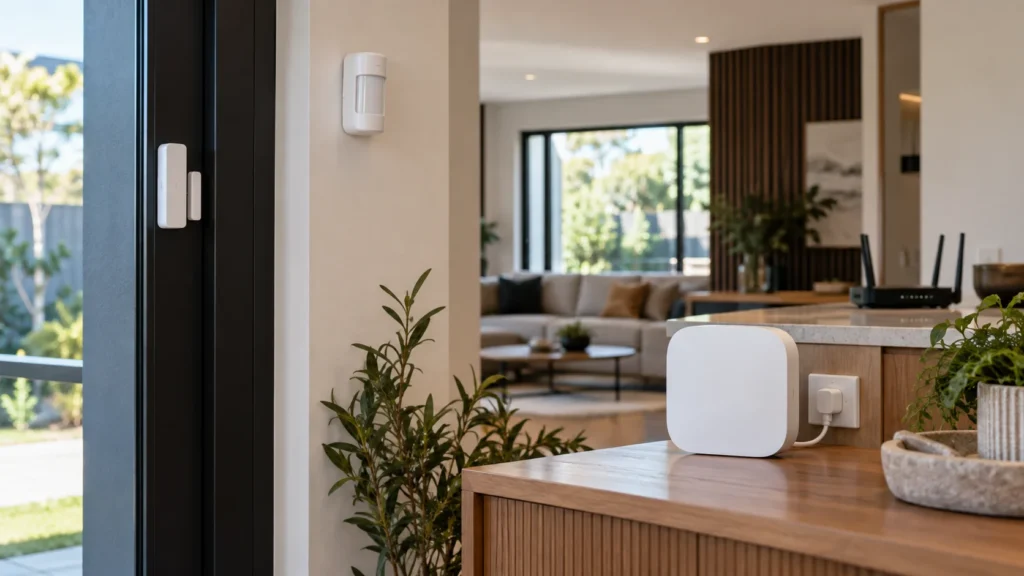
A wireless alarm system replaces most field cabling with radio communication between devices and a central panel or hub. The hub is the decision-maker. It listens to signals from door contacts, motion detectors, glass-break sensors, panic buttons, and in some cases smoke, flood, or temperature devices. It also keeps track of whether the system is armed, which zones should trigger immediately, which zones should start an entry delay, and whether any device is reporting tamper or low-battery conditions.

That means “wireless” does not mean casual. It does not mean a few battery devices loosely scattered around a property. A properly configured wireless alarm is a supervised network. When a protected door opens at the wrong time, the panel checks which detector triggered, what rules apply to that zone, what communication paths are available, and which response actions should start next. Depending on the programming, that could mean a local siren, an external siren, a mobile push alert, a text message, a call sequence, a signal to a monitoring centre, or more than one of these at the same time.

Control hub or panel: receives signals, applies logic, logs events, and starts the response path.
Door and window contacts: detect opening at perimeter points such as entry doors, rear doors, sliding doors, and selected windows.
PIR motion detectors: watch the internal routes an intruder is likely to use once inside.
Sirens and strobe devices: create an immediate local consequence and attract attention.
Communication modules: provide app connectivity, remote reporting, and, where configured, monitoring-centre transmission.
Backup batteries: keep the panel and wireless devices working when mains power is lost.

How the signal moves from sensor to response

The easiest way to understand wireless alarms is to think in stages rather than hardware. A good system is not just waiting for something to happen. It is supervising device health, checking communication status, and applying different rules to different zones. A front entry used by the household every day should not behave the same way as a rear laundry door, an internal garage entry, or a storeroom zone in a small business.

1

Detection

A sensor notices a change: a door opens, movement appears in a protected path, glass breaks, or a panic button is pressed.

2

Transmission

The device sends an encrypted radio signal to the hub. In better systems, this communication is supervised rather than one-directional, so the panel also checks whether devices are still present and reporting properly.

3

Decision logic

The hub checks which zone triggered, whether the system is in full arm, stay, night, or partial business mode, and whether an entry delay or instant alarm should apply.

4

Output

The panel logs the event and starts the assigned response path. That may include sounding a siren, sending an app notification, transmitting an alarm signal, or all of these together.

Why this matters in practice: the quality of the alarm experience depends at least as much on programming as on device count. Two systems with the same number of sensors can behave very differently if one has sensible zoning and the other has generic one-size-fits-all settings.

What monitored alarms really mean in Victoria

Many homeowners assume that “monitored” automatically means police dispatch. Victoria Police’s own explanation is more precise. The agency states that an Alpha Code is a three-letter code issued to licensed and graded security monitoring companies and that it allows them to seek police assistance for Category A alarms. The same page also says that anyone requiring Category A alarm responses should use a monitoring company holding a current Alpha Code. That is important because it places monitored alarms inside a formal process rather than a vague promise of urgent help.

Victoria Police also states that it will not respond to alarms caused by power failures or telephone or broadband outages, and that it is the monitoring company’s responsibility to determine whether infrastructure failure caused the alarm before contacting Triple Zero. For a property owner, the practical takeaway is simple: monitoring is not blind forwarding of every signal. Its value lies in triage, categorisation, verification, and disciplined escalation under defined procedures.

This matters for Melbourne readers because self-monitoring and professional monitoring solve different problems. A self-monitored setup can work well for an owner-occupied home where someone is usually reachable, the app is checked quickly, and the site is not vacant for long periods. Professional monitoring often makes more sense where there is frequent travel, staff turnover, late-night closing routines, or a genuine risk that an alarm alert will arrive when no one can safely assess it.

Important nuance: a monitored alarm is best understood as one part of a response chain. It improves the chances that a significant event is noticed and escalated properly, but it does not remove the need for good layout, strong locks, sensible lighting, and clear user routines.

Why backup communication and power matter more than the app

One of the most common consumer mistakes is to judge an alarm system by the phone app before asking what happens when one communication path fails. In the real world, mains power fails, routers freeze, broadband services drop, and people silence notifications without noticing the significance of an event. A stronger alarm design therefore treats backup communication and battery support as core functions, not optional extras.

At minimum, the panel should keep running during a blackout for a meaningful period. Wireless devices should report low-battery status before failure. Alarm reporting should not rely entirely on home broadband. A common arrangement is one primary path for routine connectivity and one backup path for alarm transmission. That design principle is much closer to how security professionals think than the consumer idea of “does the app look modern?”

It is also why cheap comparisons can mislead. A product sheet may advertise long wireless range or easy DIY setup, but brochure range is not the same as dependable performance in a Melbourne terrace with internal brick walls, a double-storey family house, or a small shop with a storeroom and rear service entry. Real reliability comes from supervised communication, sensible detector placement, appropriate siren audibility, and post-install testing under realistic conditions.

Design choices that affect real-world performance

Good alarm design starts with the likely route of entry rather than the most visible wall. Victoria Police burglary-prevention guidance highlights internal and external garage doors, windows, gates, sheds, pet doors, skylights, and other access points. That matters because many households over-focus on the front façade while underestimating side access, rear doors, garage-to-house connections, and sliding doors screened from the street.

Wireless alarms perform best when they are matched to how a property is actually used. A family home where people move downstairs at night needs different zoning from a ground-floor apartment with one main entry, and both differ from a retail premises where the front-of-house and back-of-house areas close at different times.

Detached home

Often-overlooked risk points: rear doors, side gates, garage entry to the house, sheds, pet doors, sliding doors, and skylights.

Alarm priorities: perimeter contacts, path-based motion protection, an external siren, communication backup, and a clear night mode that matches real household movement.

Apartment or townhouse

Often-overlooked risk points: internal corridor entry, balcony doors, storage areas, car-park access routes, and the false assumption that shared access equals safety.

Alarm priorities: strong entry protection, selected interior motion coverage, dependable app alerts, and practical arming routines that people will actually use consistently.

Small business

Often-overlooked risk points: rear service entries, staff-only areas, storerooms, roller access, and after-hours delivery points.

Alarm priorities: clear opening and closing logic, partitioning where needed, visible deterrence, event history, and monitored escalation where the operating pattern justifies it.

How false alarms usually happen

False alarms are often blamed on the wireless concept itself, but most nuisance events come from avoidable design or usage mistakes. Motion detectors can become unreliable when they are aimed into direct sunlight, across moving curtains, or into strong heating and cooling drafts. Pet-tolerant sensors can still misbehave if mounted at the wrong height or placed in a room where furniture creates unexpected movement paths. Door contacts can be inconsistent on unstable or poorly aligned frames. Users can also generate unnecessary alarms if everyone shares the same code, opening routines are unclear, or night mode is poorly explained.

Common mistake 1: choosing the cheapest kit before mapping the likely entry route.
Common mistake 2: protecting only the front door while ignoring rear access and garage links.
Common mistake 3: assuming app control is enough without backup communication.
Common mistake 4: mounting detectors for convenience instead of proper coverage.
Common mistake 5: using one generic arming mode for every household or staff scenario.
Common mistake 6: failing to test low-battery alerts, siren audibility, and communication-failure behaviour after installation.

How to judge whether a wireless alarm is genuinely well designed

A strong wireless alarm should feel simple to use because the complexity has already been solved in the design. For a Melbourne reader assessing a system, the most useful questions are not “how many devices are in the box?” but “what is protected first?”, “how does the system behave at night?”, “what happens if power fails?”, “what happens if broadband fails?”, and “who sees the event if I do not respond?” A serious system should also make it obvious when a sensor is offline, tampered with, or reaching low battery rather than quietly deteriorating in the background.

It also helps to think in layers. Victoria Police burglary-prevention advice does not treat alarms as a standalone cure. The guidance sits alongside deadlocks, screen doors, lighting, visibility, securing valuables, and reducing the signs that a home is empty. That layered approach is one reason alarm articles should not be written like gadget reviews. The real subject is not only technology. It is how technology supports a more resilient property.

For that reason, a well-designed wireless system is not necessarily the one with the longest brochure range or the most polished mobile interface. It is the one that protects the right points, behaves predictably under stress, and gives the owner a response path that still works when ordinary infrastructure or attention fails.

Frequently Asked Questions

1. Do wireless alarm systems need Wi-Fi to work?

No. Many systems use internet connectivity for app access, but stronger systems can also use cellular communication for alarm reporting. Core protection should not depend entirely on home Wi-Fi.

2. Will a wireless alarm still work during a blackout?

It should continue operating for a limited period if the panel has battery backup and the wireless devices have their own batteries. Exact runtime depends on the equipment and the load on the system.

3. Are wireless alarms reliable enough for Melbourne homes?

Yes, when they are correctly designed, signal-tested, and matched to the building layout. Reliability depends much more on design quality than on the word wireless itself.

4. What is the main advantage of monitored alarms?

The main advantage is structured event handling. A monitoring centre can receive the signal, categorise it under defined procedures, and manage escalation when the owner cannot respond quickly or safely.

5. Does a monitored alarm guarantee police attendance?

No. Victoria Police operates under defined alarm-response procedures, and not every alarm event results in police attendance. Monitoring improves escalation discipline; it is not a blanket guarantee.

6. Are wireless systems always better than hardwired systems?

No. Wireless is often the better retrofit choice in existing buildings, while hardwired systems can still be excellent in new construction and major renovations.

7. Can pets trigger motion detectors?

Yes. Pet-tolerant detectors reduce the risk, but furniture, room layout, mounting height, detector choice, and the behaviour of the animal still matter.

8. Which parts of a home should usually be protected first?

Usually the main entry, rear access, internal garage links, vulnerable sliding doors, and the routes an intruder is most likely to use once inside.

9. How often do wireless sensor batteries need replacing?

It varies by device type, environmental conditions, signal quality, and activity level. Many last several years, but a good system should warn well before a battery becomes critical.

10. Is a mobile app enough on its own?

No. A mobile app is useful, but it does not replace dependable hardware, backup communication, proper zoning, user training, and a realistic response plan.

Primary Sources

Victoria Police — Prevent home burglaries
Official burglary-prevention guidance including the recommendation to install a security screen door, monitored alarm system, cameras, and sensor lighting.
https://www.police.vic.gov.au/preventing-home-burglaries
Victoria Police — Preventing home burglaries (PDF checklist)
Printable burglary-prevention checklist repeating the monitored-alarm recommendation in a concise official format.
https://www.police.vic.gov.au/sites/default/files/2023-04/Preventing-home-burglaries.pdf
Victoria Police — Alpha Codes and alarm responses
Official explanation of Category A alarm responses, Alpha Codes, and the statement that police will not respond to alarms caused by power failures or telephone or broadband outages.
https://www.police.vic.gov.au/alpha-code-and-alarm-responses
Victoria Police — Business premises security
Official business-security guidance advising owners to install cameras and a monitored alarm system among other protective measures.
https://www.police.vic.gov.au/securing-business-premises
Crime Statistics Agency Victoria — Key Figures: Year ending December 2025
Official key figures for statewide criminal incidents and Melbourne offence-rate data.
https://www.crimestatistics.vic.gov.au/media-centre/news/key-figures-year-ending-december-2025
Crime Statistics Agency Victoria — Did you lock your house before you left for work?
Official CSA article containing the quoted residential burglary figure for the previous 12 months.
https://www.crimestatistics.vic.gov.au/media-centre/news/did-you-lock-your-house-before-you-left-for-work
Standards Australia Store — AS/NZS 2201.1:2007
Standards context covering client-premises design, installation, commissioning, and maintenance of intruder alarm systems.
https://store.standards.org.au/product/as-nzs-2201-1-2007
Standards Australia Store — AS/NZS 2201.5:2008
Standards context covering alarm transmission systems and communication paths.
https://store.standards.org.au/product/as-nzs-2201-5-2008

Leave a Comment

Your email address will not be published. Required fields are marked *