Dome vs. Bullet Cameras 2026: Which One is Right for Your Business?
If you’re planning a security camera system for your business, you’ve probably encountered the same question dozens of times: “Should I install dome cameras or bullet cameras?” It’s a deceptively simple question with a surprisingly complex answer. The wrong choice can leave blind spots in your coverage, waste thousands on unnecessary hardware, or result in a system that looks unprofessional and fails to deter theft.
This dome vs. bullet camera guide is written by the team at SIPKO Security, a professional security camera installer that designs, installs, and maintains surveillance systems across retail stores, offices, warehouses, and commercial properties worldwide. We don’t just read manufacturer specs. We mount these cameras in real buildings, troubleshoot them when environmental factors cause problems, and advise clients on which camera type actually delivers the coverage they need.
Whether you’re protecting a retail shop, a warehouse, or an office building, this guide covers everything, from field of view and vandalism resistance to installation complexity, real-world costs, and the hybrid deployment strategies that maximize coverage while minimizing expense.
1. Introduction & Overview: The Camera Selection Challenge
The security camera market has exploded over the past five years. Where businesses once had to choose between expensive hardwired systems or cheap consumer-grade WiFi cameras, today there are hundreds of professional-grade options available. But this abundance of choice has created a new problem: decision paralysis. Most business owners don’t know the technical differences between camera types, and they end up making purchasing decisions based on price alone, often resulting in systems that don’t actually meet their security needs.
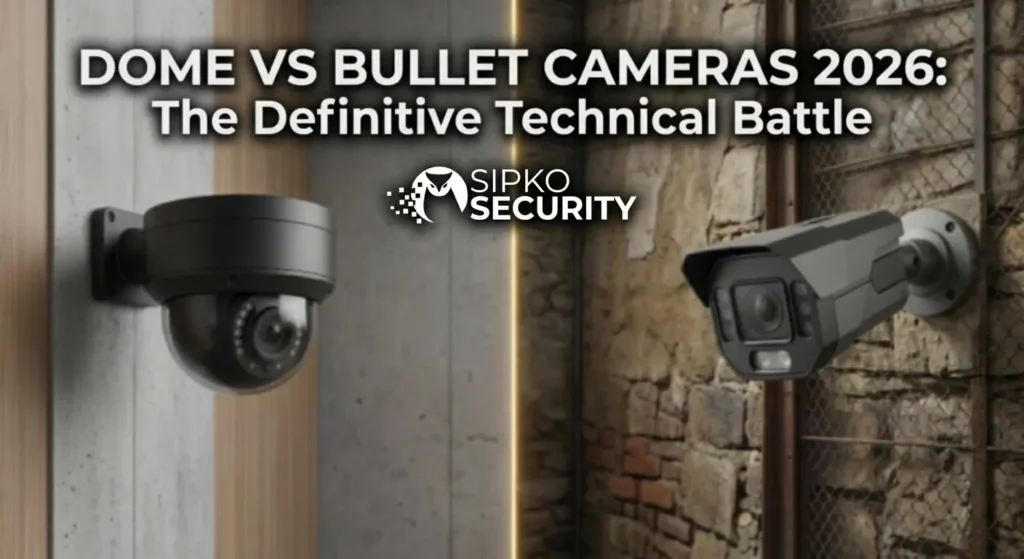
The two most common camera types are dome cameras and bullet cameras. Each has distinct advantages and disadvantages. Dome cameras excel at discreet, wide-area indoor monitoring. Bullet cameras excel at long-distance outdoor surveillance and visible deterrence. The question isn’t which one is “better”, it’s which one is better for your specific business, your property layout, your budget, and your security priorities.
According to research by the College of Policing, CCTV cameras reduce crime by approximately 13% in monitored areas compared to unmonitored locations. In high-crime areas, where property crime remains a significant concern, choosing the right camera system isn’t just about compliance, it’s about genuine protection.
At SIPKO Security, we’ve installed thousands of cameras across diverse business environments worldwide. We’ve seen dome cameras prevent retail theft in boutique shops, bullet cameras catch license plates in parking lots, and hybrid systems protect massive warehouse facilities. This guide is built on that real-world experience.
CCTV cameras reduce property crime by approximately 13% in monitored areas, according to the College of Policing research.
Dome cameras provide wide field of view coverage, ideal for monitoring large indoor areas with a single unit.
Bullet cameras offer narrower, focused coverage optimized for long-distance outdoor surveillance and perimeter monitoring.
A complete 4-8 camera professional business system typically costs $9,000-$20,000 including equipment and installation.
2. What Are Dome Cameras? Design, Technology & Specifications
A dome camera is named for its distinctive spherical or low-profile dome-shaped housing. The camera lens sits inside a protective polycarbonate or acrylic dome cover, which serves two critical functions: it protects the lens from physical damage and environmental exposure, and it obscures the camera’s viewing direction from observers.
Physical Design: Dome cameras are typically compact, ranging from 4 to 8 inches in diameter. They are most commonly mounted on ceilings (indoors) or under soffits and eaves (outdoors). The dome cover is usually tinted or smoked, making it difficult for people to determine exactly where the camera is pointing. This ambiguity is one of the key advantages of dome cameras in retail and office environments, it creates a sense of comprehensive surveillance without the intimidating presence of a visible lens.
Field of View: Dome cameras typically offer a wide field of view, ranging from 90 to 120 degrees. This means a single dome camera can monitor a large area, for example, an entire retail shop floor, a hotel lobby, or an office corridor, without requiring multiple units. The wide angle comes from the camera’s lens design and the dome’s optical properties.
Vandal Resistance: One of the most important specifications for dome cameras is their IK rating (Ingress Protection rating for mechanical impact). The IK scale ranges from IK00 (no protection) to IK10 (maximum protection). A camera with an IK10 rating can withstand up to 20 joules of impact, equivalent to a 5kg mass dropped from 40cm. Most professional dome cameras carry IK ratings of IK08 to IK10, making them extremely resistant to tampering, vandalism, and accidental damage.
The protective dome cover is typically made of polycarbonate plastic, which is significantly more impact-resistant than acrylic. The camera housing itself is usually metal (aluminum or stainless steel), providing additional structural protection. This combination makes dome cameras ideal for high-risk environments like retail stores, schools, and public facilities where vandalism is a concern.
Wide coverage angle allows a single dome camera to monitor large indoor areas efficiently.
Professional dome cameras withstand 10-20 joules of impact, making them extremely tamper-resistant.
Compact form factor allows discreet ceiling or soffit mounting without drawing attention.
Impact-resistant plastic dome cover protects lens while obscuring viewing direction from observers.
3. What Are Bullet Cameras? Design, Technology & Specifications
A bullet camera is named for its distinctive cylindrical, elongated shape, resembling a bullet or lipstick tube. Unlike dome cameras, bullet cameras make no attempt at discretion. The lens is fully exposed and clearly visible, and the camera’s viewing direction is immediately obvious to anyone looking at it. This visibility is intentional and serves a specific purpose: visible deterrence.
Physical Design: Bullet cameras are typically 2 to 8 inches long and 1 to 2 inches in diameter. They are mounted on walls, poles, corners, or under eaves using a bracket. The exposed lens is protected by a metal or plastic shroud, but the camera’s presence and direction are unmistakable. This makes bullet cameras ideal for perimeter security, parking lots, and outdoor entry points where you want potential intruders to know they are being watched.
Field of View: Bullet cameras typically offer a narrower field of view than dome cameras, ranging from 50 to 90 degrees. This narrower angle is by design, it allows the camera to focus on a specific area and achieve greater zoom capability. For example, a bullet camera mounted at the entrance to a parking lot can zoom in on license plates, while a dome camera in the same location would capture the entire lot but with less detail on individual vehicles.
Lens Options: One of the key advantages of bullet cameras is their flexibility in lens selection. Most professional bullet cameras offer either fixed focal length lenses (e.g., 4mm, 6mm, 8mm) or variable focal length lenses (e.g., 2.8-12mm). This allows installers to customize the camera’s coverage area based on the specific mounting location and distance to the target area. A 4mm lens provides a wider view, while an 8mm lens provides a narrower, more zoomed view.
Weather Resistance: Outdoor bullet cameras are engineered for harsh environmental conditions. Most professional models carry IP ratings of IP65 to IP67, meaning they are completely sealed against dust and water. Many also include built-in heaters and fans to maintain optimal operating temperature in extreme climates. The metal housing provides excellent protection against UV damage and corrosion.
Mounting Flexibility: Bullet cameras can be mounted almost anywhere, on walls, poles, under eaves, in corners, or even on moving vehicles. This flexibility makes them ideal for retrofitting existing buildings where ceiling mounting isn’t practical. At SIPKO Security, we often specify bullet cameras for warehouse perimeters, parking lot entries, and outdoor loading docks precisely because of this mounting flexibility.
Narrower coverage angle optimized for long-distance surveillance and detailed facial/license plate capture.
Outdoor bullet cameras are completely sealed against dust and water, with built-in heating for extreme temperatures.
Compact cylindrical form factor allows flexible wall, pole, or corner mounting in outdoor environments.
Fixed or variable focal length lenses (2.8-12mm) allow customization for specific coverage distances and zoom requirements.
4. Dome vs. Bullet: Direct Technical Comparison
To make an informed decision between dome and bullet cameras, you need to understand how they compare across the technical specifications that actually matter for your business. Here is a comprehensive, side-by-side comparison of the key performance metrics.
| Specification | Dome Camera | Bullet Camera | Winner |
|---|---|---|---|
| Field of View | 90-120° | 50-90° | Dome (wider) |
| Coverage Area | Large indoor spaces | Focused zones | Dome (efficient) |
| Vandal Resistance | IK08-IK10 | IK04-IK08 | Dome (protected) |
| Viewing Direction | Obscured (discreet) | Obvious (visible) | Dome (discreet) |
| Deterrent Factor | Moderate | High (obvious) | Bullet (visible) |
| Detail Capture | Limited (wide angle) | Excellent (zoom) | Bullet (detail) |
| Mounting Flexibility | Ceiling/soffit only | Wall, pole, corner | Bullet (flexible) |
| Installation Ease | Moderate (ceiling) | Simple (wall) | Bullet (easier) |
| Weather Resistance | IP54-IP67 | IP65-IP67 | Tie (both good) |
| Maintenance | Low (protected) | Moderate (exposed) | Dome (low maint) |
| Hardware Cost | $50-$300 | $100-$500 | Dome (cheaper) |
| Aesthetic Appeal | High (discreet) | Low (obvious) | Dome (blends in) |
Key Takeaway: There is no universal “winner” between dome and bullet cameras. Dome cameras excel at wide-area indoor coverage with minimal maintenance and maximum discretion. Bullet cameras excel at long-distance outdoor surveillance, visible deterrence, and detailed facial/license plate capture. The right choice depends entirely on your specific application.
5. Coverage & Field of View: Which Covers More?
One of the most misunderstood aspects of camera selection is field of view (FOV). Many business owners assume that a wider field of view is always better, but that’s not necessarily true. The “best” field of view depends on what you’re trying to monitor and how far away the target is.
Dome Cameras: Wide Coverage, Lower Detail
A typical dome camera with a 100-degree field of view can monitor an entire retail shop floor, a hotel lobby, or an office corridor from a single ceiling-mounted location. This wide angle is achieved through a wide-angle lens (typically 2.8mm to 4mm focal length). The advantage is obvious: you need fewer cameras to cover a large area, which reduces hardware costs and installation complexity.
However, there’s a tradeoff. Because the wide-angle lens spreads the camera’s resolution across a larger area, the detail captured at distance is lower. For example, if a dome camera is mounted 10 metres away from a retail counter, it can see that someone is at the counter, but it may not capture enough facial detail to identify them later. This is why dome cameras are ideal for monitoring general activity and detecting motion, but less ideal for forensic identification.
Bullet Cameras: Narrow Coverage, Higher Detail
A typical bullet camera with a 60-degree field of view and an 8mm focal length is designed to monitor a specific area at distance. If mounted at the entrance to a parking lot, it can capture license plates and facial features with forensic-quality detail. The narrow field of view means the camera’s resolution is concentrated on a smaller area, resulting in much higher pixel density and better detail.
The tradeoff is that you need more cameras to cover a large area. A parking lot that could be covered by two dome cameras might require four bullet cameras to achieve the same coverage. However, the additional detail captured by the bullet cameras often justifies the extra hardware cost.
Real-World Example: Retail Shop Coverage
Consider a typical retail shop, approximately 20 metres long and 10 metres wide. A single dome camera mounted on the ceiling can monitor the entire shop floor with a 100-degree field of view. The camera captures general activity, detects motion, and records who enters and exits. If a theft occurs, the footage shows the general area where it happened.
However, if you need to identify the specific person who stole merchandise, a single dome camera may not provide enough facial detail. In this scenario, a hybrid approach works better: use one or two dome cameras for general coverage, and add a bullet camera focused on the high-value merchandise area or the checkout counter. The bullet camera captures high-detail footage of anyone handling valuable items.
Wide angle covers large areas efficiently, ideal for retail shops, offices, and hotel lobbies.
Narrow angle concentrates resolution on specific areas, ideal for license plates and facial identification.
A single dome camera can monitor an entire retail shop floor or office corridor.
Multiple bullet cameras needed for same area coverage, but with significantly higher detail.
6. Vandalism & Tamper Resistance: Which Camera Survives Abuse?
In high-risk environments, retail shops, schools, public facilities, and areas with a history of vandalism, camera durability is not a luxury feature, it’s a necessity. A camera that gets smashed or disabled on day one provides zero protection and represents wasted investment. This is where the physical design differences between dome and bullet cameras become critically important.
Understanding IK Ratings
The IK rating (Ingress Protection rating for mechanical impact) is a standardized measure of how much physical abuse a camera can withstand. The scale ranges from IK00 (no protection) to IK10 (maximum protection). Here’s what each rating means in practical terms:
- IK04: Resistant to impacts up to 0.5 joules (equivalent to a 0.25kg mass dropped from 20cm)
- IK06: Resistant to impacts up to 2 joules (equivalent to a 1kg mass dropped from 20cm)
- IK08: Resistant to impacts up to 5 joules (equivalent to a 1.7kg mass dropped from 30cm)
- IK10: Resistant to impacts up to 20 joules (equivalent to a 5kg mass dropped from 40cm)
Dome Cameras: Superior Vandal Resistance
Professional dome cameras typically carry IK ratings of IK08 to IK10. The protective polycarbonate dome cover is specifically designed to absorb impact and protect the lens underneath. Even if someone strikes the dome with a stick or throws an object at it, the dome absorbs the impact and the lens remains protected. The metal housing provides additional structural protection.
At SIPKO Security, we’ve installed dome cameras in schools and public facilities worldwide where vandalism is a known risk. We’ve seen domes survive direct strikes that would have completely destroyed a bullet camera. The protective design is simply superior for high-vandalism environments.
Bullet Cameras: Vulnerable Lens Design
Bullet cameras typically carry IK ratings of IK04 to IK08. The exposed lens is the critical vulnerability. A direct strike to the lens will crack or shatter it, rendering the camera useless. Even if the camera body survives, a damaged lens means no usable footage.
This doesn’t mean bullet cameras are “bad”, it means they are designed for different environments. In a secure parking lot or warehouse perimeter where vandalism is unlikely, a bullet camera’s lower IK rating is not a problem. But in a high-risk retail environment or public facility, a bullet camera is a poor choice.
Protective Housings: An Option for Bullet Cameras
If you need bullet cameras in a high-vandalism environment, protective metal housings are available. These housings surround the camera and lens with a metal cage, significantly improving vandal resistance. However, they add cost, complexity, and can interfere with the camera’s field of view. In most cases, it’s simpler and more cost-effective to use dome cameras in high-risk areas.
Professional dome cameras withstand 5-20 joules of impact, making them extremely resistant to vandalism.
Bullet cameras are more vulnerable due to exposed lens design, though protective housings are available.
Impact-absorbing dome cover protects lens from direct strikes and environmental damage.
Bullet camera lens is vulnerable to direct strikes, cracks, and environmental exposure.
7. Installation & Mounting Complexity: What’s Involved?
Installation complexity directly impacts both the upfront cost and the long-term viability of your camera system. A camera that’s difficult to install may end up in a suboptimal location, resulting in poor coverage or blind spots. Understanding the installation requirements of each camera type is essential for planning your system.
Dome Camera Installation: Ceiling Mounting
Dome cameras are almost exclusively ceiling-mounted (indoors) or soffit/eave-mounted (outdoors). This mounting requirement has both advantages and disadvantages.
Advantages: Ceiling mounting provides optimal coverage for large indoor areas. The camera looks down at the entire floor, capturing activity across the entire space. The mounting location is typically out of reach, making it difficult for vandals to tamper with. The camera is also less visually intrusive than a wall-mounted bullet camera.
Disadvantages: Ceiling mounting requires working at height, which adds installation complexity and cost. In older buildings with plaster ceilings or heritage finishes, drilling mounting holes may require special permissions or techniques. In buildings with suspended ceilings, the installation is simpler, but you need to ensure the ceiling structure can support the camera weight.
At SIPKO Security, a typical dome camera installation takes 1-2 hours per camera, including mounting, cabling, and configuration. The main variables are ceiling height (higher ceilings require scaffolding or lifts) and cable routing complexity.
Bullet Camera Installation: Wall, Pole, or Corner Mounting
Bullet cameras offer significantly more mounting flexibility. They can be mounted on walls, poles, corners, under eaves, or even on moving vehicles. This flexibility is one of the key advantages of bullet cameras for retrofitting existing buildings.
Advantages: Wall mounting is simple and doesn’t require working at height. A bullet camera can be mounted at any height from ground level to roof level, depending on the coverage requirements. The mounting bracket is typically simple and requires only basic tools. Bullet cameras are ideal for retrofitting buildings where ceiling access is difficult or impossible.
Disadvantages: Wall-mounted cameras are more visible and can be perceived as intrusive in some environments (e.g., office buildings, retail shops). The camera is also more accessible to vandals. The narrow field of view means you may need more cameras to achieve the same coverage as dome cameras.
A typical bullet camera installation takes 30-45 minutes per camera, making it faster than dome installation. However, you often need more bullet cameras to achieve equivalent coverage, which can offset the installation time savings.
Cabling & Network Considerations
Both dome and bullet cameras require network cabling (typically Cat6 or Cat6A for professional installations). The cabling can be run through ceiling cavities (for dome cameras) or along walls and conduits (for bullet cameras). In modern buildings with structured cabling systems, this is straightforward. In older buildings, cabling can be complex and expensive.
Power over Ethernet (PoE) is standard for professional cameras, meaning a single cable provides both power and network connectivity. This simplifies installation compared to older systems that required separate power and network cables.
Typical installation time per dome camera, including mounting, cabling, and configuration.
Faster installation per camera, but often requires more cameras for equivalent coverage.
Dome cameras require ceiling or soffit mounting, limiting placement flexibility.
Bullet cameras can mount on walls, poles, corners, or eaves, offering maximum flexibility.
8. Aesthetics & Discretion: The Visual Impact
Security is important, but so is the customer experience. A retail shop that looks like a fortress with cameras pointing in every direction may deter customers as much as it deters thieves. Conversely, a warehouse or parking lot needs obvious security presence to deter criminal activity. The aesthetic impact of your camera choice matters more than many business owners realize.
Dome Cameras: Discreet & Professional
Dome cameras are designed to blend into their environment. The compact, spherical shape is less visually intrusive than a bullet camera. When mounted on a ceiling, a dome camera is barely noticeable, most customers won’t even register its presence. The tinted or smoked dome cover adds to the discreet appearance.
This discretion is a significant advantage in customer-facing environments. Research shows that customers feel more comfortable shopping in spaces that feel secure but not oppressive. A retail shop with discreet dome cameras creates a sense of safety without the intimidating presence of obvious surveillance equipment.
At SIPKO Security, we’ve installed dome cameras in high-end retail shops in Toorak and Brighton where the aesthetic is critical. The dome cameras blend seamlessly with modern interior design, whereas a bullet camera would look out of place.
Bullet Cameras: Obvious & Deterrent
Bullet cameras make no attempt at discretion. The cylindrical shape, exposed lens, and obvious mounting bracket make it immediately clear that surveillance is happening. This visibility is intentional and serves a specific purpose: visible deterrence.
In parking lots, warehouse perimeters, and outdoor entry points, the obvious presence of a bullet camera is a powerful theft deterrent. Potential criminals see the camera and know they are being recorded, which significantly reduces the likelihood of criminal activity. Research shows that visible security cameras reduce crime by up to 13% in monitored areas.
However, in customer-facing environments like retail shops or offices, obvious bullet cameras can create a negative impression. Customers may feel like they’re being treated as potential criminals, which can harm the business’s reputation and customer loyalty.
The Hybrid Approach: Best of Both Worlds
Many businesses benefit from a hybrid approach: use discreet dome cameras for general coverage in customer-facing areas, and use obvious bullet cameras for perimeter security and high-risk zones. This strategy provides comprehensive coverage while maintaining a professional aesthetic in customer areas.
For example, a retail shop might use dome cameras throughout the sales floor and stockroom, but place a bullet camera at the entrance to deter shoplifters and capture license plates of vehicles in the parking lot. The combination provides both comprehensive coverage and visible deterrence.
Compact, spherical design blends into modern interiors without drawing attention.
Cylindrical shape and exposed lens make surveillance immediately obvious to observers.
Dome cameras enhance the professional appearance of retail shops, offices, and hospitality venues.
When comparing bar security camera systems, assess the required detail at tills and entrances alongside the housing, lighting and staff access to recordings.
Obvious bullet cameras deter criminal activity through visible presence and clear surveillance intent.
9. Weather Resistance & Durability: Climate Challenges
Climate conditions vary significantly by region. Summer temperatures can exceed 40°C, winter brings heavy rain and wind, coastal areas experience salt spray corrosion, and UV exposure is intense year-round. Any outdoor camera system must be engineered to survive these conditions. This is where weather resistance ratings become critically important.
Understanding IP Ratings
The IP rating (Ingress Protection) measures how well a camera is sealed against dust and water. The rating consists of two digits: the first digit (0-6) indicates dust protection, and the second digit (0-9) indicates water protection. Here’s what the common ratings mean:
- IP54: Protected against dust and water splashes (suitable for covered outdoor areas)
- IP65: Completely sealed against dust and water jets (suitable for exposed outdoor areas)
- IP67: Completely sealed against dust and temporary submersion (suitable for extreme weather)
Dome Cameras: Excellent Weather Protection
Professional outdoor dome cameras typically carry IP ratings of IP54 to IP67. The protective dome cover is specifically designed to shed water and protect the lens from direct exposure. The sealed metal housing prevents moisture from entering the camera body.
In coastal areas, salt spray corrosion is a significant concern. Professional dome cameras use stainless steel or powder-coated aluminum housings that resist corrosion. The polycarbonate dome cover is UV-resistant and won’t degrade in intense sunlight.
Bullet Cameras: Also Excellent Weather Protection
Professional outdoor bullet cameras typically carry IP ratings of IP65 to IP67, matching or exceeding dome cameras. The sealed metal housing and protected lens shroud provide excellent weather resistance. Many outdoor bullet cameras include built-in heaters and fans to maintain optimal operating temperature in extreme heat and cold.
The main difference is that bullet cameras have an exposed lens, which requires more frequent cleaning in dusty or coastal environments. Salt spray can accumulate on the lens, reducing image quality. Dome cameras, with their protected lens, require less frequent cleaning.
Maintenance Requirements
In coastal areas, we recommend quarterly lens cleaning for bullet cameras and semi-annual cleaning for dome cameras. In inland areas, annual cleaning is typically sufficient. Both camera types should be inspected annually for signs of corrosion or damage.
At SIPKO Security, we include maintenance recommendations in our installation reports. We also offer annual maintenance packages that include lens cleaning, firmware updates, and system health checks.
Both dome and bullet cameras carry excellent outdoor weather ratings, completely sealed against dust and water.
Professional cameras use stainless steel or powder-coated aluminum to resist salt spray corrosion in coastal environments.
Polycarbonate dome covers won’t degrade in intense sunlight, maintaining clarity for years.
Coastal areas require quarterly lens cleaning to remove salt spray accumulation and maintain image quality.
10. Cost Analysis: Dome vs. Bullet: What You’ll Actually Pay
Cost is often the primary decision factor for business owners, but it’s important to understand the full cost picture, not just the hardware price. A cheaper camera that requires more units or more frequent maintenance can end up costing significantly more over the system’s lifetime.
Hardware Costs
Based on current market pricing in Australia (May 2026):
- Dome Cameras: $50-$300 per unit (consumer to professional grade)
- Bullet Cameras: $100-$500 per unit (consumer to professional grade)
For professional-grade systems suitable for business use, expect to pay:
- Professional Dome Cameras: $150-$300 per unit
- Professional Bullet Cameras: $250-$500 per unit
Installation Costs
Professional installation typically costs $100-$200 per camera, depending on:
- Mounting complexity (ceiling work vs. wall mounting)
- Cable routing distance and difficulty
- Network infrastructure requirements
- Site-specific challenges (heritage buildings, difficult access, etc.)
At SIPKO Security, we provide detailed quotes that break down hardware, installation labour, cabling, and network configuration costs. We also include a pre-installation site survey to identify any cost variables.
Complete System Costs: Real-World Examples
Here are typical total system costs for businesses worldwide (hardware + professional installation):
- Small Retail Shop (4 cameras): $2,000-$3,500 (typically 3 dome + 1 bullet)
- Medium Office (6 cameras): $3,500-$5,500 (typically 4 dome + 2 bullet)
- Large Warehouse (8 cameras): $5,000-$8,000 (typically 2 dome + 6 bullet)
- Parking Lot (4 cameras): $2,500-$4,000 (typically 4 bullet)
Long-Term Cost Considerations
Beyond the initial installation, consider these ongoing costs:
- Storage: Cloud storage ($20-$50/month) or local NVR ($1,000-$3,000 one-time)
- Maintenance: Annual cleaning and inspection ($200-$500)
- Repairs: Replacement parts, lens cleaning, firmware updates
- Monitoring: Optional 24/7 monitoring service ($50-$150/month)
Cost Efficiency: Dome vs. Bullet
For large indoor areas, dome cameras are more cost-efficient because a single dome camera can cover what might require 2-3 bullet cameras. However, for outdoor perimeter monitoring, bullet cameras are more cost-efficient because they provide better long-distance detail.
The most cost-efficient approach for most businesses is a hybrid system: use dome cameras for indoor coverage and bullet cameras for outdoor perimeter security. This combination typically costs 10-15% less than using all one type while providing superior coverage.
Professional-grade dome cameras typically cost $150-$300 per unit.
Professional-grade bullet cameras typically cost $250-$500 per unit.
Professional installation typically costs $100-$200 per camera depending on complexity.
A complete 4-8 camera business system typically costs $2,000-$8,000 including installation.
11. Dome Cameras for Businesses: Best Use Cases & Real-World Applications
Dome cameras excel in specific business environments where their advantages, wide coverage, discretion, vandal resistance, and low maintenance, directly address real security challenges. Here are the scenarios where dome cameras are the optimal choice.
Retail Shops & Boutiques
Retail is the most common application for dome cameras. A typical retail shop in Brighton or Toorak can be completely covered by 2-4 ceiling-mounted dome cameras. The wide field of view captures the entire sales floor, checkout area, and stockroom. The discreet appearance doesn’t intimidate customers, and the ambiguous viewing direction creates a sense of comprehensive surveillance.
Dome cameras are particularly effective for retail theft prevention because they capture activity across the entire shop floor. If a customer attempts to conceal merchandise or a staff member engages in suspicious behaviour, the dome cameras capture it from multiple angles. The high-resolution footage is also useful for identifying specific individuals if theft occurs.
Office Buildings & Corporate Spaces
Office buildings benefit from dome cameras in common areas: lobbies, corridors, conference rooms, and break rooms. The discreet appearance is important in professional environments where employees expect privacy in their workspaces. Dome cameras mounted on ceilings blend seamlessly with modern office design and don’t create a “Big Brother” atmosphere.
For access control and security, dome cameras in lobbies and entry points capture footage of everyone entering and exiting the building. The wide field of view means a single camera can monitor the entire lobby area, reducing the number of cameras needed.
Hotels & Hospitality Venues
Hotels use dome cameras extensively in lobbies, hallways, restaurants, and common areas. The discreet appearance is critical in hospitality, guests expect to feel welcome and secure, not surveilled. Dome cameras provide this balance perfectly. The wide coverage means fewer cameras are needed, reducing visual clutter.
At SIPKO Security, we’ve installed dome camera systems in hotels worldwide where the aesthetic is paramount. The cameras are virtually invisible to guests, yet they provide comprehensive coverage of all public areas.
Banks & Financial Institutions
Banks require the highest level of security, and dome cameras are a standard choice for interior monitoring. The wide field of view captures the entire banking floor, teller stations, and customer service areas. The vandal-resistant design (IK08-IK10) ensures the cameras survive any attempted tampering.
Dome cameras in banks are often combined with bullet cameras for perimeter security and ATM monitoring. The hybrid approach provides comprehensive coverage both inside and outside the building.
Schools & Educational Facilities
Schools use dome cameras in hallways, common areas, and outdoor courtyards. The discreet appearance is important for maintaining a welcoming environment for students. The vandal-resistant design is critical because schools are often targets for vandalism.
Dome cameras in schools typically focus on monitoring student movement and identifying any safety concerns. The wide field of view allows a single camera to monitor an entire hallway or courtyard.
Restaurants & Cafes
Restaurants use dome cameras in dining areas, kitchens, and storage areas. The discreet appearance in dining areas is important for customer comfort. In kitchens and storage areas, dome cameras monitor staff activity and prevent theft of food and supplies.
The wide field of view is particularly useful in open-plan restaurant layouts where a single dome camera can monitor the entire dining area and kitchen.
Warehouses & Storage Facilities (Interior)
While warehouses typically use bullet cameras for perimeter security, interior warehouse areas benefit from dome cameras. Ceiling-mounted dome cameras can monitor the entire warehouse floor, capturing activity at shelving units, loading docks, and inventory areas. The wide field of view means fewer cameras are needed to cover large warehouse spaces.
Dome cameras are the standard choice for retail shops, providing wide coverage and discreet appearance.
Dome cameras blend seamlessly into office design while monitoring lobbies, corridors, and common areas.
Hotels and restaurants use dome cameras to maintain security without creating an oppressive surveillance atmosphere.
Dome cameras’ superior vandal resistance makes them ideal for schools and public facilities.
12. Bullet Cameras for Businesses: Best Use Cases & Real-World Applications
Bullet cameras excel in outdoor environments and perimeter security applications where their advantages, long-distance detail capture, visible deterrence, and flexible mounting, directly address real security challenges. Here are the scenarios where bullet cameras are the optimal choice.
Parking Lots & Vehicle Security
Parking lots are the most common application for bullet cameras. A bullet camera mounted at the entrance to a parking lot can capture license plates, vehicle details, and driver faces with forensic-quality clarity. The narrow field of view and zoom capability make bullet cameras far superior to dome cameras for this application.
At SIPKO Security, we’ve installed bullet cameras in parking lots across Melbourne’s business districts. The visible presence of the camera deters vehicle theft and break-ins, and the high-quality footage helps identify perpetrators if incidents occur.
Warehouse & Industrial Perimeters
Warehouses and industrial facilities use bullet cameras for perimeter security. Cameras mounted on fence lines, building corners, and entry points capture anyone approaching the facility. The narrow field of view allows the camera to focus on specific entry points, and the zoom capability captures facial details and identifying features.
The visible presence of bullet cameras is a powerful deterrent for warehouse theft and break-ins. Potential criminals see the cameras and know they are being recorded, which significantly reduces the likelihood of criminal activity.
Building Entrances & Exit Points
Bullet cameras mounted above building entrances and exit points capture high-quality footage of everyone entering and leaving the building. The narrow field of view focuses on the specific entry point, and the zoom capability captures facial details for identification purposes.
This is particularly important for businesses that need to track who enters and exits the building after hours. The high-quality footage is useful for identifying unauthorized access or suspicious activity.
ATM & Cash Handling Areas
Banks and retail shops with ATMs use bullet cameras to monitor the ATM area. The narrow field of view focuses on the ATM and the person using it, capturing facial details and identifying features. The zoom capability allows the camera to capture PIN entry and card details if needed.
Bullet cameras are also used to monitor cash handling areas in retail shops and restaurants. The high-quality footage is useful for identifying staff members involved in cash theft or fraud.
Loading Docks & Delivery Areas
Warehouses and retail shops use bullet cameras to monitor loading docks and delivery areas. The narrow field of view focuses on the specific loading area, capturing details of goods being loaded or unloaded. The zoom capability allows the camera to read shipping labels and identify specific items.
Bullet cameras in loading docks are useful for preventing theft of goods during delivery and for monitoring staff activity during high-value shipments.
Outdoor Perimeter Fencing
Bullet cameras mounted along perimeter fencing capture anyone attempting to breach the fence or access the property. The narrow field of view focuses on the fence line, and the zoom capability captures facial details and identifying features.
The visible presence of bullet cameras along the perimeter is a powerful deterrent for trespassing and break-ins. Potential criminals see the cameras and know they are being recorded.
Parking Structures & Multi-Level Facilities
Multi-level parking structures use bullet cameras to monitor each level and the entry/exit ramps. The narrow field of view focuses on specific areas, and the zoom capability captures license plates and vehicle details. The visible presence of cameras deters vehicle theft and break-ins.
At SIPKO Security, we’ve designed parking structure systems with bullet cameras positioned to capture every vehicle entering and exiting, providing comprehensive coverage and excellent forensic detail.
Outdoor Courtyards & Recreation Areas
Schools, universities, and corporate campuses use bullet cameras to monitor outdoor courtyards and recreation areas. The visible presence of cameras deters vandalism and inappropriate behaviour. The narrow field of view focuses on specific areas, capturing details of any incidents.
Bullet cameras excel at capturing license plates and vehicle details in parking lots and structures.
Bullet cameras monitor fence lines and building perimeters, deterring break-ins and trespassing.
Bullet cameras at building entrances capture high-quality facial details for identification and access tracking.
Variable focal length lenses allow bullet cameras to zoom in on specific details like license plates and faces.
13. Hybrid Deployment Strategy: Using Both Dome & Bullet Cameras
The most cost-efficient and effective security systems don’t rely on a single camera type. Instead, they use a hybrid deployment strategy that combines dome cameras for indoor coverage with bullet cameras for outdoor perimeter security. This approach maximizes coverage efficiency while minimizing cost and maintenance requirements.
The 70/30 Deployment Model
Industry research shows that the most cost-efficient camera deployments use approximately 70% dome cameras and 30% bullet cameras. This ratio balances the advantages of both camera types while optimizing total system cost.
For example, a retail shop with a parking lot might deploy:
- Interior (70%): 3 dome cameras covering the sales floor, stockroom, and checkout area
- Exterior (30%): 1 bullet camera at the parking lot entrance capturing license plates and vehicle details
This 4-camera system provides comprehensive coverage both inside and outside the building, with the dome cameras handling general activity monitoring and the bullet camera handling forensic detail capture.
Real-World Hybrid System Examples
Example 1: Medium Retail Shop (Brighton)
- 3 dome cameras: Sales floor, stockroom, checkout area
- 1 bullet camera: Parking lot entrance (license plate capture)
- Total Cost: $2,200-$3,200 (hardware + installation)
- Coverage: Complete interior + parking lot perimeter
Example 2: Warehouse with Office (Bentleigh)
- 2 dome cameras: Office areas and interior warehouse
- 6 bullet cameras: Perimeter fence, loading dock, entry points, parking area
- Total Cost: $5,500-$7,500 (hardware + installation)
- Coverage: Complete interior + comprehensive perimeter security
Example 3: Office Building (Toorak)
- 5 dome cameras: Lobby, corridors, common areas, conference rooms
- 2 bullet cameras: Building entrance, parking area
- Total Cost: $3,800-$5,200 (hardware + installation)
- Coverage: Complete interior + access control + parking security
Cost Efficiency Analysis
A hybrid 70/30 deployment is typically 10-15% cheaper than using all one camera type while providing superior coverage. Here’s why:
- Fewer Total Cameras: Dome cameras’ wide field of view means fewer cameras needed for interior coverage
- Optimized Detail Capture: Bullet cameras focus on high-value areas (parking, entrances) where detail matters
- Lower Maintenance: Dome cameras require less frequent cleaning and maintenance
- Better Aesthetics: Discreet dome cameras in customer areas, obvious bullet cameras in perimeter areas
Hybrid System Design Process
At SIPKO Security, we design hybrid systems using a structured process:
- Site Assessment: We identify all areas requiring coverage (interior, exterior, perimeter, parking)
- Coverage Planning: We determine which areas need general activity monitoring (dome) vs. forensic detail (bullet)
- Camera Placement: We position cameras to maximize coverage efficiency and minimize blind spots
- Cost Optimization: We balance camera count, installation complexity, and long-term maintenance costs
- Scalability Planning: We design systems that can be expanded in the future without major redesign
70% dome cameras for interior coverage, 30% bullet cameras for perimeter security.
Hybrid deployments typically cost 10-15% less than single-type systems.
Combines wide interior coverage with detailed perimeter monitoring for comprehensive security.
Hybrid systems can be easily expanded in the future without major redesign or reconfiguration.
14. Integration with Alarm Systems: Video Verification & Smart Alerts
Modern security systems don’t operate in isolation. The most effective systems integrate cameras with alarm systems, access control, and monitoring services. This integration enables video verification, the ability to instantly view camera footage when an alarm is triggered, allowing security operators to determine whether an alarm is genuine or false.
Video Verification: How It Works
When an alarm sensor (motion detector, door contact, glass break) is triggered, the system immediately sends a signal to the monitoring centre and captures video from the nearest camera. Within seconds, the monitoring operator can view the footage and determine whether there is a genuine intrusion or a false alarm.
This capability is critical in Melbourne, where Victoria Police has strict false alarm policies. Repeat false alarms can result in police refusing to attend your property or issuing substantial fines. Video verification dramatically reduces false alarm rates because the monitoring operator can instantly confirm whether an alarm is genuine before dispatching emergency services.
Dome Cameras & Video Verification
Dome cameras are excellent for general activity monitoring and motion detection. When a dome camera detects motion, it can trigger an alarm and send video to the monitoring centre. However, the wide field of view means the video may not capture enough detail to identify specific individuals or confirm the nature of the intrusion.
Dome cameras are most effective for video verification when combined with bullet cameras. The dome camera detects motion and triggers the alarm, while the bullet camera captures high-detail footage for verification.
Bullet Cameras & Video Verification
Bullet cameras are ideal for video verification because their narrow field of view and zoom capability capture high-detail footage. When a bullet camera detects motion at an entry point or perimeter area, it can capture clear facial features, license plates, or other identifying details.
At SIPKO Security, we often recommend placing bullet cameras at high-risk areas (entry points, loading docks, parking lots) specifically for video verification purposes. When an alarm is triggered in these areas, the bullet camera footage provides the detail needed for the monitoring operator to instantly confirm whether there is a genuine threat.
Integration with Ajax Alarm Systems
If you’re using an Ajax alarm system, integration with cameras is seamless. Ajax’s NVR (Network Video Recorder) can integrate with both Ajax native cameras and third-party IP cameras from brands like Hikvision and Dahua.
When an Ajax sensor triggers an alarm, the system automatically captures video from the nearest camera and sends it to the monitoring centre and your smartphone. This video verification capability is one of the key advantages of modern integrated security systems.
Smart Alert Features
Modern camera systems offer advanced alert features that go beyond simple motion detection:
- AI Object Detection: Cameras can distinguish between humans, vehicles, and animals, reducing false alerts from pets or moving vegetation
- Perimeter Intrusion Detection: Cameras can alert when someone crosses a virtual boundary line (e.g., fence line or building perimeter)
- Loitering Detection: Cameras can alert when someone remains in a specific area for longer than a configured time period
- Directional Motion: Cameras can alert only when motion is detected in a specific direction (e.g., entering the property, not leaving)
These advanced features significantly reduce false alarms and allow security operators to focus on genuine threats.
Monitoring operators can instantly view camera footage when an alarm is triggered to confirm genuine threats.
Video verification dramatically reduces false alarm rates and associated Victoria Police fines.
Advanced AI algorithms distinguish between humans, vehicles, and animals for intelligent alert filtering.
Modern cameras integrate with Ajax, Bosch, and other alarm systems for unified security management.
15. Dome vs. Bullet vs. PTZ Cameras: When PTZ Makes Sense
While dome and bullet cameras are the most common choices, there’s a third option worth considering: PTZ cameras (Pan-Tilt-Zoom). PTZ cameras can rotate horizontally (pan), tilt vertically, and zoom in and out, all remotely controlled. Understanding when PTZ cameras make sense is important for designing optimal security systems.
What Are PTZ Cameras?
A PTZ camera is a motorized camera that can pan (rotate left/right), tilt (rotate up/down), and zoom (magnify the image). The camera is controlled remotely via software or a joystick, allowing an operator to point the camera at any area of interest and zoom in for detail.
PTZ cameras are typically mounted on poles, building corners, or rooftops where they have a clear view of large areas. A single PTZ camera can cover the area that would require 4-6 fixed cameras.
PTZ Advantages
- Massive Coverage Area: A single PTZ camera can cover 360 degrees horizontally and 90+ degrees vertically, covering areas that would require multiple fixed cameras
- Zoom Capability: PTZ cameras can zoom in on specific areas to capture high-detail footage of faces, license plates, or other identifying features
- Operator Control: Security operators can remotely control the camera to track moving subjects or focus on areas of interest
- Flexible Coverage: PTZ cameras can be repositioned to cover different areas as security needs change
PTZ Disadvantages
- High Cost: PTZ cameras typically cost $1,100-$3,000 per unit, significantly more than dome or bullet cameras
- Requires Operator: PTZ cameras require active monitoring and operator control to be effective. They can’t provide continuous coverage of all areas simultaneously
- Blind Spots: While a PTZ camera is pointing at one area, other areas are unmonitored. This creates blind spots that can be exploited by criminals
- Maintenance: PTZ cameras have moving parts (motors, gears) that require regular maintenance and are more prone to failure
- Weather Vulnerability: The moving parts make PTZ cameras more vulnerable to weather damage and corrosion
When PTZ Cameras Make Sense
PTZ cameras are ideal for specific applications where their advantages outweigh their disadvantages:
- Large Open Areas: Parking lots, sports fields, or large outdoor areas where a single PTZ camera can cover what would require 4-6 fixed cameras
- Active Monitoring: Facilities with 24/7 security staff who can actively monitor and control the camera to track suspicious activity
- High-Value Assets: Areas with high-value inventory or equipment where the cost of a PTZ camera is justified by the asset protection value
- Event Security: Temporary security for events, festivals, or gatherings where flexible coverage is needed
Hybrid Approach: Fixed + PTZ
The most effective approach for large facilities is a hybrid system combining fixed cameras (dome and bullet) with one or more PTZ cameras. The fixed cameras provide continuous coverage of all areas, while the PTZ camera provides flexible, operator-controlled coverage of high-risk areas.
For example, a large warehouse might use:
- 2 dome cameras for interior warehouse monitoring
- 4 bullet cameras for perimeter security and entry points
- 1 PTZ camera on the roof for flexible coverage of the parking lot and perimeter
This hybrid approach provides comprehensive fixed coverage plus flexible operator-controlled coverage, maximizing security effectiveness.
PTZ cameras can rotate 360 degrees horizontally, covering massive areas with a single unit.
PTZ cameras typically cost $1,100-$3,000 per unit, significantly more than fixed cameras.
PTZ cameras require active monitoring and operator control to be effective, creating blind spots when not in use.
Combining fixed cameras with one PTZ camera provides comprehensive coverage plus flexible operator control.
16. Maintenance & Long-Term Costs: 5-Year Total Cost of Ownership
When evaluating camera systems, most business owners focus on the upfront hardware and installation costs. However, the true cost of ownership extends far beyond the initial purchase. Maintenance, repairs, storage, and eventual replacement all add to the total cost. Understanding these long-term costs is critical for making informed purchasing decisions.
Maintenance Requirements: Dome vs. Bullet
Dome Cameras: Dome cameras require minimal maintenance. The protected lens means less frequent cleaning is needed. In inland areas, annual lens cleaning is typically sufficient. In coastal areas, quarterly cleaning is recommended to remove salt spray accumulation.
Typical annual maintenance for dome cameras includes:
- Lens cleaning (1-4 times per year depending on location)
- Firmware updates (typically 1-2 per year)
- Visual inspection for damage or corrosion
- Network connectivity verification
Bullet Cameras: Bullet cameras require more frequent maintenance due to the exposed lens. In inland areas, semi-annual cleaning is recommended. In coastal areas, quarterly cleaning is essential to maintain image quality.
Typical annual maintenance for bullet cameras includes:
- Lens cleaning (2-4 times per year depending on location)
- Lens shroud inspection and cleaning
- Firmware updates (typically 1-2 per year)
- Visual inspection for damage or corrosion
- Network connectivity verification
Maintenance Costs
At SIPKO Security, we offer annual maintenance packages:
- Dome Camera Maintenance: $150-$250 per camera per year (inland), $250-$350 per camera per year (coastal)
- Bullet Camera Maintenance: $200-$300 per camera per year (inland), $300-$450 per camera per year (coastal)
These costs include scheduled cleaning, firmware updates, and system health checks. Emergency repairs or replacement parts are additional.
Storage Costs
Camera footage must be stored somewhere, either in the cloud or on a local NVR (Network Video Recorder). This is an ongoing cost that many business owners overlook.
- Cloud Storage: $20-$50 per month depending on the number of cameras and retention period
- Local NVR Storage: $1,000-$3,000 one-time cost for the NVR unit, plus occasional hard drive replacement ($200-$500 per drive)
For most businesses, local NVR storage is more cost-effective over the long term. The upfront cost is higher, but there are no ongoing monthly fees.
Repair & Replacement Costs
Even with proper maintenance, cameras eventually fail or require repair. Common issues include:
- Lens Damage: Cracked or scratched lenses require replacement ($100-$300 per lens)
- Network Issues: Failed network ports or cables require replacement ($50-$150)
- Motor Failure (PTZ only): Failed pan/tilt motors require replacement ($300-$800)
- Complete Camera Failure: Failed cameras require replacement ($150-$500 per camera)
Professional cameras typically have a 3-5 year lifespan before significant repairs or replacement becomes necessary.
5-Year Total Cost of Ownership: Real-World Example
Let’s calculate the 5-year total cost of ownership for a typical retail shop with 4 cameras (3 dome + 1 bullet):
- Initial Hardware & Installation: $2,500
- Local NVR Storage: $2,000 (one-time)
- Annual Maintenance (5 years): $1,000/year × 5 = $5,000
- Repairs & Replacement (estimated): $1,500
- Total 5-Year Cost: $11,000
This breaks down to approximately $2,200 per year or $55 per camera per month for a complete, professionally maintained security system.
Dome cameras require minimal maintenance: annual lens cleaning and firmware updates in most areas.
Bullet cameras require more frequent maintenance due to exposed lens: semi-annual cleaning recommended.
Cloud storage costs $20-$50 per month depending on cameras and retention period.
Local NVR storage costs $1,000-$3,000 one-time with no ongoing monthly fees.
17. Melbourne-Specific Considerations: Climate, Crime, & Compliance
Melbourne’s unique climate, crime patterns, and regulatory environment create specific considerations for camera system design. Understanding these local factors is critical for choosing the right cameras and ensuring your system performs optimally.
Melbourne’s Climate Challenges
Melbourne is famous for its variable weather. Summer temperatures exceed 40°C, winter brings heavy rain and wind, and the city experiences intense UV exposure year-round. These conditions create specific challenges for camera systems:
- Coastal Salt Spray: Suburbs like Brighton, Hampton, and Bentleigh experience significant salt spray corrosion. Cameras must use stainless steel housings and require quarterly maintenance to remove salt accumulation.
- Temperature Extremes: Summer heat can damage camera electronics, while winter cold can affect battery performance. Professional cameras include built-in heaters and fans to maintain optimal operating temperature.
- UV Exposure: Melbourne’s intense UV exposure can degrade polycarbonate dome covers and plastic components. UV-resistant materials are essential for long-term durability.
- Heavy Rain: Melbourne’s winter storms bring heavy rain and wind. Cameras must have excellent IP ratings (IP65 or higher) and secure mounting to withstand wind loads.
Melbourne Crime Patterns
According to the Crime Statistics Agency Victoria, property crime remains a significant concern across Melbourne. Different suburbs experience different crime patterns:
- Retail Theft: Inner-city retail areas experience higher rates of shoplifting and organized retail theft. Dome cameras with wide coverage are essential for monitoring sales floors.
- Vehicle Theft: Parking lots and vehicle storage areas are common targets. Bullet cameras with license plate capture capability are essential for parking lot security.
- Break-ins: Warehouses and commercial properties experience break-ins. Perimeter bullet cameras and alarm integration are critical for detecting unauthorized access.
- Vandalism: Some areas experience higher rates of vandalism. Vandal-resistant dome cameras (IK08-IK10) are recommended for high-risk areas.
Victoria Police False Alarm Policy
This is critical: Victoria Police has strict false alarm policies. Repeat false alarms can result in:
- Police refusing to attend your property
- Substantial fines (up to $1,000+ per false alarm)
- Loss of police response priority
This is why video verification is so important. When your camera system can provide instant video verification of alarms, the monitoring centre can confirm genuine threats before dispatching police, dramatically reducing false alarm rates.
Strata & Body Corporate Regulations
If your business is in a strata property or multi-tenant building, you may face restrictions on camera installation. Common restrictions include:
- No drilling into common property walls
- No cabling through common areas
- Restrictions on camera placement and viewing angles
- Privacy concerns regarding neighboring properties
Dome cameras are often the best choice for strata properties because they can be ceiling-mounted within your own space without affecting common areas. Bullet cameras may require body corporate approval if they point toward common areas or neighboring properties.
Heritage Building Considerations
Melbourne has many heritage-listed buildings, particularly in inner suburbs like Toorak and Hawthorn. Heritage restrictions may limit camera installation options:
- No visible external cameras (bullet cameras may be prohibited)
- Restrictions on drilling or mounting hardware
- Requirements for heritage-appropriate materials and finishes
In heritage buildings, discreet dome cameras are often the only option. At SIPKO Security, we have experience working with heritage buildings and can design systems that comply with heritage restrictions while providing effective security.
Coastal suburbs require stainless steel cameras and quarterly maintenance to combat salt corrosion.
Melbourne’s extreme temperatures require cameras with built-in heating and cooling systems.
Victoria Police false alarm policies make video verification critical for Melbourne businesses.
Heritage buildings require discreet dome cameras that comply with heritage restrictions.
18. Overall Rating & Verdict: Dome vs. Bullet: SIPKO’s Recommendation
After reviewing all the technical specifications and real-world applications, here is SIPKO Security’s overall assessment of dome vs. bullet cameras for businesses.
| Category | Dome Rating | Bullet Rating | Verdict |
|---|---|---|---|
| Coverage Efficiency | ⭐⭐⭐⭐⭐ 5/5 | ⭐⭐⭐⭐ 4/5 | Dome wins for indoor areas |
| Detail Capture | ⭐⭐⭐ 3/5 | ⭐⭐⭐⭐⭐ 5/5 | Bullet wins for forensic detail |
| Vandal Resistance | ⭐⭐⭐⭐⭐ 5/5 | ⭐⭐⭐⭐ 4/5 | Dome wins for high-risk areas |
| Aesthetic Appeal | ⭐⭐⭐⭐⭐ 5/5 | ⭐⭐⭐ 3/5 | Dome wins for customer-facing areas |
| Deterrent Factor | ⭐⭐⭐⭐ 4/5 | ⭐⭐⭐⭐⭐ 5/5 | Bullet wins for visible deterrence |
| Installation Ease | ⭐⭐⭐⭐ 4/5 | ⭐⭐⭐⭐⭐ 5/5 | Bullet wins for flexibility |
| Maintenance Requirements | ⭐⭐⭐⭐⭐ 5/5 | ⭐⭐⭐⭐ 4/5 | Dome wins for low maintenance |
| Weather Durability | ⭐⭐⭐⭐⭐ 5/5 | ⭐⭐⭐⭐⭐ 5/5 | Tie, both excellent |
| Value for Money | ⭐⭐⭐⭐⭐ 5/5 | ⭐⭐⭐⭐ 4/5 | Dome wins for cost efficiency |
SIPKO’s Bottom Line:
There is no universal “best” camera type. The optimal choice depends on your specific application:
- Choose Dome Cameras If: You need to monitor large indoor areas (retail shops, offices, warehouses), you want a discreet appearance, you’re in a high-vandalism area, or you want minimal maintenance requirements.
- Choose Bullet Cameras If: You need to monitor outdoor areas or perimeters, you need to capture license plates or facial details at distance, you want visible deterrence, or you need flexible mounting options.
- Choose Hybrid (70% Dome + 30% Bullet) If: You want comprehensive coverage of both indoor and outdoor areas, you want to optimize cost and coverage efficiency, or you want the best balance of all factors.
For Most Melbourne Businesses: We recommend a hybrid 70/30 dome-to-bullet deployment. This approach provides comprehensive coverage, excellent cost efficiency, and the flexibility to address both indoor and outdoor security needs. The hybrid approach typically costs 10-15% less than using all one camera type while providing superior overall coverage.
19. Common Mistakes When Choosing Dome vs. Bullet Cameras
Over years of installing camera systems across Melbourne, we’ve seen business owners make the same mistakes repeatedly. Learning from these mistakes can save you thousands of dollars and ensure your system actually meets your security needs.
Mistake #1: Choosing Based on Price Alone
The most common mistake is selecting cameras based purely on upfront hardware cost. A cheaper camera that requires more units or more frequent maintenance can end up costing significantly more over the system’s lifetime.
The Right Approach: Calculate the 5-year total cost of ownership, including hardware, installation, maintenance, storage, and repairs. A slightly more expensive camera that requires less maintenance often provides better value over time.
Mistake #2: Ignoring Coverage Efficiency
Many business owners install too many bullet cameras when a few dome cameras would provide better coverage at lower cost. They focus on the individual camera rather than the overall system efficiency.
The Right Approach: Design your system based on coverage requirements, not camera count. A single dome camera covering a large area is more efficient than three bullet cameras covering the same area.
Mistake #3: Poor Camera Placement
We’ve seen countless systems where cameras are mounted in suboptimal locations, too high, too low, pointing at walls, or positioned to create blind spots. Poor placement renders even expensive cameras ineffective.
The Right Approach: Conduct a professional site assessment before purchasing any cameras. Identify optimal mounting locations, test signal strength, and plan cable routes. This planning phase typically takes 1-2 hours but saves significant time and cost during installation.
Mistake #4: Neglecting Maintenance Planning
Many businesses install cameras and then ignore them for years. Without regular maintenance, lens degradation, firmware updates, and environmental damage reduce system effectiveness.
The Right Approach: Plan for regular maintenance from day one. Budget for annual cleaning, firmware updates, and system health checks. A maintenance contract with a professional installer ensures your system remains effective over its lifetime.
Mistake #5: Overlooking Integration with Alarm Systems
Many businesses install cameras and alarm systems separately, missing the opportunity for video verification. This results in higher false alarm rates and potential Victoria Police fines.
The Right Approach: Design your camera system to integrate with your alarm system from the start. Ensure cameras can provide instant video verification when alarms are triggered. This integration dramatically reduces false alarms and improves emergency response effectiveness.
Mistake #6: Ignoring Coastal Environment Challenges
Businesses in coastal suburbs like Brighton and Hampton often install standard cameras without considering salt spray corrosion. Within a few years, the cameras fail due to corrosion.
The Right Approach: If you’re in a coastal area, invest in stainless steel camera housings and schedule quarterly maintenance. The extra upfront cost is far less than replacing corroded cameras every few years.
Mistake #7: Choosing Cameras Without Professional Guidance
Many business owners purchase cameras online or from big-box retailers without professional consultation. They end up with systems that don’t meet their actual security needs.
The Right Approach: Consult with a professional security installer before purchasing any cameras. A professional can assess your specific needs, recommend the optimal system, and ensure proper installation and configuration.
Choosing based on upfront cost alone ignores long-term maintenance and replacement costs.
Ignoring coverage efficiency leads to too many cameras and wasted budget.
Poor camera placement creates blind spots and reduces system effectiveness.
Neglecting maintenance leads to lens degradation and system failure over time.
20. Who Should Choose Dome vs. Bullet: Decision Framework by Business Type
To help you make the right decision, here’s a framework showing which camera type is optimal for different business types and scenarios.
| Business Type | Recommended Approach | Primary Reason |
|---|---|---|
| Retail Shop | Hybrid (3 dome + 1 bullet) | Dome for interior coverage, bullet for parking lot |
| Office Building | Hybrid (4 dome + 1 bullet) | Dome for lobbies/corridors, bullet for entrance |
| Warehouse | Hybrid (2 dome + 6 bullet) | Dome for interior, bullet for perimeter security |
| Parking Lot | Bullet Only | License plate capture and vehicle detail |
| Hotel/Hospitality | Hybrid (5 dome + 2 bullet) | Dome for guest areas, bullet for perimeter |
| Bank/Financial | Hybrid (3 dome + 3 bullet) | Dome for interior, bullet for ATM/perimeter |
| School/University | Hybrid (4 dome + 2 bullet) | Dome for hallways, bullet for perimeter |
| Restaurant/Cafe | Hybrid (2 dome + 1 bullet) | Dome for dining area, bullet for parking |
| High-Vandalism Area | Dome Preferred | Superior vandal resistance (IK08-IK10) |
| Heritage Building | Dome Only | Discreet appearance complies with restrictions |
Key Decision Factors:
- Customer-Facing Areas: Use dome cameras for retail shops, offices, and hospitality venues where aesthetic appeal is important
- Outdoor/Perimeter Areas: Use bullet cameras for parking lots, fence lines, and building perimeters where detail capture and deterrence are important
- High-Vandalism Areas: Use dome cameras for their superior vandal resistance
- Coastal Areas: Use stainless steel cameras (both dome and bullet) and plan for quarterly maintenance
- Heritage Buildings: Use discreet dome cameras to comply with heritage restrictions
21. SIPKO Security Melbourne: Professional Camera Installation & Design
At SIPKO Security, we’ve been designing and installing professional camera systems across Melbourne for years. We understand the local climate, crime patterns, regulatory requirements, and building types. We don’t just install cameras, we design comprehensive security solutions tailored to your specific business needs.
Our Process
1. Free Site Assessment: We conduct a comprehensive site assessment to identify your security needs, evaluate your property layout, and identify optimal camera locations. This assessment typically takes 1-2 hours and is completely free.
2. System Design: Based on the site assessment, we design a custom camera system that optimizes coverage, cost, and long-term maintenance. We provide detailed drawings showing camera locations, cable routes, and coverage diagrams.
3. Detailed Quote: We provide a transparent, itemized quote that breaks down hardware costs, installation labour, cabling, and any additional services. No hidden fees or surprises.
4. Professional Installation: Our licensed technicians install your system to the highest professional standards. We test every camera, verify network connectivity, and ensure optimal performance before handover.
5. Client Training: We walk you through every feature of your system, show you how to access footage, configure alerts, and manage user accounts. We ensure you feel completely confident using your new system.
6. Ongoing Support: We offer annual maintenance packages, emergency repairs, and technical support. We’re here to ensure your system continues to perform optimally for years to come.
Our Expertise
- Dome camera systems for retail, offices, and hospitality venues
- Bullet camera systems for parking lots, warehouses, and perimeter security
- Hybrid systems combining dome and bullet cameras for comprehensive coverage
- Integration with alarm systems for video verification
- Coastal environment solutions with stainless steel housings and maintenance plans
- Heritage building compliance and discreet camera placement
- Strata and body corporate compliance
Service Areas
We serve all of Melbourne and surrounding suburbs, including Brighton, Toorak, Hampton, Bentleigh, Hawthorn, and beyond.
22. Frequently Asked Questions: Dome vs. Bullet Cameras
Q: Can I mix dome and bullet cameras in the same system?
A: Absolutely. In fact, we recommend it. A hybrid system combining dome and bullet cameras provides superior coverage and cost efficiency compared to using all one type. The 70/30 dome-to-bullet ratio is optimal for most businesses.
Q: What’s the typical lifespan of a security camera?
A: Professional-grade cameras typically last 5-7 years before significant repairs or replacement becomes necessary. With proper maintenance, some cameras can last 10+ years. Consumer-grade cameras typically last 2-3 years.
Q: Do I need professional installation?
A: While DIY installation is technically possible, professional installation is strongly recommended. Professional installers ensure optimal camera placement, proper network configuration, and integration with alarm systems. Poor installation can result in blind spots, false alarms, and system failures.
Q: What about night vision? Do both camera types support it?
A: Yes, both dome and bullet cameras can include infrared (IR) night vision. IR allows cameras to capture footage in complete darkness. However, IR has a limited range (typically 10-30 metres depending on the camera). For outdoor perimeter security, ensure your bullet cameras have adequate IR range.
Q: How much storage do I need for camera footage?
A: Storage requirements depend on the number of cameras, resolution, and retention period. A typical 4-camera system recording at 1080p requires approximately 1-2 TB of storage per week. Most businesses retain footage for 30 days, requiring 4-8 TB of storage. We recommend local NVR storage for most businesses.
Q: Can I integrate existing cameras with a new system?
A: Yes, if your existing cameras are IP-based (network cameras). We can integrate them with a new NVR and management system. Older analog cameras cannot be integrated with modern IP systems without additional conversion equipment.
Q: What’s the difference between cloud and local storage?
A: Cloud storage stores footage on remote servers (typically $20-$50/month), while local storage uses an on-site NVR (typically $1,000-$3,000 one-time cost). Local storage is more cost-effective long-term but requires on-site equipment. Cloud storage is more convenient but has ongoing monthly fees.
Q: How often should cameras be cleaned?
A: Dome cameras require annual cleaning in inland areas, quarterly in coastal areas. Bullet cameras require semi-annual cleaning in inland areas, quarterly in coastal areas. Regular cleaning maintains image quality and extends camera lifespan.
Q: What’s the difference between IP and analog cameras?
A: IP cameras transmit video over network cables (Ethernet), while analog cameras transmit video over coaxial cables. IP cameras are superior: they offer higher resolution, better integration with modern systems, and easier remote access. Analog cameras are outdated and should not be used for new installations.
Q: Can cameras be hacked?
A: Yes, if not properly configured. Professional installation includes security hardening: strong passwords, firmware updates, network segmentation, and encrypted communication. We ensure your system is secure from day one.
Q: What’s the warranty on professional cameras?
A: Professional cameras typically come with 2-3 year manufacturer warranties. SIPKO Security provides extended 3-year warranties on all professionally installed systems, covering parts and labour.
Q: Can I access footage remotely from my phone?
A: Yes, modern camera systems include mobile apps that allow remote access to live video and recorded footage. You can view your cameras from anywhere with an internet connection.
Ready to Upgrade Your Business Security?
Get a free site assessment and custom camera system design from SIPKO Security. We’ll help you choose the right cameras for your Melbourne business and ensure professional installation and ongoing support.
Licensed security installer serving all of Melbourne. No hidden fees. Transparent pricing. Professional installation guaranteed.