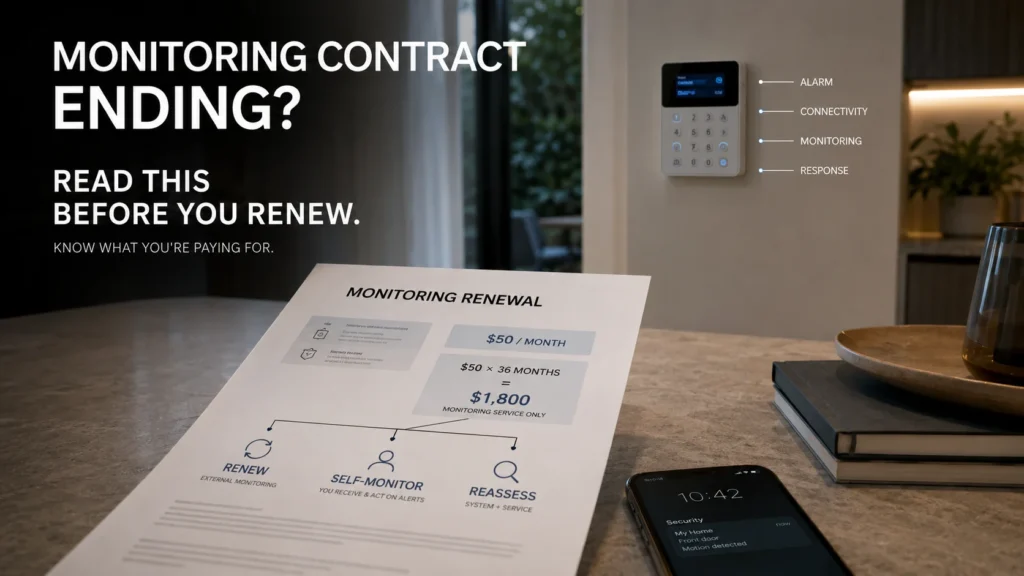
Your alarm is fine. Nothing has failed. But a renewal notice has landed, and the monthly amount looks small enough on its own — until you notice what you’re actually being asked to agree to is another full period of that same recurring cost. Multiply it by however many months you’re about to commit to, and a figure that looked easy to ignore on a single line item starts to look like a real decision, not a formality.
This is the moment you’re actually making a decision about your alarm monitoring contract, whether it feels that way or not. Nobody sends a renewal notice framed as “here’s a choice to make” — it arrives looking like a bill, and most people treat it that way: pay it, move on, think about it again next time it lands. But the alarm working fine right now doesn’t tell you whether the service you’re about to pay for again is still the right one for how you actually live.
Before signing anything, it’s worth separating four things that easily blur together:
- The alarm hardware you already own.
- The monitoring service you’re being asked to pay for.
- The communication or connectivity your system uses to report events.
- The response you actually expect if something happens.
Renewal notices bundle all four into one number. But only one of them — the monitoring service itself — is actually up for renewal. The rest are worth understanding on their own before you decide what that renewal is really buying you.
First, Find Out What You’re Actually Renewing
Before anything else, get the actual agreement or renewal notice in front of you and check what it actually says. Look for:
- The monthly or annual fee.
- What the monitoring service actually includes.
- The contract duration.
- How renewal works.
- What notice, if any, is required to cancel.
- Cancellation or exit terms.
- Whether communication or SIM/data charges are separate.
- Any patrol or response charges beyond the base fee.
- Any equipment or service obligations tied to the agreement.
Contract length, renewal mechanics, notice periods and cancellation terms vary by provider — there’s no standard Australian default to assume here. Check whether your agreement renews into another fixed term, moves to a month-to-month arrangement, or uses some other renewal structure, and whether notice is required before a particular date. The only reliable source for your situation is the agreement you’re actually being asked to renew, not a general rule of thumb. If any of these terms aren’t clear from the paperwork itself, that’s worth clarifying directly with the provider before any applicable notice deadline has passed.
What Are You Paying a Monitoring Company to Do?
It’s worth being clear about what a monitoring fee actually buys, because it’s easy to conflate the alarm system itself with the service layered on top of it.
The alarm hardware — panel, sensors, siren — does the detecting. Professional monitoring is a separate, external layer: a monitoring centre receives the events your system reports, and follows an agreed process for what happens next. That’s a genuinely different thing from the alarm simply working. For the full mechanics of how that response process works — who gets contacted, what escalation looks like, what’s confirmed before anyone acts — our guide to professional alarm monitoring in Melbourne covers that in detail. Here, the more useful question is narrower: given what that service actually does, is it still what you want to keep paying for?
Would You Actually Be Comfortable Self-Monitoring?
This is worth working through honestly before looking at any numbers, because it’s the part a renewal notice never asks you to think about.
- Who actually sees the alert if your alarm goes off?
- What happens if you’re asleep when it triggers?
- What if your phone is off, or you’re somewhere without a signal?
- What happens if you’re overseas?
- Who can physically check the property if you can’t?
- Do you actually want the responsibility of deciding what happens next, in the moment, yourself?
- Does your insurer’s policy expect or reward monitored systems? (More on this below.)
Self-monitoring removes the monitoring-station fee. It also transfers the responsibility for seeing and acting on alerts back to you. Neither of those is automatically the right answer — it depends on how confident you genuinely are that you’d notice, and respond, every time it mattered.
None of this is about whether you’re a responsible person. It’s about whether the pattern of your actual life — how deeply you sleep, how often your phone is out of reach, whether you travel, whether anyone else can reasonably step in — matches what self-monitoring quietly assumes. A property that’s occupied most nights by someone who checks their phone constantly is a very different situation from one that sits empty for weeks at a time. The honest answer to these questions matters more here than anywhere else in this article.
It’s also worth being honest about a separate question: does your existing alarm actually give you enough information to self-monitor well in the first place? An app that only tells you “alarm triggered,” with little detail about the event, gives you less to work with than one that can identify the relevant zone, sensor or system event. Our guide on what an alarm app actually adds covers that gap in more depth, including whether an existing system can gain that capability without being replaced.
What Does Another Three Years Actually Cost?
To make the renewal decision concrete, it helps to see what a monthly fee adds up to over time. We’re using 36 months here simply as a comparison horizon — not because every monitoring contract runs for three years. Use whatever period actually matches your own agreement.
These are illustrative examples, not an Australian average — monitoring fees vary by provider, service level and location. The number that actually matters is the one on your own renewal notice: take that figure and run it through the same multiplication to see what your specific renewal represents over the period you’re actually being asked to commit to.
The Cheapest Option Isn’t Automatically the Right One
It’s tempting to look at a number like $1,800 and treat “self-monitoring costs nothing” as the obvious answer. That’s not quite right, and it’s worth being precise about why.
The $1,800 figure above is the monitoring-service component only. A full comparison also needs to account for the alarm hardware itself, installation, any communication or SIM/data costs the system relies on, ongoing maintenance, and — as covered below — any insurance implications either way. Recurring monitoring cost is one component of total ownership cost, not the whole comparison. Treating it as the whole picture is how a genuinely useful decision turns into a misleading one.
Can Ajax Run Without a Monitoring Subscription?
Yes — with an important qualification.
Ajax’s own documentation states plainly that the system is free to operate when self-monitored, and that a monthly fee applies only if you connect it to a central monitoring station. That’s a genuine, manufacturer-confirmed distinction, and it’s why Ajax self-monitoring and “alarm without subscription” show up as accurate, standard descriptions of how the platform actually works — not marketing exaggeration.
But no monitoring subscription doesn’t necessarily mean zero ongoing cost. If the system uses a cellular connection as part of how it communicates — which Ajax’s own hub documentation recommends alongside Wi-Fi or Ethernet for more reliable communication — that requires a SIM with its own data/SMS costs. That’s a separate cost from the monitoring-station fee, and it’s worth knowing about rather than discovering later, buried in a device settings menu after the system’s already installed. The exact setup that suits a given property — whether it needs a cellular backup at all, and what that might cost month to month — is a configuration question specific to the site, not something this article can answer in general terms.
Professional Monitoring vs Self-Monitoring: Compare the Service, Not Just the Fee
The fee is only part of the difference. It’s worth comparing what each option actually involves.
This is a comparison of two genuinely different service models, not an old expensive option against a new free one.
On the insurance point specifically: professionally monitored systems may affect premiums or policy conditions with some insurers, but requirements vary. Before cancelling monitoring on cost grounds alone, it’s worth checking your actual home and contents policy rather than assuming the change has no consequence either way.
Four Options When the Contract Ends
Once you’ve actually worked through what you’re paying for, what you need, and what it costs, the decision usually comes down to one of four paths.
Renew professional monitoring. A reasonable choice if the external response layer is something you genuinely value and the terms are acceptable to you.
Renegotiate or change the monitoring arrangement. Worth exploring, though there’s no guarantee a provider will offer better terms — it depends entirely on the conversation. Sometimes simply asking what options exist at renewal, rather than letting it auto-continue on default terms, is enough to surface a better fit.
Move to self-monitoring. Makes sense where the platform supports it and you’re genuinely comfortable taking on the responsibility outlined earlier.
Reassess the alarm system itself. Sometimes a contract ending is what actually reveals that the underlying platform, communication path or user experience no longer fits what you want — not just the monitoring arrangement sitting on top of it. If that’s the case, our guide to upgrading an older Bosch, DSC or Hills alarm to Ajax covers what that process actually involves.
Before renewing another monitoring term, SIPKO can assess what you currently have, what you’re actually paying for, what level of response you genuinely want, and whether keeping professional monitoring, moving to self-monitoring, or changing the system makes the most sense for your property.
FAQ
Do I need professional monitoring for my home alarm?
There’s no universal answer — it depends on the response model you actually want, and how comfortable you are with the self-monitoring questions covered above.
Can Ajax work without a monthly monitoring fee?
Yes. Ajax’s own documentation confirms self-monitoring is free, with a fee only applying if you connect to a central monitoring station. A separate, usually small SIM/data cost may still apply if the system uses a cellular connection.
Does self-monitoring mean there are no ongoing costs?
Not necessarily — see the cellular/SIM point above. It removes the monitoring-station fee specifically, not every possible ongoing cost.
How much does alarm monitoring cost over three years?
It depends entirely on your specific fee. As a worked example, a $50-a-month service totals $1,800 over 36 months — take the figure on your own renewal notice and run the same calculation.
Will my alarm monitoring contract automatically renew?
That depends on your specific agreement and provider — there’s no standard Australian default. Check the terms in your own contract.
Can cancelling professional monitoring affect my insurance?
It may, depending on your insurer and policy. Check your actual policy before making a decision based on cost alone.