A PTZ camera can pan across a parking lot, tilt to check a gate, and zoom in on a delivery truck — but it can only do one of those things at a time. A fixed camera can’t move at all, but it watches its one view continuously, every second the system is running. Neither of those facts makes one camera type better than the other. The real question for a commercial property is simpler: what does this specific location need to see, and does that view need to be continuous, or does it need to be inspected on demand?
What “Coverage” Actually Means — and Why It’s Not the Same for Both
A fixed camera and a PTZ camera solve coverage differently:
The practical consequence: a PTZ pointed at one entrance isn’t simultaneously watching another entrance, a loading dock, or a car park boundary, even if it’s technically capable of reaching all three.
A wide available range and simultaneous coverage are two different things, and this distinction is the one most PTZ-vs-fixed comparisons skip.
What a Fixed Camera Actually Offers
Fixed doesn’t mean basic. Modern fixed cameras carry the same low-light, wide dynamic range and analytics technology found on PTZ lines — the defining difference is simply that a fixed camera’s viewing direction doesn’t change after installation. That makes lens selection and positioning a deliberate, one-time design decision rather than something adjusted later. Choosing the right point on that range — wide for general awareness, narrower for a specific critical zone — is exactly the kind of decision a fixed camera locks in at setup.
For guidance on getting that positioning right, our CCTV camera placement guide covers how field of view, distance and lighting affect what a fixed camera actually captures.
What PTZ Movement and Zoom Actually Add
What a PTZ genuinely adds isn’t guaranteed better detail — it’s the ability to change the viewed direction and optical framing after installation, on demand. A fixed camera’s view is designed once and stays pointed at that scene; a PTZ can be redirected to a different part of the property or zoomed in on something specific, in real time. It’s worth being precise about what this does and doesn’t prove: a properly selected fixed telephoto or varifocal lens can also deliver high-detail footage at distance; optical zoom on a PTZ isn’t inherently capable of something a well-designed fixed camera can’t achieve. The difference is flexibility of framing after the fact, not a monopoly on detail.
The Simultaneous-Coverage Problem
This is the central trade-off the rest of this guide works from. Because a PTZ has one sensor and one field of view at a time, using its zoom or pan capability to inspect one area means it isn’t watching whatever it turned away from. This isn’t a flaw specific to lower-cost units — it’s a structural property of any camera that changes where it points.
The difference in image detail is substantial:
A PTZ can zoom in to increase detail on one subject, but while it does that, its view is committed to that scene. More detail in one direction does not create simultaneous coverage elsewhere. Whether that trade-off is worth it depends entirely on what else needs watching at the same time.
Manual Control, Presets, Patrols and Auto-Tracking — What Automation Actually Changes
Not every PTZ requires someone at a joystick. Modern systems support several ways of directing a PTZ’s attention:
- Manual control — an operator actively repositions the camera in real time.
- Preset positions — the camera can jump to predefined views on command or on a schedule.
- Patrol or tour sequences — the camera cycles through a set of preset views automatically.
- Auto-tracking, where model-supported — the camera follows a detected subject within its current field of view.
Automation changes how a PTZ’s attention gets directed, but it doesn’t remove the underlying question of where the camera is looking at any given moment. A patrol sequence still means the camera is only watching one point in its cycle at a time; auto-tracking still means the camera has committed its view to one subject while tracking it.
Commercial Property Scenarios
Rather than assigning a camera type from a property label alone, it helps to ask two questions for each area: what needs to stay visible continuously, and what would benefit from being inspected dynamically?
Retail entrance or register. A strong fixed-camera use case when that view needs to remain continuously recorded — this is exactly the kind of critical, narrow zone that benefits from a permanently framed view.
Warehouse aisle or loading dock. The dock itself is often a good fixed-coverage candidate for the same reason; a PTZ can add value covering the wider yard around it where activity is more spread out.
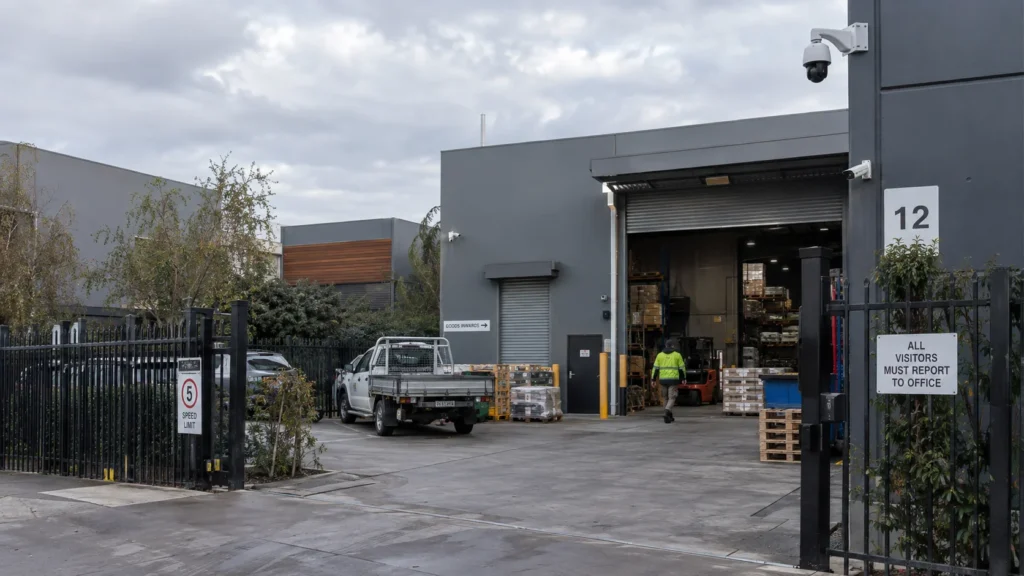
Car park. Frequently where a PTZ’s inspection value shows up — following a vehicle or zooming on an incident — usually alongside fixed cameras on the fixed entry and exit points.
Large open yard. A genuine PTZ-strength scenario, provided the simultaneous-coverage trade-off is accepted and, ideally, paired with fixed coverage of anything that must never be missed.
Perimeter. Often suits fixed cameras for continuous boundary coverage, with PTZ available for investigation once something triggers attention.
Actively monitored site. Where a live operator can make a PTZ’s real-time inspection genuinely valuable, redirecting it as situations develop.
Unattended site. Without an active operator, a PTZ still offers presets, patrols and supported automation, but its movable view does not become simultaneous coverage — the property still needs to decide what has to be watched continuously regardless of whether anyone is actively driving the camera.
Comparing Fixed and PTZ by Decision Factor
When Mixed Fixed + PTZ Genuinely Makes Sense
Fixed cameras preserve continuous views of critical zones; PTZ adds movable inspection where changing direction or zoom has real operational value. A common example is fixed cameras covering entrances, registers or loading points — the areas that can’t afford a gap — combined with one PTZ covering the open space between them, where dynamic inspection is more useful than trying to fix a camera on every possible point of interest.
That said, mixed isn’t automatically the answer. A small site with a handful of clearly defined critical areas may be fully served by fixed cameras alone. A large open site with an active security operator and no single critical fixed point may get more value from PTZ alone. Professional CCTV installation starts with identifying which of these situations actually applies to a property, rather than assuming a mixed system by default.
Choosing the Right Coverage for Your Property
Working through the decision in order helps more than starting from a camera type:
- Identify which areas must remain visible continuously, without gaps.
- Identify which areas would benefit from being inspected dynamically rather than watched constantly.
- Confirm whether an active operator will actually be using the system, since that changes how valuable PTZ’s real-time control is.
- Only then decide between fixed, PTZ, or a mix that matches those specific requirements.
For a fuller picture of what a complete camera system design covers beyond camera type, see what’s included in a CCTV installation.
Getting this right starts with the property’s actual requirements, not a generic recommendation for one camera type over another.
Frequently Asked Questions
Can a PTZ camera replace several fixed cameras?
Not entirely, if those fixed cameras were covering different areas that need to be watched at the same time. A PTZ can reach more area than a single fixed camera, but it can only show one part of that area at once — replacing multiple fixed cameras with one PTZ means accepting that the areas it isn’t currently pointed at aren’t being covered.
Does a PTZ camera record while it’s moving?
Generally yes, most PTZ cameras continue recording during pan, tilt or zoom movement — but the footage during that transition reflects wherever the camera happens to be pointed moment to moment, not a stable view of any one area.
What happens to the area a PTZ camera turns away from?
It isn’t being actively viewed or recorded in detail until the camera returns to that position, whether by preset, patrol sequence or operator command. This is the core trade-off of PTZ coverage, and it’s why critical areas that can’t afford a gap are usually better served by a dedicated fixed camera.
Can fixed and PTZ cameras work in the same CCTV system?
Yes, mixed systems combining both are common and well supported on modern platforms. The two camera types are typically managed through the same recorder and app, so combining them is a design decision about coverage, not a technical limitation.
Sources