
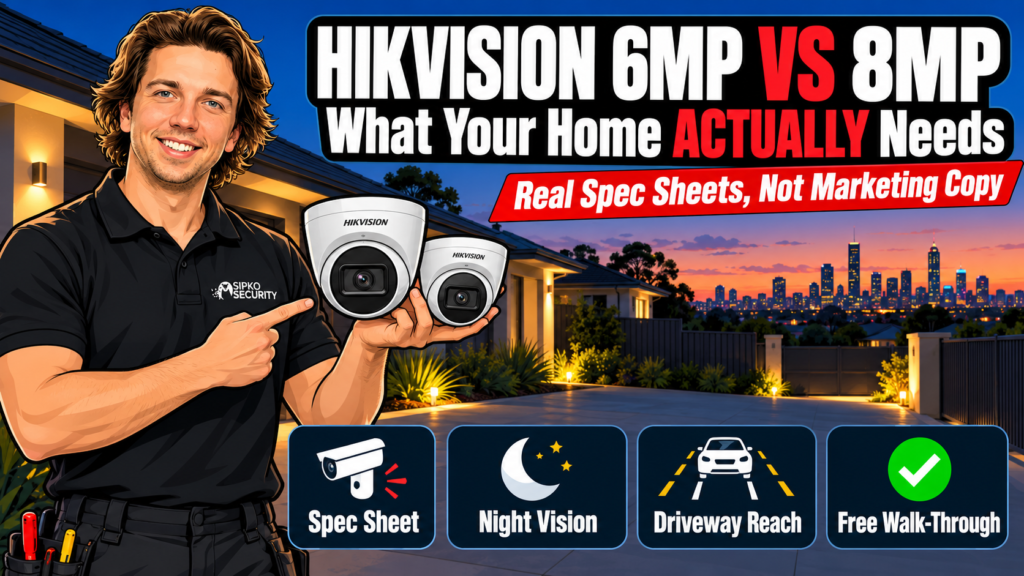
Hikvision 6MP vs 8MP: which do you actually need at home? For most houses, 6MP is already more detail than you’ll ever zoom into at a front door, hallway or laundry. The extra 2MP earns its keep in one place: a long driveway or a wide block where you need to read a number plate at the far end, not just confirm a car drove past. We default to 8MP on most residential jobs anyway, but that’s a standardisation call on our end, not a verdict that 6MP is the lesser camera.
Most “6MP vs 8MP” results online are either old forum threads about cameras Hikvision stopped making years ago, or marketing pages that never say which one an actual homeowner should buy. We pulled the current spec sheets for two cameras from the same Hikvision AcuSense family and lined them up side by side, so you can see exactly what changes for a home install, and just as importantly, what doesn’t.
This is our opinion as a working CCTV installer, based on hands-on home installs and Hikvision’s own published specifications, not an independent lab test. Every home and every block is different. If resolution genuinely matters for your place, we’ll talk it through properly at your free walk-through.
- What "6MP" and "8MP" actually mean on a Hikvision camera
- Hikvision's own spec sheet, side by side
- Does more megapixels mean worse night vision?
- Where the extra 2MP actually shows up at home
- What matters more than resolution for a home camera
- When 6MP is the right call for your home
- When 8MP earns its keep
- Why we still default to 8MP anyway
What “6MP” and “8MP” actually mean on a Hikvision camera
Megapixels just count how many pixels the sensor captures in one frame, nothing more mystical than that. A Hikvision 6MP camera in the current AcuSense range captures 3200 × 1800 pixels, about 5.8 million. An 8MP camera captures 3840 × 2160, the same resolution as a 4K UHD TV, about 8.3 million.
More pixels can mean more fine detail, but only if the lens, the sensor and the lighting at your place can actually back it up. Past a certain point, extra megapixels just mean a bigger video file of the same picture, not a noticeably sharper one. That’s the part the spec sheet on a shop shelf never explains.
Hikvision’s own spec sheet, side by side
Rather than comparing two random models off a retailer’s shelf, we lined up two cameras from Hikvision’s current AcuSense fixed turret range that share the same body style, the same lens options and the same core feature set. The only real difference is resolution and sensor size, which makes this a fair comparison, not an apples-to-oranges one.
| Spec | 6MP AcuSense Turret | 8MP AcuSense Turret |
|---|---|---|
| Model | DS-2CD2366G2-IU | DS-2CD2386G2-IU |
| Image sensor | 1/2.4″ CMOS | 1/1.8″ CMOS |
| Max. resolution | 3200 × 1800 (~5.8MP) | 3840 × 2160 / 4K UHD (~8.3MP) |
| Min. illumination (colour) | 0.003 lux @ F1.6, AGC on | 0.003 lux @ F1.6, AGC on |
| IR range | Up to 30 m | Up to 30 m |
| WDR | 120 dB | 120 dB |
| Lens options | 2.8 / 4 / 6 mm fixed | 2.8 / 4 / 6 mm fixed |
| Weatherproofing | IP67 | IP67 |
Caption: Specs taken from Hikvision’s published datasheets for the DS-2CD2366G2-IU and DS-2CD2386G2-IU, current as of September 2026.
Does more megapixels mean worse night vision?
You’ll often hear that packing more pixels onto a sensor hurts low-light performance, because each individual pixel gathers less light. That’s a real effect when two cameras share the same sensor size, and it’s where most of the “6MP is better at night” forum wisdom comes from.
It doesn’t hold up on this particular pair. Hikvision didn’t just add pixels; they stepped up the sensor too. The 8MP model uses a larger 1/1.8″ sensor against the 6MP model’s 1/2.4″, which is exactly why both are rated at the same 0.003 lux minimum illumination and the same 30 m IR range. Pixel-for-pixel, the 8MP sensor is working with more light-gathering area per pixel than you might expect from the resolution jump alone. We wouldn’t tell a homeowner to buy 8MP purely for better night vision, because on this generation of camera, that’s simply not where the real difference sits.
Where the extra 2MP actually shows up at home
Two places, and neither of them is “sharpness” in the way most people picture it.
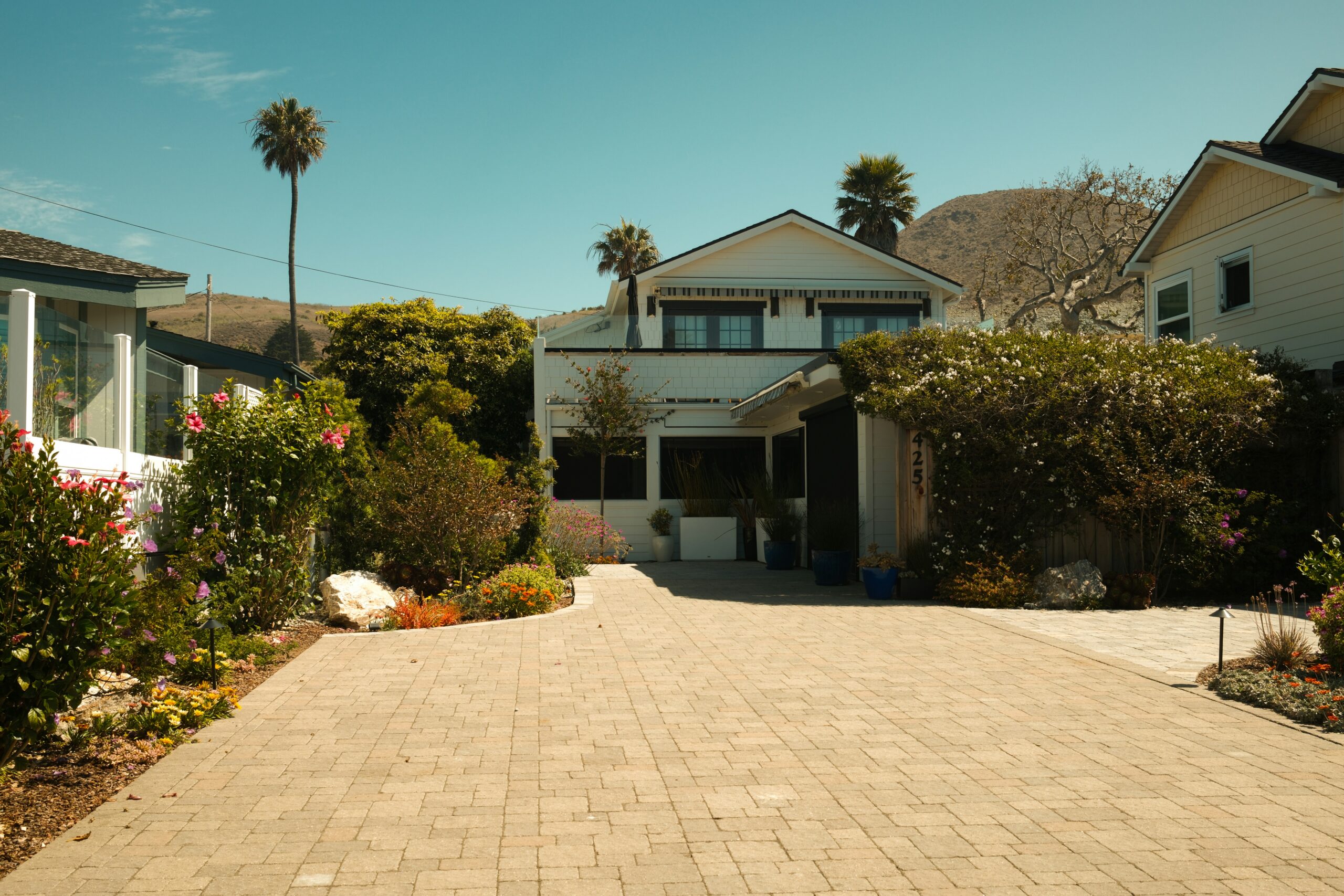
Detail at distance. More pixels spread across the same field of view means more of them land on a face, a number plate or a parcel left at the gate, the further away it is. On the 8MP model, Hikvision’s own figures put recognition distance at roughly 35 m and identification distance at roughly 18 m on a 2.8 mm lens. That’s useful if your camera has to cover a long driveway or a wide front yard. Right next to the lens, on a front door or a hallway, 6MP is already more detail than most people will ever zoom in on.
File size and storage. The 8MP camera captures roughly 44% more pixels per frame than the 6MP one (8.3 million versus 5.8 million). H.265 compression narrows that gap, but it doesn’t erase it. An 8MP system generally needs a bit more storage for the same number of recording days. We size the NVR around whichever resolution you land on; if you want the exact day-by-day storage maths for your setup, our CCTV storage guide walks through it.
What matters more than resolution for a home camera
This is the part that gets skipped in most “vs” articles, and it’s arguably more important than the megapixel decision. Three things affect what you actually see on playback more than 6MP versus 8MP does:
- Lens and field of view. A wide-angle lens spreads the same pixel count over a bigger area, so a wide 2.8 mm lens on an 8MP camera can end up with similar per-metre detail to a narrower 6 mm lens on a 6MP one. The megapixel number on the box doesn’t tell you this; the focal length does.
- Mounting height and angle. A camera mounted under the eaves and aimed too steeply down mostly captures the top of someone’s head. No resolution fixes that; it’s a placement problem, and it’s one we regularly find and correct on takeover jobs at existing homes.
- IR washout at night. A camera mounted too close to a white eave, a security screen door or a reflective surface can bounce its own infrared light straight back into the lens, blowing out anything closer than a few metres. This has nothing to do with sensor resolution and everything to do with where the camera sits.
Get these three right and a 6MP camera can easily out-perform a poorly mounted 8MP one. It’s why we walk every property in person rather than quoting resolution off a floor plan.
When 6MP is the right call for your home
- A front door, porch, hallway or laundry where the camera sits a few metres from what it’s watching
- A unit, townhouse or smaller block where several cameras covering close range matter more than 4K detail on any single one of them
- Good, consistent lighting where you’re not relying on extra resolution to compensate for anything
When 8MP earns its keep
- A long driveway, acreage property or wide front yard, where one camera needs to cover a lot of ground and still hold detail at the far edge
- Gate or letterbox cameras where reading a number plate matters, not just confirming a car arrived
- Larger homes where fewer, higher-resolution cameras genuinely replace what would otherwise take two or three lower-resolution ones
Why we still default to 8MP anyway
Storage is cheaper than it used to be, and most of the homes we quote end up wanting the driveway or front gate covered at some point, even if that’s not the brief on day one. Standardising on 8MP across a job means every camera can do double duty if you ever want to move one, and you’re not caught out six months later wishing the letterbox camera had a bit more reach. If your budget or your NVR’s channel count is tight, though, 6MP on the close-range cameras and 8MP on the one covering the driveway is a perfectly sensible mixed setup, and one we quote often.
If you’re comparing brands as well as resolutions, our Hikvision vs Dahua guide covers how the two makers stack up more broadly, and the same 6MP-vs-8MP logic holds true on the Dahua side of the range too. See our Dahua 6MP vs 8MP breakdown if that’s the brand you’re weighing up. For a wider look at putting a system together for a house, our guide to choosing a home CCTV system is a good next read.
Is 8MP always better than 6MP for a home security camera?
Not always. It’s genuinely better for long-range coverage like a driveway or front gate, but at close range, a front door or hallway, 6MP already gives you more detail than most people will ever use. “Better” depends on what that specific camera is watching.
Will an 8MP camera fill up my NVR faster than a 6MP one?
Yes, by roughly 44% more data per frame before compression. H.265 narrows the gap, but if storage days matter to you, it’s worth sizing the hard drive around whichever resolution you choose rather than assuming they’re interchangeable.
Does 8MP mean better night vision than 6MP?
Not on current Hikvision AcuSense models. The two cameras we compared share the same minimum illumination rating and the same IR range, because the 8MP model uses a larger sensor to offset its extra pixels. Night performance comes down to the sensor and lens, not the megapixel number alone.
Can I mix 6MP and 8MP cameras on the same system?
Yes. It’s common and often sensible: 6MP on close-range cameras like the front door, 8MP on the one covering a driveway or wide yard. Most Hikvision NVRs handle mixed resolutions without issue; we just size the recorder’s bandwidth and storage for the mix you actually choose.
Do I need to pay more for 8MP cameras?
Generally yes, there’s a modest price step up for the higher-resolution model, though the gap has narrowed as 8MP has become more common. We’ll give you exact current pricing for your setup at your free walk-through rather than guessing here, since it depends on the specific cameras and lens options your property needs.
If you’re not sure which resolution makes sense for your place, that’s exactly what the free walk-through is for. Book one with us and we’ll tell you honestly what your home actually needs.

