
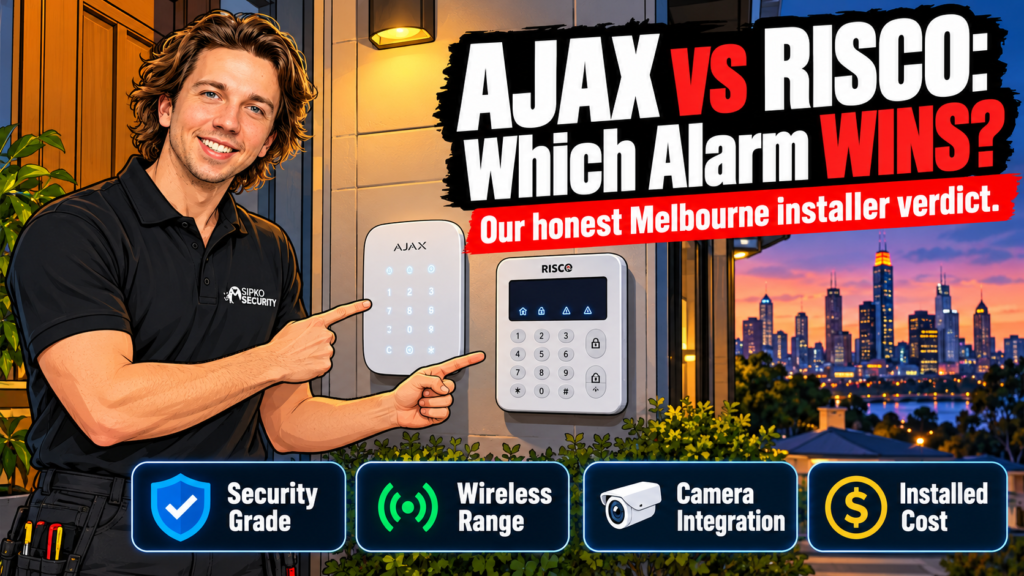
Comparing Ajax vs Risco alarm systems? Short answer: if you want one wireless system that pairs photo-verified alarm sensors with your own cameras and a fast, no-drilling Melbourne install, Ajax is what we’d put in. If you’re fitting out a large commercial site that needs a certified Grade 3 panel running hundreds of wired and wireless zones, Risco’s LightSYS+ is built for that scale. We install Ajax ourselves and don’t currently install Risco, so take the Risco side of this as researched rather than first-hand. Here’s how the two actually compare.
This comparison is SIPKO Security’s own opinion as a working Melbourne alarm installer, based on published specifications and our own installation experience with Ajax. We install and support Ajax systems; we don’t currently install Risco panels, so our read on Risco is researched, not installed. Nothing here is sponsored by either brand, and we’re not here to talk either system down. Both are legitimate, certified security products with a long track record. Specs and pricing below are current as at 2 October 2026 and reviewed quarterly. For a final recommendation on your own property, book a free walk-through rather than relying on a generic comparison.
- Ajax vs Risco at a glance
- What is Ajax?
- What is Risco?
- Security grade and certification
- Wireless range and how many devices you can run
- Photo and video verification
- App, self-monitoring and professional monitoring
- Camera and CCTV integration
- Installation time and property fit
- Who should buy Ajax
- Who should buy Risco
- What we'd install instead for a business
- Ajax vs Risco alarm: frequently asked questions
Ajax vs Risco at a glance
| Factor | Ajax | Risco |
|---|---|---|
| System type | Fully wireless (Jeweller radio) | Wireless (Agility 4) or hybrid wired/wireless (LightSYS+) |
| Security grade | EN 50131 Grade 2 | EN 50131 Grade 2 (Agility 4) or Grade 2/3 (LightSYS+) |
| Device capacity | Up to 100 wireless devices per hub | 32 wireless zones (Agility 4) up to 512 zones total (LightSYS+) |
| Wireless range | Up to 2,000 m open space | Manufacturer range varies by model; not independently published for Australia |
| Photo verification | Yes: MotionCam sensors | Yes: eyeWave camera detectors |
| App and self-monitoring | Ajax app, free self-monitoring | RISCO Cloud app, free self-monitoring |
| Own camera range | Yes: TurretCam and Ajax NVRs | No: pairs with third-party IP cameras and NVRs |
| Best fit | Homes, apartments, shops, small-to-medium business | Large commercial or multi-tenant sites needing Grade 3 and high zone counts |
| Installed by SIPKO | Yes, from $2,880 AUD incl. GST | Not currently part of our installed range |
What is Ajax?
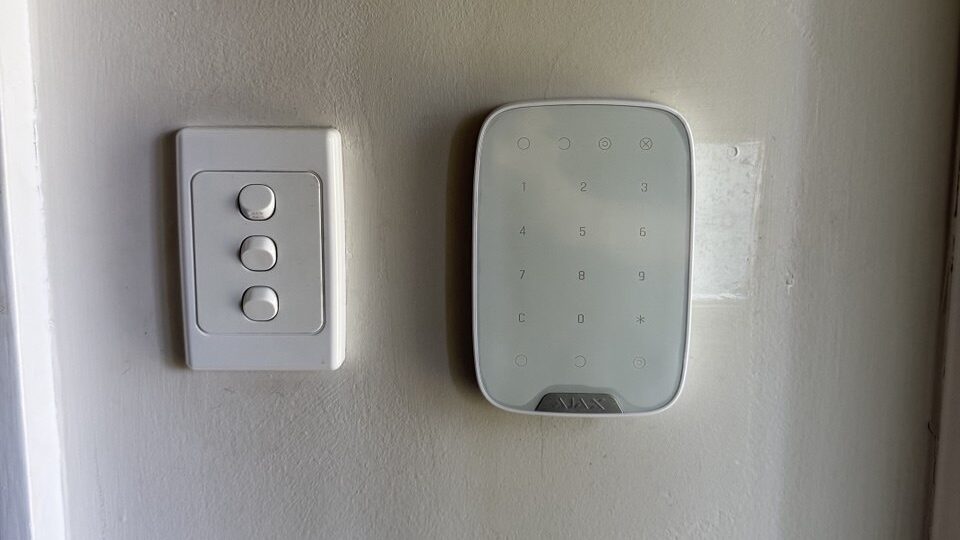
Ajax is a fully wireless alarm ecosystem built around the Ajax Hub 2, which pairs with up to 100 wireless sensors, sirens and keypads over its own Jeweller radio protocol, reaching up to 2,000 metres in open space. It’s certified to EN 50131 Grade 2, supports photo-verified alarm events through its MotionCam sensors, and runs from a single app that also controls Ajax’s own TurretCam cameras and NVRs. That last part matters more than it sounds: most wireless alarm brands make the panel and leave cameras to someone else. Ajax does both under one roof, which is the main reason we standardised on it for Melbourne installs.
What is Risco?
Risco Group is an Israeli security manufacturer with detectors and panels going back to 1978. For a head-to-head with Ajax, two Risco product lines matter. Agility 4 is Risco’s fully wireless panel: EN 50131 Grade 2, up to 32 wireless zones, with eyeWave camera detectors for photo verification and a RISCO Cloud app for self-monitoring. LightSYS+ is Risco’s flagship hybrid panel, combining wired and wireless inputs on one board, certified to Grade 2 or Grade 3 depending on how it’s installed, and scaling up to 512 zones. Risco is distributed in Australia through licensed security wholesalers and installed by RISCO-authorised integrators; SIPKO isn’t currently one of them, which we’ll come back to.
Security grade and certification
Both brands cover the ground most Melbourne properties actually need. Ajax’s Hub 2 and Risco’s Agility 4 are both certified to EN 50131 Grade 2: the standard tier for homes, apartments, shops and most small-to-medium business sites, and the level most insurers ask for. Risco’s LightSYS+ goes a step further with an optional Grade 3 certification, built for sites with a genuinely higher security classification: large commercial premises, cash-handling businesses, or sites where an insurer or security consultant specifies it in writing.
Winner: a tie for most homes and shops. Risco only pulls ahead if your property specifically needs a certified Grade 3 panel.
Wireless range and how many devices you can run
Ajax’s Hub 2 supports up to 100 wireless devices on a single hub with a published Jeweller range of up to 2,000 metres in open space, more than enough for most houses, double-storey homes and small commercial fit-outs without adding any extra hardware. Risco’s Agility 4 tops out at 32 wireless zones before you need an expander. Where Risco pulls ahead is scale. LightSYS+ can run up to 512 zones across wired and wireless inputs combined, which suits a different category of job: multi-tenant buildings, warehouses with hundreds of sensor points, or sites being upgraded in stages over several years.
Winner: Ajax for a single wireless hub that needs more than 32 devices without going hybrid. Risco’s LightSYS+ wins once a site genuinely needs hundreds of zones in one panel.
Photo and video verification
Both systems solve the same problem the same way. Ajax’s MotionCam sensors and Risco’s eyeWave camera detectors are both wireless PIR sensors with a built-in camera that captures a short image sequence the moment an alarm triggers, so a monitoring operator (or you, from the app) can see what actually set it off before responding. Functionally, it’s a tie; the difference comes down to which ecosystem the rest of your sensors and cameras sit in.
App, self-monitoring and professional monitoring
Both the Ajax app and the RISCO Cloud app let you arm, disarm, check zone status and review alarm history yourself, at no ongoing cost. Where SIPKO can speak with certainty is our own side: Ajax alarms we install can be connected to professional, ASIAL-certified monitoring from $49 a month incl. GST, no lock-in contract, where a real monitoring operator responds to every alarm event. We can’t quote Risco’s Australian monitoring pricing with the same confidence, since it isn’t a system we install or monitor ourselves. Ask your Risco installer for their current rates before you compare the two on cost.
Camera and CCTV integration
This is the practical difference most Melbourne buyers care about once they get past specs. Ajax makes its own camera range (TurretCam models and compatible NVRs), so alarm sensors and security cameras sit in the same app, the same account, and the same install. Risco is primarily an alarm and detector company; its panels integrate with third-party IP cameras and NVRs (Dahua, Hikvision and others support RISCO integrations) rather than a camera line of its own. Neither approach is wrong. A hybrid wired commercial site often already has a camera system the installer wants to connect into, which is exactly where Risco’s third-party integration is designed to fit. But if the goal is cameras and alarm under one native ecosystem with minimal moving parts, that’s closer to how Ajax is built.
Installation time and property fit
Ajax is fully wireless end to end, which means no cabling and no walls drilled, so most residential Ajax installs run in a single visit. Risco’s Agility 4 is also wireless and installs in a similar timeframe for a comparable-sized property. LightSYS+ is a different scope of job: because it’s a hybrid panel designed to use wired zones where cabling already exists, a LightSYS+ fit-out on a larger commercial site typically involves more planning, more on-site time and, often, an existing cabled infrastructure to work with or around.
Who should buy Ajax
- Homeowners, renters and apartment owners who don’t want cabling or drilled walls
- Small-to-medium Melbourne businesses (shops, offices, clinics) wanting alarm and cameras in one app
- Anyone replacing an older panel (Bosch, Ness, Hills) who wants app-based control from day one
- Properties where a Grade 2 certified system is sufficient, which covers the large majority of residential and light-commercial sites
Who should buy Risco
- Large commercial, industrial or multi-tenant sites that need a certified Grade 3 panel
- Sites planning to scale past 100 zones, or that already have wired infrastructure LightSYS+ can use
- Properties where an existing RISCO-authorised installer relationship or site standard already specifies the brand
What we’d install instead for a business
For almost every Melbourne home or small-to-medium business we quote, Ajax is still what we’d recommend installing: it’s the system we know best, support directly, and can back with our own monitoring and callout service. If a commercial property genuinely needs a Grade 3, multi-hundred-zone hybrid panel, that’s a job better scoped by a RISCO-authorised integrator, and we’d say so plainly rather than stretch Ajax past where it fits. Where we can help either way is on the camera and site-assessment side: see our Ajax alarm cost guide for Melbourne for the factors that drive pricing, or our Ajax security systems hub for Melbourne for what a typical Ajax fit-out includes. If Ajax vs Ness is more your comparison, we’ve covered that one too.
Ajax vs Risco alarm: frequently asked questions
Is Risco or Ajax the better alarm system?
Neither is universally “better”: they’re built for different jobs. Ajax is a fully wireless system built around its own app and camera range, which suits most homes and small-to-medium businesses. Risco’s strength is scale and certification: Agility 4 competes directly with Ajax on a wireless residential job, while LightSYS+ is built for large commercial sites needing Grade 3 and hundreds of zones.
Does Ajax need a monthly monitoring subscription?
No. Self-monitoring through the Ajax app is free. Professional, ASIAL-certified monitoring is optional, starts from $49 a month incl. GST with no lock-in contract, and is worth adding if you want a real operator responding to every alarm event rather than relying on app notifications alone.
Can both Ajax and Risco alarms be professionally monitored in Australia?
Yes. Both brands’ panels can be connected to a professional monitoring centre through the installer who fits them. For Ajax systems we install, that’s our own $49-a-month (incl. GST) monitoring; for Risco, your RISCO-authorised installer will quote their monitoring arrangement separately.
Does SIPKO Security install Risco alarms?
No, we specialise in Ajax. We can still give you an honest comparison and point you toward what to ask a Risco installer, but for a Risco-specific quote you’d need a RISCO-authorised integrator.
Which system integrates better with CCTV cameras?
Ajax pairs with its own TurretCam range and compatible NVRs under one app, so alarm and cameras sit in the same ecosystem from installation onward. Risco integrates with third-party IP cameras and NVR brands, which works well on a site that already has a camera system the installer wants to connect into, but it isn’t a native, single-app setup the way Ajax’s is.
Want cameras and alarm under one Ajax system, properly quoted for your Melbourne property? Request a free site walk-through and we’ll tell you honestly whether Ajax is the right fit before we quote anything.

