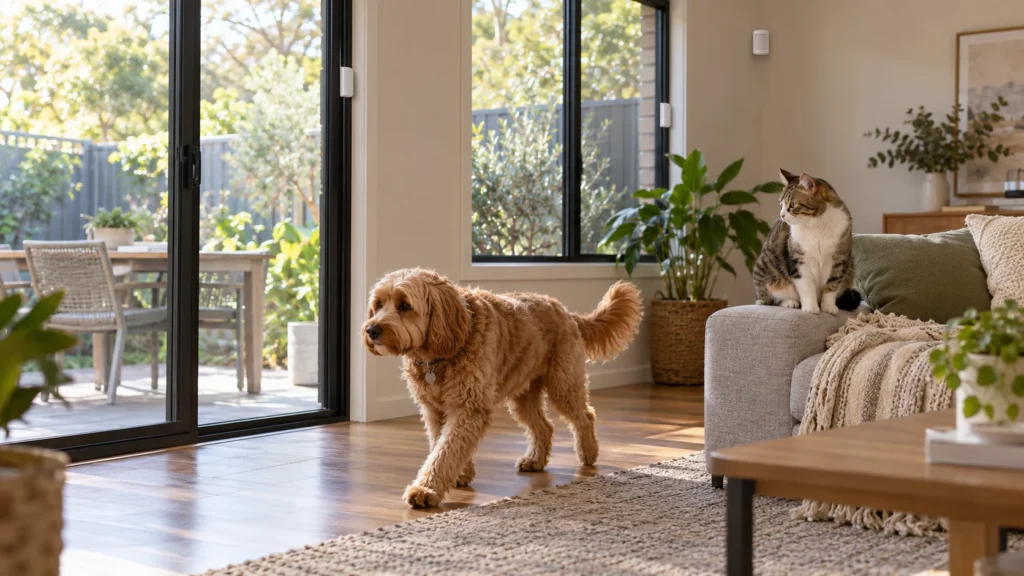
A cat crossing the lounge at 2 am, a dog wandering down the hallway and someone opening a back window are three very different events. An alarm system doesn’t have to detect all of them in the same way.
That gets lost when most advice for pet owners comes down to buying a “pet-immune” motion detector. Motion detection can have documented pet immunity, under specific conditions. But a door opening, glass breaking or someone passing through a narrow entry point can each be picked up by other mechanisms that aren’t watching for movement across the whole room.
So the starting point is deciding what the system actually needs to detect in each part of the home. The aim is fewer avoidable pet-related alarms, not a promise that a pet can never set the system off.
A Pet-Friendly Alarm Is More Than a Pet-Immune Motion Detector
A room-wide motion detector answers one question: is something moving here? In a home where a dog or cat can move around while the system is armed, ordinary pet movement becomes part of that detection problem.
Each row is watching for something different. Only the first is built around general movement across a room — the same kind of ordinary movement a pet may make while the system is armed.
So the useful question isn’t simply “which detector will ignore my pet?” It’s “what event needs to be detected here?” Sometimes the answer is still movement. Often it’s something more specific.
Pet Immunity Depends on Setting and Position, Not Just Weight
When movement is the event that matters, pet immunity comes into play, and it’s more conditional than a single figure on the box suggests.
Ajax’s MotionProtect is a useful documented example. Ajax states that, when installed and configured correctly, it doesn’t react to animals up to 50 cm tall and weighing up to 20 kg. In Ajax’s own explanation, what matters is the size of the animal’s heat spot in the infrared spectrum; the maximum weight is described as an “understandable orienting point”. The detector is meant to be mounted at 2.4 m with nothing obstructing its view.
Sensitivity then changes the documented condition. On High, MotionProtect doesn’t react to cats up to 25 cm tall. On Medium, it doesn’t react to small dogs up to 35 cm, and on Low, to animals up to 50 cm. That scale is tied to the animal’s height, not to a particular kind of pet.
Position is the part no weight figure can capture. Ajax warns that the detector will raise an alarm if an animal can jump to its level or move near it, and gives the example of a cat that has climbed onto a cupboard close to the detector. A light cat on top of a bookcase is in a different position from the same cat on the floor, and no sensitivity setting changes that.
What matters besides weight:
- the exact detector model and what its manual documents;
- mounting height;
- where the detector is positioned and what it can see;
- the sensitivity setting;
- furniture and other surfaces the animal can reach within the detector’s view.
Doors and Windows Give You Another Kind of Trigger
Doors and windows can be watched directly. Ajax’s DoorProtect is one example of an opening detector. The detector sits on the frame and a magnet goes on the moving door or window. While the magnet is close, a reed relay inside the detector holds a closed circuit. When the door or window opens, the magnet moves away, the circuit opens and the detector registers the opening.
A pet walking across the room is not the event an opening detector is looking for. Its trigger is the protected door or window being opened. That doesn’t make it “pet-proof”. It means the detector is answering a narrower question.
That distinction is useful when the security event is specific:
- a back door being opened;
- a window being opened while the house is armed;
- an opening in a pet-accessible room where ordinary movement is expected.
In each case, the system can watch the opening itself rather than treating every movement through the room as the event of interest.
Glass Break Is a Different Event Again
An opening detector reports that a window has opened. A pane broken while the window stays shut doesn’t move the magnet, so that’s a different event, and it needs a different mechanism.
Ajax’s GlassProtect uses a microphone. Ajax describes the sound of breaking glass as a low-frequency hit followed by the high-frequency crash of shattering glass, and the detector listens for that sequence. It isn’t assessing what’s moving around the room.
This mechanism has limits of its own. Ajax states that GlassProtect doesn’t react to the breaking of film-covered glass, including shockproof, sunscreen and decorative film. That’s worth checking before relying on it for filmed windows.
Opening detection answers whether the window opened. Glass-break detection answers a different question: whether the protected glass produced the sound pattern associated with breaking.
A Narrow Detection Zone Can Change the Problem
Sometimes movement is the right trigger, but not movement anywhere in the room. It might only matter along a window line, through a doorway or down a passage. That’s the job of a curtain detector, which watches a narrow zone rather than a wide area.
MotionProtect Curtain: Control the Zone, Not the Whole Room
Ajax designed MotionProtect Curtain for indoor perimeter control: windows, doorways and other entrances or exits. Pet immunity isn’t stated as one of its features. Instead, the manual describes installing the detector upside down, leaving space below the detection zone for animals to move freely. That’s an installation arrangement that changes where the zone sits, not a stated pet-immunity function.
DualCurtain Outdoor Is a Different Device
DualCurtain Outdoor is an outdoor detector with two opposite narrow detection zones. Ajax states that, when set up and installed correctly, it ignores pets up to 80 cm tall, and that respecting its installation height is necessary for pet immunity to work. Its Near Area detection mode, however, significantly reduces the efficacy of pet immunity close to the detector, and Ajax says that mode is intended for windows and passages animals can’t reach.
The important difference is:
- MotionProtect Curtain: no stated pet-immunity feature; the manual documents an installation arrangement that changes where the detection zone sits.
- DualCurtain Outdoor: documented pet immunity under specific installation conditions, with an important limitation when Near Area is used.
So “curtain detector” on its own tells you very little about how a particular model behaves around animals.
Build the Alarm Around How the Home Is Actually Used
A real system can combine these approaches according to how the home is used. A pet-accessible living area, protected openings, particular glazing and a narrow side entry may each present a different detection problem. Motion detection can still make sense where movement itself is the event that matters.
What the installer needs to know:
- where the pet can go while the system is armed;
- how high it can realistically climb or jump;
- which furniture or surfaces it can reach;
- which doors, windows and other openings matter most;
- whether indoor and outdoor areas raise different detection problems.
Ordinary activity that isn’t an intrusion can vary from one part of a property to another. SIPKO applies the same zone-by-zone principle to alarm installation in Hampton, where busier boundaries affected by neighbouring activity may need to be treated differently from quieter ones.
If Your Pet Is Already Setting the Alarm Off
Everything above is about planning. If a system is already installed and your cat or dog keeps triggering it, the question changes. It becomes a matter of which detector is raising the event, where it’s mounted, how it’s configured and what the animal is doing when it happens. That’s diagnosis rather than design, and it’s covered in our guide to troubleshooting false alarms on an existing Ajax system.
Start With the Event, Then Choose the Detector
A pet-friendly alarm isn’t defined by one weight figure on a motion detector’s box. The better starting point is the home itself: where the pet moves, which openings matter and which events actually need a response. From there, the right detection method can be chosen for each part of the property.
If you’re planning a residential alarm system for a home with a cat or dog, that’s the conversation to have before any detector goes on the wall.
Frequently Asked Questions
Can my cat still trigger a pet-immune motion detector?
Yes. Documented pet immunity depends on the detector model, its configuration and where it’s mounted. For MotionProtect, Ajax notes the detector will raise an alarm if an animal can jump to its level or move near it.
Should I set an Ajax motion detector to Low sensitivity if I have a cat?
Not automatically. For MotionProtect, Ajax documents High as not reacting to cats up to 25 cm tall, Medium to small dogs up to 35 cm and Low to animals up to 50 cm. None of those settings covers a cat that reaches the detector’s level by climbing or jumping. That’s a question of position.
Are door and window sensors better than motion detectors for homes with pets?
They detect a different event rather than being better or worse. An opening detector reports that a specific door or window has opened; a motion detector reports movement within its detection area. Which fits depends on what needs detecting in that part of the home.
Are curtain motion detectors pet immune?
It depends on the model. Ajax doesn’t state pet immunity as a feature of MotionProtect Curtain; its manual describes an upside-down installation that leaves space for animals below the detection zone. DualCurtain Outdoor has documented pet immunity when set up and installed correctly, but its Near Area mode significantly reduces that immunity close to the detector.
Sources