
For an Ajax vs Hikvision comparison, start with the job your security system must do. Ajax deserves an early look when cameras, intrusion detection, staff or family access and alarm verification need to work together. Hikvision is a natural starting point when the brief centres on extensive CCTV coverage, specialist cameras, substantial recording or a larger video-management system.
Those are starting recommendations, not brand rankings. Ajax now has its own cameras, recorders and desktop video tools. Hikvision also offers alarms, intercoms and access control. For a Melbourne home, shop or warehouse, the useful comparison is the proposed system and daily workflow.
Research checked September 2026 against manufacturer documentation and Australian product listings. This is a project-planning comparison, not a controlled camera performance test. Confirm exact models, firmware, local supply and supported functions before ordering.
What SIPKO installs, and why that matters
SIPKO offers Ajax CCTV installation with cameras, NVR recording, app setup and handover, alongside Ajax alarm installation and takeover. Its Hikvision installation catalogue covers cameras and recorders; separate services include repairs and AX PRO alarms. Both appear across residential and business work.
The design question is therefore practical: which combination delivers the required coverage, alarm response and administration without unnecessary complexity?
Which system fits your project?
- Consider Ajax first: intrusion protection, monitoring, user permissions and linked verification drive the project, with CCTV planned around those needs.
- Consider Hikvision first: camera selection, recording capacity, specialist views or central video operations dominate the brief.
- Compare both carefully: you need substantial CCTV and strong intrusion protection. A mixed design is worthwhile only when retaining equipment or meeting a specific requirement justifies separate administration.
Ajax vs Hikvision CCTV: practical comparison
Features below apply to suitable products and configurations, not every device carrying the brand name.
The architectural differences behind the table
Ajax: cameras within a wider security workflow
Ajax brings intrusion devices and video into a shared app environment. Wireless Jeweller devices can help with retrofits; wired Fibra options serve suitable projects. That does not make a wired Ajax CCTV installation cable-free: Ethernet cameras still need network connectivity and power.
The current BulletCam manual documents continuous recording, local storage options and human, vehicle and pet recognition. HL and VF naming identifies hybrid illumination and variable focal length. Australian listings include these newer families, but listing a product does not establish stock or delivery time.
The standard Ajax NVR has 8- and 16-channel versions. NVR H adds HDMI local viewing; the wider global H family includes higher-capacity variants. Specify the actual recorder rather than assuming all Ajax NVRs share channel counts, PoE ports or storage arrangements.
Desktop video walls also mean Ajax is not restricted to phone viewing. However, a desktop display’s camera capacity is different from one recorder’s channel or bandwidth limit.
Hikvision: more choices for demanding video briefs
Hikvision’s camera range spans ordinary home coverage through PTZ, panoramic and specialist applications. That breadth helps when a warehouse needs different views for a loading dock, long aisle and yard. It does not establish better image quality for every quoted camera.
Recording choices extend to multi-drive units such as the DS-9664NI-M8, with 64 channels and supported RAID arrangements. HikCentral Professional adds central management and security modules; licences, server sizing and compatible devices belong in the specification.
Hikvision’s Hik-Connect ecosystem also includes compatible alarm and intercom equipment. Selected Live Guard cameras provide audible warnings and lights. Newer AcuSeek recorder families offer text-based video search, but that is not a standard feature of every Hikvision NVR.
Seven property scenarios: where to start
1. Existing Melbourne home
Start with Ajax when the household wants a new alarm, cameras, phone notifications and verification with limited disruption. Wireless intrusion devices can reduce alarm cabling, while cameras cover entry points. Check radio coverage, camera cable routes, family permissions and night-time identification. Existing serviceable Hikvision equipment may make retaining that CCTV and upgrading only the alarm more sensible.
2. New home CCTV project
Start with Hikvision for a CCTV-led brief: compare lenses and lighting options for the driveway, entry and side access, then size the recorder. Install network cabling while access is straightforward. If an Ajax alarm is already specified and its cameras satisfy those views, compare an all-Ajax option. Verify recorded detail, PoE capacity and room for expansion rather than choosing by megapixels alone.
3. Small shop or office
Start with Ajax when staff arming, panic, after-hours alerts and incident verification matter as much as footage. Plan separate staff access and camera permissions, with views of entrances and stockrooms. Check panic escalation, hub compatibility and recording retention. A CCTV-focused shop with an adequate existing alarm may instead benefit from Hikvision cameras and recording without replacing the alarm.
4. Warehouse
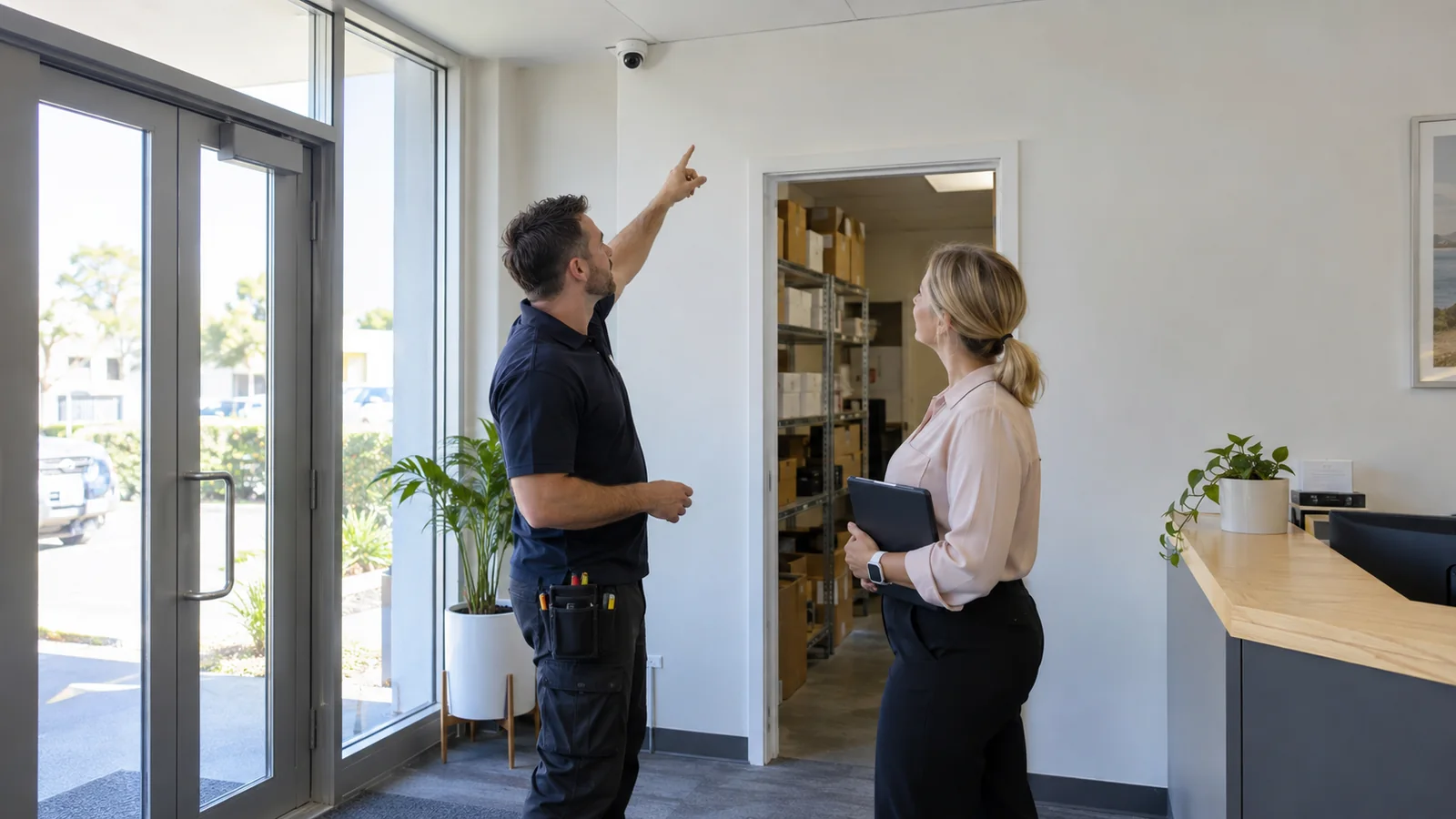
Start with Hikvision where multiple docks, aisles and perimeter views create a demanding video brief. Lens selection, lighting, bandwidth and usable retention matter more than a uniform camera package. An intrusion-led warehouse with modest video needs can suit Ajax. A mixed system is justified when existing CCTV is worth retaining or a separate alarm requirement demands it. For warehouse security planning, verify dock identification, detection zones, staff response and the exact verification path.
5. Large camera-heavy commercial property
Start with Hikvision and a documented VMS design when many cameras, central operators, specialist coverage and substantial storage are essential. Its recorder and management options provide a broad starting catalogue. Check server and network capacity, licences, operator rights, redundancy and incident export. Ajax desktop tools merit consideration where they satisfy the operational brief; a video wall alone does not establish equivalent enterprise functionality.

6. Intrusion-first commercial property
Start with Ajax when doors, windows, panic, staff permissions and monitored alarms define success. Add cameras to verify meaningful alarm zones. Check detector suitability, hub/device limits, communications backup and the monitoring centre’s supported workflow. Where access control or an existing Hikvision platform drives operations, compare the complete Hikvision proposal before committing.
7. Existing CCTV replacement or takeover
Start with an equipment audit, not a new brand. Record camera models, passwords/ownership, cable condition, PoE load, recorder health and remaining storage life. Retaining serviceable Hikvision infrastructure may minimise replacement work. Ajax NVR can be considered for compatible third-party IP cameras where its workflow is useful. Test recording, audio, events and export before promising migration; analogue coax cameras do not become ONVIF IP cameras through configuration.
Strengths and checks before choosing
Ajax
Particularly strong when: people need a coherent alarm-and-video routine, with verification and controlled access central to the design.
Things to check: exact camera coverage, recorder generation, local supply, permissions and monitoring compatibility. Wireless alarm flexibility does not remove CCTV infrastructure costs.
Hikvision
Particularly strong when: diverse views, recording depth and central video operations need a broad hardware/software selection.
Things to check: model suffixes, analytics combinations, regional firmware, licences and administration. A large catalogue makes accurate specification more important.
Image quality, storage and everyday ownership
Compare recorded footage from the proposed models at the required distance, including a moving person at night and a backlit doorway. Sensor, lens, lighting, mounting, exposure, bitrate and firmware all affect usable detail. Colour night footage or a higher megapixel count alone does not prove better identification.
Size retention from camera count, bitrate, recording schedule and usable drive capacity. Allow growth and demonstrate playback and export at handover. RAID on a supported recorder can address some drive failures; it is not an independent evidence backup.
For either platform, agree who owns accounts, removes departing users, applies updates and checks recording health. Ajax provides per-camera video permissions; HikCentral uses configured roles and permissions. Give staff only the access their job needs, rather than sharing an administrator login.
Compare complete installed scopes: cameras, alarm devices, NVR, drives, cabling, networking, labour, monitoring, licences, integration and commissioning. There is no defensible blanket price winner without equivalent Australian quotes.
Integration and monitoring: define the promised result
Native features are manufacturer-supported workflows within a compatible ecosystem. ONVIF/RTSP can make a third-party video connection possible; they do not automatically carry every analytic, alarm, audio or control function.
Ajax video scenarios associate recordings with selected detector alarms. That event association differs from direct integration between an Ajax hub and a Hikvision recorder. Installing both brands side-by-side is another arrangement entirely. Supported VMS interfaces are a separate layer, with their own firmware and feature checks.
Professional monitoring also needs an agreed service. SIPKO’s Ajax monitoring and verification service distinguishes its installation role from operator monitoring supplied through IMS. Confirm accepted events, camera permissions, escalation contacts and response arrangements. MotionCam photo verification supplies detector photos; it is different from continuous CCTV video. An app notification alone is not a monitored response.
For automation, specify the trigger and result: for example, a compatible relay operating lights after an alarm. Ajax documents automation scenarios, while Hikvision offers supported alarm and active-deterrence workflows. Neither description guarantees compatibility with an existing gate, lock or lighting circuit; confirm the interface and safe operation.
What should you ask your installer?
- Is the priority intrusion detection, video evidence or both?
- Which views need identification, at what distance and lighting?
- How many cameras now, and what expansion is allowed?
- What retention will the actual recording settings deliver?
- Are monitoring and active deterrence required, and who responds?
- Can existing cabling, PoE equipment and cameras be retained?
- Who needs app, archive, export and administrator access?
- Does the project need VMS licences or specialist integrations?
- Which compatibility functions will be demonstrated at handover?
- What remains operational during internet or power failure?
FAQ
Is Ajax better than Hikvision for CCTV?
For a home needing an alarm and CCTV, Ajax is worth comparing when its cameras meet the brief. For a warehouse or larger commercial site focused on specialist camera views and recording, start with Hikvision. Compare the specified systems, not the logos.
Does Ajax have its own cameras and NVRs?
Yes. Ajax offers cameras and network recorders, including NVR H models with HDMI. Supported cameras can record continuously. Confirm storage, channel limits and Australian availability for the exact equipment quoted.
Can Hikvision cameras work with Ajax?
Compatible IP cameras may connect to an Ajax NVR through ONVIF or RTSP. Test the exact model and required functions. A working stream does not prove native alarm integration or full analytics support.
Which system suits professional alarm monitoring?
Ajax is a sensible starting point for an intrusion-and-verification brief. Hikvision alarm options also deserve assessment. The deciding checks are monitoring-provider support, communications, permissions and the agreed response workflow.
Will the cameras still work if the internet fails?
Local recording can continue with functioning power, local networking and storage, while cloud remote viewing or notifications may be unavailable. Ajax NVR H supports offline HDMI viewing with a configured local user account. Test outage behaviour separately from alarm cellular backup; backup alarm signalling is not automatically backup video connectivity.
Build the proposal around your property
Ask SIPKO to assess camera coverage, alarm requirements, existing cabling, recording retention, monitoring, network capacity and how the property is used. A CCTV and security assessment in Melbourne can turn those requirements into a model-by-model proposal, with a clear explanation of why Ajax, Hikvision or a carefully defined combination fits.