
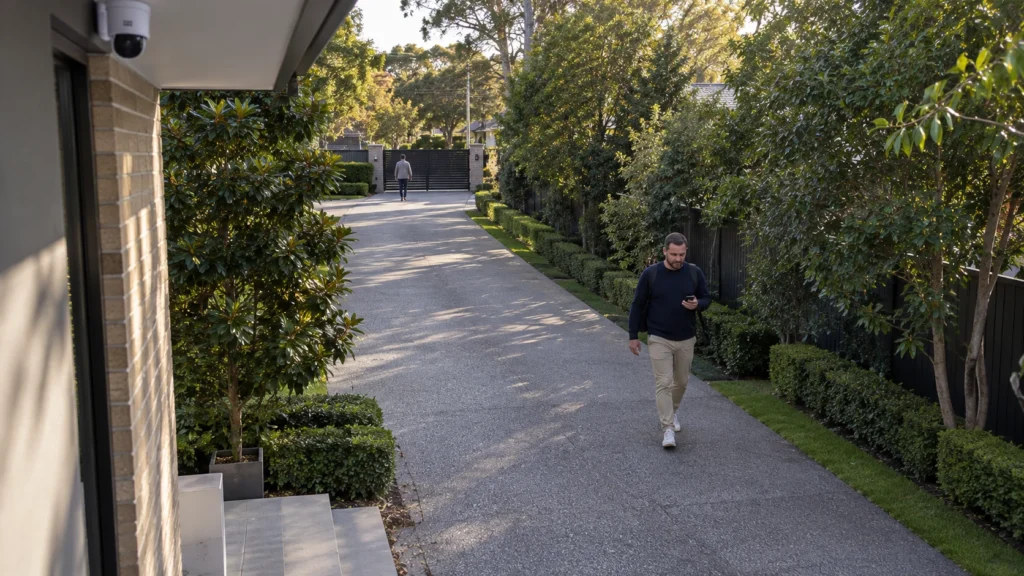
The footage shows someone walking up the driveway. You can see them the whole way — from the moment they pass the front gate to the moment they reach the door. But when you actually need to identify who it was, only part of that recording turns out to be useful. The same camera, the same continuous clip, and yet the answer to “who is this?” only becomes possible at one particular point.
Seeing activity and identifying a person are different surveillance tasks. A camera can do the first across an entire long driveway while only being capable of the second somewhere much narrower along it.
A Long Driveway Is Not One CCTV Task
A camera watching a long approach is often asked to do several different jobs at once, without anyone naming them separately:
- detect that somebody has entered the approach;
- observe what they’re doing as they move through it;
- recognise whether they’re someone seen before;
- provide enough detail for identification.
These are different surveillance objectives, not interchangeable descriptions of “good footage.” A camera that does the first well doesn’t automatically do the last well, even in the same recording, even of the same person.
Detection, Observation, Recognition and Identification Are Different
The IEC 62676-4:2014 framework distinguishes four operational requirements for visual surveillance: Detection, Observation, Recognition and Identification, commonly referred to as DORI. Axis Communications continues to document this framework as a practical pixel-density model for surveillance planning:
In plain terms: detection means you can tell someone is there. Observation means you can make out what they’re doing and characteristic details like clothing. Recognition means you can tell whether this is someone you’ve seen before. Identification means there’s enough detail to identify the individual — Axis’s guideline for this is roughly 40 pixels across an average human face.
These figures are planning guidelines rather than guarantees. Pixel density is one requirement; lighting, optics, image compression and other conditions can also affect whether the required level of detail is achieved in practice.
A camera capable of detecting someone at the far end of a driveway therefore does not automatically provide identification-level imagery at that same point.
Why the Same Person Can Move from Detected to Identifiable
In a typical fixed view, as a person moves closer and occupies more of the image, more pixels can represent their face and features. That can increase the available pixel density and change which surveillance task the footage can support.
Picture it as a rough progression through a single continuous shot:
Far end of the approach → detection opportunity — presence can be confirmed, little else.
Moving through the scene → observation or recognition opportunity — activity and characteristic detail become visible.
Where sufficient usable detail becomes available → identification opportunity — enough detail exists to identify the person.
This is a conceptual progression, not a universal map of where these points occur on every driveway. Where exactly each threshold is crossed depends entirely on the specific camera, lens, distance and scene — it’s illustrative of the mechanism, not a distance chart to apply to your own property.
Why “How Far Can This Camera Identify Someone?” Has No Universal Answer
This is a reasonable question to ask, and it doesn’t have a single-number answer, because achievable pixel density at any given point depends on several things at once:
- image resolution;
- field of view;
- lens and optics;
- distance to the subject;
- the resulting pixel density at that distance;
- lighting and image conditions at the time.
A wider field of view spreads the same resolution across more of the scene, which is useful for covering a whole driveway but reduces the detail available on any one subject within it. A tighter view concentrates that same resolution onto a smaller area, at the cost of overall context. Neither is simply “better” — they serve different objectives.
Identification is not defined by a universal distance. What matters is whether enough usable image detail exists at the point where identification is actually required — not how many metres separate the camera from the subject in the abstract.
Where Should Identification Actually Happen on a Long Driveway?
This is the design question worth asking, and it doesn’t have one universal answer either: where along the normal approach is identification actually required?
Depending on the property, that point might be:
- a controlled entrance or gate;
- a narrower part of the approach;
- a point where visitors naturally pass closer to the camera;
- an arrival area nearer the residence.
These are examples of where identification opportunity can occur, not a recommendation that any one of them is automatically the right choice. A gate might be an excellent identification point on one property and a poor one on another, depending on the angle available, the lighting at that spot, and how people and vehicles actually move through it. The point where identification is needed has to be established for the specific site, not assumed from a generic list.
On larger residential sites, the same site-specific planning is relevant to security camera installation in Toorak, where gates, setbacks and established landscaping can change where useful identification detail is actually achievable.
An Overview View and an Identification View May Be Doing Different Jobs
Once detection, observation, recognition and identification are treated as separate tasks, a practical pattern emerges: a wide overview and a tighter identification view often serve genuinely different purposes.
This does not mean every long driveway needs two cameras. Depending on the site’s geometry and what’s actually required, overview and identification needs may be met by different views, by one carefully positioned view, or by another design entirely. The right answer follows from the surveillance objectives, not from a default camera count.
Identification Needs to Be Checked in Day and Night Conditions
Victoria Police’s guidance on CCTV installation specifically advises considering image quality during the day and at night, noting that images need to be clear for offenders to be identified. A driveway camera that meets an identification-level guideline in daylight doesn’t automatically deliver the same result after dark — available light changes, and motion or other scene conditions can affect usable detail.
This isn’t the place to get into IR settings, shutter speeds or exposure recipes — those are installation-level decisions for a specific camera and site. The point worth taking away is simpler: daytime performance and night-time performance are two separate things to check, not one result that can be assumed to carry over from the other.
Person Identification and Number-Plate Capture Are Different Tasks
Seeing enough facial or personal detail to identify someone and capturing a readable vehicle number plate are separate surveillance objectives, with different requirements. The DORI pixel-density thresholds above are built around identifying a person’s face — they don’t transfer directly to plate legibility, which depends on its own set of factors: plate size in the image, viewing angle, vehicle motion, and exposure under night conditions.
If reliable plate capture matters for a driveway, it’s worth treating as its own design problem alongside person identification, rather than assuming one camera view naturally does both — that’s a question of capturing a number plate at night in its own right, with its own distance, angle and exposure considerations separate from person identification.
Design the Driveway Around the Required Result
Before deciding on camera count or position, it helps to work through what the system actually needs to achieve:
- What only needs to be detected?
- What needs to be observed?
- Where would recognition genuinely be useful?
- Where is identification actually required?
- Is sufficient detail available at that point?
- Does that hold true at night as well as during the day?
- Is number-plate capture a separate requirement here?
- Does landscaping or property geometry change what’s actually achievable?
Define the surveillance objective first; camera count and placement follow from that, not the other way around. If identification-level detail matters somewhere along a long driveway, that’s worth planning for specifically rather than assuming a general camera will deliver it as a side effect.
SIPKO can assess these objectives as part of professional security camera installation, working out where detection, recognition and identification actually need to happen on a given property before equipment is selected.
Sources
-
Axis Communications.
Pixel density based on IEC 62676-4:2014. Updated April 2026. -
Victoria Police.
CCTV installation. Updated 17 April 2025.