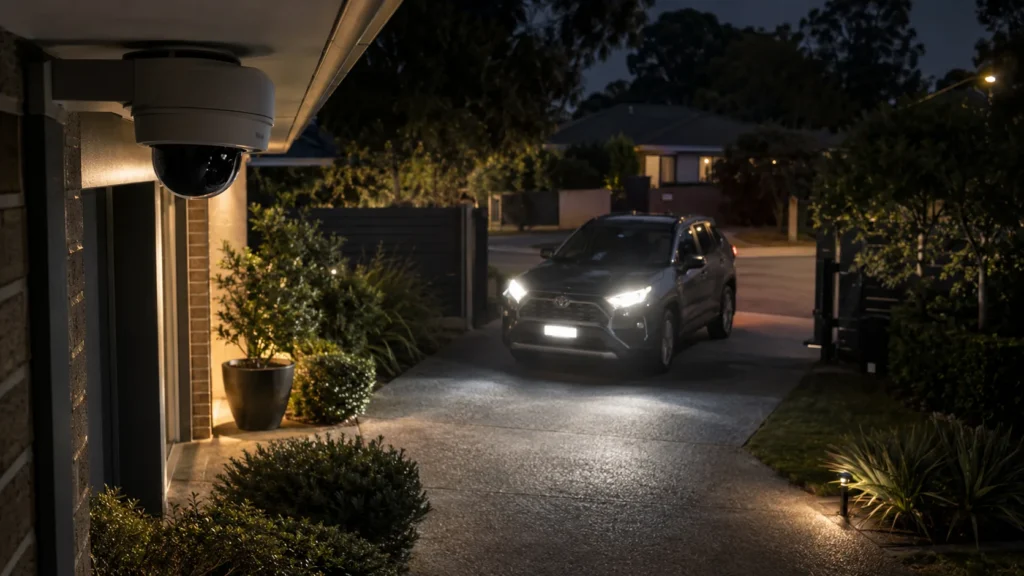
A car pulls into the driveway at night. On the footage, you can see it clearly — the shape, the colour, which way it’s facing. You zoom in on the number plate and it’s a white smear, too small to read, or gone into a wash of glare. The camera worked. It recorded a vehicle. It just didn’t capture a readable plate.
A CCTV camera can capture a number plate at night, but only if the plate itself is recorded with enough usable detail. Seeing the vehicle is not enough — plate capture is a distinct imaging task with its own requirements, and general CCTV coverage doesn’t automatically meet them.
A Camera Can See the Car Without Capturing the Plate
A camera pointed at a driveway or gate may clearly show the car and still include the plate somewhere in the image — but there’s a real difference between four separate outcomes:
- Vehicle visible — the car is clearly present in frame.
- Plate visible — the plate can be seen as an object in the image.
- Plate readable — individual characters can actually be distinguished.
- Plate recognised — LPR/ANPR software can interpret the characters automatically.
The difficulty starts at the third stage — readable characters — because a plate being visible as an object in the picture doesn’t mean the image contains enough information to actually read it.
This is sometimes described in the industry as the difference between license plate capture (LPC) — producing a readable image — and license plate recognition (LPR), the automated software step that reads and logs the characters. A home camera aiming to record a readable plate is really only concerned with the first of those. Whether it succeeds depends on a handful of specific conditions, not on how good the camera looks on paper.
The Plate Needs Enough Image Detail
Megapixel count is the number most people look at, but it’s not the number that determines whether a plate is readable. What matters is how many of those pixels actually land on the plate itself.
What determines how much plate detail reaches the image:
- distance to the vehicle;
- field of view;
- focal length / optical framing;
- how much of the frame the plate actually occupies.
A high-resolution sensor covering a wide scene spreads its detail across everything in that scene — the whole driveway, the fence line, the garden. A plate that occupies a small corner of a wide shot gets a small share of that resolution, no matter how many total megapixels the camera has. The same sensor, aimed more tightly at the area where a plate is expected to appear, gives that plate far more of the available detail to work with.
In Axis’s example for a standard European license plate, roughly 74–75 pixels across the plate width are needed to resolve the smallest character structures, while many LPR systems require around 100–150 pixels across the plate. These are Axis’s own figures for its technical examples — not a guarantee for every camera, Australian plate or recognition system — but they illustrate the underlying point well: more megapixels on the camera spec sheet does not compensate for a plate that occupies too little of the frame.
Distance and Field of View Work Together
A vehicle further from the camera puts a smaller plate into the image, and a wider field of view spreads the same resolution across a larger area — both effects work in the same direction, and both reduce the detail available on the plate itself.
This is why the same camera, at the same location, can deliver very different results depending on how it’s set up. Zoomed out to take in the whole driveway and both side fences, the plate might occupy a few dozen pixels. Zoomed or positioned to concentrate on the specific point where a vehicle enters, the same optical hardware can deliver a plate large enough in the frame to actually read.
The practical takeaway isn’t a distance figure to aim for — that varies by camera, lens and scene — but a design principle: the same camera can give an excellent overview of a driveway while giving too little image detail to read a plate at the far end of it. Wide coverage and readable plate detail are somewhat competing goals from the same lens.
Camera Angle Can Make a Readable Plate Much Harder
A plate viewed nearly head-on is far easier to read than the same plate viewed at a sharp angle, because an angled plate presents a foreshortened, distorted version of its characters to the sensor — less width, less contrast, more room for blur to obscure detail.
Axis’s LPC guidance recommends keeping the total angle between the camera and the vehicle’s direction of travel below 30° for reliable plate capture. That’s specific guidance for a purpose-built plate-capture setup, not a universal rule for every residential CCTV installation. A general driveway camera designed for overview coverage may operate at a wider angle, because the position that shows more of the scene is not necessarily the position best suited to plate capture.
That trade-off is worth sitting with: a camera can have an excellent overview of a driveway while viewing every approaching plate from an angle that makes it genuinely hard to read. The same positioning choice that makes a camera good at one job can make it weak at the other.
A Moving Plate Needs a Short Enough Exposure
A vehicle in motion means the plate is moving across the camera’s sensor while the image is being captured. If the shutter stays open too long relative to that movement, the characters blur into an unreadable streak rather than staying sharp.
The obvious fix — a shorter exposure time — comes with its own cost: a shorter exposure collects less light. In brighter daytime conditions, the camera generally has more available light to work with. At night, that trade-off becomes much more restrictive. Reducing motion blur enough to keep a moving plate sharp also reduces the amount of light the camera has to work with at exactly the time of day when light is already scarce.
Axis’s technical guidance shows just how steep this trade-off gets — the shutter time needed to avoid blur changes substantially with both vehicle speed and camera angle, tightening sharply as either increases. The exact numbers are specific to a dedicated LPC setup and aren’t something to translate into DIY camera settings, but the relationship they illustrate is the one that matters for understanding why night plate capture is harder than daytime capture: speed and angle both push toward a shorter exposure, and a shorter exposure pushes toward a darker image.
Why Number Plates Can Turn Into a Bright White Patch at Night
This is often the most visible symptom of the whole problem, and it has a specific physical cause. Axis explains that license plates are retroreflective, sending much of the incoming light back toward its source — which is exactly why plates show up so clearly in a car’s own headlights at night.
That same property works against a camera’s built-in infrared illumination. IR light sitting close to the lens reflects straight back off a retroreflective plate far more strongly than it reflects off the surrounding paintwork, brickwork or garden. The result can be a plate that comes back brighter — sometimes much brighter — than everything around it, to the point where the camera’s exposure and gain settings can’t hold on to the character detail. The car can remain clearly visible while the plate itself is overexposed into a blank white patch.
This isn’t something that happens on every camera or every setup — it depends on distance, IR intensity, gain settings and how close the illumination sits to the lens. But it’s a real, physically grounded reason a plate can fail even on a camera producing an otherwise clear night image.
Why More Infrared Is Not Automatically Better
The instinct when a night image looks dark is to want more infrared illumination. For general scene visibility, that’s often reasonable. For plate capture specifically, it’s not a reliable fix, and can sometimes make things worse.
IR intensity falls off quickly with distance — Axis’s guidance notes that, for a reflective object like a plate, doubling the distance to the light source requires roughly four times the IR power to maintain the same effective illumination. The distance at which a camera can illuminate a general scene at night is not necessarily the distance at which it can capture a readable moving plate.
At the same time, because plates are retroreflective, adding more IR power can push an already-bright plate further into overexposure rather than solving anything. Night vision range and plate-readability range are not automatically the same thing — a camera that produces a perfectly usable night image of the driveway can still fail specifically on the plate, for reasons that have nothing to do with the camera being faulty.
At night, plate readability becomes harder when:
- the plate is viewed at a sharper angle;
- the vehicle moves faster;
- the exposure needs to be shortened to reduce blur;
- the shorter exposure leaves less light for the image;
- IR then has to illuminate a highly reflective target without washing it out.
Why WDR Is Not a Guaranteed Fix
Wide dynamic range (WDR) is a genuinely useful feature for a lot of general CCTV scenes — it helps bring out detail in shadows and stop the camera being “blinded” by a bright light source in frame, which is common with headlights.
Plate capture is a different case. Axis’s guidance specifically warns that WDR can introduce motion artefacts into images of moving vehicles, depending on how a particular camera implements it, and recommends switching WDR off for license plate capture unless a camera’s own specification says otherwise. A feature that improves overall scene visibility doesn’t automatically improve character readability on a plate that’s moving through the frame — the two goals can pull in different directions.
General CCTV and Plate Capture Are Different Imaging Jobs
Putting the factors above together, a pattern emerges: the settings and positioning that make a camera good at general driveway coverage are often not the same ones that make it good at capturing a readable plate.
This doesn’t mean every home needs a dedicated LPR camera bolted onto the driveway. It means reliable plate capture is worth treating as a specific requirement, rather than something assumed to come free with general CCTV coverage. A perfectly working, well-maintained camera can still be the wrong view for this particular job.
Why a Driveway or Gate Can Be Easier to Design Around
Everything above sounds like a long list of obstacles, but a controlled entry point — a driveway or a gate — genuinely does make the underlying problem more manageable than a public road would.
A controlled driveway or gate can provide a more predictable vehicle path and a deliberately chosen capture point, with camera geometry and lighting assessed at that specific location. That predictability gives whoever is designing the camera setup more control over exactly the variables covered above — where the capture point sits, what angle the camera views it from, and what the lighting actually looks like at that precise spot, rather than across an entire open scene.
Victoria Police separately recommends considering sensor lighting and CCTV for vehicles parked in a driveway. That is general crime-prevention guidance, not a plate-capture standard — it doesn’t confirm any of the technical detail above, and readability still isn’t guaranteed just because the entry point is controlled. It simply means the variables that determine readability are easier to work with there than across an open, unpredictable scene.
So, Can Home CCTV Capture a Number Plate at Night?
Yes — but not simply because the camera has night vision, a high megapixel rating, or a clear overall view of the vehicle. A readable plate depends on the plate occupying enough of the image, being viewed at a workable angle, avoiding excessive motion blur, and being exposed correctly under night conditions, all at the same time.
If plate readability is an actual requirement — not just a nice-to-have alongside general coverage — it’s worth planning as its own specific imaging task, rather than assuming it will come along automatically with a camera that’s otherwise doing a good job of covering the property.
When Plate Capture Should Be Planned as a Specific CCTV Requirement
Plate capture should be treated as a specific requirement when:
- vehicle identification is an actual security goal;
- an existing camera records cars but not readable plates;
- the property has a long driveway or a controlled gate;
- one camera is expected to provide both wide context and close identification;
- reliable night plate detail matters consistently rather than occasionally.
Sometimes the fix is modest — adjusting an existing camera’s position, angle or field of view can be enough. In other cases, reliable plate capture calls for a separate camera view, or equipment chosen specifically for that task, rather than stretching a general-purpose setup to cover a job it wasn’t really designed for.
If readable vehicle detail is part of what a system needs to achieve, that’s worth defining before camera positions and lenses are finalised. SIPKO plans security camera installation in Melbourne around the identification distance, field of view and lighting a property actually needs, rather than treating every camera position as interchangeable.
FAQ
Can a normal CCTV camera capture a number plate at night?
Sometimes, yes — but not automatically. It depends on how much detail the plate occupies in the frame, the angle it’s viewed at, how much motion blur is present, and how well the night exposure is handled. A camera that records the vehicle clearly can still fail on the plate specifically.
Why does a number plate look white on CCTV at night?
Number plates use retroreflective material that sends much of the incoming light straight back toward its source. Infrared illumination positioned close to the camera lens can reflect off the plate strongly enough to overexpose it, washing out the character detail even while the rest of the scene stays properly exposed.
Does a 4K CCTV camera guarantee readable number plates?
No. Overall resolution matters less than how many of those pixels actually land on the plate, which depends on distance and field of view. Angle, motion blur and night exposure all matter as well — a high-resolution camera can still fail to capture a readable plate if any of these aren’t right.
Do I need an LPR camera to capture number plates?
Not always for occasional, best-effort capture. But reliable, consistent plate capture is a specialised imaging requirement, and dedicated LPC/LPR equipment — designed and configurable specifically around plate-capture requirements — can make that outcome far more predictable than asking a general CCTV camera to do it as a secondary job.
Sources
-
Axis Communications.
License Plate Capture: Key Factors for Successful License Plate Recognition. Updated December 2024. -
Victoria Police.
CCTV installation. Updated 17 April 2025. -
Victoria Police.
Preventing motor vehicle theft. Updated 24 August 2026.