
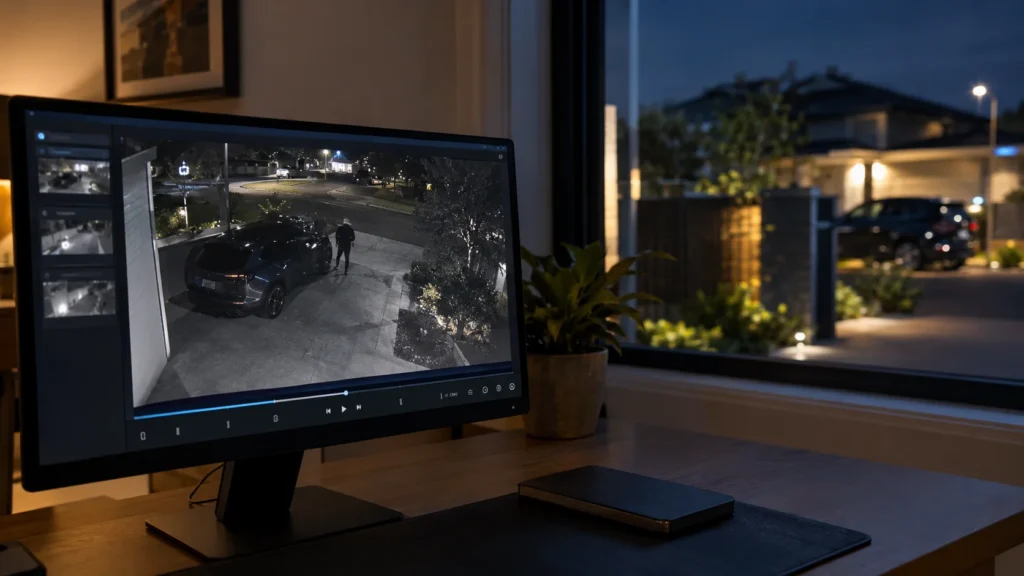
The camera was working. The incident is right there on the timeline. The recording opens without any trouble. On the surface, the system did exactly what it was supposed to do.
But opening a recording and getting something useful from it are not the same event. Only once you actually watch the footage does the real question appear: can you tell what happened? A CCTV system can record an incident from start to finish and still leave you no closer to answering that question. Recorded is not the same as useful — and the gap between the two only becomes obvious at the one moment it actually matters.
Recording an Incident and Recording Useful Detail Are Different Things
An event being present in a recording is not the same as the recording containing what you actually need from that event. The timestamp is correct, the camera was pointed the right way, and the footage plays back without errors — and it can still fail to answer the question you opened it to answer.
Sometimes that question is who was there. Victoria Police’s guidance on CCTV installation notes that images need to be clear for offenders to be identified, and that’s a fair benchmark when identification is genuinely the point of a particular camera. But it isn’t the only value footage can have.
Useful footage may help establish:
- who or what was present;
- what happened;
- the sequence of actions;
- which vehicle or person was involved;
- when a relevant action occurred.
None of that necessarily depends on a clear face. These are simply examples of what a recording might be asked to do — not a formal or official classification. Treating identification as the only measure of useful footage sets an unnecessarily high bar and misses a lot of what CCTV actually does well. The more accurate question is broader: does this recording tell you what you need to know, for the reason you’re looking at it?
What Does the Footage Actually Let You See?
It’s easy to judge a camera by whether the picture looks sharp on a monitor. That’s not quite the right test. The better question is what the recording actually lets you determine about a specific event.
A few questions get closer to it:
- Can you distinguish the relevant person, vehicle or action — not just notice that something moved?
- Can you follow what happened, rather than only see that something happened?
- Is the detail that actually matters visible at the moment it matters, not just somewhere in the frame?
- Does the recording answer the question you opened it to answer, or does it leave you guessing?
A camera can technically cover an area and still fail every one of these questions. The picture can look perfectly fine in isolation and still not tell you anything useful about the one event you needed it for. Footage quality isn’t really a property of the image on its own — it’s a property of the image relative to the task it’s being asked to do.
Why Footage That Works in Daylight May Fail at Night
Victoria Police specifically advises considering CCTV image quality during the day and at night. That makes both conditions worth reviewing when assessing what a system actually records.
A recording that shows clear, useful detail in daylight doesn’t automatically produce the same result after dark. The same doorway, the same angle, the same camera can behave very differently depending on the light available at the time. Darkness changes what’s visible. A bright light source in the frame can obscure everything around it. Shadows can hide detail that would otherwise be plain to see. None of this is a fault as such — it’s simply a different set of conditions producing a different result from the same equipment.
The point isn’t to diagnose why a particular night recording looks the way it does. It’s that daytime footage looking clear tells you very little about what the same camera will actually capture at night. If a system is only ever checked during the day, its real performance is only half known.
The Useful Moment Has to Still Be There When You Look for It
Useful footage only matters if the relevant recording is still there when someone actually needs it. A camera producing excellent footage in the moment doesn’t guarantee that the specific clip you need will still exist a week later, or that it hasn’t been overwritten before anyone realised it mattered.
Victoria Police’s CCTV guidance specifically points to three parts of recording availability:
- adequate storage space;
- storage that is hidden and secured;
- footage backed up off site.
The reasoning behind that advice is straightforward: a system that records well but doesn’t hold onto what it records isn’t fully doing its job. Storage isn’t a separate technical detail bolted onto a CCTV system — it’s part of whether the footage is actually useful, because footage that no longer exists can’t be useful to anyone.
This isn’t a question of how many days of storage is enough for a given property, or which hardware handles that job best — those are separate, more technical decisions. The point here is simpler: a recording being available when it’s needed is one of the conditions that makes it useful in the first place, alongside everything the image itself shows.
Finding the Recording Is Part of Whether It Is Useful
Footage existing somewhere on a recorder and being able to actually put your hands on the right clip are two different things. A system can hold a large volume of recordings and still leave someone struggling to locate the short period that actually matters, especially under the mild pressure of dealing with an incident after the fact.
When footage is needed, the practical sequence is:
- identify the relevant time period;
- locate that period in the recording system;
- retrieve the relevant footage;
- provide it if required.
That last step becomes practically relevant if an incident needs to be reported. Victoria Police’s online reporting process allows a person submitting a report to indicate that they have digital evidence, including CCTV footage, as part of that report. Where digital evidence has been indicated, the guidance notes that a link to upload the footage may be provided at a later stage. In other words, knowing that a recording exists is only the first part — being able to locate and provide the right piece of it is a separate, practical step in its own right.
Check the Recorded Result Before an Incident Tests It for You
Most of what makes footage useful or not can be checked before it’s ever needed, simply by looking at what the system actually produces rather than assuming it from a live view.
A reasonable check covers:
- Review actual recorded footage, not only the live screen — recorded playback is what will matter later, and it’s worth confirming what it actually shows.
- Look at recordings from both daytime and night-time conditions, since one doesn’t tell you much about the other.
- Check what useful detail the recording actually preserves for the areas that matter most, rather than assuming the picture is good enough because it looks fine at a glance.
- Confirm that recordings remain available for the period that’s relevant to your own situation, not just for however long happens to be the default.
- Make sure you actually know how to locate and retrieve a specific recording, rather than finding out for the first time during an incident.
This isn’t about chasing a perfect image. It’s about finding out, on your own terms, whether the system currently gives you what you’d actually need — before an incident forces the question.
When the Problem Is the CCTV Design, Not Just the Recording
If checking actual recordings turns up the same problem repeatedly — footage that exists but consistently doesn’t answer the question it needed to — that can be a sign the issue needs to be assessed at system level rather than chased down one setting at a time.
It may require looking at how camera views, lighting conditions, recording capacity and access work together across the system, rather than treating the symptom as one isolated setting. Working through that properly usually means looking at the site itself rather than guessing at a cause remotely.
This is the kind of assessment that comes with professional security camera installation in Melbourne — reviewing what a system currently produces against what it’s actually meant to capture, and adjusting the parts that aren’t pulling their weight. It isn’t a guarantee that every future recording will answer every question. It’s a more realistic way of closing the gap between a system that records and one that actually gives you something useful when you go looking for it.
FAQ
Why is my CCTV footage less useful at night than during the day?
Daytime and night-time are different conditions for a camera, not variations on the same result. A recording that looks clear in daylight doesn’t tell you how the same camera performs after dark — that’s worth checking separately, rather than assumed from how the daytime footage looks.
Does high-resolution CCTV automatically mean useful footage?
Not on its own. Resolution is one factor among several, and a high-resolution camera can still produce footage that doesn’t answer the question you need it to. Usefulness depends on what the actual recording shows for the specific situation, not on a single specification.
Can CCTV footage be provided to Victoria Police?
When submitting an applicable report, Victoria Police allows you to indicate that you have digital evidence, including CCTV footage. Where that’s indicated, its guidance says a link to upload the footage may be provided at a later stage.
Should I check recorded footage even if the live view looks clear?
Yes. A live view showing a clear picture in the moment doesn’t confirm what the system actually records and stores — that’s worth checking separately, on its own terms.
Sources
- Victoria Police. CCTV installation. Crime prevention guidance, updated 17 April 2025.
- Victoria Police. Online Police Report and Assistance Line. Reporting and digital evidence guidance, updated 23 June 2026.