A camera can be pointed at exactly the right part of a property and still fail you at the one moment you need it. The footage exists, the camera was recording, and the area was technically “covered” — but when you go back to look at what actually happened, the image doesn’t show enough to be useful. This doesn’t necessarily mean there is a fault with the equipment.
A camera being present in an area doesn’t mean that area is usefully covered. That distinction — visible area versus usable view — is the difference between a system that looks complete and one that actually works when it matters. This article explains why that gap happens, how to recognise it on your own system, and when it’s worth having someone assess it properly.
What Counts as a Blind Spot (and What Doesn’t)
Security camera blind spots are not always areas the camera cannot see at all.
In practice, there are two different problems to look for:
- A true blind spot — part of the property isn’t captured by the camera at all.
- A usable-coverage gap — the area appears in the frame, but the recorded view doesn’t provide enough relevant detail for the purpose it is meant to serve.
Both lead to the same practical problem: the footage cannot answer the question it was expected to answer.
A true blind spot is the easier of the two to identify — check the footage, and the area simply isn’t there. A usable-coverage gap is less obvious, because the camera is pointed at the right spot and the area is inside the frame, and yet the recording still doesn’t help. This can happen when something sits in front of part of the view, when the camera’s angle doesn’t line up with the direction someone would actually approach from, when the field of view is wide enough to show the general area but not enough to see relevant detail, or when conditions on the day simply weren’t good enough to produce a useful image.
How Blind Spots Actually Form
Coverage gaps rarely appear because someone forgot to point a camera at an area. They usually form gradually, or as a side effect of something else on the property.
Blind spots can develop because of:
- Physical obstructions — beams, downpipes, parked vehicles, bins or other objects blocking part of the view.
- Angle mismatch — the area is visible, but the actual approach or access route is not captured usefully.
- Too much area in one view — the scene is visible, but relevant subjects occupy too little of the recorded image to distinguish useful detail.
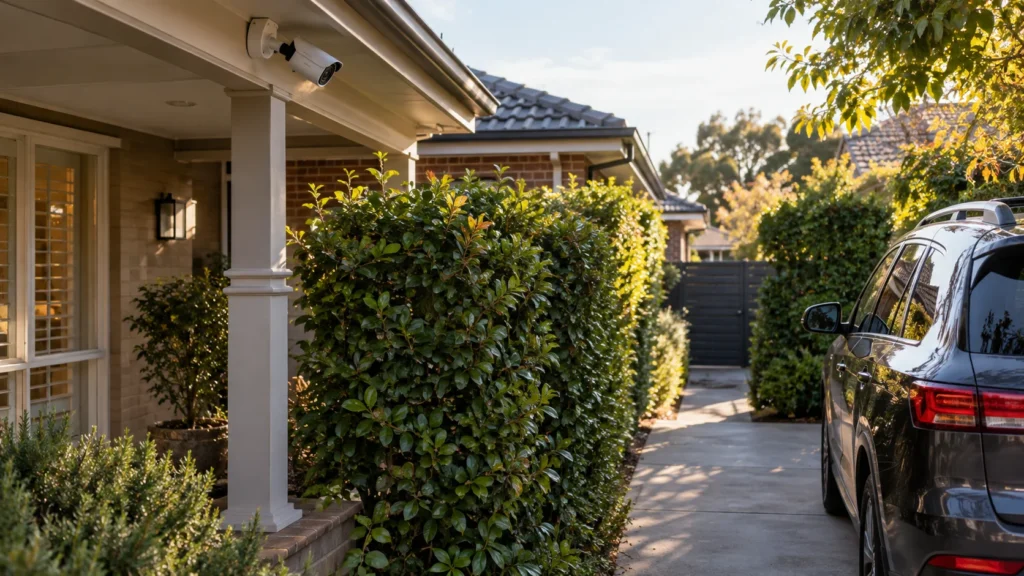
- Changes around the property — vehicles, gates, furniture, landscaping or vegetation alter what the camera can actually see compared to when it was installed.
Some of these causes are permanent; others come and go, which means a camera can have a clear view one day and a partially blocked one the next. Landscaping is one of the slower-moving versions of this: a hedge or tree that was low enough to ignore during installation can, over a year or two, grow into part of the frame.
On established properties in areas such as Brighton, mature landscaping, verandahs and other architectural features can affect the intended camera view, particularly as vegetation grows or conditions around the property change.
Coverage That Looks Complete on Paper, Not in Practice
CCTV coverage gaps can develop even when the original camera view appeared adequate. There’s a meaningful difference between a property having cameras in the right general areas and a system actually producing useful footage from those areas.
Victoria Police’s guidance on CCTV installation lists entry and exit points, driveways and the street in front of a property among the areas worth covering. Those are reasonable priorities — but having a camera somewhere in each of those zones isn’t the same as confirming that a real event in that zone would be captured with enough detail to be useful. A camera can technically cover a driveway and still miss the specific angle needed to distinguish useful detail on it, simply because “covering the driveway” and “producing a usable view of the driveway” aren’t automatically the same thing.
This is worth checking area by area rather than assuming that ticking off a list of recommended zones means the job is done. A coverage checklist is a reasonable starting point for where cameras should exist. It isn’t evidence that every relevant event within those areas will actually be captured usefully.
Day Coverage vs Night Coverage
A camera that produces a clear, detailed image during the day can behave very differently once the light changes. Victoria Police specifically flags image quality during the day and at night as something to consider when installing CCTV. It’s an easy gap to overlook if the system has only been assessed under daytime conditions.
Lighting conditions around a property shift throughout the day and across seasons, and a camera view that looks complete in daylight can lose meaningful detail after dark — even without any change to the camera itself or its position. The point isn’t that night coverage is automatically worse; it’s that day and night performance are two separate things to check, not one assumption that carries over from the other.
When comparing daytime and night footage, it’s worth checking whether:
- the same areas remain clearly visible;
- important detail remains distinguishable;
- lighting changes create new dark or overexposed areas;
- the usable part of the recorded view changes as lighting conditions change.
Gaps Between Multiple Cameras
Adding more cameras to a property doesn’t automatically close every gap, because each camera only covers its own field of view — and the space between two cameras’ views doesn’t disappear just because there are now two cameras instead of one.
Two cameras can appear to cover most of the same general area from different angles and still leave a narrow strip between them that neither one captures well. Alternatively, both cameras might show an area, but from angles that both struggle with the same obstruction or the same approach direction, so adding the second camera doesn’t actually add much. Overlap is only useful when it’s overlap of the kind that matters for what the system needs to do — not simply overlap in general coverage.
This is a reason to think about how camera views relate to each other, rather than treating “more cameras” as an automatic fix for a gap identified elsewhere on the property.
Privacy-Aware Blind Spot Review
When a blind spot is identified, the instinct can be to simply widen a camera’s angle or point it further to close the gap. That approach carries its own risk. Victoria Police’s guidance on CCTV installation recommends that cameras cover a property while avoiding angles that capture neighbouring property — so a fix for one gap shouldn’t come at the cost of recording more of next door than necessary.
The Office of the Australian Information Commissioner also notes that residential CCTV can be subject to state or territory laws, and in some cases council requirements or strata by-laws, depending on where the property is and how it’s set up. None of this amounts to a single fixed rule about what is or isn’t allowed everywhere — the point is that closing a blind spot is worth approaching deliberately, with the property’s own boundaries in mind, rather than by simply increasing how much the camera can see.
How to Check Your Own Coverage for Gaps
A useful first pass at identifying blind spots doesn’t require new equipment — it starts with looking at what the system is actually recording, rather than what it’s assumed to be recording.
A basic coverage check should include:
- Review recorded footage, not only the live view — the question is what the system actually captured when the area was being used.
- Check the same areas at different times of day, since day and night performance can differ.
- Test real approach and access routes to entrances, driveway, side access and other monitored areas, then check what the camera actually recorded while moving through them.
- Look for temporary obstructions, such as a parked vehicle or an open gate.
- Re-check after property changes, including landscaping, vegetation growth, a shift in where vehicles are usually parked, or alterations to the CCTV system.
This kind of review can surface a genuine gap. It won’t tell you everything a professional site assessment would, and it isn’t meant to replace one.
When a Gap Needs a Professional Review
A self-check can identify that something isn’t being captured well. It’s harder to work out, without visiting the property, exactly why — and what the practical options are to fix it.
An on-site review can assess:
- the actual field of view;
- physical obstructions;
- day versus night performance;
- overlap between existing cameras;
- available mounting options;
- cable routes and access;
- what the existing system can realistically support.
If a blind spot has been identified but the cause isn’t clear, or if closing it would mean reworking part of an existing system, a professional review through professional security camera installation in Melbourne can help confirm what’s actually causing the gap and what the realistic options are to close it — not to replace a system that’s largely working, but to resolve the specific problem the self-check surfaced.
FAQ
Can I fix a CCTV blind spot without adding another camera?
Sometimes. In some cases the issue is an obstruction, an angle, or a setting that can be adjusted on an existing camera. In others, the gap can only be closed by changing the system itself. Which applies depends on the specific cause, not a general rule.
Do CCTV blind spots mean my security system is broken?
Not necessarily. A blind spot can be a coverage or design issue rather than an equipment fault — a gap that was always there, or one that developed as the property changed. A camera can be working correctly and still have a blind spot.
When should I re-check my CCTV coverage for blind spots?
Rather than on a fixed schedule, it’s worth re-checking after anything that could change what a camera actually sees — noticeable vegetation growth, landscaping or property changes, a shift in where vehicles are usually parked, or any alteration made to the CCTV system itself.
Can a camera see an area but still miss useful detail?
Yes. An area can be clearly visible in the frame while the footage still lacks the detail needed to understand what happened, because visibility and useful detail aren’t the same thing.
Does adding more cameras always close existing gaps?
Not automatically. Extra cameras only help if their field of view genuinely covers the specific gap in a useful way. Two cameras can show much of the same general area and still leave a narrow section, or share the same obstruction, without resolving the original problem.
Sources
- Victoria Police — CCTV installation
- Office of the Australian Information Commissioner — Security cameras