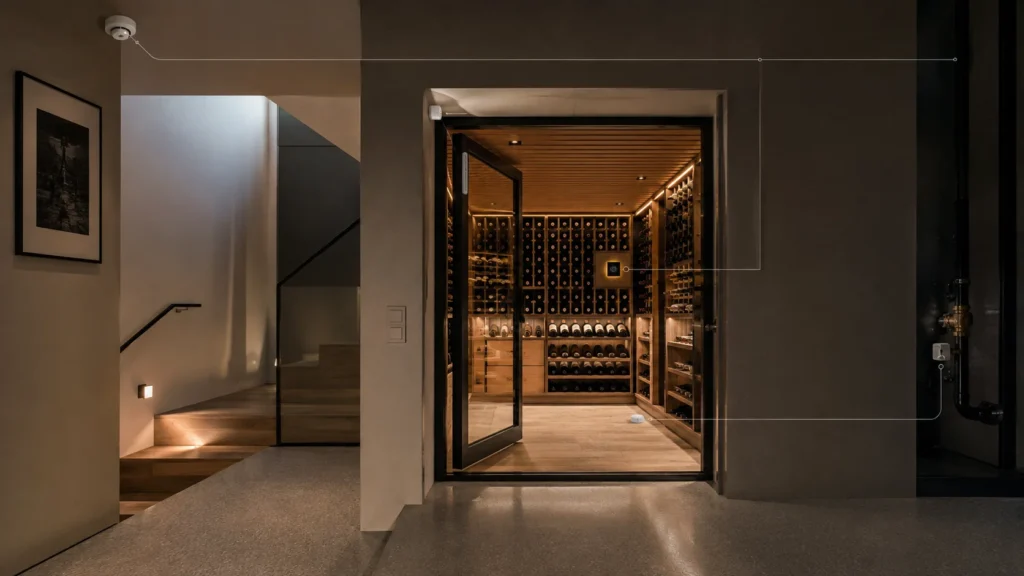
The alarm is armed, doors and windows are protected, and every entry point is covered. But the cellar sits inside that perimeter, and its risks don’t all come from outside it.
A house can be genuinely secure from intrusion and still leave a valuable collection exposed to threats that have nothing to do with someone breaking in.
What can actually threaten a collection like this?
- unauthorised access
- liquid water reaching the room
- a fire-related event
- temperature or humidity drifting outside the range the collection needs
None of these four risks are solved by the same layer of protection.
Treat the Cellar as Its Own Protected Zone
A whole-house alarm can be organised around a simple question: is the property armed or disarmed? A dedicated collection room doesn’t always fit that logic comfortably. The cellar can hold real value while the rest of the house is full of normal daily activity — family coming and going, guests visiting, staff working.
Treating the cellar as its own protected zone means its security state doesn’t have to track the state of the rest of the house. That distinction matters for a wine cellar because access to the collection doesn’t necessarily need to follow the same pattern as access to the rest of the home.
Protecting the Collection While the Rest of the House Is in Use
This is the practical version of the previous point. Ajax’s system supports Group Mode, which lets specific users be granted access to specific groups of devices rather than the whole property — a user without rights to a group can’t see it or control its security mode.
Applied to a cellar, this means the room’s door or motion protection can, where the system is configured this way, remain in a separate security state from the rest of the house — armed or restricted even while family members are elsewhere in the property going about a normal day. A door contact on the cellar entrance and an appropriately placed motion detector can cover the room without needing to be tied to the whole-house arming schedule.
The useful distinction isn’t simply home armed versus home disarmed. A dedicated room may need its own security state even while people are elsewhere in the house.
Water Is a Real Threat Even Without a Break-In
Water reaching the cellar from a pipe, connected equipment or another source inside the property can damage a collection without anyone ever entering the room.
Ajax’s LeaksProtect detector works through direct contact — electrodes on the underside of the unit sense when liquid actually touches them, which then triggers an alert to the hub. It isn’t measuring humidity in the air; it’s detecting the physical presence of water pooling or spreading across a surface. Its published operating range covers humidity up to 100% and a temperature range of 0°C to 50°C, so a typically humid cellar environment doesn’t sit outside what the device is rated for. That’s not the same as a guarantee that every cellar’s specific conditions and placement will suit it — that still needs checking against the room itself, including exactly where water would realistically collect first.
Where the plumbing allows, a leak event can also be configured to trigger Ajax’s WaterStop, a valve that closes a controlled water line automatically. This is a genuinely useful mechanism, but it has real limits.
What WaterStop cannot solve by itself:
- water entering from a source outside the controlled supply line
- building, drainage or waterproofing problems
- a leak where the relevant supply can’t physically be isolated by that valve
WaterStop can isolate a controlled water line. It cannot stop every possible source of water entering a cellar.
Fire Detection Needs to Suit the Environment
Not every fire detector is built the same way, and the exact variant installed matters more than the general category of “smoke alarm.”
Ajax’s FireProtect 2 range includes versions that detect smoke and heat only, and versions that add carbon monoxide detection on top. The range includes battery-powered and mains-powered versions with battery backup. The important point is that FireProtect 2 is not one universal specification: the selected variant determines whether the system is detecting smoke and heat only, or smoke, heat and CO. Which variant and placement are appropriate depends on the room and the wider fire-safety design.
Ajax states that its dual-spectrum smoke sensor is designed to distinguish real smoke from water vapour and steam, rather than treating both the same way, and that the detector’s heat sensors are built to pick up a rapid temperature rise rather than relying on smoke alone. Those are manufacturer-stated characteristics of the detection system, but the right response to any specific cellar’s conditions is still a matter of choosing and placing the correct detector, not assuming any smoke alarm will behave the same way in every room.
Environmental Awareness Isn’t the Same as Climate Control
This is where the distinction between security and preservation becomes important.
Ajax’s LifeQuality monitor measures temperature and humidity with genuine precision — the manufacturer states an accuracy of ±0.2°C and ±1.8% relative humidity, using an industrial-grade digital sensor positioned in an isolated part of the device’s board specifically to keep other components from affecting the reading. Measurements update at least once a minute, and configured thresholds can generate a notification, or trigger an automation scenario, when a reading moves outside the range set for it.
Monitoring conditions and controlling conditions are two different jobs.
LifeQuality can tell you when the cellar has drifted outside the range it should be in. It doesn’t run the refrigeration or humidity-control equipment that’s actually meant to keep the cellar in that range day to day. That job stays with dedicated climate-control hardware built for the purpose. An early-warning layer is genuinely valuable because it can show that conditions have moved outside the configured range before the consequences become obvious, while also providing a record of how those conditions changed — but it’s a warning system, not a substitute for the equipment doing the actual preservation work.
What Happens When These Layers Work Together?
Put together, the picture looks like this:
These aren’t interchangeable sensors. Each is watching for a different kind of failure, and none of them substitutes for another. An intrusion event doesn’t tell you anything about a leak. A leak detector won’t notice a fire. A fire detector says nothing about whether the cellar’s temperature has quietly crept upward over the past week. Treating any one of these as sufficient on its own leaves an obvious gap — the value of the architecture is that all four questions get asked at once, not that any single device is doing more work than it actually can.
Extend the Existing Alarm or Modernise the System?
For a property with an older alarm already installed, the requirement has just changed shape. It’s no longer just “detect an intruder” — it now potentially includes a separately managed room, liquid-water detection, environmental thresholds and possibly an automated water shutoff.
Extend the existing system when:
- the current platform genuinely supports the required functions
- appropriate compatible add-on modules are actually available for it
- events from the new layers can be presented and managed coherently alongside the existing alarm
- adding the extension doesn’t create unreasonable complexity
Modernise when:
- the required functions depend on stacking multiple ageing or proprietary add-ons
- suitable modules are unavailable, discontinued, or of uncertain long-term support
- the separate-zone, environmental or automated-response behaviour becomes genuinely awkward to configure
- a modern platform produces a cleaner result than continuing to bolt functions onto what’s already there
This isn’t a question that can be answered from the age of the panel alone — some older systems extend perfectly well with the right module, and some newer ones are already limited by what they were originally designed for. What matters is whether the specific existing platform can actually deliver this specific set of requirements: a separately managed room, reliable leak detection, sensible fire coverage and threshold-based environmental alerts, all presented in a way that’s actually usable day to day. A modern Ajax installation is one option worth assessing once the requirements have genuinely outgrown what’s practical to bolt onto the existing alarm.
Getting the Layers Right
The real value isn’t in treating these as individually purchased sensors. It’s in how the layers are configured together — which group the cellar sits in, what triggers the water shutoff, which fire detector variant actually suits the space, and where the thresholds are set on the environmental monitor.
SIPKO Security installs and configures Ajax alarm systems across Melbourne, including assessing an existing alarm to determine whether extending it or moving to a new system makes more sense for a property with a collection room like this. That assessment covers the actual plumbing, the existing panel’s real capabilities, and the specific layout of the space being protected — details that only become clear on site, not from a general description of the property.
Frequently Asked Questions
Does a security system replace dedicated wine cellar climate control?
No. Devices like LifeQuality can monitor temperature and humidity and alert you when conditions drift outside a set range, but the ongoing job of maintaining that range belongs to dedicated refrigeration and humidity-control equipment.
Can a wine cellar be armed separately from the rest of the house?
Yes. Ajax Group Mode allows a cellar to be configured as a separately managed group, so its intrusion protection does not have to follow the same security state as the rest of the home.
Will a water leak detector stop flooding in a cellar?
On its own, no — it detects liquid contact and sends an alert, it doesn’t act on it. Combined with a compatible automated shutoff valve, it can close a controlled water line, but only for sources of water that specific line can actually isolate.
Do all fire detectors work the same way?
No. Variants differ in whether they detect smoke, heat, carbon monoxide or a combination, and in how they’re powered — battery, sealed battery, or mains with backup. The right choice depends on what’s actually near the protected room, not a single default model.
Is it worth adding this to an older alarm system, or should I upgrade?
It depends on whether the existing platform genuinely supports the required functions with available, well-supported components. Some systems extend reasonably; others make more sense to modernise once the requirements grow this specific.