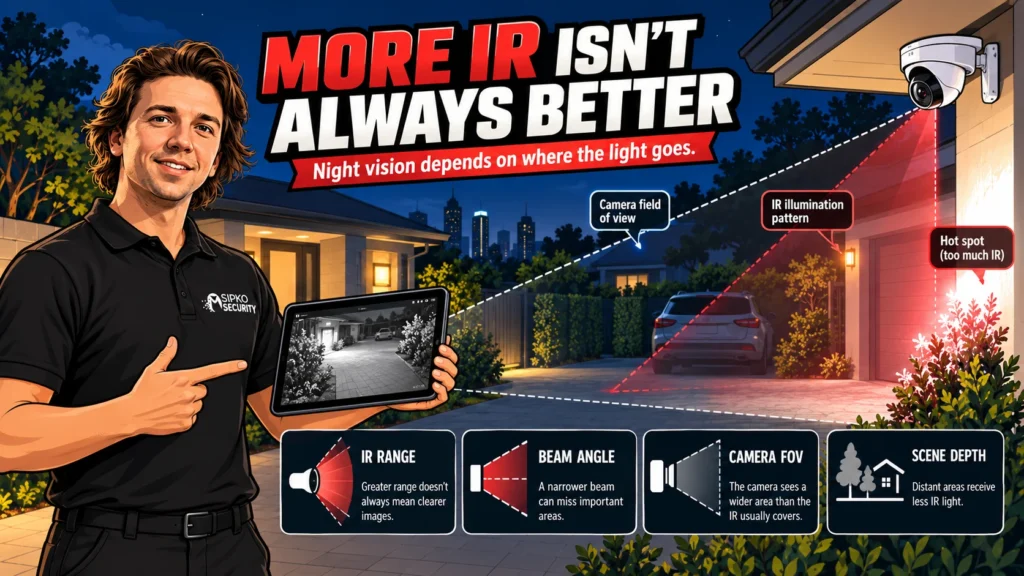
Two cameras are being compared for the same spot on a property. One advertises a longer infrared range than the other. It’s tempting to assume the bigger number means the better night camera. It doesn’t necessarily.
The useful question isn’t simply how far the infrared reaches. It’s where that illumination actually goes, and what happens across the rest of the scene once it gets there.
What an IR Range Number Doesn’t Tell You
A headline IR distance gives you a reach figure. It doesn’t describe:
- how evenly that light spreads across the camera’s field of view;
- whether the beam actually matches the area the camera is covering;
- what happens to objects close to the lens while the beam reaches for distant ones;
- how reflective surfaces in the scene affect the result;
- whether the area that actually matters ends up usefully lit.
None of this means an advertised range figure is false. It simply describes reach, not distribution — and distribution is what determines whether the resulting footage is actually useful.
If an installed camera has recently become dark, hazy or washed out at night, that’s a different problem. SIPKO’s guide to CCTV night vision problems covers troubleshooting an existing system; here, the question is how the illumination should be designed in the first place.
The IR Beam and the Camera’s Field of View Need to Work Together
Infrared illumination is projected as a beam with a particular angle. A camera’s field of view is also an angle. When these two don’t correspond well, the results are predictable.
This isn’t a flaw specific to cheap cameras. Axis Communications’ technical documentation describes the same requirement for any IR illuminator, integrated or standalone: it should provide a uniform light field across the camera’s whole field of view, with enough reach, while avoiding overexposure of anything close by. Manufacturers who sell standalone illuminators — including Axis’s own T90D40 illuminator — offer interchangeable lenses specifically so the beam angle can be matched to a given camera’s field of view, rather than assuming one setting suits every installation. That’s a real design decision manufacturers build hardware around, not an abstract concern.
Why Nearby Objects Can Matter More Than Distant Ones
A camera might need useful detail toward the far end of a driveway, a side path or a yard. But the object closest to the illuminator — a wall, an eave, a post, a ceiling, a fence line — can end up having a disproportionate effect on the result when a nearby surface receives strong IR illumination and reflects it back towards the camera.
This is why night illumination isn’t only a distance problem. It’s also a scene-depth problem: what sits between the illuminator and the part of the scene that actually matters changes what the camera can usefully record, independent of how far the beam is rated to reach.
The practical implication isn’t “avoid all nearby surfaces” — that’s rarely possible. It’s that scene depth needs to be considered as part of planning illumination, not treated as an afterthought once something looks washed out.
Something Outside the Video Frame Can Still Be Inside the IR Beam
Here’s a distinction that’s easy to miss: a camera’s field of view and its IR illumination angle aren’t necessarily identical. Axis’s own documentation notes this directly — a camera’s angle of IR illumination can be wider than its angle of view, particularly on cameras without more advanced illumination control.
In practice, that means looking at the live video image doesn’t always tell you everything the IR beam is actually interacting with. A wall or surface that sits just outside the visible frame can still be inside the illuminated area, contributing to reflections or exposure effects that seem to come from nowhere when you’re only looking at what the camera composition shows.
This doesn’t mean every object near a camera causes a problem — it depends on the specific geometry and surface involved. But it’s a reason to think about the IR beam as its own three-dimensional space, not as something that simply matches whatever’s visible on screen.
Why Adaptive IR Exists
If maximum infrared output were always the right goal, there’d be little reason for manufacturers to build technology that deliberately limits or redistributes it. They do exactly that.
Axis’s OptimizedIR illustrates this approach. On supported remote-zoom models, the IR illumination angle can adapt as the camera’s field of view changes. Some more advanced implementations can also adjust individual LED intensity, including reducing illumination near a wall or corner where reflections could otherwise saturate part of the image.
In practical terms, adaptive IR is trying to balance several things at once:
- enough illumination to reach the area of interest;
- even coverage across the camera’s field of view;
- less excessive illumination on nearby objects;
- changes in field of view on cameras where zoom or viewing angle can vary.
Hanwha Vision’s WiseIR technology addresses a similar underlying problem: distributing and controlling illumination rather than simply maximising it.
The point isn’t that any particular product solves everything. It’s that engineers building this equipment are solving for distribution and control, not for a bigger number on a spec sheet — which is itself evidence that raw output was never the actual goal.
Integrated IR and External Illuminators Solve Different Design Problems
Camera-integrated IR keeps the illuminator built into the camera itself. It’s compact, straightforward to install, and on supported models, integrated illumination can be tailored or adapted to the camera’s own field of view.
Standalone illuminators separate the light source from the camera. That separation gives an installer more flexibility over illuminator position, direction and reach, and — as with the interchangeable lenses on products like the T90D40 — the ability to select a beam angle to suit the scene rather than relying on whatever ships with the camera.
Neither is simply better. Which arrangement makes sense depends on what the specific scene actually needs — the distance involved, the geometry of nearby surfaces, and whether the camera’s own field of view is likely to change (zoom, pan-tilt-zoom models) or stay fixed.
What Should Actually Be Checked When Planning Night CCTV?
Once illumination is treated as a design problem rather than a spec-sheet comparison, a few questions become genuinely useful:
- What part of the scene actually needs useful detail at night?
- At what distance does that detail matter most?
- How wide is the camera’s field of view at that point?
- Is the IR illumination actually reaching that area, or concentrated somewhere else?
- What’s the nearest reflective surface to the camera or illuminator?
- Could that surface sit inside the IR beam even if it’s not obviously part of the video composition?
- Is too much illumination landing in the foreground at the expense of the area that matters?
- Does the result stay usable from the near part of the scene through to the far part?
None of this produces a universal formula for the right wattage, beam angle or exposure setting — those depend on the specific camera, illuminator and property. What it does is turn “why does my night footage look wrong” into a more useful question: does the illumination pattern actually match what this scene and this camera need?
Why Night CCTV Should Be Tested After Dark
Daytime commissioning can confirm plenty — framing, general field of view, camera position, obvious obstructions. What it can’t confirm is how illumination, reflections, foreground-to-background balance and exposure actually interact once the light changes.
An after-dark check is what confirms how the illumination design actually performs on the property, rather than assuming a daytime-correct installation will translate automatically.
Planning camera position, field of view and after-dark illumination as one system — rather than choosing a camera on IR range alone and hoping it works out — is part of what SIPKO does as part of how we install security cameras in Melbourne.
FAQ
Does a longer IR range mean better night vision?
Not automatically. Range gives you a reach figure, not how evenly the illumination is distributed across the camera’s actual field of view or how it interacts with the specific scene.
Can infrared affect objects outside the camera’s visible frame?
Yes. A camera’s IR illumination angle can be wider than its field of view, so surfaces just outside the visible composition can still be lit by the IR beam and affect exposure.
Is external IR better than built-in IR?
Neither is inherently better. Integrated IR is compact and, on supported models, adapted to the camera; external illuminators offer more flexibility over position and beam angle. The right choice depends on the specific scene.
Should CCTV be tested at night after installation?
Yes. Daytime testing can’t demonstrate how illumination, reflections and exposure behave after dark — that only becomes clear once the system is actually checked under night conditions.
Sources
-
Axis Communications.
IR in surveillance. Updated July 2026. -
Axis Communications.
AXIS T90D40 IR-LED product documentation. -
Hanwha Vision.
WiseIR Technology white paper. Published February 2026.