
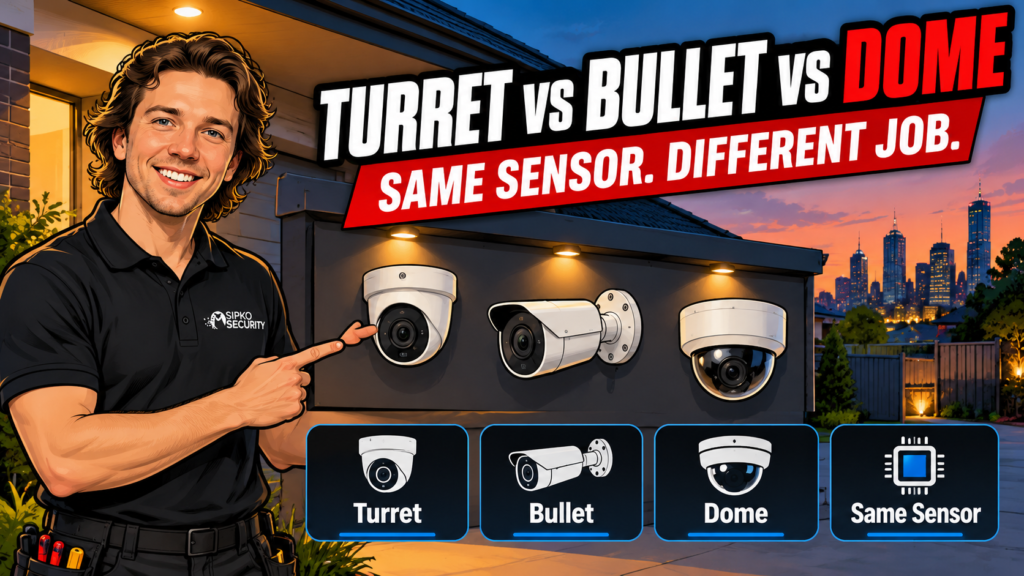
Short answer: for most Melbourne homes and shops, a turret is the easiest default under an eave or soffit, a bullet earns its spot when you need visible deterrence or a long, straight throw along a fence line or driveway, and a dome stays indoors or in vandal-prone spots like a stairwell or loading dock. All three come off the same 8MP AcuSense sensor in Hikvision’s range — the housing is what changes, not the image behind it.
This is our take as a Melbourne installer who fits all three housings, not an independent lab test. Turret, bullet and dome are all good cameras from the same manufacturer — this article is about matching the housing to the mounting point, not ranking one above the others.
- What actually changes between turret, bullet and dome (it isn't the sensor)
- Turret vs bullet vs dome at a glance
- Turret cameras: where this housing earns its keep
- Bullet cameras: where this housing earns its keep
- Dome cameras: where this housing earns its keep
- The one spec that actually separates them: IR reflection
- Does the housing limit your lens options?
- What Melbourne conditions do to each housing
- Can you run turret, bullet and dome on the same system?
- What we'd install for common jobs
- FAQ
What actually changes between turret, bullet and dome (it isn’t the sensor)
Hikvision’s AcuSense line proves the point in its own model numbers. The DS-2CD2083G2-IU (bullet), DS-2CD2183G2-IU (dome) and DS-2CD2383G2-IU (turret) all ship with the same 8MP sensor and AcuSense human/vehicle detection. They’re the identical camera electronics in three different shells, per the ADI Global distributor catalogue for the AcuSense Value Series.
That matters for how we spec a job. We’re not choosing resolution, detection accuracy or night-vision tech when we pick turret over bullet over dome. Those stay constant within a model tier. We’re choosing how the housing handles weather, mounting height, glare and whether the camera itself needs to look imposing.
Turret vs bullet vs dome at a glance
| Factor | Turret | Bullet | Dome |
|---|---|---|---|
| Shape | Flat-faced half-sphere (“eyeball”) | Cylindrical, lens sits forward | Rounded dome over the lens |
| Mounting | Ceiling or wall, flush base | Wall or pole, bracket extends it out | Ceiling-recessed or surface |
| IR glare risk | Low — exposed lens, no dome glass to reflect off | Low — same exposed-lens design | Higher — IR can bounce off the inner dome in rain or direct light |
| Visibility | Discreet, low profile | Obvious, visible deterrent | Discreet, blends into a fitout |
| Adjustment | Pan/tilt by hand, quick | Pan/tilt via bracket, a bit slower | Pan/tilt inside the dome, needs the cover off |
| Best suited to | Eaves, soffits, general outdoor coverage | Fence lines, driveways, open boundaries | Indoor ceilings, shopfronts, vandal-prone spots |
| Weatherproofing | IP67 on most AcuSense models | IP67 on most AcuSense models | IP67 outdoor, lower-rated indoor variants exist |
Caption: Hikvision’s AcuSense turret, bullet and dome models share the same 8MP sensor and detection tech. Only the housing changes.
Turret cameras: where this housing earns its keep
A turret is our go-to for a standard eave or soffit mount on a house or small shop. The flat, exposed lens means there’s no dome glass for the built-in IR to bounce off, so you don’t get the washed-out “halo” effect some dome cameras produce on a rainy night. It’s also the quickest housing to re-aim on a ladder — loosen the ball joint, point it, lock it off.
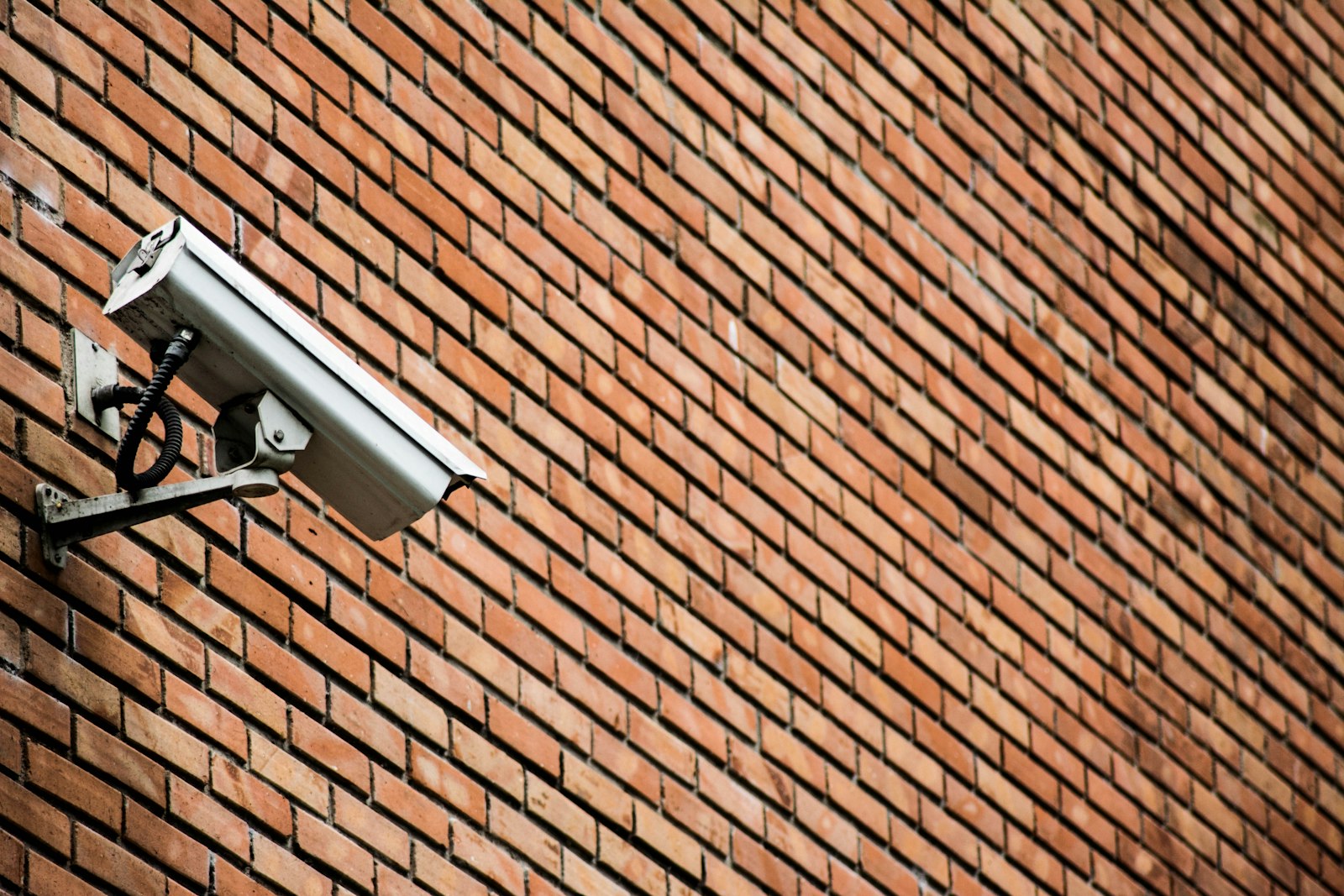
Turret housings don’t come with a mounting junction box built in, so a clean cable run through brick or render still needs a separate junction box or wall-mount bracket behind it. We budget that into every turret quote rather than letting it turn into a surprise on install day.
Bullet cameras: where this housing earns its keep
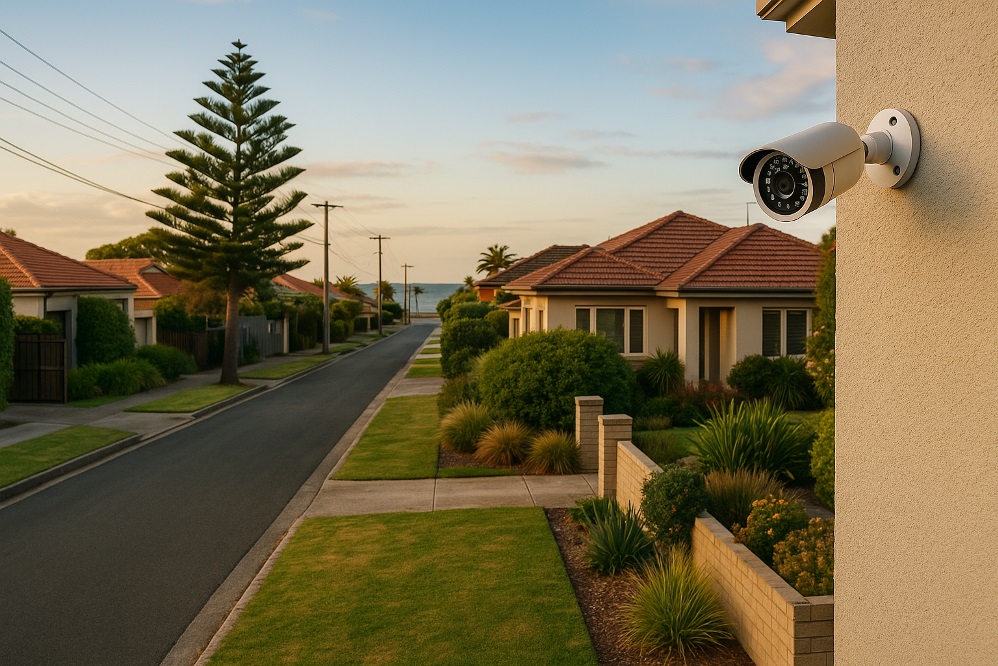
A bullet is the one you point at a fence line, a driveway entrance or a car park boundary where you want the camera seen, not hidden. The housing itself does the deterrent work. Most people clock a bullet camera from across the street in a way they’d never notice a turret tucked under an eave.
The bracket that holds a bullet out from the wall is also what makes it easiest to redirect later. If a new shed or a tree changes your sightline six months after install, a bullet’s mounting arm gives more room to re-angle it than a turret’s flush base does.
Dome cameras: where this housing earns its keep
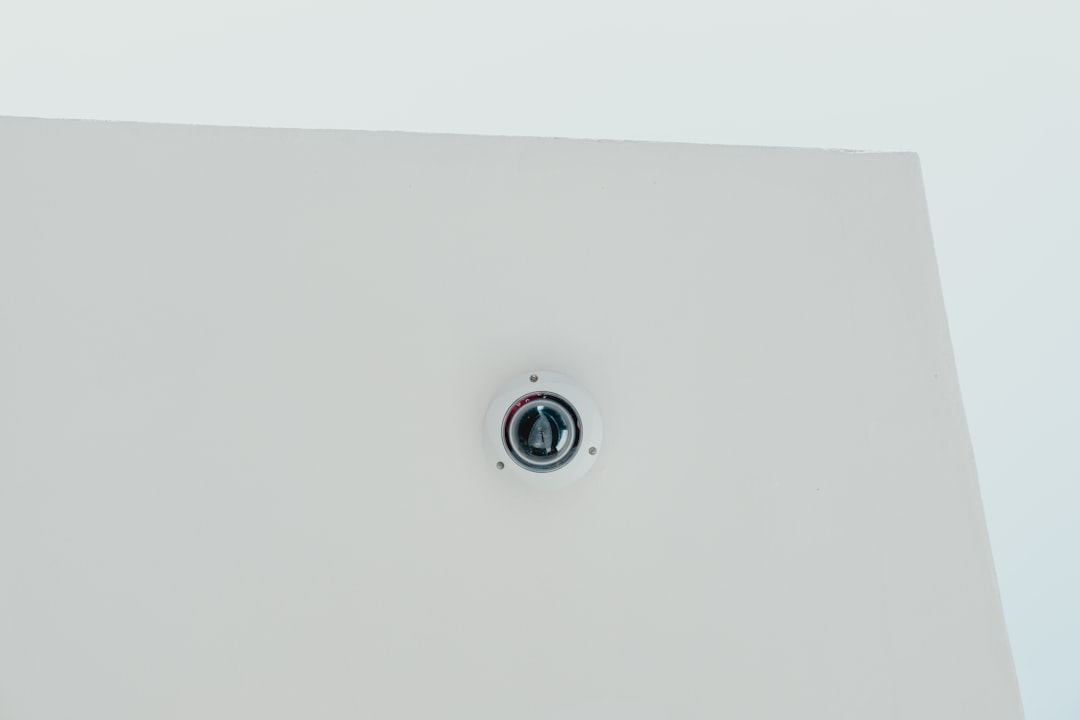
Indoors, a dome is still the right call more often than not — over a till, in a stairwell, along a loading dock (see our external vs internal camera guide if you’re deciding what needs outdoor coverage at all first). The rounded cover is harder to knock off-axis by hand than an exposed turret lens, which is exactly why it’s the housing we reach for in a space where the camera is within arm’s reach of the public.
Outdoors, a dome’s glass cover is the trade-off. In heavy rain or under a security light, the IR illuminators can reflect back off the inside of the dome and wash out the image. Every manufacturer’s dome camera shares this trait, because of the shape. It’s why we lean turret or bullet for anywhere rain or floodlight hits the lens directly.
The one spec that actually separates them: IR reflection
Resolution, AcuSense detection and app features are identical across the three housings in a given tier, so the practical difference comes down to how each shape handles its own infrared light at night. Turret and bullet housings expose the lens directly, so the IR beam goes straight out and doesn’t bounce back. Dome housings sit the lens behind curved glass, and depending on mounting angle and weather, some of that IR can reflect straight back into the sensor.
If you’ve ever seen a security camera image with a glowing white patch in the middle of an otherwise dark frame, that’s usually IR reflection off a dome’s inner glass, not a faulty camera. It’s the single biggest reason outdoor dome installs need more care around mounting angle than turret or bullet.
Does the housing limit your lens options?
Mostly no. Fixed and varifocal (adjustable zoom) lens versions exist across Hikvision’s AcuSense turret and bullet ranges, so a longer throw or a tighter field of view is a lens choice, not a reason to switch housing shape. In our experience, varifocal options turn up more often in turret and bullet models than in standard dome housings, which tend to ship fixed-lens only once you’re outside the PTZ (motorised) tier. If you’re not certain of the exact angle you’ll need until the camera’s actually mounted, that’s worth raising before you commit to a dome in that spot.
What Melbourne conditions do to each housing
We fit all three housings across the same postcodes, and the local conditions do shift the decision:
- A turret’s flat face gives a spider less to anchor a web to than a dome’s curved glass or a bullet’s forward lens ring. It’s one less thing to clean on a turret, though not a reason on its own to rule out dome or bullet.
- North-facing walls catching afternoon sun can wash out a dome’s image through the same glass that causes IR glare at night; a turret or bullet in that spot avoids the problem entirely.
- Dust isn’t a reason to pick one housing over another. All three AcuSense models carry an IP67 rating, so dust is handled at the sensor and seal level, not the shape.
- For strata or rental properties, a discreet turret or dome is usually the easier sell to a body corporate than a bullet’s more obvious housing, simply because it reads as less intrusive from a neighbour’s point of view.
Can you run turret, bullet and dome on the same system?
Yes. Because the three housings share the same sensor and recording platform, mixing them on one NVR is standard practice, not a workaround. We regularly spec a turret under the front eave, a bullet on the driveway post and a dome over the till inside, all recording to the same box, consistent with Hikvision’s own camera range notes on mixing housings.
If you’re mounting a camera somewhere fully sheltered, with no direct sun or rain ever reaching the lens, you don’t need to overthink the housing choice at all. A basic dome will do the same job as a premium turret in that one spot, and the saving is better spent on a second camera covering a blind corner.
What we’d install for common jobs
For a typical house, we default to turret cameras at the front and back eaves, with a bullet reserved for anyone who specifically wants the camera seen on an open boundary. For a shopfront, it’s usually an indoor dome over the counter and a turret or bullet covering the entry from outside. For a warehouse or yard perimeter, bullet cameras do most of the work along fence lines, with turrets picking up the areas directly under cover.
Where a client wants cameras, alarm and app notifications in one system rather than a standalone NVR setup, we point them to the Ajax camera range instead. It’s a different conversation to this one, but worth raising at the quote stage if that’s the direction you’re leaning. If you’re adding live monitoring to any of these, the camera housing choice doesn’t change anything on that side.
FAQ
Is a turret camera better than a dome camera?
Neither is “better” outright — a turret avoids the IR reflection a dome can get in rain or direct light, which is why we favour turret outdoors, while a dome’s covered lens suits indoor spots within reach of the public.
Is a bullet camera a better deterrent than a turret or dome?
Yes, by design. A bullet’s obvious housing is the most visible of the three, which is exactly why it’s the pick for a fence line or driveway where you want the camera noticed.
Do turret cameras get the same IR reflection problem as dome cameras?
No. Turret and bullet housings expose the lens directly, so there’s no curved glass for the infrared to bounce off. The reflection issue is specific to the dome shape.
Can I mix Hikvision turret, bullet and dome cameras on one recorder?
Yes. All three housings in a given AcuSense tier share the same sensor and recording platform, so mixing them on one NVR is standard, not a special setup.
Which Hikvision camera type should I use outdoors in Melbourne?
Turret or bullet for most outdoor spots, since neither has a dome’s glass to collect glare or rain reflection. Dome stays our pick for covered outdoor areas or anywhere indoors within reach of the public.
If you’re not sure which housing suits a specific wall, eave or fence line, that’s exactly what we walk through on a free site visit before any quote goes out.

