Security Cameras Outside House: The Complete Australian Homeowner Guide
Most break-ins start outside — a gate left unmonitored, a side path nobody checks, a front door approached in broad daylight because nothing’s watching. Outside house security cameras change that. A visible security camera outside house entry points does two jobs at once: it deters someone from trying in the first place, and it gives you usable footage if they do.
This guide covers the camera types worth considering, where to actually put them, weatherproofing requirements, and what a proper install of external house security cameras costs in Australia.
Why Install Outdoor Security Cameras Around the House
House security cameras outdoor use isn’t just about catching an intruder after the fact. The main reasons homeowners install them:
- Deterrence — a visible camera on the driveway or front door puts off a meaningful share of opportunistic break-ins;
- Parcel and delivery monitoring — porch theft is common enough that a front-facing camera pays for itself;
- Perimeter awareness — knowing when someone’s on the property before they reach the door;
- Evidence for police and insurance — clear footage speeds up both processes considerably;
- Remote check-ins — checking the property from work, from holidays, or from another state;
- Monitoring pets, kids and visitors — a secondary but common reason for backyard and driveway coverage.
Types of CCTV Cameras for House Outdoor Use
| Camera Type | Best For | Strengths | Limitations |
|---|---|---|---|
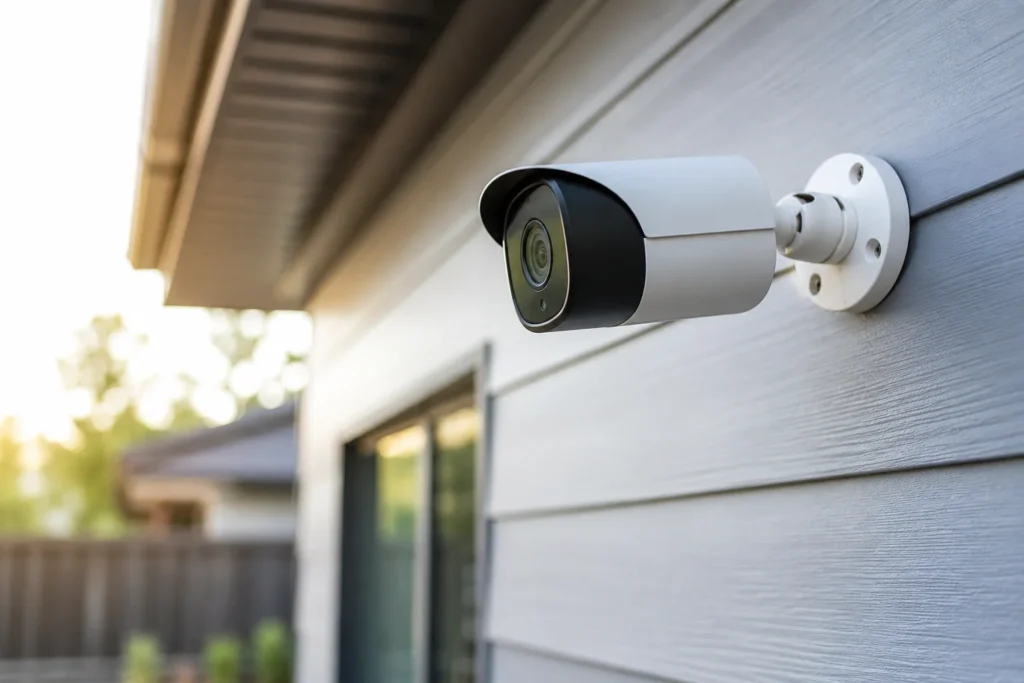
| Bullet camera | Driveways, side paths, long sightlines | Long-range clarity, clearly visible deterrent | Fixed angle, less discreet |
| Dome camera | Under eaves, porch ceilings | Hard to tell viewing direction, tamper-resistant options | Slightly shorter range than bullet types |
| Turret camera | Corners, gutter lines | Wide field of view, less glare in bright conditions | Less common in bundled kits |
| Video doorbell camera | Front door | Two-way audio, parcel and visitor monitoring in one unit | Narrower field of view than a dedicated camera |
| PTZ (pan-tilt-zoom) | Large blocks, acreage properties | Covers wide areas with one unit, active monitoring | Higher cost, more setup |
| Solar-assisted wireless camera | Gates, sheds, spots without power | No cabling needed, reduced battery maintenance | Depends on adequate sun exposure |
Where to Install CCTV Cameras Outside a House
Positioning is what separates a system that works from one that just looks like it does. Priority locations for cctv cameras on house exteriors:
- Front door and porch — a security camera for front of house coverage should capture visitors and deliveries clearly, not just movement;
- Driveway — covers vehicle access, the most common entry point for a break-in attempt;
- Side gates and paths — frequently the quietest, least-watched access route around a house;
- Rear entry doors — hidden from street view, a common target once someone is on the property;
- Garage and shed — separate structures that often have weaker locks than the main house;
- Backyard boundary line — useful where a fence line borders a laneway or public access;
- Ground-floor windows — particularly any obscured by fencing, hedges or garden beds.
A standard suburban block is usually well covered with four to six cameras spread across these zones. Larger or corner blocks typically need more.
Wired vs Wireless External House Security Cameras
| Factor | Wired | Wireless |
|---|---|---|
| Installation | Requires cable runs, more setup time | Faster, minimal drilling |
| Reliability | Not dependent on Wi-Fi signal | Performance tied to network strength at each camera |
| Power | Continuous, no charging | Battery or solar, needs periodic recharging |
| Best for | Permanent installs, high camera counts | Gates, sheds, rentals, spots without power access |
| Renters | Needs landlord approval for cabling | Easier to install without permanent changes |
Wireless security cameras outside house use has become the more common default for homeowners wanting a fast, low-disruption install, especially at gates and detached structures where running cable isn’t practical.
Features to Look For in Outside House Security Cameras
| Feature | Why It Matters Outdoors | Priority |
|---|---|---|
| Weatherproof housing (IP65+) | Handles rain, dust and temperature swings | Essential |
| Night vision / colour night vision | Covers the hours most break-ins occur | Essential |
| Motion-triggered alerts | Flags activity the moment it happens | High |
| Wide dynamic range (WDR) | Balances bright daylight against shaded porch areas | High |
| 1080p–4K resolution | Clear enough to identify faces and number plates | High |
| Two-way audio | Lets you speak to a visitor or warn off an intruder | Medium |
| Local + cloud storage | Protects footage if the camera or hub is damaged or stolen | High |
| Vandal-resistant housing | Useful for cameras within reach at ground level | Medium, site-dependent |
Weatherproofing and Durability for a CCTV Camera Installed Outside a House
Not every “outdoor-rated” camera survives an Australian summer or a wet Melbourne winter equally well. IP ratings tell you what a camera actually tolerates.
| IP Rating | Protection Level | Suitable Placement |
|---|---|---|
| IP54 | Splash and light dust resistance | Sheltered spots — under a deep eave, a covered porch |
| IP65 | Full dust protection, low-pressure water jets | Standard exposed outdoor placement — most homes |
| IP66 | Full dust protection, higher-pressure water resistance | Coastal areas, high-wind and high-rain regions |
| IP67 | Temporary submersion resistance | Rarely needed for residential use, common in industrial cameras |
For most Melbourne homes, IP65 covers standard exposure. Coastal properties or anywhere facing driving rain benefit from stepping up to IP66.
Best Placement for a Security Camera for the Front of House
Getting the front-of-house camera right matters more than any other single position, since it usually captures the most footage over time.
- Height — around 2.4–3m is high enough to avoid casual tampering, low enough to still capture faces clearly;
- Angle — aimed slightly downward across the walkway, not straight down at the doormat;
- Avoid backlighting — a camera facing directly into morning or afternoon sun washes out faces; angle it side-on to the sun’s path where possible;
- Cover the full approach — the path from the street or driveway to the door, not just the doorway itself;
- Combine with a doorbell camera — a wider driveway-facing camera plus a doorbell unit covers both distance and close-up detail.
Legal Considerations for Security Cameras Around the House
Installing security cameras around the house is broadly unrestricted in Australia when they’re pointed at your own property, but a few points are worth checking before installation:
- Neighbouring properties — most states restrict recording another person’s private activities without consent, even from your own land, so avoid angling cameras deep into a neighbour’s yard;
- Audio recording — some states apply stricter consent rules to audio than video, which matters for doorbell cameras with two-way audio;
- Shared driveways and fence lines — cameras covering shared access points can raise consent questions with neighbours sharing that space;
- Rental properties — tenants installing external house security cameras should check lease terms before drilling or permanently mounting anything.
Lighting and Seasonal Considerations
Outdoor cameras behave differently depending on the season and the light conditions around a specific spot on the house — something worth planning for rather than discovering after installation.
| Condition | Impact on Footage | How to Address It |
|---|---|---|
| Direct morning/afternoon sun on the lens | Washes out faces, creates silhouettes | Angle the camera side-on to the sun’s path rather than facing into it |
| Long summer daylight hours | More footage recorded during bright conditions | Confirm WDR handling is adequate for high-contrast scenes |
| Short winter days | More reliance on night vision and IR range | Check IR range covers the full monitored area, not just close range |
| Heavy rain or storms | Water droplets on the lens can trigger false motion alerts | Adjust motion sensitivity settings seasonally if false alerts increase |
| Bushfire smoke haze | Can reduce visibility and trigger unnecessary alerts | Temporary sensitivity adjustment during smoke events |
| Security lighting nearby | Can cause glare or overexposure at night | Position cameras to avoid facing directly into external floodlights |
None of this requires a different camera for every season — it’s mostly about getting the initial angle and sensitivity settings right during installation, then reviewing them once as the seasons change.
What Outside House Security Cameras Cost
| Setup Size | Camera Count | Typical Range (AUD) |
|---|---|---|
| Basic (front + driveway) | 2–3 cameras | $700 – $1,400 |
| Standard full perimeter | 4–6 cameras | $1,400 – $2,800 |
| Large block or multiple structures | 8+ cameras | $2,800+ |
Costs vary depending on whether cameras are wired or wireless, resolution, and whether the system includes cloud storage subscriptions.
Installing CCTV Cameras Outside a House: The Process
- Walk the property — identify entry points, blind spots, and areas with poor lighting;
- Choose camera types per location — wired for permanent coverage, wireless or solar for gates and sheds;
- Check weatherproof ratings — match IP rating to actual exposure at each mounting point;
- Mount at the correct height and angle — avoid backlighting and out-of-reach tampering risk;
- Configure motion zones and alerts — limit false triggers from street traffic or passing wildlife;
- Test footage in daylight and at night — confirm faces and number plates are actually identifiable, not just movement;
- Set up remote access — link cameras to a phone app for live viewing and alerts.
Maintaining Outdoor House Security Cameras
An outdoor camera left unchecked for a year or two rarely performs the way it did on day one. Weather, dust and general wear all take a toll on external house security cameras specifically, more so than anything mounted indoors.
- Lens cleaning — spider webs, dust and salt residue (in coastal areas) build up gradually and blur footage well before anyone notices;
- Housing checks — seals around wired connections can degrade over a few years of sun exposure, letting moisture in;
- Battery servicing — wireless units typically need a recharge or battery swap every 1–3 months depending on activity levels;
- Firmware updates — both cameras and recorders receive security patches that are easy to skip and important not to;
- Angle verification — wind, garden growth, or a knocked mount can shift a camera’s field of view without anyone realising until footage is needed;
- Storage confirmation — check that retention settings are actually holding the intended window, particularly after a firmware update resets defaults.
A quarterly check — even a quick one — catches most of these before they become the reason footage isn’t there when you need it.
Want security cameras outside your house placed where they’ll actually catch what matters? SIPKO Security assesses Melbourne properties on-site and builds external coverage around your home’s real entry points and blind spots, not a generic kit. Go to contacts

FAQ
What’s the best type of security camera for outside a house?
For most homes, a mix works best — a bullet or turret camera on the driveway for range, a dome camera under the porch eave for discretion, and a video doorbell for close-up entry monitoring. No single camera type covers every angle a house needs.
Do outside house security cameras need to be wired?
No. Wireless security cameras outside house installs have become common, particularly at gates, sheds and other spots without nearby power. Wired systems still suit permanent, high-camera-count installs better, especially for larger properties.
How high should a CCTV camera be installed outside a house?
Around 2.4 to 3 metres is the usual range — high enough to deter tampering, low enough to still capture clear facial detail rather than just the top of someone’s head.
Are cctv cameras on a house legal if they face the street?
Generally yes, since footage of a public street from your own property isn’t typically restricted. Issues arise when a camera is angled specifically to capture a neighbour’s private yard or windows rather than incidental street view.
How many cameras does a typical house need for outdoor coverage?
Most suburban blocks are properly covered with four to six cameras across the front door, driveway, side access and rear entry. Larger or corner blocks, or properties with a shed and separate garage, usually need more.
Can I install security cameras for outside my house myself?
Basic single-camera setups, particularly wireless or doorbell cameras, are often DIY-friendly. Full-perimeter coverage with multiple cameras, correct angle planning and weatherproof-rated wiring tends to perform better with a professional site assessment.