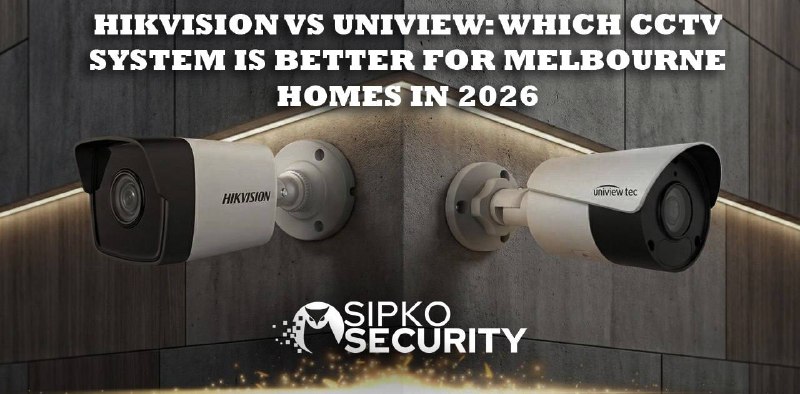
Hikvision vs Uniview: Which CCTV System Is Better for Melbourne Homes in 2026
Hikvision vs Uniview: Two leading Chinese CCTV manufacturers compete for Australian homes. We compare their night vision, AI features, pricing, and integration to help Melbourne homeowners decide which system delivers the best value.
Introduction: Choosing Between Hikvision vs Uniview for Your Home
The Hikvision vs Uniview debate ranks among the most common questions Melbourne homeowners ask when shopping for security cameras. Both brands manufacture advanced CCTV systems in Hangzhou, China. However, they target different needs and budgets in the Australian market.
Across Melbourne suburbs like Brighton, McKinnon, Moorabbin, and St Kilda, homeowners face similar challenges. Dark side passages, unlit driveways, and varying street lighting create conditions where standard cameras struggle. Consequently, some families need full-colour night footage to identify intruders clearly. Meanwhile, others want reliable monitoring without stretching their security budget.
SIPKO Security has installed Hikvision CCTV systems across inner and bayside Melbourne for more than a decade. Therefore, the team sees firsthand how these cameras handle salty coastal air, extreme summer heat, and low-light conditions. This practical experience shapes how the company approaches comparisons for residential clients.
This guide examines image quality, night vision technologies, artificial intelligence capabilities, pricing structures, and cybersecurity considerations. Additionally, it explores local support networks. By the end, readers will understand which brand suits their specific Melbourne property rather than relying on generic online reviews.
“
CCTV should support how people live and work, not the other way around.
— Professional security design principle
Understanding Hikvision vs Uniview: Brand Overview in Australia
The Hikvision vs Uniview comparison begins with understanding that both manufacturers represent serious players in the professional security industry. They are not generic imports. Additionally, both maintain strong Australian distribution networks, warranty support channels, and established relationships with professional installers across Melbourne.
Hikvision’s Market Position
Hikvision stands as the world’s largest CCTV manufacturer. Consequently, it invests heavily in research and development. This commitment shows in an extensive product catalogue. It ranges from basic fixed-lens cameras suitable for Brighton townhouses through to specialized analytics cameras. These are designed for car parks, warehouses, and retail environments. Hikvision systems carry the feel of professional-grade tools adapted for residential use rather than consumer products scaled up.
Uniview’s Competitive Strategy
Uniview has emerged as the fast-growing challenger in the security market. The company focuses on delivering strong specifications and useful AI features. Furthermore, it achieves this at price points that appeal to homeowners and small businesses. Within Australia, Uniview now maintains clear distribution presence through local wholesalers. This ensures spare parts availability, firmware support, and warranty repairs proceed smoothly.
Despite sharing origins in Hangzhou, China, their strategies diverge significantly:
- Hikvision targets the premium and professional market segments where industry-leading low-light imaging and advanced AI analytics matter most
- Uniview concentrates on buyers seeking strong performance at sensible costs who may not require every premium feature available
Why SIPKO Security Recommends Both Brands
SIPKO Security chose to build residential installations primarily around Hikvision for several practical reasons. Hikvision’s IP67-rated cameras withstand Melbourne rain and summer heat effectively. ColorVu night performance provides significant advantages in bayside streets with limited lighting. The integration between Hikvision equipment, AJAX wireless alarms, and Aiphone intercoms suits the comprehensive security systems the company designs.
Nevertheless, the team monitors Uniview’s development closely. This helps provide balanced guidance when clients ask about Hikvision vs Uniview for their specific properties.
Hikvision vs Uniview Image Quality: 4K Performance Compared
Image quality forms the foundation of any Hikvision vs Uniview evaluation. Cameras that fail to capture number plates or facial details during incidents serve limited security value. This remains true regardless of other features.
Resolution and Clarity
Both brands manufacture cameras reaching 4K Ultra HD resolution at 8 megapixels. This specification provides more than adequate detail for typical Melbourne residential applications. Whether monitoring front doors in McKinnon or shared driveways in Moorabbin, the results impress. In practical deployment, both brands produce crisp footage. Operators can pause playback and clearly identify relevant details.
Compression Technology
Both manufacturers implement smart compression technologies such as H.265+. These reduce file sizes while maintaining image clarity. This capability matters significantly when systems run six or eight 4K cameras recording continuously. Effective compression reduces strain on network video recorders and home networks. Moreover, it achieves this without degrading footage into unusable blur.
Where Hikvision Advances
Hikvision advances slightly ahead in image tests. This relates to breadth of options and fine-tuning capabilities:
- More models available across different resolutions and lens configurations
- More sophisticated image processing handling backlighting, shadows, and mixed lighting conditions
- Additional controls for wide dynamic range and noise reduction adjustments
Uniview maintains a tighter product range that still performs excellently for most residential applications. However, it offers somewhat less variety for challenging installation locations.
For standard Brighton or St Kilda homes, both brands deliver sufficient resolution. The significant performance gap emerges when ambient light levels drop substantially. This explains why night vision receives dedicated analysis in this guide.
Hikvision vs Uniview Night Vision: The Critical Differentiator
Most security incidents occur after dark. In Melbourne suburbs, this might involve someone checking unlocked vehicles in quiet courts. They may move along house sides or navigate dim rear laneways. This reality explains why comparisons pay particular attention to night performance.
Traditional Infrared Limitations
Traditional infrared night vision operates by flooding scenes with invisible IR light. Simultaneously, it switches images to black and white. This approach improves on complete darkness. However, it often produces grainy, flat footage. Faces blur into grey masses. Additionally, dark clothing blends into backgrounds. When police request footage following incidents, such clips provide less assistance than property owners expect.
Modern Night Vision Technology
Modern night vision technology focuses on maintaining colour as long as possible. At the same time, it minimizes noise. This area represents where both brands have invested substantially. Furthermore, it’s where the performance gap becomes most apparent.
Hikvision’s Low-Light Technologies
Hikvision employs two primary approaches for low-light conditions. Both prove highly relevant to Melbourne homes on dark streets:
DarkFighter
DarkFighter cameras target scenes with minimal ambient light. Examples include streetlights at driveway ends or subtle garden illumination. These cameras use larger sensors and intelligent processing. Consequently, they generate very clean images even when human eyes struggle to see clearly. The result produces black-and-white video showing distinct shapes, faces, and number plates. Moreover, it achieves this without typical noise interference.
ColorVu
ColorVu technology advances further. It represents a major factor in the decision for many buyers. ColorVu cameras utilize very bright F1.0 lenses and sensitive sensors. Therefore, they capture far more light than standard cameras. In truly dark conditions, cameras activate small warm-white LEDs. This illumination remains gentle enough not to disturb neighbours. At the same time, it provides sufficient light for cameras to maintain full-colour recording.
Across Brighton and Moorabbin installations, SIPKO Security has observed ColorVu cameras transform near pitch-black driveways. They make scenes resemble early evening. The ability to confirm that vehicles were red, hoodies were blue, and intruders wore white runners makes substantial differences. This stands in contrast with grey shadows moving past cameras.
Uniview’s LightHunter Technology
Uniview’s response comes through LightHunter technology in the night vision comparison. This system also employs more sensitive sensors and advanced processing. Therefore, it maintains colour video in low-light conditions. In areas with some existing lighting, LightHunter cameras produce bright, clear footage. Examples include front yards with porch lights or streets with decent lamp coverage. Furthermore, they achieve significantly less noise than basic IR cameras.
For many Melbourne homes, this performance level proves perfectly adequate. Properties already maintain reasonable lighting. Additionally, primary objectives involve seeing who approached front doors or moved through side gates. In these cases, LightHunter works well. From a value perspective, Uniview performs strongly in this category.
Performance in Extreme Darkness
When conditions become very dark, Hikvision ColorVu maintains an edge. This applies particularly in long side paths or large backyards without any ambient light. In the harshest conditions tested, ColorVu simply produces brighter, more colour-accurate images than LightHunter. This performance trade-off at night represents one primary reason some families choose to invest more in Hikvision systems.
Hikvision vs Uniview AI Features: Reducing False Alarms
Traditional motion detection triggers alerts whenever trees sway or moths fly past lenses. As a result, people quickly stop checking notifications. This reduces systems to expensive recorders. A significant component of the comparison examines how effectively each brand uses AI to eliminate false alarms.
How Modern AI Detection Works
Modern deep-learning AI distinguishes between people, vehicles, and everything else. Instead of requesting cameras alert on any pixel change, systems can now notify only when specific events occur. For example, they trigger when people walk into driveways or vehicles enter designated zones. This capability transforms CCTV from passive recording tools into active security components.
Uniview’s AI Capabilities
On the Uniview side, AI feature sets prove strong enough for most residential and small business applications. Many Uniview cameras include smart motion detection. This understands general movement patterns. Additional features include:
- Virtual lines and intrusion zones triggering alerts when people cross fence lines or enter restricted areas
- Options to focus on people or vehicles, reducing alerts from pets and plants
Uniview labels some AI models under names like AlphaView. This describes cameras that improve accuracy as they observe more real-world scenes. Higher-end Uniview models also employ Tri-Guard technology. This combines AI detection with active responses. When cameras determine someone occupies unauthorized locations, they can flash lights and play warning sounds. This proves useful for deterring potential intruders.
In everyday Melbourne applications, Uniview’s AI performs well. Examples include detecting people approaching driveways in McKinnon or entering rear carports in Moorabbin. It reduces random triggers sufficiently. Therefore, homeowners trust and check alerts.
Hikvision’s Advanced AI and AcuSense
Hikvision advances AI capabilities further. This represents a significant factor when evaluating for busier homes or small business sites. AcuSense technology uses deep-learning models trained specifically to distinguish people and vehicles from everything else. This precision means cats, flying birds, or moving branches very rarely trigger false alarms.
Beyond basic detection, Hikvision offers more detailed analytics including:
- Loitering detection
- People counting through doorways
- Number plate recognition for vehicle gates and driveways
While these features commonly appear in commercial installations, they also benefit larger homes. Additionally, they suit multi-tenant properties across inner Melbourne.
Integration Benefits
For SIPKO Security clients, one noticeable difference involves how reliable alerts feel when AcuSense operates correctly. Notifications for people or vehicles prove far more dependable. Consequently, this simplifies CCTV integration into AJAX alarms or smart devices. For example, Hikvision cameras can notify AJAX systems when people enter yards. This prompts push alerts and potentially activates external lights through smart assistants. This automation works best when AI operates with high accuracy. Therefore, many homeowners perceive value in paying more for Hikvision.
⚠️ Important Note:
Professional installation matters significantly regardless of brand choice. Cameras mounted at incorrect angles, misconfigured AI zones, or default passwords left unchanged can undermine even premium systems. SIPKO Security completes most residential installations within 24 to 48 hours of initial site visits. This ensures correct placement and secure configuration.
Hikvision vs Uniview : Installation, Usability, and Remote Access
Many people approach Hikvision vs Uniview comparisons focusing solely on cameras and recorders. However, experience shows that installation quality and day-to-day usability matter equally to specification sheets.
Uniview’s Plug-and-Play Approach
Uniview equipment receives praise for straightforward plug-and-play pairing. This applies when using Uniview cameras with Uniview NVRs. Recorders can discover cameras on networks. Furthermore, they add them with minimal manual configuration. This feels approachable to installers and people who enjoy technical projects. For straightforward systems where all equipment comes from Uniview, setup processes usually proceed smoothly.
Hikvision’s Configuration Flexibility
Hikvision installations can involve more configuration steps. More options exist within NVR menus. Additionally, more settings require tuning. This additional work provides greater flexibility ultimately. This proves especially true when mixing different Hikvision product ranges. It also applies when linking Hikvision with AJAX alarms and Aiphone intercoms.
Why Professional Installation Matters
Regardless of brand choice in the debate, professional installation receives strong recommendation. DIY installations often suffer from:
- Cameras mounted too high or at incorrect angles
- Blind spots at side gates or rear entries
- Default passwords remaining unchanged
- Misconfigured AI zones sending alerts throughout nights
Mobile Applications and Remote Access
App experience forms another key component of daily life with Hikvision vs Uniview. Users want to check cameras quickly from phones. Additionally, they want to locate needed information without tapping through endless menus.
Uniview EZView
Uniview uses the EZView app for live view, playback, and push alerts. The layout remains simple. Consequently, most people understand it within minutes. For families preferring straightforward approaches, EZView feels easy and reliable. This applies whether checking front doors, monitoring children arriving home, or investigating driveway noises.
Hikvision Hik-Connect
Hikvision uses the Hik-Connect app. This offers more settings and deeper control. It means more options for fine-tuning alerts, picture quality, and smart features directly from phones. However, it comes with steeper learning curves. Some users find it somewhat busy initially. Nevertheless, once configured it proves very powerful.
As part of every installation, SIPKO Security configures apps on phones and tablets. They demonstrate key features and test notifications before leaving properties. Because the same specialist who installed systems answers subsequent support calls, no overseas call centres intervene. Instead, clients receive just local assistance when adjustments become necessary.
Hikvision vs Uniview Smart Home Integration
Another important angle involves smart home integration. More Melbourne homes now feature smart speakers. Additionally, they include app-controlled lighting and wireless alarms such as AJAX.
Hikvision’s Integration Advantages
Thanks to substantial market share, Hikvision receives support from more third-party platforms and software. It integrates well with many video management programs. Furthermore, it works with popular assistants such as Google Home and Alexa. SIPKO Security frequently connects Hikvision CCTV with AJAX wireless alarms and Aiphone video intercoms. As a result, unified systems can display camera feeds, arm or disarm alarms, and manage access. This depends on how homeowners want systems to operate.
Uniview’s Integration Capabilities
Uniview can integrate in certain cases. However, it does not yet match Hikvision’s breadth of options. For people wanting simple standalone CCTV systems, this rarely creates problems. On the other hand, for those building tightly linked smart homes, Hikvision tends to advance ahead in the choice.
Hikvision vs Uniview Pricing: Understanding the Investment
Price often becomes the first consideration people raise when asking about Hikvision vs Uniview. Hikvision generally costs more, sometimes by noticeable margins. Therefore, that difference requires justification.
Melbourne Installation Pricing Guide
As rough guides for supplied-and-installed systems in Melbourne:
- Four-camera Uniview systems with 4K cameras and suitable NVRs may range around $1,200 to $1,800. This depends on cable routes and property types.
- Similar Hikvision setups with ColorVu and AcuSense often range from approximately $1,800 to $2,800 under the same conditions.
Uniview’s Value Proposition
Uniview often costs around thirty to forty percent less for similar basic specifications. For families wanting professional installation and good quality without reaching into premium features, that price gap proves attractive. Uniview still delivers clear video, LightHunter low-light performance, and solid AI features. Moreover, it’s backed by strong local warranties.
Why Hikvision Costs More
Hikvision commands more in the comparison because equipment usually provides better performance in the toughest conditions. Additionally, it offers deeper toolsets. This includes brighter colour footage on very dark nights. It also features fewer false alarms through AcuSense, more models for special requirements, and wider integration options. For people valuing these gains and wanting systems closer to commercial-grade performance, higher upfront investment can make sense.
SIPKO Security’s Transparent Approach
SIPKO Security maintains transparent quotes free from long locked-in contracts. The team explains trade-offs in straightforward terms. Furthermore, they factor in each property’s layout, lighting, and risk profile. In some cases Uniview makes sense. This applies especially for rentals or secondary dwellings with lower risk. However, in many owner-occupied homes with dark yards, Hikvision’s added strengths justify extra costs.
Hikvision vs Uniview : Cybersecurity, Warranty, and Local Support
Cybersecurity and privacy concerns represent another component of Hikvision vs Uniview that surfaces frequently. Both brands originate from China. Additionally, Hikvision particularly has appeared in overseas news regarding government restrictions on certain public projects.
Hikvision’s Security Concerns
Hikvision has faced more government-level attention. This occurred especially in the USA and UK. Some public bodies ceased using equipment for political and security reasons. In response, Hikvision invested more effort in security testing. They improved firmware and created clearer privacy controls. Nevertheless, some buyers remain concerned. This is because the brand name appears so widely in discussions.
Uniview’s Lower Profile
Uniview has not attracted the same level of political focus. Systems still include strong security features. However, the brand sits outside most public debates. For homeowners feeling uncomfortable with headlines around the comparison, that quieter profile can provide reassurance.
Practical Security Steps for Melbourne Homes
From practical perspectives on Melbourne home networks, both brands can operate safely. This requires correct setup. This means:
- Changing default passwords
- Keeping firmware current
- Using strong passwords or passphrases
- Where possible, keeping CCTV devices on separate network segments
As part of every installation, SIPKO Security hardens systems. They disable unneeded features and configure secure remote access. This prevents leaving open ports for random scanners to discover.
Warranty and Support
Warranty and support prove strong on both sides in Australia. Uniview commonly offers three-year warranties on cameras and recorders. Hikvision ranges usually provide two or three years. This depends on exact models and local importers. The key involves purchasing through authorized Australian channels. Cheap imports from overseas websites may appear tempting. However, they often arrive without local warranties, local firmware, or proper support. This potentially creates expensive problems later.
With SIPKO Security, the same person who planned and installed systems remains the point of contact for support. The company offers regular maintenance checks, camera cleaning, storage health checks, and firmware updates. Additionally, they provide 24/7 local phone support when issues arise.
Which CCTV System Should Melbourne Homeowners Choose in 2026?
By this point, it should be clear that Hikvision vs Uniview does not represent a simple good versus bad choice. Both brands can protect Melbourne homes effectively when installed and configured properly. The better fit depends on budget, lighting conditions, feature requirements, and intended system usage.
Choose Uniview if:
- Price represents a major factor. Additionally, the goal involves obtaining strong security without paying for every advanced feature.
- Homes already maintain good street and yard lighting. Therefore, LightHunter cameras provide more than adequate low-light performance.
- Simpler app experiences appeal. Furthermore, EZView keeping remote access straightforward sounds attractive.
- Landlords want good but cost-effective camera systems for rental properties or secondary dwellings.
Choose Hikvision if:
- Properties have very dark areas. Examples include long unlit side paths, deep backyards, or carports with no ambient lighting.
- ColorVu cameras with AcuSense AI for clear colour detail at night sound valuable. Additionally, fewer false alerts from pets or plants prove important.
- Building connected systems where CCTV links with AJAX wireless alarms, Aiphone intercoms, and smart speakers.
- Best possible performance and tighter integration matter. Furthermore, higher upfront spending feels comfortable.
For most owner-occupied houses across Brighton, St Kilda, McKinnon, and Moorabbin, Hikvision’s low-light and AI benefits justify extra costs. This applies especially around driveways and entrances. That said, in rental homes, light commercial spaces with good lighting, or lower-risk locations, Uniview can represent the better value choice in the debate.
Conclusion
Hikvision vs Uniview represents one of the most common questions Melbourne homeowners ask. The honest answer confirms that both brands prove capable. Each can deliver 4K footage, smart motion detection, and steady day and night coverage. However, this requires professional installation. The choice comes down to how much value someone places on premium night vision, deeper AI features, and wide integration.
Hikvision leads in low-light performance with ColorVu and DarkFighter technologies. Additionally, it excels in AI with AcuSense and other analytics. It also offers wider integration with AJAX alarms, Aiphone intercoms, and smart home platforms.
Uniview stands out in the comparison for price and simplicity. LightHunter cameras offer very good low-light performance in many suburban conditions. Meanwhile, the EZView app keeps remote access simple.
That extra performance comes at higher prices though. This explains why some families and landlords lean toward Uniview instead. For people wanting professional CCTV without stretching budgets, it can represent a very sensible option.
SIPKO Security does not simply push the most expensive equipment. The team examines each property in Brighton, St Kilda, McKinnon, or Moorabbin. They discuss lighting, risk, and budgets. Then they recommend systems that make sense. The same specialist designs, installs, and supports systems. Furthermore, no overseas call centres are involved.
If weighing Hikvision vs Uniview for homes or rentals, reaching out for clear, obligation-free conversations helps map out the right path. For more information on other CCTV brand comparisons, check out our detailed guide on Hikvision vs Dahua for Australian homes and businesses.
Ready to Choose Your CCTV System?
If weighing Hikvision versus Uniview for homes, shops, or rental properties in or around Brighton, SIPKO Security stands ready to help. Reach out for personal site assessments. Speak with the same local team that installs and supports systems.
📞 Contact SIPKO Security for a free consultation
💡 Pro Tip:
Well-designed, professionally installed Uniview systems will outperform badly installed Hikvision setups every time. Focus first on correct camera placement, secure configuration, and clear user training. Only then fine-tune brand selection based on lighting conditions and integration requirements.
Frequently Asked Questions about Hikvision vs Uniview
QCan I mix Hikvision cameras with a Uniview NVR, or the other way around?
Mixing equipment across Hikvision vs Uniview proves possible. This is because both support common network video standards. In practice, setup becomes more complicated. Additionally, some advanced AI or smart functions may not work when brands mix. For most homes, using cameras and NVR from the same brand keeps things stable and easy to support. Professional installers can work with mixed systems when needed. However, they will explain trade-offs first.
QHow much does a four camera Hikvision vs Uniview system cost in Melbourne?
Prices vary by camera model, cable length, and property type. However, patterns exist in Hikvision vs Uniview pricing. Four-camera Uniview systems with 4K cameras and NVRs, fully installed, often land around $1,200 to $1,800. Similar Hikvision systems with ColorVu and AcuSense commonly sit between $1,800 and $2,800. SIPKO Security provides clear quotes upfront. Furthermore, they match systems to both sites and budgets.
QAre there cybersecurity concerns with Chinese CCTV brands like Hikvision and Uniview?
Hikvision has appeared in overseas news. Additionally, it faced some government bans on public projects. This often surfaces in Hikvision vs Uniview discussions. Uniview has not seen the same level of public debate. For home use, when systems receive setup with strong passwords, current firmware, and careful remote access, both brands operate safely. As installers, SIPKO Security locks down default settings. They close unneeded access paths. Furthermore, they keep clients informed about updates. For anyone still worried about headlines, Uniview can feel like safer choices emotionally.
QDo I need professional CCTV installation, or can I install Hikvision or Uniview cameras myself?
Both brands sell DIY-friendly equipment. However, many problems arise when complex systems receive self-installation. Common issues across Hikvision vs Uniview DIY jobs include cameras mounted in wrong places. Additionally, blind spots near side gates, poor cable terminations, and unsecured remote access occur frequently. Professional installation means cameras get placed correctly. Furthermore, recorders get tuned, AI zones work as intended, and privacy rules get followed. With SIPKO Security, most residential installs finish within one or two days. Moreover, support remains just a call away.
QWhich brand works better with AJAX alarms and smart home systems?
Hikvision usually proves the better partner for integrated systems in the Hikvision vs Uniview choice. Its devices connect well with AJAX wireless alarms, Aiphone video intercoms, and popular smart assistants. This allows joined-up control from one or two apps. SIPKO Security often designs systems where Hikvision cameras, AJAX sensors, and intercoms all work together. This depends on how properties operate each day. Uniview integration improves but remains more limited. Therefore, it suits people wanting capable standalone CCTV systems rather than tightly linked smart home setups.
Sources
- Australian Bureau of Statistics – Crime and Justice
- Australian Institute of Criminology – CCTV study on domestic & family violence
- ACT Government – Closed Circuit Television Network
- ACT Government – Public Safety CCTV Network
- Australian Institute of Criminology – Closed circuit television (CCTV) as a crime prevention measure
- Australian Institute of Criminology – CCTV use by local government survey
- Australian Institute of Criminology – Open‑street CCTV in Australia
- Western Australian Government – Registration of CCTV Systems