
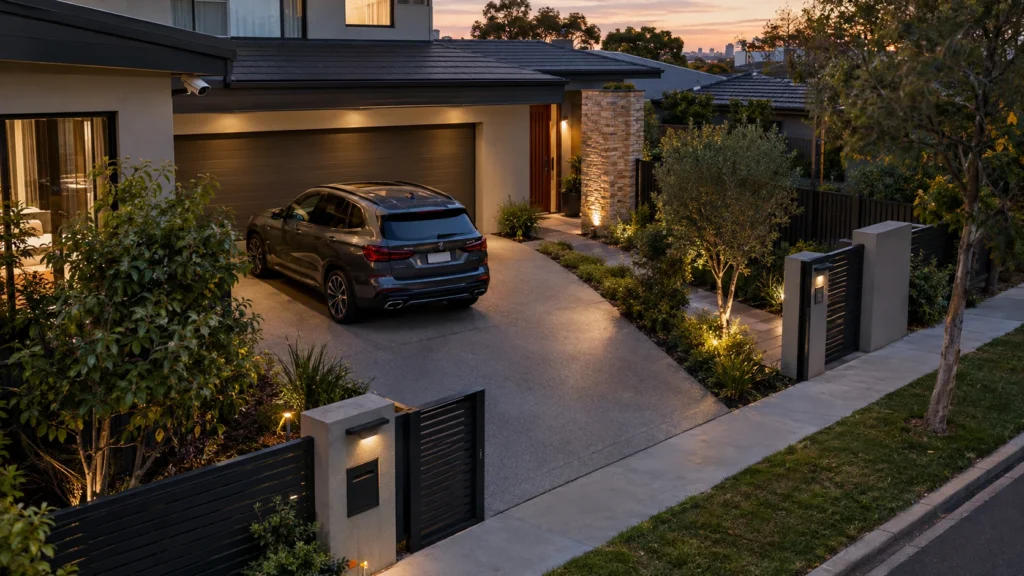
A camera pointed at the driveway can see the car. Whether it changes the odds of that car being stolen is a different question — and the honest answer isn’t simply yes or no.
Research suggests CCTV can contribute to reductions in vehicle crime, and vehicle-related crime has historically been one of the areas where CCTV has shown relatively strong effects. But that doesn’t mean installing a camera on a Melbourne driveway will stop a particular vehicle from being stolen. CCTV works best as one layer within a broader vehicle and property-security strategy, not as a stand-alone answer.
Two different kinds of evidence get mixed together when this question comes up. One is Victorian crime data, which shows what’s happening to vehicle theft in the state. The other is research into whether CCTV itself changes offending behaviour. They answer different questions, and this article keeps them separate.
Does CCTV Actually Stop Car Theft?
“Stop,” “deter,” “reduce” and “record” aren’t the same claim, and it’s worth being precise about which one the evidence actually supports.
The most comprehensive answer comes from 2019 systematic review and meta-analysis by Piza, Welsh, Farrington and Thomas, which examined 80 CCTV evaluations spanning 40 years. It found CCTV associated with a significant but modest reduction in crime overall. The largest and most consistent effects appeared in car parks, with significant reductions also found in other settings — particularly residential areas. Systems using active monitoring performed better than passive ones, and CCTV deployed alongside other security measures performed better than CCTV used alone. The review’s own policy conclusion is explicit: CCTV works best narrowly targeted at vehicle and property crime, and shouldn’t be deployed as a stand-alone crime-prevention measure.
That’s a genuinely supportive finding for vehicle-related CCTV — but it’s an association found across many evaluations in many settings, not a guarantee for any single driveway.
What the Research Actually Found About Vehicle Crime
The numbers behind this research are worth seeing directly, because they’re often quoted without enough context.
These are three distinct figures, not three ways of stating the same result. The 26% reduction relates specifically to vehicle crime across 22 evaluations. The 51% figure relates to car-park settings across all crime types measured there. The 16% figure is a broader pooled effect across every setting in that review, not a vehicle-theft-specific number. Using them interchangeably — or presenting any of them as an individual household’s expected risk reduction — goes beyond what the research supports.
The 22 vehicle-crime evaluations also varied substantially from each other statistically, which is itself informative: results differed enough between studies that a single pooled percentage shouldn’t be read as a reliable individual-property outcome. Not every later analysis has found the same setting-specific pattern, either — subsequent review by Alexandrie in 2017 found reductions in some public-street and transport settings but no clear effect in parking facilities, a result that diverges from the earlier reviews. That variation is itself part of the honest picture: effects differ by setting, and settings aren’t interchangeable.
Why Those Percentages Are Not a Promise for Your Driveway
The strongest results in this research come almost entirely from car parks — and a public car park has very little in common with a private Melbourne driveway.
Car-park evaluations often involved more than CCTV on its own. Several of the strongest results came from schemes that combined cameras with lighting upgrades, fencing, or on-site security staff, which means the isolated effect of the camera itself often can’t be separated from the effect of everything installed alongside it. Monitoring type varied too — some systems were actively watched in real time, others were passive recording only, and Piza et al. found active monitoring produced larger effects. None of that describes a typical residential setup, where a single camera usually isn’t being actively monitored by anyone in real time.
None of this means residential CCTV has no value — the same research found significant effects in residential settings too. It means the specific percentage reductions from car-park and multi-measure studies don’t transfer directly to “install this camera and your risk drops by this amount.”
What Is Happening With Vehicle Theft in Victoria?
According to Victoria Police’s release of Crime Statistics Agency data for the year ending March 2026, motor vehicle theft — the vehicle itself being stolen — reached 31,851 offences, up 1% on the previous year and the highest level since 2001–02. Theft from motor vehicles — property stolen from inside a vehicle, a separate offence category — was recorded at 80,786 offences, down 2% over the same period.
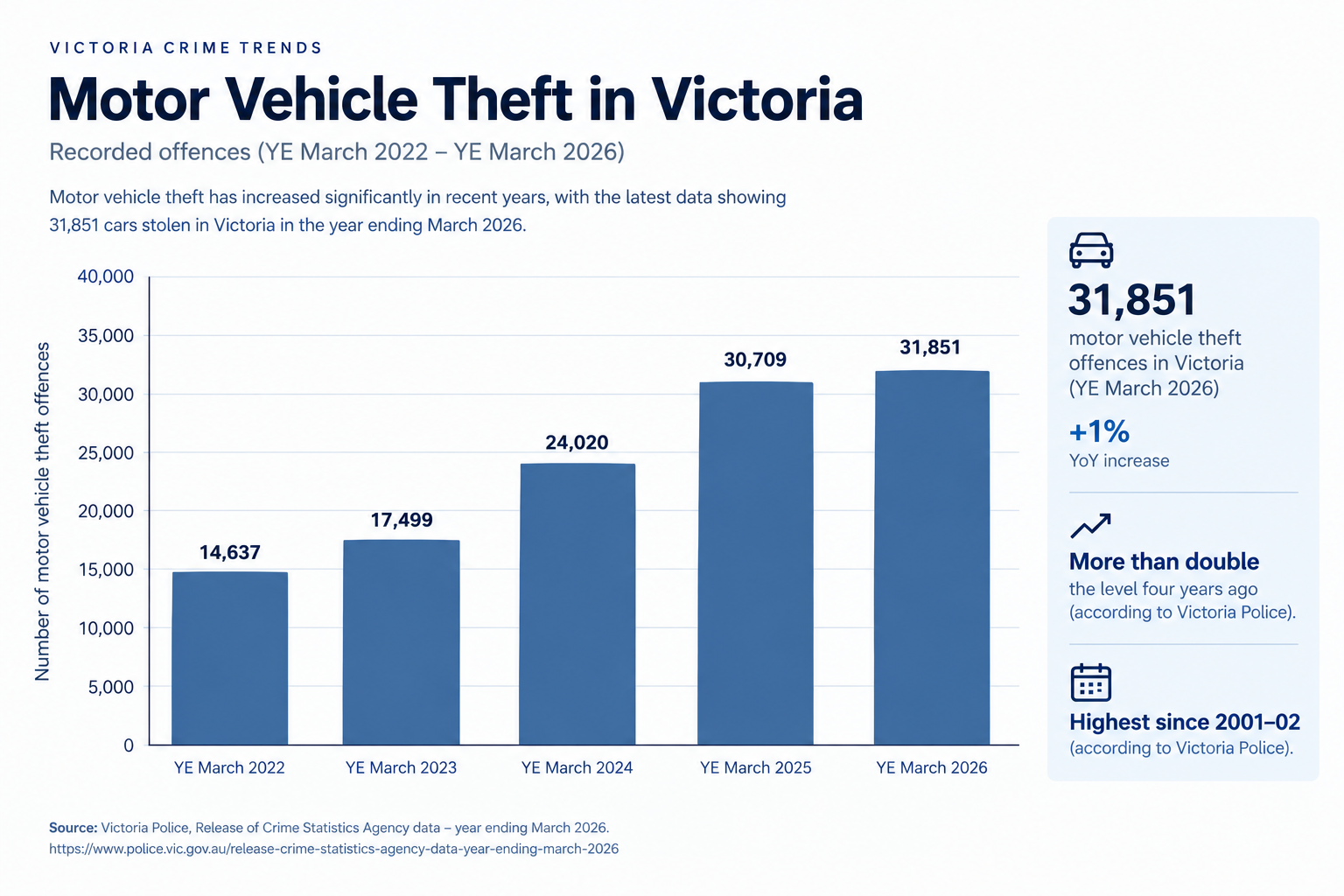
These are two different things, and the distinction matters for understanding the problem:
Motor vehicle theft means the vehicle itself is taken.
Theft from a motor vehicle means property is taken from inside or from the vehicle, while the vehicle itself remains.
This local context explains why the question matters to Melbourne homeowners specifically. It doesn’t, on its own, say anything about whether CCTV changes the outcome for an individual property — that’s a separate question, answered by the research above, not by the trend data.
Modern Car Theft Changes What CCTV Can and Cannot Do
Modern electronic vehicle theft also changes the limits of what a property camera can control.
Victoria Police has stated that more than 10,000 vehicles are stolen using electronic devices in Victoria each year. Victoria Police also describes electronic theft methods affecting some vehicles with push-start technology, including key mimicking, cloning and reprogramming that can override a vehicle’s own security system without the offender needing to force entry in any visible way.
That has a real implication for CCTV’s role. A camera can observe a vehicle’s surroundings and record activity near it. It cannot physically prevent a vehicle from being unlocked, started or driven away once an offender has bypassed its electronic security. CCTV operates at the property-surveillance layer. Vehicle-specific measures — an OBD port lock, key protection, immobilisers — operate at the vehicle-security layer, and they’re addressing a different part of the problem.
Where CCTV Can Help Around a Melbourne Driveway
None of this means CCTV has no place in protecting a vehicle at home — it means understanding what it can realistically contribute.
Victoria Police’s own guidance recommends parking off the street where possible, and for a car parked in a driveway, specifically suggests considering the installation of a sensor light and CCTV. That’s a genuine, current recommendation from the agency responsible for vehicle-theft prevention in Victoria — worth taking seriously, while being clear it’s a recommendation to consider, not evidence that the combination reliably prevents theft in every case.
Where CCTV can realistically help:
- observing who or what approaches the driveway
- recording the approach and exit path around a parking area
- contributing to deterrence under some conditions, although research shows that outcomes vary substantially by deployment and setting
- providing evidentiary footage if an incident does occur, supporting a police report even when prevention hasn’t worked
Deterrence and post-incident evidence are genuinely different functions. A camera that didn’t stop a theft can still be valuable for what it recorded — those are separate outcomes, not one failed promise.
A Camera Pointing at Your Car Is Not Necessarily a Useful Car-Theft Camera
This is where a lot of driveway CCTV setups fall short in practice, and it’s a genuinely different question from whether CCTV research supports using cameras at all.
A car being visible somewhere in the frame isn’t the same as the footage being useful if something happens. A useful driveway CCTV design needs to account for:
- the route someone would take to approach the vehicle
- the front boundary, gate and driveway entrance
- likely entry and exit directions
- mounting height and viewing angle
- night-time lighting, headlights and backlighting
- trees, columns, gates or the parked vehicle blocking important sightlines
- whether the subject is large enough in the frame to provide useful detail
- reliable recording, playback and footage export
Camera resolution alone doesn’t guarantee that a face or number plate will actually be identifiable in the conditions that matter — distance, lighting angle, and the subject’s size within the frame all affect that outcome, not the megapixel count on a spec sheet. For homeowners considering security camera installation in Melbourne, the practical question isn’t simply how many cameras to install, but whether the driveway, approach routes, lighting and recording setup actually produce coverage that’s useful when it’s needed.
CCTV Works Better as One Layer of Vehicle Security
The research and Victoria Police’s own guidance point toward the same conclusion: CCTV is one part of a layered approach, not a substitute for the other layers.
Property layer
- secure garage or gate
- sensor lighting
- CCTV coverage
- property-level alarm or motion detection where relevant
Vehicle layer
- lock the vehicle
- protect keys from cloning or reprogramming
- OBD port protection where the car has electronic push-start technology
- immobilisers and other vehicle-specific anti-theft devices
Behaviour layer
- lock doors and close windows every time
- keep keys away from accessible entrances and windows
- secure the garage or gate
- remove valuables from view
CCTV adds another layer of information and deterrence; it does not replace basic vehicle-security measures.
Frequently Asked Questions
Does CCTV deter car thieves?
Research associates CCTV with a modest overall reduction in crime, with some of the strongest and most consistent effects specifically in vehicle-related and car-park settings. That supports CCTV as a potentially useful deterrent, but the effect varies by setting and isn’t guaranteed for any individual property.
Will CCTV stop someone stealing a car from my driveway?
There’s no guarantee. CCTV can contribute to a property’s overall security, particularly alongside other measures like lighting and vehicle-specific protection, but the research doesn’t support treating a single driveway camera as a reliable stand-alone deterrent.
Where should a security camera be positioned to protect a driveway?
Useful positioning depends on the approach path, the front boundary, lighting conditions at night, and avoiding obstructions like vegetation or the parked vehicle itself blocking the relevant sightline — not a single universal camera position that works for every property.
Can CCTV stop electronic car theft?
No. A camera can observe activity around a vehicle, but it can’t disable electronic attacks such as key cloning or reprogramming. Preventing that requires vehicle-specific measures like an OBD port lock, separate from anything CCTV does.
Can CCTV footage help police after a car theft?
It can, depending on what the footage actually captured and how clear it is. Footage may support a police report and investigation, but it doesn’t guarantee that an offender will be identified, recovered vehicles found, or a prosecution result.