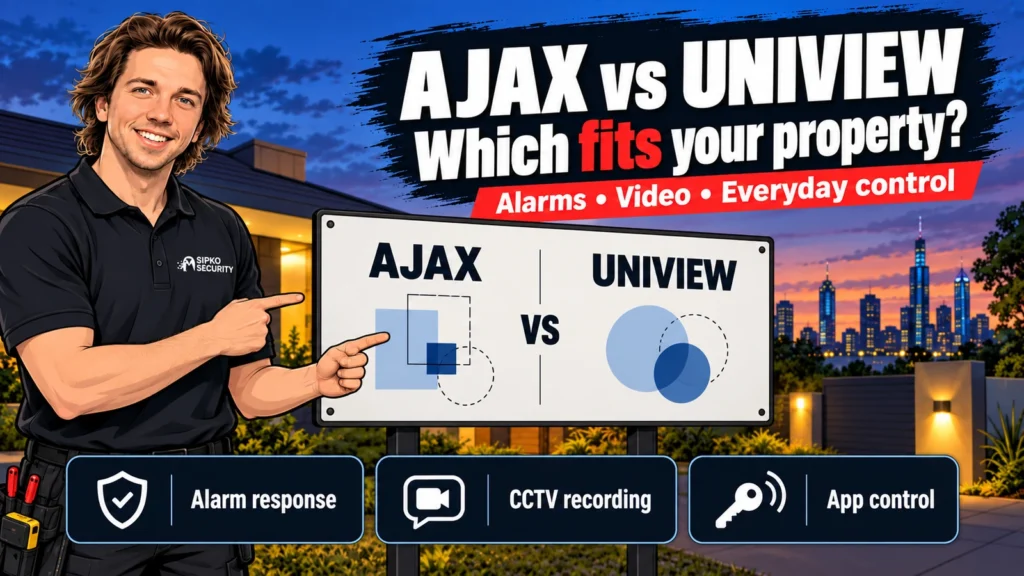
Ajax vs Uniview starts with a practical choice: alarm response, recorded video, or both. A Melbourne townhouse may need door and motion detection with app arming. A warehouse may need extensive camera coverage, long recording retention and a workstation for reviewing incidents.
Ajax combines intrusion protection with an expanding camera and recorder range. Uniview specialises in video surveillance and recording infrastructure, with access-control and intercom products alongside it. Both offer meaningful video capability; the installation should follow the job you need the system to do.
SIPKO installs and supports both brands. These recommendations are based on current manufacturer documentation and practical design requirements, rather than a controlled head-to-head product test.
Which system fits your project?
- Intrusion, app arming and monitoring come first: start by assessing Ajax.
- Recorded coverage, specialist cameras and central video management come first: start by assessing Uniview.
- Both are essential: compare an Ajax alarm-and-video design with a separate alarm and CCTV design. Require any proposed integration to be demonstrated.
The deciding question is what should happen during an incident: who receives the alert, what they can see, and who responds.
What each ecosystem actually covers
Ajax: alarm control, verification and a growing video platform
Ajax combines hubs, opening and motion detectors, keypads, sirens, panic controls and compatible automation devices. Select the hub around the number of devices, users and arming groups the property needs.
Jeweller connects wireless alarm devices; Fibra connects wired devices on compatible systems. Wireless and hybrid hubs have different capacities and communication paths. Specify the hub model and compatible detectors together.
SIPKO’s Ajax installation service covers new systems, takeovers, app setup and commissioning.
Uniview: cameras, recording and video infrastructure
Uniview’s current range includes IP and analogue cameras, specialist cameras, NVRs, DVRs, storage, network equipment and video-management systems (VMS). Its access-control and intercom ranges extend the design beyond cameras alone.
SIPKO’s Uniview installation service covers camera selection, recorder capacity, storage retention, PoE cabling and alerts.
Ajax vs Uniview at a glance
These are platform-level distinctions. Confirm the quoted equipment and firmware before relying on a feature. Each card compares the two brands against one requirement.
Intrusion protection
Ajax
Dedicated hubs, detectors, arming groups, panic devices and monitoring pathways.
Uniview
Camera analytics, deterrence and alarm interfaces on selected equipment; assess a separate intrusion system where needed.
Video and recording
Ajax
Own cameras and NVRs, local storage and video within Ajax apps.
Uniview
Extensive camera, NVR/DVR, storage and VMS choices.
Wiring and retrofit
Ajax
Wireless Jeweller and wired Fibra options; video and power requirements remain separate.
Uniview
PoE-based CCTV is a common design; wireless and specialist alternatives are model-dependent.
Apps and administration
Ajax
User apps, Ajax Desktop and PRO tools for security and video management.
Uniview
UNV-Link/EZView deployment-dependent mobile workflows, EZStation and larger VMS options.
Analytics
Ajax
Object recognition and other functions depend on camera, recorder and firmware.
Uniview
Perimeter detection, classification, search and specialist analytics depend on camera/recorder combinations.
Monitoring and automation
Ajax
Documented CMS connections, verification workflows and compatible automation scenarios.
Uniview
Video events and external interfaces require a specified monitoring or integration design.
Access and intercom
Ajax
Alarm permissions and access-related controls are not automatically a complete door-access system.
Uniview
Dedicated access-control and intercom ranges; verify compatibility and local supply.
Alarm response and video evidence are different jobs
An intrusion-first design starts with doors, windows, movement routes, occupied areas and arming routines. Ajax is particularly relevant when those detectors must work with app control, named users, panic alerts and an agreed monitoring response.
A MotionCam detector supplies alarm-verification photographs; it does not replace continuous CCTV recording. Separately, Ajax video scenarios can associate detector alarms with footage from an Ajax camera or Ajax NVR in the same space, subject to configuration and permissions.
Communications also need a design. For example, Superior Hub Hybrid offers Ethernet and two SIM slots, with cellular capabilities varying by version. Select equipment and services suited to current Australian networks. Backup alarm communication does not automatically keep the router, cameras and recorder powered.
Professional monitoring needs an agreed provider, supported events, fees and response instructions. An app notification alone is not an operator monitoring service. Include that response arrangement in the alarm quote.
Compatible Ajax automation devices can act on alarms, schedules or arming changes. Describe the required action in the quote and check the selected relay, hub and connected equipment can perform it.
CCTV depth: compare the recording job, not an old channel limit
Ajax cameras and NVRs provide live viewing and recorded video within its apps. BulletCam supports microSD or NVR recording and recognition of humans, animals and vehicles. Desktop tools add video-wall viewing.
Ajax’s current NVR H range includes a 32-channel Superior model. HDMI outputs, drive bays, PoE and AI functions vary across the range, so compare the quoted recorder rather than assuming all Ajax NVRs have the original 8/16-channel limits.
Uniview offers extensive camera and recording choices for projects centred on video infrastructure, including Unicorn VMS and professional recorders. Selected recorders support multi-drive RAID and resilience features; a small standalone NVR will not necessarily provide the same functions.
Low-light performance also needs a model-level comparison. Uniview’s Tri-Guard range combines selected imaging, intrusion-analysis and active-deterrence functions. Wise-ISP and other night-imaging technologies are product-specific. Test useful detail on moving people at the actual distance and lighting, rather than accepting a bright static demonstration as proof.
For either brand, check recording bandwidth, simultaneous playback, analytics capacity, usable storage and export workflow. A channel count does not tell you how long footage remains available or how easily staff can find an incident.
Apps, staff permissions and ongoing management
Ajax supports separate user permissions, group-based alarm control and professional administration. PRO Desktop supports managing and monitoring multiple Ajax systems; Ajax should not be dismissed as a single-home platform.
Uniview’s current software guidance covers UNV-Link, EZView and EZStation workflows, including sharing, playback and events. The appropriate app and feature set depend on the deployment. Larger projects may need VMS roles and workstations beyond a phone app.

Ask for a demonstration using an owner, manager and ordinary staff account. Check who can disarm, view cameras, export footage and change settings. Agree who maintains firmware, batteries, storage health and user access after handover.
Seven property scenarios
1. An existing Melbourne home
If the priority is door and motion protection, app arming and visual confirmation, Ajax is a natural starting point. Wireless detectors can reduce new alarm cabling. The hub still needs a suitable power and communication plan, radio coverage needs testing, and CCTV may need separate network cabling.
2. A small shop or office
Ajax suits opening/closing routines, staff alarm permissions and panic requirements. Where the bigger problem is reviewing transactions or stock movement, Uniview CCTV deserves equal attention. Alarm users and door-access credentials are different requirements: specify each, rather than assuming one app solves both.
3. A warehouse or commercial site
A warehouse may need Ajax for after-hours doors and internal intrusion detection, with Uniview for loading bays, aisles and extensive recorded coverage. A single-platform alternative is still worth assessing. Metal racking, radio paths, storage, operator workflow and monitoring matter more than keeping every device under one badge.
4. A project dominated by many cameras
Uniview is a strong candidate when camera variety, central recording, storage resilience and VMS operation drive the brief. Validate the recorder’s throughput and simultaneous analytics limits. Ajax remains a legitimate video option where its selected cameras, recorders and management tools meet the complete specification.
5. An intrusion-first project
Ajax is particularly suitable when the essentials are supervised detectors, arming groups, panic response and professional alarm monitoring. Camera-based intrusion analytics can add context and deterrence, but should not be assumed to replace every door contact, internal detector or agreed response procedure.
6. Retrofitting an existing building
Survey what can be retained before replacing equipment. Ajax offers wireless and compatible wired/hybrid paths; existing detectors require an appropriate interface and testing. Uniview may suit retaining serviceable camera cabling or planning an IP upgrade. Neither approach is automatically cheaper once access, remedial cabling and commissioning are included.
7. A new build or large commercial project
Early cable routes, racks, power and network planning make a deeper Uniview CCTV/VMS design practical. Ajax wired or hybrid intrusion protection may sit alongside it. Larger Ajax generations also merit assessment: verify actual device, group and user limits rather than treating every Ajax hub as a small-system controller.
Strengths and limitations to take into the quote
Ajax
Particularly strong when: intrusion, alarm control, verification and monitoring form the main daily workflow.
Things to check: hub/device compatibility, radio coverage, battery maintenance, professional-line installation requirements and whether the proposed video system meets the recording brief.
Uniview
Particularly strong when: camera choice, recording infrastructure, specialist analytics and central video operation dominate.
Things to check: exact camera/NVR/VMS compatibility, analytics limits, licences, storage design and any separate intrusion or monitoring requirement.
Using both does not automatically mean integration
An Ajax alarm and Uniview CCTV can be installed at the same property as separate systems. That alone creates no shared alarm logic, account structure or monitoring connection.
Ajax’s NVR manual documents third-party camera support through ONVIF and RTSP. That is a possible compatibility route, not proof that every Uniview camera, analytic event or recorder function transfers. Require the exact camera, firmware, interface and intended behaviour to be tested. No native Ajax–Uniview integration is assumed here.
What should you ask before choosing?
- Is the priority intrusion response, recorded evidence, or both?
- Which areas need identification detail, and how many cameras are required?
- What cabling, power backup and internet resilience are practical?
- Who receives alarms, and is professional monitoring included?
- What retention, playback, export and central VMS functions are required?
- Who owns the accounts, and how will staff access be removed?
- What expansion capacity and integration tests are included?
Compare installed scopes: devices, cameras, cabling, storage, network work, labour, monitoring and ongoing administration. There is no defensible blanket price winner without equivalent Australian quotes.
Ask for Australian supply, local support, regional hardware and required approvals to be confirmed on the equipment schedule. A model appearing in a global catalogue does not establish local availability.
FAQ
Is Ajax better than Uniview?
Shortlist Ajax when intrusion detection, arming and alarm response lead the brief. Shortlist Uniview when camera coverage, recording and central video management lead it. Compare complete designs if both jobs matter; neither brand wins every project.
Is Ajax an alarm system or a CCTV system?
It offers both. Alarm hubs and detectors, photo verification, IP cameras and NVRs perform different tasks. Specify which functions the property needs rather than treating them as interchangeable.
Can Uniview cameras replace an intrusion alarm?
Selected cameras provide intrusion analytics and active deterrence. That does not establish an equivalent replacement for a complete detector, arming, panic and monitored-alarm design. Assess the uncovered requirements separately.
Which is better for a home retrofit?
Ajax often suits a retrofit centred on intrusion protection because wireless detectors can reduce cabling. If the home primarily needs recorded camera coverage, compare suitable CCTV designs, including Uniview, against the actual cable routes and lighting.
Can Ajax and Uniview work on the same property?
Yes, as separately designed systems. Any shared viewing or event workflow needs a documented, tested compatibility path. Having both installed does not itself mean they integrate.
Manufacturer sources — checked September 2026
Ajax: Ajax video scenarios; Superior Hub Hybrid; BulletCam documentation; NVR H documentation; PRO Desktop; NVR manual.
Uniview: 2026 product guide; professional NVR and RAID; Tri-Guard range; software guidance.
Capabilities and Australian availability must be confirmed for the equipment and service package quoted.
Start with the property, then choose the platform
Request a site assessment with SIPKO covering alarm response, camera coverage, existing cabling and user responsibilities. Bring a list of the incidents you need to detect or review so the proposed system addresses those jobs.