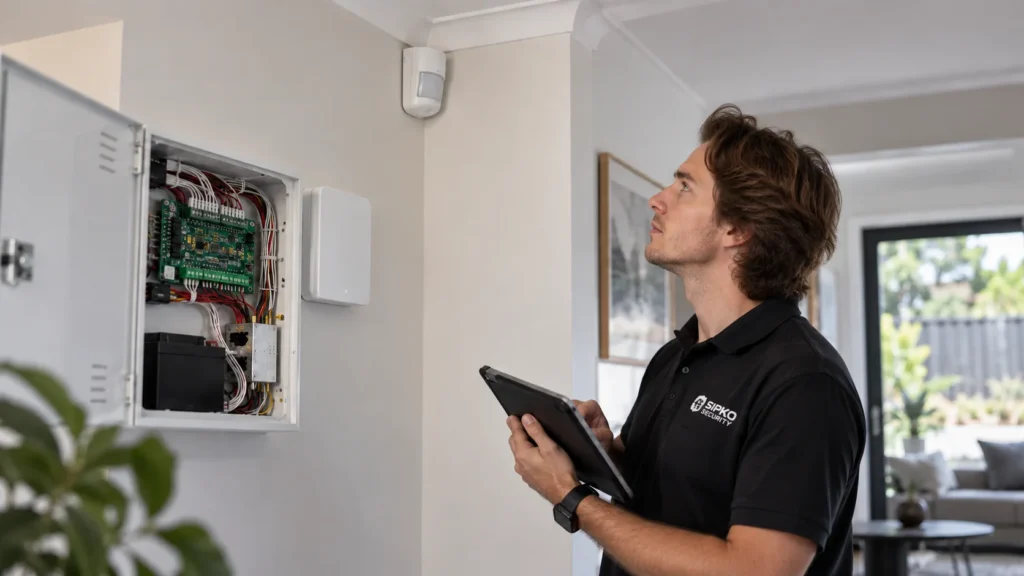
The old PIR still detects movement. The door contact still triggers the alarm. The wiring is already inside the walls. So why replace any of it when the alarm system gets upgraded?
A sensor still working on the old alarm is not the same as that sensor being suitable for reuse with a different system. The real question is whether it is compatible with the new system, still reliable, and still right for the job.
The Short Answer: Sometimes, but Not Automatically
Existing wired sensors may be reusable — but the answer isn’t decided by the age of the system, the brand on the panel, or whether the detector currently triggers. It’s decided device by device, circuit by circuit.
Modern integration hardware genuinely does allow compatible third-party wired devices to work with a new alarm system. That’s real. What it doesn’t mean is that every wired sensor already installed will automatically qualify.
REUSE = COMPATIBILITY + CONDITION + PURPOSE
First Question: Is the Sensor Compatible With the New System?
A modern panel or hub doesn’t automatically understand any wired detector connected to it. Whether a specific device can actually work with the new system’s interface depends on several things.
Compatibility may depend on:
- the type of wired connection the detector uses;
- how the zone is supervised;
- whether the device needs power, and whether the new interface can supply it appropriately;
- what the integration hardware supports;
- any device-specific manufacturer requirements.
Some integration hardware supports a range of connection types — commonly referred to as NC, NO, EOL, 2EOL or 3EOL — as different ways of wiring a detector into a supervised zone. These are examples of what some systems support, not a checklist to work through yourself.
Wired does not mean universally compatible. The fact that a cable exists doesn’t tell you whether the device at the end of it will work with a different control system.
Second Question: Are the Sensor and Wiring Still Reliable?
Compatibility answers whether the new system can work with a device. It doesn’t answer whether that device — or the wiring behind it — is still worth relying on. These are assessed separately.
For the detector itself, the assessment may look at:
- consistent operation;
- physical condition;
- signs of intermittent or unreliable behaviour.
For the wiring and circuit:
- whether the cable run can be identified;
- cable and termination condition;
- intermittent faults;
- whether the circuit can be properly tested.
Age alone is not enough to decide whether a sensor should be retained or replaced. A sensor that still triggers is not automatically a component worth carrying into the next system.
Reusing the Cable Is Not the Same as Reusing the Sensor
“Existing wired alarm” sounds like one thing. It usually isn’t — the cable and the detector at the end of it are assessed separately, and they don’t always reach the same conclusion.
Each of these is a genuine, possible outcome — none is the default. Different zones within the same property may reach different conclusions once they are assessed.
Third Question: Does the Sensor Still Protect the Right Area?
A detector can pass every compatibility and condition check and still not be worth keeping — because what it’s actually protecting may no longer be what the property needs protected.
The original protection plan may have changed because of:
- renovations or extensions;
- new or removed entry points;
- different room use;
- changed furniture or circulation paths;
- different security priorities.
An old PIR may still function exactly as designed, but that doesn’t prove its present location is still the right one.
COMPATIBLE ≠ WORTH KEEPING
Which Existing Wired Devices Might Be Considered for Reuse?
Categories that may be worth assessing include:
- wired motion detectors;
- door and window contacts;
- glass-break detectors;
- panic or auxiliary inputs;
- other compatible intrusion devices.
These are categories that may be considered for integration; the device type alone does not establish that a particular existing sensor should be retained. Each one still has to pass the same three-part assessment.
Fire and other life-safety devices require separate device-specific assessment and should not be treated as ordinary intrusion sensors under the general reuse logic in this article.
What Changes When the New System Is Ajax?
Ajax is a useful, concrete example of how this works in practice, not the point of the article. Ajax has integration hardware — MultiTransmitter is one example — designed to connect compatible third-party wired devices to the system.
But Ajax’s own official documentation is explicit about the limits of that: it directs installers to check the compatibility of the specific device before adding it to the system. The presence of integration hardware does not settle the compatibility question on its own.
MultiTransmitter enables integration; it does not make every existing detector compatible.
When Ajax is being considered as the new platform, sensor reuse becomes one design decision within the broader installation — not a reason to keep every legacy component by default. SIPKO covers the full scope of that as part of Ajax alarm installation in Melbourne.
How Does an Installer Decide What Should Stay?
Put together, the assessment follows a consistent sequence:
- Identify — what device and circuit actually exist.
- Check compatibility — can the intended modern system or interface support it.
- Assess condition — are the detector and wiring reliable.
- Review purpose — does it still protect the right area.
- Decide — retain, replace the detector, reuse only the cable, or replace more of the circuit as appropriate.
- Verify — retained components operate correctly as part of the completed system.
IDENTIFY → COMPATIBILITY → CONDITION → PURPOSE → KEEP / REPLACE → VERIFY
The purpose is to explain how the reuse decision is made, not to provide a wiring procedure.
When Does Reuse Make Sense During an Alarm Upgrade?
Reuse may make sense when:
- compatibility with the intended system is confirmed;
- the detector and relevant wiring are still reliable;
- the detector still serves the required protection purpose.
Replacement may make more sense when:
- the device cannot be integrated correctly;
- the detector or circuit is unreliable;
- the existing location or function no longer suits the property.
Whether reuse changes the amount of installation work depends on what the assessment finds, so it should not be assumed in advance.
Once the question moves from one sensor to the whole existing alarm, the decision becomes broader: which parts of the legacy system should remain, and which should change as part of the takeover. That’s the territory covered by upgrading an older Bosch, DSC or Hills alarm to Ajax.
Don’t Decide What to Keep Until the Existing System Has Been Assessed
“It still works” is useful evidence. It’s not the reuse decision.
The actual questions are narrower and more specific: can the new system support it? Can the device and its circuit still be trusted? Does it still do the job the property actually needs done?
If the wider question is whether to repair, upgrade or replace the alarm altogether — rather than one sensor’s fate — that assessment sits with security alarm installation in Melbourne.
The best upgrade is not the one that retains the most old equipment, or the one that replaces the most. It’s the one that keeps only what still makes technical and practical sense.
FAQ
Can old wired PIR sensors be reused with a new alarm?
Sometimes — it depends on whether the new system can support the specific device, whether the detector and its wiring are still reliable, and whether its current position still protects the right area.
Can existing alarm wiring be reused if the sensors are replaced?
Potentially. Cable condition and sensor condition are assessed separately — suitable wiring doesn’t require keeping the original detector, and vice versa.
Can existing wired sensors be connected to Ajax?
Some compatible third-party wired devices can be integrated through appropriate Ajax hardware, but compatibility has to be checked for the specific device — Ajax’s own documentation requires this before a device is added.
Does upgrading an alarm mean replacing every detector?
No — there’s no universal requirement to keep everything or replace everything. Assessment of each device determines what’s actually sensible to retain.
Sources
-
Ajax Systems.
MultiTransmitter Jeweller — integration of third-party wired devices -
Ajax Systems.
Superior MultiTransmitter Fibra user manual