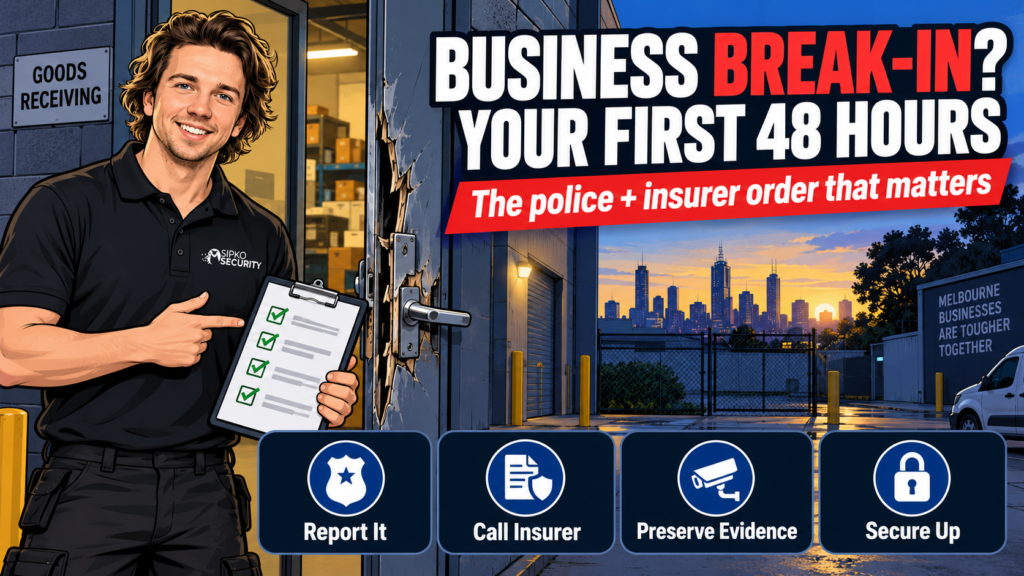
After a business break-in, the order matters more than the speed: check everyone’s safe, don’t touch anything, report it to Victoria Police (000 if it’s happening now, online or 131 444 if it’s not), photograph the damage before you clean up, then call your insurer. Locks, cameras and alarms come after, once the scene’s been reported and recorded.
- Is anyone still in danger? Do this first
- Who to call, and why
- Report it to Victoria Police: the right way
- Is Crime Stoppers the number to call?
- Call your insurer and know what to expect
- Preserve the evidence before you clean up
- Get a locksmith and secure the premises today
- Cameras and alarms: what actually stops it happening again
- If this has shaken you: the Victims of Crime Helpline
- Common mistakes in the first 48 hours
- FAQ
Is anyone still in danger? Do this first
Before anything else: is the offender still there, and is anyone hurt?
If the break-in is happening right now, the offender might still be on site, or anyone is in danger, call Triple Zero (000) immediately and get yourself and your staff to a safe place outside the building. Don’t go back in to check what’s missing, and don’t try to stop or confront whoever’s there.
If you’ve arrived to find the damage already done and the building’s empty, Victoria Police’s guidance for business premises is specific: don’t touch anything, and call your insurance company. That’s the whole first move. Resist the urge to start tidying up, propping the door shut, or picking up what’s been dropped, before we get to why in the evidence section below.
Who to call, and why
| Situation | Who to call | Why |
|---|---|---|
| In progress, or anyone’s in danger | Triple Zero (000) | Emergency police attendance |
| Already happened, offender’s gone, nobody hurt | Online report or Police Assistance Line 131 444 | Non-urgent report plus insurance reference number |
| You know something about who did it | Crime Stoppers Victoria 1800 333 000 | Anonymous tips, not victim reports |
| Ready to claim for the loss | Your insurer or broker | Starts the claims process against your PDS |
| Feeling rattled by it | Victims of Crime Helpline 1800 819 817 | Free, confidential support, with or without a police report |
Caption: The five calls a business owner actually needs after a break-in, and what each one is for.
Report it to Victoria Police: the right way
There are two different paths, and using the wrong one either wastes police resources or leaves you without a proper record.
Right now, in progress, or anyone’s in danger: call 000.
Discovered after the fact, offender’s gone, nobody’s hurt: this is a non-urgent report. You can do it two ways: report online through Victoria Police’s Online Reporting service, or call the Police Assistance Line on 131 444. A break-in with property stolen or an attempted break-in both fall under the categories Victoria Police accepts through online reporting.
The online form asks for the basics: location, time, whether you have photo or CCTV evidence. If you don’t have everything to hand, you can save your progress and come back within 30 days to finish it. Once your report’s assessed and allocated, Victoria Police issues a Notice to the Victim form, which includes a reference number for your insurance purposes. Keep that number, your insurer will ask for it. If you flagged that you have CCTV footage or photos, you’ll get a separate link later to upload it, so don’t feel you need to have footage exported and ready before you start the report.
Is Crime Stoppers the number to call?
Not for reporting your own break-in. That’s a common mix-up. Crime Stoppers Victoria (1800 333 000) exists for the public to pass on anonymous information about crime, not for victims to lodge their own report. As the business that was broken into, your report goes to Victoria Police through the channels above. Where Crime Stoppers is genuinely useful is afterwards: if a staff member or a neighbouring business remembers a vehicle, a face, or someone acting oddly near your premises beforehand, that’s the number for them to pass it on, especially if they’d rather stay anonymous.
Call your insurer and know what to expect
Once you’ve reported to police and you’re not still standing in the middle of a scene you haven’t photographed yet, call your insurer or broker. Most business policies expect you to notify them as soon as you reasonably can. The exact wording is in your Product Disclosure Statement (PDS), which is the document that spells out what’s covered, what’s excluded, and how a claim actually works. If you’re not sure where it is, your broker or insurer’s website will have a copy.
Have this ready when you call:
- Your police report reference number (from the Notice to the Victim form)
- Date and approximate time of the break-in
- Photos and video of the damage and the scene, taken before anything was moved
- A list of what’s stolen or damaged, as specific as you can get, with serial numbers if you have them
- Any temporary repair or board-up receipts if you’ve already had to secure a door or window
Insurers who subscribe to the General Insurance Code of Practice (which covers most standard business insurance products in Australia, not just home and car) commit to timeframes for acknowledging your claim and telling you what happens next, and to explaining themselves if they need longer. It’s monitored with the involvement of the Australian Financial Complaints Authority, which is also who you’d contact if an insurer isn’t meeting those standards. We’re installers, not brokers, so for anything specific to your policy or a dispute with your insurer, that’s a conversation for your broker, your insurer directly, or AFCA.
Preserve the evidence before you clean up
This is the step that gets skipped most, usually because the instinct after a break-in is to make the place look normal again as fast as possible. Don’t. Not yet.
- Don’t touch or move anything at the point of entry or anywhere items were disturbed, even once you’re sure the offender’s gone. Fingerprint and other forensic evidence degrades every time a surface gets handled.
- Photograph everything first, covering the point of entry, any damage, where things were left, what’s missing from where. Wide shots and close-ups both. Do this before police arrive if it’s safe to, and definitely before you start any cleanup or temporary repairs.
- Pull your CCTV footage immediately, if you have it. Most DVRs and NVRs record over old footage on a loop, and the retention window is often shorter than owners expect. It’ll happily overwrite the one clip that matters if nobody exports it first. Save it to a USB drive or download it from the app the same day, not “when things calm down.”
- Write down what’s missing while it’s fresh, covering stock, tools, cash, equipment, anything with a serial number. It’s far harder to reconstruct a list two weeks later than it is right now.

Get a locksmith and secure the premises today
Once the scene’s photographed and reported, get the building secure before you leave it for the night.
If a door or window’s been forced, a locksmith can usually tell you on the spot whether the existing locks can be rekeyed or need replacing outright. Rekeying is the quicker, cheaper option where the hardware itself isn’t damaged; replacement is the call when a cylinder’s been drilled, snapped, or the frame’s compromised. Get a quote before anyone starts work, and if glass or a door frame needs repair as well as the lock, that’s usually a separate glazier, so don’t let one job get scoped as the other. If you can’t get a locksmith out same-day, even a temporary board-up on a smashed window or door is better than leaving the opening as-is overnight.
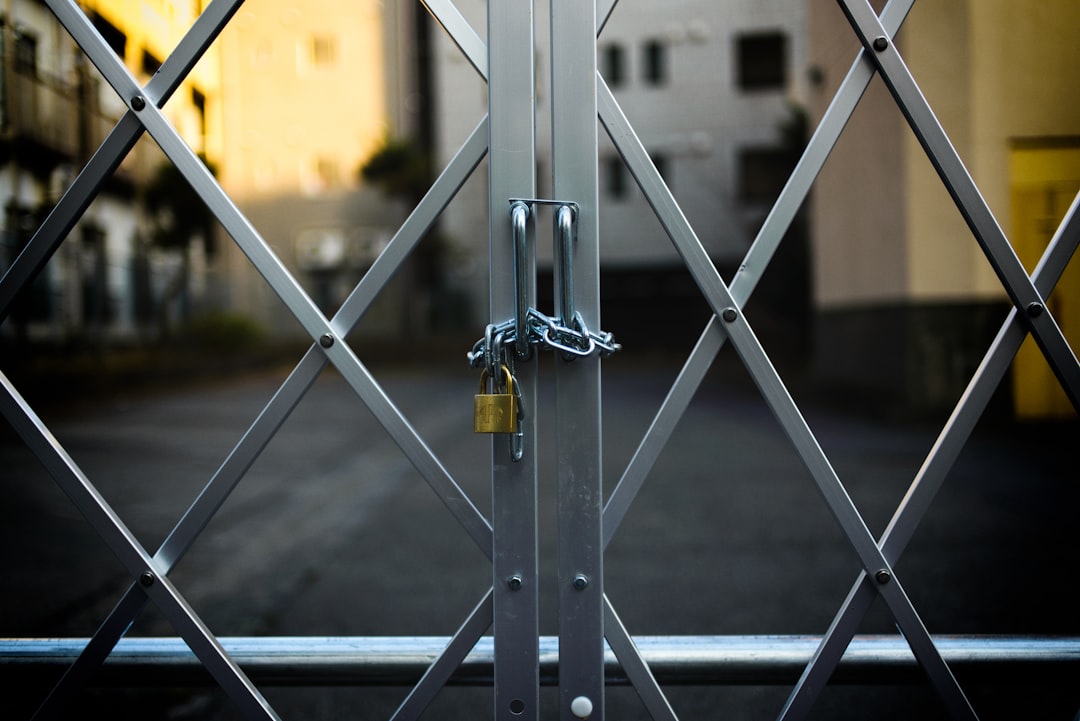
Our rule of thumb from Melbourne install jobs: if a break-in exploited a specific weak point, such as a rear fire door with a domestic-grade lock or a window with no sensor on it, fixing that exact point is worth doing immediately, even before you’ve decided on a bigger security upgrade. A repeat break-in through the same gap in the first week is depressingly common.
Cameras and alarms: what actually stops it happening again
Locks get you secure tonight. Cameras and a proper alarm are what change the odds on there being a next time.
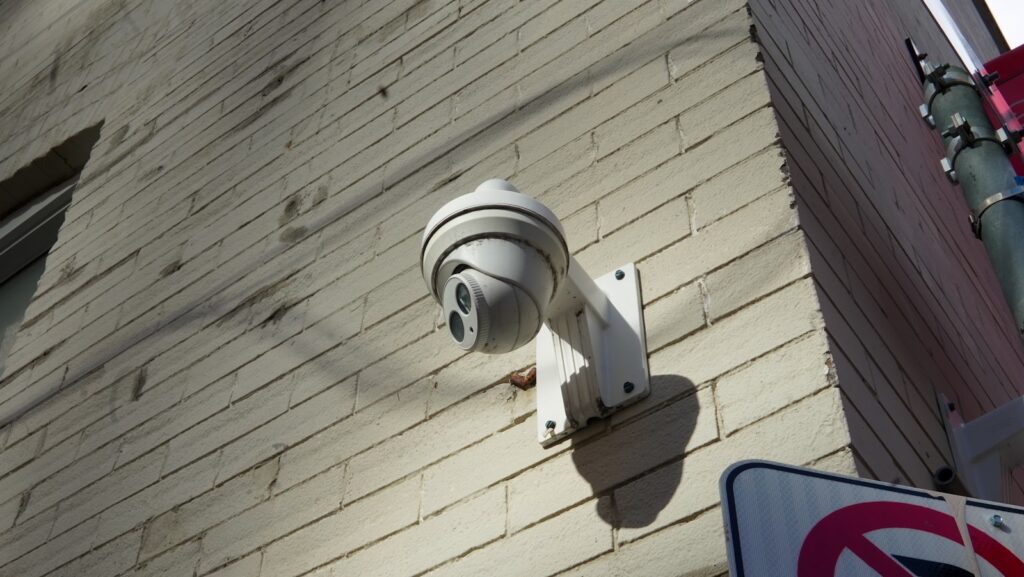
For most small businesses, that’s two things working together rather than one:
- A camera system that actually covers your points of entry, the loading dock, the rear door, the till or safe area, not just a token camera over the front counter. We install everything from mainstream 8MP turret cameras up to the Ajax TurretCam, which pairs the camera with an alarm and app in one system and sends a photo-verified alert the moment something trips it, rather than just recording for later. See our Ajax range if that’s the kind of setup you’re after.
- An alarm with real 24/7 monitoring, not just a siren that goes off with nobody listening. A monitored system means someone’s actually notified in real time, at 3am on a Sunday, not just when you happen to check your phone.
If you’re weighing up what a proper upgrade costs against what you just lost, we’ve broken down CCTV pricing for Melbourne businesses here, worth a read before you commit to anything. And whoever you use for the install, it’s worth asking whether they hold a security equipment installer licence under Victoria’s Private Security Act. It’s not always obvious from a website who’s actually licensed and who isn’t.
We’re not going to pretend every business needs the top tier of everything. A single-door shopfront with good lighting and a monitored alarm is often plenty; a warehouse with multiple entry points and stock worth protecting is a different conversation. Our business security page has the detail if you want to look at what fits your site, or call us on 0406 432 691 and we’ll talk it through straight.
If this has shaken you: the Victims of Crime Helpline
A break-in is unsettling even when nothing violent happened and even when the financial loss is small. That reaction is normal, not an overreaction. The Victims of Crime Helpline (1800 819 817) is a free, confidential Victorian Government service that can talk you through what to expect next and refer you to practical or emotional support. You can call whether or not you’ve already reported to police, and you don’t need to have anything sorted out first.
Common mistakes in the first 48 hours
- Cleaning up before photographing. Once it’s tidy, you can’t go back and document it.
- Letting CCTV footage overwrite itself because exporting it felt like a task for later.
- Reporting to Crime Stoppers instead of Victoria Police, then wondering why there’s no reference number for the insurer.
- Assuming the insurer will just take your word for it. Photos, a stolen-items list, and a police reference number make the claim faster, not slower.
- Fixing the lock and stopping there. If the same weak point isn’t addressed with detection as well as a better lock, it’s often only a matter of time.
FAQ
Do I have to report a break-in to police even if nothing was stolen?
You don’t have to, but it’s worth doing anyway. Attempted break-ins are reportable, and your insurer will likely still want a police reference number if there’s any damage to claim for.
How quickly do I need to tell my insurer?
There’s no single fixed number of days set by law. Your policy’s PDS will use wording like “as soon as reasonably possible,” and the safest approach is to call as soon as you’ve reported to police and photographed the scene, rather than waiting.
Will Victoria Police send an officer out for a break-in that’s already happened?
Not usually if the offender’s gone and nobody’s in danger. That’s treated as a non-urgent report, handled through the online reporting service or the Police Assistance Line rather than an on-site attendance.
What if I don’t have CCTV footage of the break-in itself?
Report what you can regardless: location, time, what’s missing, any other evidence. You can still upload photos or footage of the aftermath later if you’re prompted to during the online report.
Should I fix the lock or upgrade the whole system?
Get the immediate entry point secure today regardless. Whether it’s worth a fuller upgrade depends on what got exploited and what’s at the site. Happy to walk through it on a call rather than sell you more than the job needs.
If you’ve just been through this, we’re glad you found something useful here rather than a wall of “request a quote.” Give us a call on 0406 432 691 if you want a straight opinion on what your site actually needs, no pressure either way.
This article is general information, not legal or insurance advice. For anything specific to your policy, speak with your insurer or broker; for anything specific to your legal position, speak with a solicitor or Victoria Legal Aid.