The newest Crime Statistics Agency release (year to 31 March 2026) shows Victoria’s overall crime rate actually dipped, for the first time in nearly four years. That is not what Melbourne business crime looks like on the ground. Retail theft is up sharply, businesses now make up close to a third of all recorded crime victims, and a fresh statewide survey puts a real dollar figure on what that’s costing. We install security systems for Melbourne businesses every week, so we went through the release ourselves. Here’s what it actually says, and what we’d do with it.
- What this year's CSA numbers actually say
- The number every shop owner should actually watch: retail theft
- Why Melbourne's CBD is still the highest-crime LGA in the state
- What crime is actually costing Victorian businesses
- What shop and warehouse owners can actually do with this
- Is crime going up or down in Melbourne right now?
- What counts as an "organisation victim" in CSA data?
- Why is Melbourne still the highest-crime LGA if the state-wide rate is falling?
- Does CCTV actually stop shop and warehouse theft?
- What's the first thing you'd check if you walked into my shop or warehouse today?
- Sources
What this year’s CSA numbers actually say
CSA data comes in a few different flavours, and mixing them up is how headlines get it wrong. “Offences” are individual criminal acts. “Criminal incidents” are the events police attend, which can involve several offences at once. “Victim reports” record who was harmed. “Alleged offender incidents” only count cases where police identified a suspect. For the year to 31 March 2026, Victoria recorded 625,426 offences (down 0.2%) and 468,711 criminal incidents (down 1.0%). That’s the first annual dip since the current run of increases began, though Victoria Police’s own release notes total crime is still roughly 26% higher than it was three years ago.
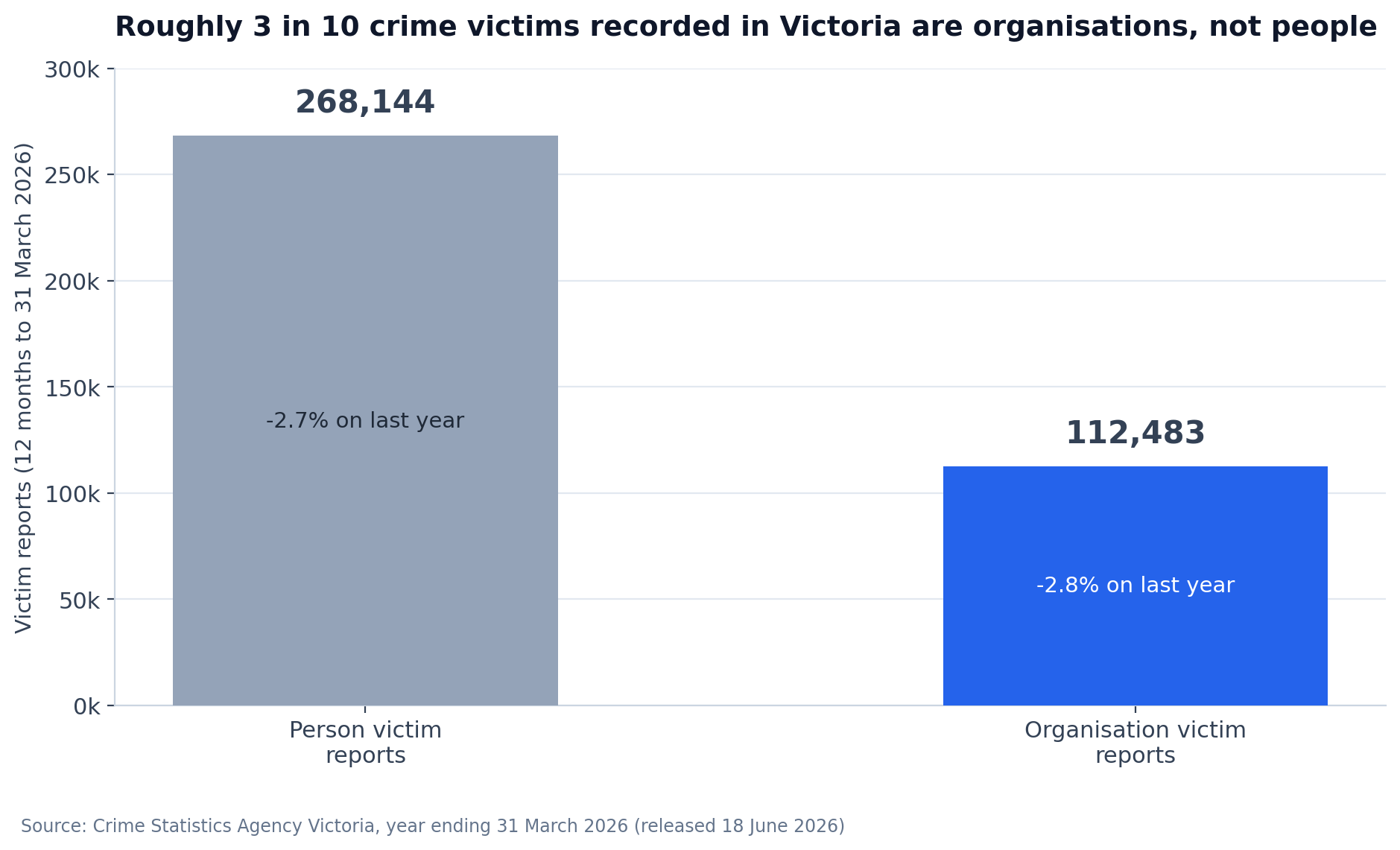
Of the 380,627 victim reports Victoria Police logged in the year to March 2026, 112,483 named an organisation rather than a person as the victim, just under a third of the total. On the CSA’s own numbers, a Melbourne shop or warehouse is now a completely ordinary category of crime victim, not an edge case.
The number every shop owner should actually watch: retail theft
Buried inside that mostly-flat state total is one line that moved a lot: “steal from a retail store” alleged offender incidents rose 11.7% to 20,998, up from 18,803 the year before. CSA Chief Statistician Fiona Dowsley named stealing from retail stores as one of the specific drivers behind this year’s rise in adult offending. It’s worth being precise about what that number actually measures. It only counts incidents where police identified a suspect, so it understates total shoplifting rather than overstates it. Every retail theft that never gets pinned on anyone doesn’t show up here at all.
| Metric (alleged offender incidents) | Year to Mar 2025 | Year to Mar 2026 | Change |
|---|---|---|---|
| Steal from a retail store | 18,803 | 20,998 | +11.7% |
| All theft | 41,631 | 44,257 | +6.3% |
| All offence types | 179,797 | 195,343 | +8.6% |
Adults are driving nearly all of it. Adult alleged offender incidents rose 10.8% to 171,812 across the state in the same period, while incidents linked to youth offenders actually fell 6.0%. If your mental picture of shop theft is teenagers on a dare, the current data doesn’t back that up.
Why Melbourne’s CBD is still the highest-crime LGA in the state
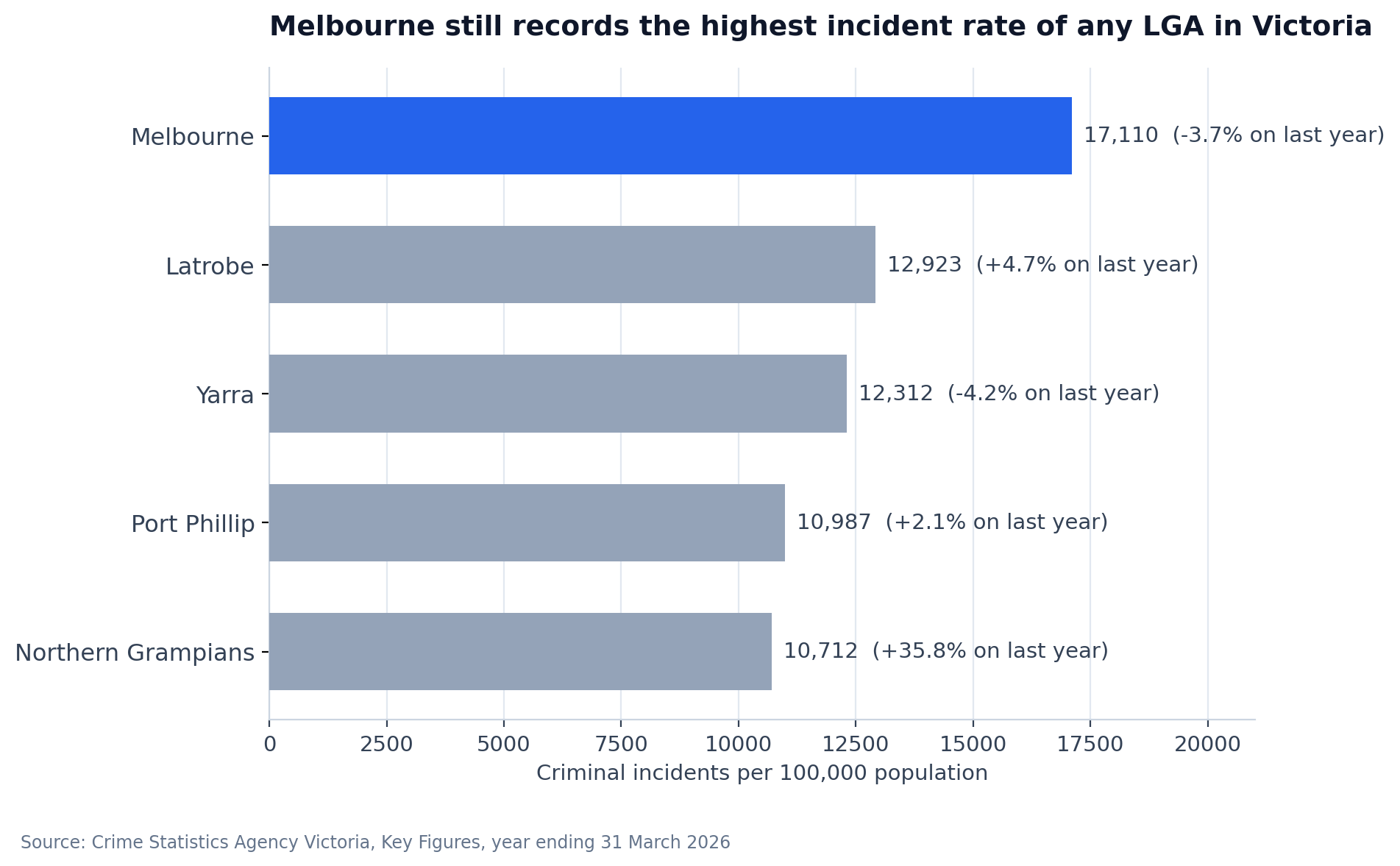
The City of Melbourne recorded 17,110.1 criminal incidents per 100,000 population in the year to March 2026, per CSA Key Figures. That’s down 3.7% on last year, but still comfortably the highest rate of any local government area in Victoria. Latrobe (12,922.8, up 4.7%), Yarra (12,312.1, down 4.2%) and Port Phillip (10,986.9, up 2.1%) round out the rest of the top five. Part of that is a genuine denominator problem worth knowing about: the rate is calculated against the resident population, but the CBD’s daytime population (workers, shoppers, tourists, delivery drivers) is many multiples of who actually sleeps there. That doesn’t make the number wrong; it just means “per 100,000 residents” undercounts how exposed a CBD retail site actually is relative to its foot traffic.
What crime is actually costing Victorian businesses
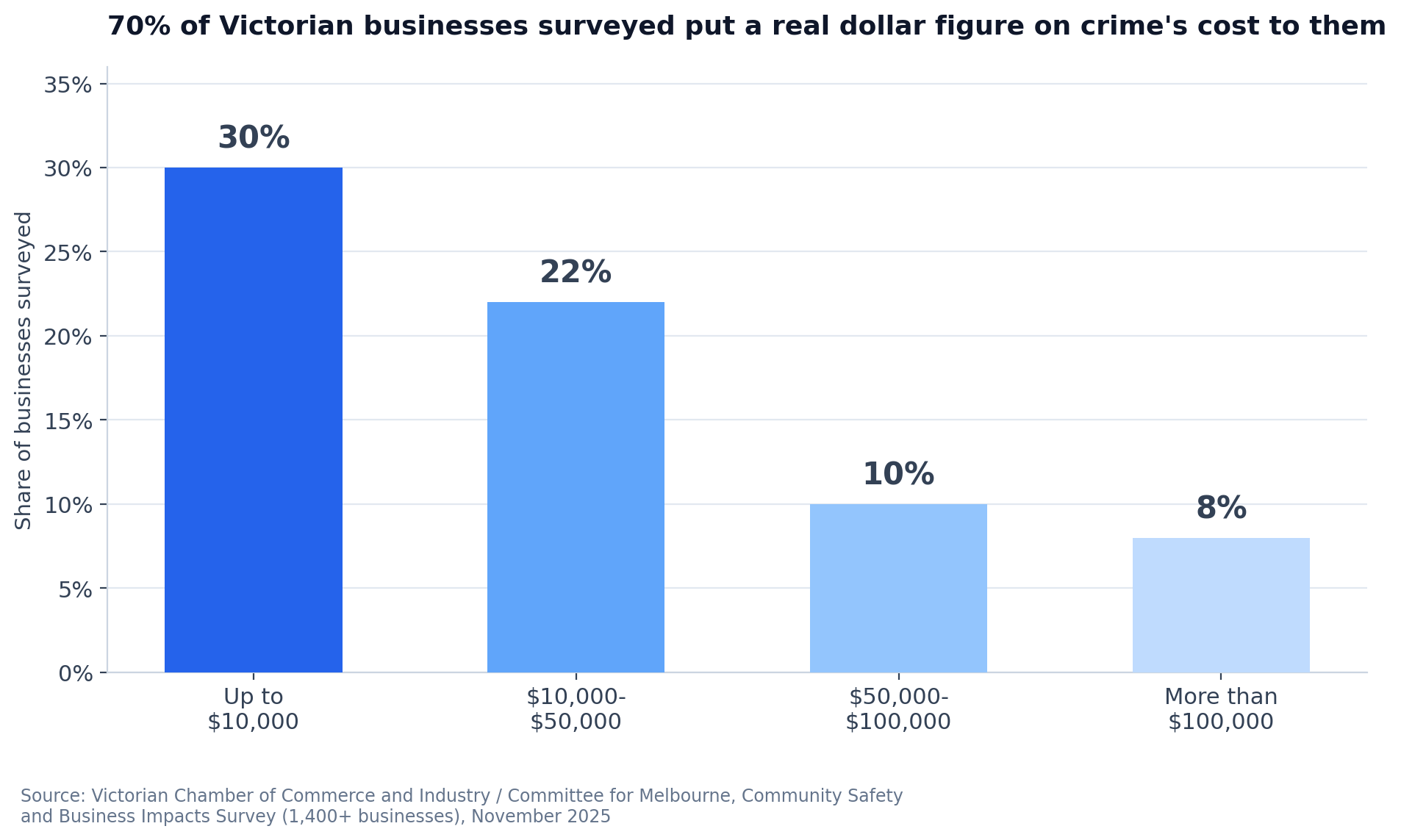
Police data tells you what happened. It doesn’t tell you what it cost. For that, the clearest recent number comes from a different source: the Victorian Chamber of Commerce and Industry and Committee for Melbourne’s Community Safety and Business Impacts Survey, which ran in November 2025 across more than 1,400 businesses statewide. Ninety-two percent of employers said their concern for staff safety has increased, and 49% said safety and antisocial behaviour had specifically worsened over the past year. Fifteen percent of businesses said they deal with incidents daily; another 35% said weekly. That means half the businesses surveyed are dealing with something at least once a week.
Seventy percent of businesses surveyed put an actual dollar figure on what crime cost them in the past year: 30% said up to $10,000, 22% said $10,000 to $50,000, 10% said $50,000 to $100,000, and 8% said over $100,000. Seventy-four percent said safety and crime issues had directly influenced a major business decision: extra security spend, changed rosters, reduced trading hours, delayed expansion, even relocation.
What shop and warehouse owners can actually do with this
None of this data changes much on its own. What it should change is where you put your attention and your budget. For a shop, that’s usually entrances, the till, the stockroom and the delivery door. A retail security setup earns its keep exactly there, covering the spots where refunds, till disputes and after-hours entry cause the most grief. For a warehouse, it’s the perimeter, the loading dock and roller doors, and who’s allowed into which zone after hours. That’s the focus of most warehouse security jobs we run.
Cameras and access control don’t stop someone determined enough to force their way in. What they change is what happens next: whether you’ve got usable footage and a real-time alert, or just a shrug and an insurance claim. If incidents are happening after hours, or you’re not on-site to see an alert land, 24/7 monitoring closes that gap. We run it from $49–99/month +GST, no lock-in contract. And honestly, most small shops don’t need enterprise-grade, badge-and-log access control; most multi-tenant warehouses do. Match the system to what you’re actually protecting, not to what sounds impressive.
Is crime going up or down in Melbourne right now?
Both, depending on what you’re measuring. Total offences and criminal incidents across Victoria both edged down slightly in the year to March 2026, the first annual dip in nearly four years. But specific categories that matter to businesses, like retail theft and overall alleged offender incidents, rose over the same period, and total crime is still around 26% higher than three years ago. There’s no single honest answer to “is it up or down”; it depends which number you’re asking about.
What counts as an “organisation victim” in CSA data?
CSA tags every victim report as either a person or an organisation, based on who actually suffered the loss. A shop hit by a break-in, criminal damage or shoplifting is generally logged as an organisation report; a staff member assaulted on the job would usually be logged as a person report instead. It’s a useful split because it’s the closest official measure of how much recorded crime is landing on businesses specifically, rather than on individuals.
Why is Melbourne still the highest-crime LGA if the state-wide rate is falling?
Because “falling slightly” and “still the highest in the state” aren’t contradictory. Melbourne’s rate dropped 3.7% but started from a much higher base than everywhere else. The CBD also concentrates retail, hospitality and transit in a small area with a huge daytime population relative to its resident count, which pushes any per-capita rate up regardless of the year-on-year trend.
Does CCTV actually stop shop and warehouse theft?
It changes the odds and the aftermath more than it guarantees prevention. Visible cameras deter a real share of opportunistic theft and break-ins, but a determined offender can still get in. Where CCTV earns its cost is afterwards: clear footage for police and insurance, and for monitored systems, a real-time alert instead of finding out the next morning.
What’s the first thing you’d check if you walked into my shop or warehouse today?
For a shop: the till, the stockroom door and whatever camera covers your main entrance. Those are the spots we most often find are blind or badly angled. For a warehouse: the loading dock, roller doors and who still has active access codes from staff who’ve left. Both are usually the cheapest gaps to fix, and they’re where we start on a free walk-through.
Sources
Want a second set of eyes on your setup? Book a free site walk-through and we’ll tell you honestly what needs fixing and what doesn’t.
Figures current as at the CSA’s year-ending-31-March-2026 release (published 18 June 2026) and the Chamber/Committee for Melbourne survey (November 2025); CSA data is reviewed quarterly. Any fixed security quote follows a free site walk-through.