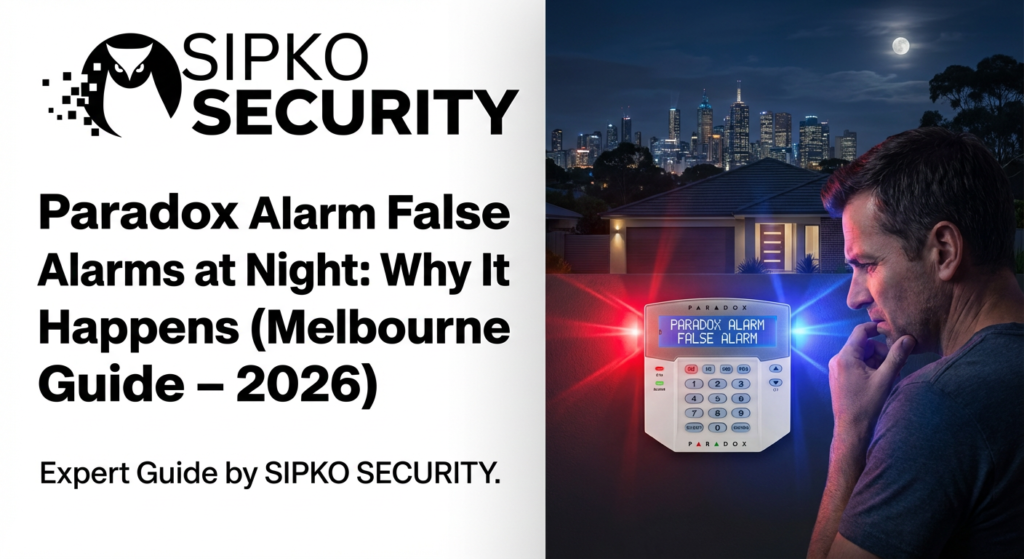
Paradox Alarm False Alarms at Night: Why It Happens (Melbourne Guide – 2026)
Woken up by your Paradox alarm at 2am with no intruder in sight? You’re not alone. Night-time false alarms are the most disruptive fault a homeowner can face — and in 95% of cases, the cause is entirely technical, not criminal. This complete Melbourne guide explains every cause and fix.
Introduction: Why Night-Time False Alarms Are So Frustrating
A false alarm at 3am is more than an inconvenience. It wakes your household, disturbs neighbours, triggers stress hormones, and — if repeated — erodes your confidence in the entire security system. Some homeowners even begin disabling their alarms overnight, which defeats the purpose entirely. Read our guide on securing your home while travelling and our Ness troubleshooting guide to see why a reliable system is non-negotiable.
If your Paradox alarm system is triggering at night without obvious cause, the first thing to understand is this: the system is working. It detected something. The question is what — and whether that trigger source should be there at all. Our guide to 5 signs your alarm is outdated often reveals that night false alarms are the first symptom of a failing system.
✓ The 7 Night False Alarm Causes — At a Glance
- 🌡️ Temperature-triggered PIR sensors
- 🕷️ Insects & spiders inside detectors
- 🐾 Pets not covered by immunity settings
- ⚡ Loose or aging wiring
- 🔋 Low or failing backup battery
- 📐 Poor sensor placement
- 🛑 Faulty or outdated motion detectors
Why False Alarms Happen More Often at Night
Night-time creates a perfect storm of conditions that older Paradox systems struggle to handle. During daylight hours, background noise, movement, and temperature variation are constant — the alarm’s sensors are continuously processing signals. At night, the house becomes still and the environment changes rapidly in ways that PIR sensors misinterpret as human movement.
🌙 The Night Environment
- Temperature drops 5–12°C between midnight and 5am in Melbourne winters
- HVAC systems cycle on and off — hot air plumes from vents
- House becomes acoustically and thermally “still” — small changes are amplified
- Wildlife activity peaks — possums, cats, foxes
📡 Why PIR Sensors Struggle
- PIR sensors detect change in infrared radiation, not motion itself
- A thermal gradient (hot air from heater vent moving through sensor field) is indistinguishable from a human body
- Older single-tech Paradox PIRs have no secondary verification — one trigger = instant alarm
- Component sensitivity drifts as sensors age — false trigger threshold lowers over time
The 7 Most Common Causes of Paradox False Alarms at Night
Cause #1 – Temperature Changes Affecting Motion Sensors
This is the single most common cause of night false alarms in Melbourne homes — particularly during autumn and winter when overnight temperatures drop sharply. Older wired Paradox systems use single-technology PIR sensors that cannot distinguish between a body emitting infrared heat and a warm air current from a heating duct.
⚠️ The Melbourne Winter Risk
Between midnight and 5am in Melbourne winters, ambient temperature can drop 8–12°C. A sensor mounted near a return air vent or facing a single-glazed window will experience rapid thermal cycling. Each cycle can register as a zone trigger. Homes in Brighton, Kew, and Hampton with large heritage windows are most vulnerable.
Cause #2 – Insects Inside Motion Sensors
Small insects — particularly spiders — are drawn to the warmth of PIR sensors at night. A spider building a web across the sensor’s Fresnel lens creates a persistent false trigger source that appears random because the spider moves intermittently. This is covered in detail in our guide to minimising IR attraction and spider webs on security devices.
✅ Quick Fix
Remove the sensor cover, clean the Fresnel lens with a soft dry cloth, and apply a light layer of insect deterrent (citronella spray) around — not on — the sensor housing. Re-seal the cover firmly. Repeat every 6 months in summer.
Cause #3 – Pets Moving at Night
Many Melbourne homeowners assume their Paradox system has pet immunity settings correctly configured — when in practice the settings were never adjusted from the factory default. A 10kg cat jumping onto a kitchen bench at 2am will trigger most standard PIR sensors unless the zone is specifically programmed for pet immunity and the sensor is correctly angled. Read our guide on alarm settings for homes with regular movement for configuration best practices.
Cause #4 – Loose or Aging Wiring
In wired Paradox systems installed before 2010, thermal expansion and contraction of building materials overnight causes micro-movement at terminal connections. A wire with even 0.1mm of play at its terminal will generate intermittent zone opens — which the panel logs as a trigger. This is particularly severe in Camberwell and Balwyn homes with older timber-framed construction.
Cause #5 – Low or Failing Backup Battery
A failing 12V backup battery whose voltage drops below 11V overnight — as ambient temperature falls and load increases — can cause the panel to misregister zone states. The panel’s microcontroller requires stable voltage to accurately read zone inputs. Voltage fluctuations corrupt these readings, generating phantom zone triggers. See our guide on security system maintenance for battery replacement schedules.
Cause #6 – Poor Sensor Placement
Many Paradox systems were installed without following current best-practice placement guidelines. A PIR sensor facing a window will detect the thermal signature of passing car headlights at 3am. A sensor near a curtain will trigger when cold night air causes the curtain to billow. Our sensor placement guide covers optimal mounting angles and positions.
| Bad Placement | Why It Causes Night False Alarms | Fix |
|---|---|---|
| Facing a window | Car headlights and radiated heat from glass surfaces at dusk/dawn | Reposition 90° away from exterior glazing |
| Near HVAC vents | Hot air plumes from heating cycling on overnight | Maintain minimum 1.5m clearance from any duct outlet |
| Near curtains/blinds | Thermal mass of fabric moves in cold drafts near sill | Angle sensor away from window treatments |
| Facing reflective surfaces | Mirrors redirect IR radiation back into sensor field | Reposition or mask sensor lateral coverage |
Cause #7 – Faulty or Outdated Motion Detectors
PIR sensors have a functional lifespan of 8–12 years under normal conditions. Beyond this point, the pyroelectric sensor element degrades — its sensitivity threshold drifts unpredictably toward false-positive territory. A 15-year-old Paradox sensor may trigger at thermal differentials it would have ignored when new. If your alarm system is past its service life, sensor replacement is the most cost-effective first step before considering full replacement.
Outdoor Sensors Triggering Indoor Alarms
Outdoor PIR sensors on Paradox systems are often configured as “interior” zones — meaning when they trigger, they activate the full interior siren, not just a perimeter alert. This causes homeowners to assume an indoor sensor has triggered when the actual source is an outdoor detector responding to wildlife, wind-blown vegetation, or a neighbour’s cat.
🦘 Melbourne Wildlife & Night Triggers
Brushtail possums (common across Bayside, Boroondara, Stonnington) are nocturnal and reach up to 4.5kg. A possum on a roofline or fence post within a PIR’s detection field will trigger most standard outdoor detectors. Configure outdoor zones as perimeter-only with a separate chime rather than full siren — or upgrade to dual-tech exterior detectors that require both PIR and microwave confirmation before triggering.
How to Identify Which Zone Is Causing the Alarm
Before calling anyone, use your Paradox keypad to pinpoint the exact zone. This information is critical for a technician and can save significant diagnostic time on a callout.
After an alarm, the keypad displays the zone that triggered. Note the zone number before silencing or clearing the alarm.
On Paradox EVO/EVOHD: enter your Master Code, go to Event Buffer (usually ✱ + 6). This shows timestamped zone triggers — crucial for identifying patterns.
Cross-reference the zone number with your zone label list (usually on a card inside the panel enclosure or in your installer documentation).
If the alarm triggers at the same time each night (e.g., 2:30am when the heating activates), it confirms an environmental cause rather than a hardware fault.
Quick Troubleshooting Steps Homeowners Can Try
✅ Safe DIY Checks — In Order
- Note the zone number from the keypad display or event log before clearing the alarm.
- Physically inspect the sensor on that zone — press the cover to ensure it’s fully clicked shut (tamper contact).
- Clean the sensor’s Fresnel lens with a dry cloth — remove any cobwebs or dust.
- Check for animals, insects, or environmental heat sources in the sensor’s line of sight.
- Replace the panel backup battery if it’s more than 3 years old.
- Perform an arm/disarm cycle with your master code to clear latched faults.
- Monitor for 48 hours — if the false alarm repeats at the same time, note the exact time and call a technician.
When to Call a Professional Technician
- False alarm repeats on multiple consecutive nights
- Multiple zones triggering simultaneously
- Wiring damage or burning smell from panel
- Paradox panel 10+ years old with no service history
- High-value or multi-storey property
- You’ve received a false alarm warning from Victoria Police
- Your system is failing to report to the monitoring centre
- Single zone, single occurrence
- Cause clearly identified (insect, pet, draft)
- Battery replacement resolves the issue
- Alarm doesn’t recur after 48 hours
When in doubt, call Sipko Security on 0406 432 691. Avoid the #1 mistake homeowners make when choosing security technicians. We service Brighton, Kew, Hampton, Mornington Peninsula, Mount Eliza, Frankston, Somerville and all Greater Melbourne — see our full service area.
How Professional Recalibration Fixes Night False Alarms
A Sipko Security technician attending a night false alarm fault performs a systematic recalibration that addresses every potential root cause in a single visit — not just the most obvious one. Book a maintenance visit to get a full system audit.
Every sensor is assessed for placement issues — proximity to HVAC vents, windows, reflective surfaces, and pet pathways. Repositioned and re-angled to eliminate environmental triggers.
PIR sensitivity is adjusted to match the specific thermal environment of each room. Zones near HVAC are set to lower sensitivity; entry points are set to maximum.
Every terminal screw is re-torqued. Zone wiring is checked for chafe, proximity to power cables, and micro-fractures that generate overnight vibration-triggered faults.
Panel firmware is updated where available. The full event log is reviewed to identify repeat trigger patterns and confirm whether faults are zone-specific or panel-wide.
Why Older Paradox Systems Are More Prone to Night False Alarms
Time is not kind to legacy alarm hardware. The Paradox SP and EVO series panels installed in Melbourne homes between 2000 and 2012 were excellent for their era — but they were designed for a different threat environment. Many owners are now choosing between Hikvision vs Bosch or Ajax vs Hills when upgrading. Read our full Ajax vs Paradox comparison to see how much the technology has advanced.
| Factor | Legacy Paradox (2000–2012) | Modern Grade 2 Systems |
|---|---|---|
| Motion Detection | Single-tech PIR only — no secondary verification | Dual-tech PIR + microwave — requires both to trigger |
| Environmental Filtering | Basic temperature compensation only | AI-powered false alarm filtering with motion classification |
| Communication | PSTN only — now defunct with NBN rollout | GSM + WiFi + Ethernet — triple redundancy |
| Notification | Panel siren only — wakes entire street | Silent phone push notification with photo verification first |
| Anti-masking | None in standard sensors | Active anti-masking detects spray, covers, blockage |
Modern Solutions That Reduce Night False Alarms
Modern Grade 2 wireless platforms — such as Ajax Systems installed by Sipko Security — re-engineer the false alarm problem at the architectural level. Read what makes Ajax so powerful for the full technical breakdown.
Why Ajax Systems Eliminate Most Night False Alarms
- Dual-tech MotionProtect detectors require simultaneous PIR and microwave detection — a thermal draft alone cannot trigger an alarm.
- Photo verification on demand — MotionCam sensors capture a photo burst on trigger, letting you verify before any siren sounds.
- Silent phone notifications first — you see a push notification and photo on your phone before any siren activates. Choose to escalate or dismiss silently.
- Active anti-masking detects sensor obstructions — spray, covers, and insect nests are flagged as tamper events before they cause false triggers.
- Smart home integration — link alarm to smart home devices so lights activate on trigger before siren, allowing visual verification without disturbing the household.
Protecting Luxury Homes in Brighton & Melbourne Suburbs
Large luxury homes in Melbourne’s premium suburbs face compounded night false alarm risk: more sensors, longer cable runs, larger perimeter zones, and higher environmental variation across multiple floors and outdoor areas. Read about the specific security threats facing Brighton homeowners and our suburb safety ratings.
Brighton & Bayside
Older Paradox systems near Port Phillip Bay suffer accelerated terminal corrosion from salt air, increasing overnight wiring-related false triggers. Consider a full wireless retrofit. This is critical when you consider the real cost of a break-in in Melbourne.
Repair vs Upgrade: What Makes More Sense?
The critical decision point: is the cost of fixing the existing Paradox system less than the cost of replacing it? When calculating how much a security system costs in Melbourne, factor in the recurring callouts for an old system. Use our homeowner’s security system guide to assess your situation.
The Decision Framework
- System is less than 8 years old
- Single sensor or single zone is the cause
- Issue clearly traced to one identifiable component
- No wiring degradation across multiple zones
- System is 10+ years old with 2+ service calls
- Multiple zones contributing to false alarms
- PSTN communicator fault present
- Wiring shows widespread degradation
- High-value property requiring Grade 2 compliance
Night False Alarms Are a Warning Sign — Act Before the Next One
Don’t wait for another 3am wake-up. Check batteries and sensor placement tonight — and book a professional assessment if the problem persists.
📞 Call Sipko Security: 0406 432 691Frequently Asked Questions
Why does my Paradox alarm only go off at night and not during the day?
Night-time creates conditions daytime doesn’t: larger temperature swings, HVAC cycling, reduced ambient noise (making small vibrations more significant), and increased wildlife activity. Older PIR sensors without dual-tech verification are particularly vulnerable to these environmental triggers.
Can I just bypass the zone causing the false alarm?
You can temporarily isolate (bypass) a zone on a Paradox panel, but doing so leaves that area unprotected. This is a band-aid, not a fix. If a zone is causing repeated night false alarms, the underlying cause must be identified and resolved — not indefinitely bypassed.
How much does a professional night false alarm diagnosis cost?
Sipko Security charges a standard service call rate for a diagnostic visit. In most cases, the fault is identified and resolved in the same visit. This is significantly less expensive than repeated emergency call-outs at 3am, or a false alarm fine from Victoria Police after multiple incidents.
Will upgrading to Ajax eliminate night false alarms?
Ajax’s dual-tech MotionProtect sensors require simultaneous PIR and microwave confirmation before triggering — eliminating the vast majority of thermal and environmental false triggers. Combined with photo verification via MotionCam, virtually no false alarms reach the siren stage. See our Ajax vs Paradox comparison.
Resources and Melbourne Security Standards
- Victoria Police – Private Security Licensing Regulatory authority for licensed alarm installers in Victoria. False alarm regulations and penalties for repeated activations.
- ACMA Cabling Provider Rules Australian telecommunications cabling standards applicable to alarm communicator installations.
- Consumer Affairs Victoria Your rights when engaging licensed security contractors in Victoria.