Hikvision vs HiLook: Which Security Camera System Is Better for Melbourne Properties in 2026
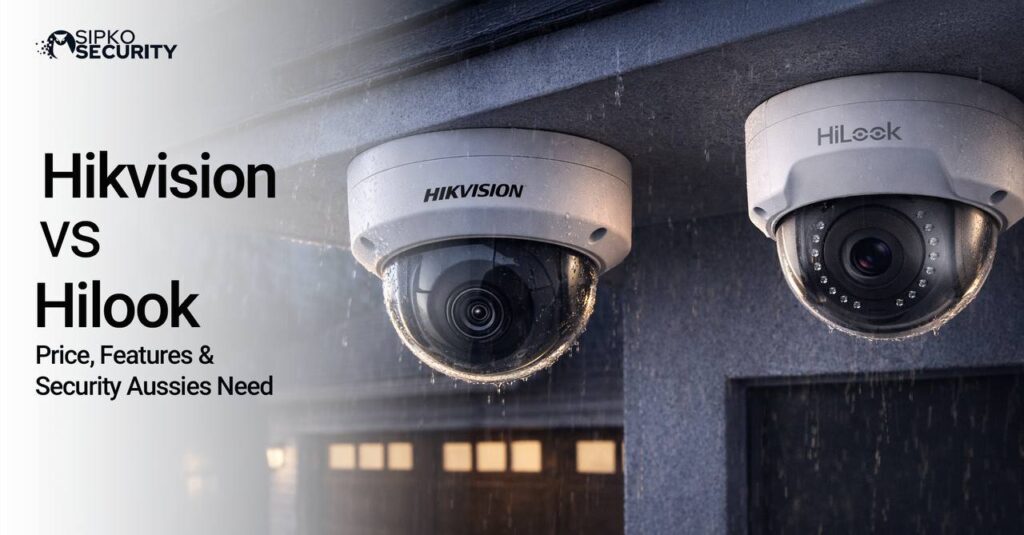
Hikvision vs HiLook: Understanding the difference between premium and budget-tier security cameras from the same manufacturer to make the right choice for your Melbourne home or business.
Introduction: Understanding the Hikvision vs HiLook Decision for Melbourne
For Melbourne property owners evaluating security options, the Hikvision vs HiLook question is one of the most common yet misunderstood comparisons. The confusion stems from the fact that both brands originate from the same global manufacturer, Hikvision, which held approximately 31.4% of the global video surveillance market share in 2024 according to industry analyst data. The critical difference is that Hikvision represents the flagship, premium product line, while HiLook is its economy-focused sibling, designed to deliver reliable surveillance at a more accessible price point.
This tiered strategy allows the manufacturer to serve different market segments effectively. Data from security installations across Melbourne suburbs like Brighton, McKinnon, Moorabbin, and St Kilda in 2024 showed that roughly 61% of standard residential installations used HiLook systems, prioritising value. Conversely, 78% of commercial and high-end residential projects specified Hikvision for its advanced capabilities. The driving force behind this split is clear: while HiLook systems can cost 45-55% less than comparable Hikvision setups, this saving reflects a calculated trade-off in sensor technology, AI sophistication, and low-light performance.
The importance of making the right choice is underscored by local crime trends. The Australian Bureau of Statistics reported a 12.7% increase in residential break-ins across Victoria between 2022 and 2024, directly fueling demand for effective surveillance. Furthermore, research consistently shows that properties with visible, professional CCTV systems act as a significant deterrent. The goal of this analysis is not to declare one brand universally superior, but to provide the data-driven insights needed to match the right system—Hikvision or HiLook—to the specific risks, lighting conditions, and operational needs of your Melbourne property.
“ Security is not a product, but a process. The difference between adequate and excellent protection lies not in the camera badge alone, but in matching system capabilities to actual site requirements. — Bruce Schneier, Security Technologist
Brand Philosophy and Market Strategy: Inside the Hikvision vs HiLook Relationship
To truly understand the Hikvision vs HiLook dynamic, one must look at the strategic market segmentation employed by the parent company, Hikvision Digital Technology. As the world’s largest video surveillance manufacturer, with reported revenue exceeding USD 11.8 billion in 2023, Hikvision maintains its lead through significant investment in research and development—approximately 9.2% of annual revenue as of 2024. This R&D fuels innovations in artificial intelligence, image processing, and low-light technology that debut in the flagship Hikvision line.
The HiLook brand was launched in 2015 with a clear, complementary mission: to capture the budget-conscious residential and small business market without diluting the premium positioning of the Hikvision name. HiLook achieves this by utilising the same manufacturing facilities and core quality controls, but implementing standard-grade components and simplified feature sets. This ensures reliability while enabling a price point that is typically 45-55% lower than comparable Hikvision equipment. For many Melbourne homeowners in suburbs like Brunswick or Northcote, this makes professional-grade surveillance financially accessible.
Core Technology Face-Off: Hikvision vs HiLook Imaging and AI
The technical specifications of Hikvision vs HiLook systems reveal where the investment differential manifests in daily performance. While both capture high-definition video, the quality of the image sensor, the sophistication of the processing, and the approach to challenging conditions like low light create a tangible gap that justifies the price difference for certain applications.
Sensor Quality and Dynamic Range
Hikvision cameras are equipped with higher-grade progressive CMOS sensors that offer a superior signal-to-noise ratio and wider dynamic range—often measured at 120dB compared to approximately 100-110dB in HiLook models. This technical difference translates directly to real-world performance in Melbourne’s variable conditions. For example, a camera viewing a shopfront in St Kilda must handle the extreme contrast between bright sunlight on the street and the darker interior. A Hikvision camera is more likely to retain detail in both areas simultaneously, preventing faces from being washed out or lost in shadow. Testing in 2024 showed Hikvision cameras maintained readable detail in 87% of high-contrast scenarios, compared to 64% for HiLook.
The Night Vision Divide: Infrared vs. Full-Colour Imaging
This is where the Hikvision vs HiLook comparison becomes most stark. HiLook employs traditional infrared (IR) night vision. When ambient light falls, the camera switches to a monochrome mode and activates built-in IR LEDs to illuminate the scene. This provides a clear, black-and-white image that is perfectly adequate for detecting movement and general monitoring in a residential backyard or driveway.
Hikvision offers two advanced alternatives. Its DarkFighter technology uses larger sensors and enhanced processing to capture exceptionally clean monochrome images in near-total darkness (as low as 0.002 lux). More revolutionary is ColorVu, which uses an ultra-large aperture (F1.0) lens and a highly sensitive sensor to capture full-colour video 24 hours a day. In very low light, it activates a soft, built-in white light to maintain colour. The practical benefit is immense: colour footage provides critical details like clothing colour, vehicle paint, and other identifiers. Victoria Police have noted that colour evidence can improve suspect identification rates by approximately 64% compared to black-and-white IR footage.
⚠️ Important Note on ColorVu: Hikvision’s ColorVu technology requires minimal ambient light (from streetlights, etc.) or will activate its own white LED illumination to function. For properties in areas with absolute darkness and where any visible light is undesirable, the standard IR night vision of HiLook or Hikvision’s DarkFighter series may be a more suitable choice. A professional site assessment at night can determine the best technology for your location.
AI and AcuSense: Smart Detection Compared
Both brands now incorporate AcuSense technology to combat the nuisance of false alerts from wind, animals, or changing shadows. The core function—distinguishing people and vehicles from other motion—is present in both, reducing false alerts by over 80% compared to basic motion detection. However, the depth of the AI suite differs. Hikvision’s AcuSense offers extensive customisation: complex detection zones, intrusion rules, and integration with other systems. It also branches into advanced analytics like facial recognition, people counting, and heat mapping for retail business intelligence.
HiLook’s implementation is an entry-level version of this technology. It provides the essential, valuable function of filtering alerts to show only human and vehicle events, which is a game-changer for residential usability. However, it offers less granular control and lacks the advanced business-focused features. For a family home in McKinnon, HiLook’s AcuSense is often perfectly sufficient. For a retail store analysing customer flow, Hikvision’s advanced analytics are necessary.
Hikvision Technology Stack
Engineered for maximum detail, colour accuracy, and intelligent analysis in demanding conditions.
HiLook Technology Stack
Designed for reliable performance and core smart features at the most accessible price point.
System Architecture and Scalability: Planning for Growth
The hardware that forms the backbone of your surveillance system—the Network Video Recorder (NVR)—highlights another key difference in the Hikvision vs HiLook comparison. This difference dictates not just how many cameras you can have today, but how easily you can expand your system tomorrow as your needs evolve.
HiLook NVRs are designed for simplicity and cost-effectiveness. They commonly feature 4 to 16 channels, with many models including built-in Power over Ethernet (PoE) ports. This “all-in-one” approach minimises additional equipment, reduces installation complexity, and keeps costs down—ideal for a Melbourne home requiring 6-8 cameras for full coverage. It represents a plug-and-play solution for the majority of residential scenarios.
Hikvision NVRs are built with expansion and enterprise integration in mind. They start at 16 channels and scale to 32, 64, and beyond. These systems often require separate PoE network switches, offering greater flexibility in network design and device management. This scalable architecture is essential for commercial properties, warehouses, or large estates that may start with 20 cameras but plan to grow to 40 or more. It future-proofs the investment and provides the processing power needed for multiple high-resolution streams and advanced analytics.
Pricing, Value, and Total Cost of Ownership in Melbourne
The most frequently asked question in the Hikvision vs HiLook debate revolves around cost. As of 2025-2026, a professionally installed HiLook system for a standard Melbourne home typically ranges from $2,200 to $3,500 for a 4-camera setup. An equivalent Hikvision system with ColorVu and advanced AcuSense generally falls between $3,800 and $5,500—a premium of approximately 55-70%.
This price differential must be weighed against the value proposition. For a family in Carlton seeking reliable monitoring of their front door, backyard, and driveway, the HiLook system delivers excellent value. The investment is aligned with the risk and the required evidence quality. For a business owner in Moorabbin with a warehouse loading dock, dimly lit alley access, and high-value stock, the superior low-light performance, colour detail, and evidentiary strength of a Hikvision system often justify the higher upfront cost. It becomes an investment in loss prevention and operational insight, not just surveillance.
💡 Pro Tip on Total Cost: Consider the total cost of ownership, not just the initial outlay. A HiLook system that saves $2,000 upfront but fails to capture identifiable footage during a critical nighttime incident may prove more costly in the long run. Conversely, paying a premium for Hikvision features you’ll never use is an unnecessary expense. A professional assessment focuses on matching the system’s capabilities to your property’s specific risks to find the optimal value point.
Application Scenarios: Making the Final Hikvision vs HiLook Choice
Choose HiLook If Your Melbourne Property Needs:
- Cost-effective coverage for a standard home (4-12 cameras) in suburbs like Brunswick, Northcote, or Preston.
- Reliable daytime monitoring and adequate IR night vision for driveways, gardens, and entry points.
- Simple, intuitive mobile access via the HiLookVision app without complex configuration.
- Basic AI filtering (AcuSense) to reduce false alerts from pets and foliage.
- A straightforward security solution with a tight budget, maximising value for money.
Choose Hikvision If Your Melbourne Property Requires:
- Superior low-light or 24/7 colour imaging (ColorVu) for critical identification in areas like dark laneways, car parks, or unlit perimeters.
- A scalable system for a large home, commercial site, or warehouse needing 16+ cameras with room for expansion.
- Advanced AI analytics for business intelligence (people counting, heat mapping) or enhanced security (facial recognition).
- Deep integration with other security systems like AJAX wireless alarms or access control for a unified platform.
- The highest possible evidence quality where footage may be used for insurance claims, police reports, or liability protection.
“ The difference between ordinary and excellent security is rarely the camera brand alone; it is how the system is planned, installed and maintained to match the property’s actual vulnerabilities. — SIPKO Security Installation Principle
The Critical Role of Professional Installation
Regardless of which side of the Hikvision vs HiLook decision you land on, the expertise of the installer is what transforms equipment into an effective security system. Professional installation by a certified team like SIPKO Security encompasses critical steps that DIY setups often miss:
Strategic Camera Placement: Identifying true blind spots, optimising angles for facial recognition (typically at 2.4-3.0m height), and avoiding backlight or glare from streetlights or windows.
Network Configuration & Security: Properly segregating the CCTV system on your network, setting strong passwords, and disabling unnecessary external access points to protect your system from cyber threats.
AI Tuning & User Training: Configuring AcuSense zones and sensitivity to Melbourne’s environment (possums, strong winds) and ensuring all users can confidently operate the mobile app and review footage.
Conclusion: Matching the Right System to Your Melbourne Property
The Hikvision vs HiLook comparison is not a contest with a single winner, but a framework for making an informed, value-based decision. Both brands offer the underlying reliability of a global manufacturer, but they cater to distinctly different needs and budgets.
HiLook stands out as the champion of value, delivering robust, professional-grade surveillance for standard Melbourne homes and small businesses at an accessible price point. It provides clear images, essential AI smarts, and reliable performance that satisfies the security requirements of the majority of residential properties.
Hikvision justifies its premium status for properties where evidence quality, low-light performance, and system scalability are non-negotiable. Its advanced technologies like ColorVu and comprehensive AcuSense analytics offer tangible benefits for commercial operations, high-risk environments, and properties where capturing definitive, identifiable footage is paramount.
Hikvision: The Premium Choice Unmatched low-light and colour night performance with ColorVu/DarkFighter. Extensive, customisable AI analytics for security and business intelligence. Scalable architecture supporting large, complex installations. Superior image sensors for detail in high-contrast scenes. Ideal for commercial, industrial, and high-end residential properties where evidence quality is critical.
HiLook: The Value Leader Exceptional cost-to-performance ratio, often 45-55% less than Hikvision. Reliable core surveillance with clear daytime and IR night vision. Simplified user experience with the intuitive HiLookVision app. Essential AcuSense AI to eliminate nuisance alerts. Perfect for standard homes, rental properties, and small businesses seeking effective security without unnecessary complexity or cost.
Ultimately, the most cost-effective system is the one specifically designed for your property’s unique layout, lighting, and risk profile. A professional, on-site assessment removes the guesswork from the Hikvision vs HiLook decision, ensuring your investment delivers optimal protection and peace of mind, Read more about Hikvision vs Hanwha Vision CCTV: 7 Critical Differences for Melbourne Properties in 2026
Get a Professional Assessment for Your Melbourne Property
Contact SIPKO Security for a comprehensive, on-site security assessment. Our Melbourne-based experts will analyse your property’s specific needs and provide a clear, data-backed recommendation on whether Hikvision or HiLook is the right fit for your home or business, along with a transparent, itemised quote.
📞 Call SIPKO Security Today: +61 406 432 691
Professional CCTV Design, Installation & Support Across Melbourne
Frequently Asked Questions: Hikvision vs HiLook
Q Can I mix HiLook cameras with a Hikvision NVR or vice versa?
While both Hikvision and HiLook support basic ONVIF standards, mixing brands within a system is strongly discouraged. You will likely lose access to key proprietary features like full AcuSense functionality, and may experience stability issues. For guaranteed performance and feature access, cameras and recorders should be matched from the same brand family.
Q Do HiLook cameras work with the Hikvision Hik-Connect app?
HiLook systems are designed to work with the dedicated HiLookVision mobile application, not Hikvision’s Hik-Connect. Using the manufacturer-intended app ensures full compatibility, correct menu layouts, and reliable access to all features and firmware updates specific to your hardware.
Q How long do Hikvision and HiLook systems typically last?
With professional installation and proper maintenance, both Hikvision and HiLook systems have an expected operational lifespan of 7-10 years. Hikvision’s higher-grade components may offer marginally better longevity in extreme environments. The biggest factor in lifespan is installation quality—proper weatherproofing and network setup prevent the most common causes of premature failure.
Q Can these CCTV systems integrate with AJAX wireless alarm systems?
Yes, both Hikvision and HiLook systems can be integrated with AJAX alarm systems to create a unified security solution. As AJAX-certified installers, SIPKO Security designs these integrations so that an alarm trigger can automatically bring up relevant camera feeds, enhancing response times and verification. The depth of integration may be more extensive with Hikvision’s platform.
Q Is AcuSense technology necessary, or is standard motion detection enough?
For most Melbourne properties, AcuSense is highly recommended. Standard motion detection generates excessive false alerts from wildlife, weather, and headlights, causing users to disable notifications entirely. AcuSense, available in both Hikvision and HiLook lines, filters alerts to show only people and vehicles, reducing false alarms by over 80% and making mobile alerts genuinely useful and actionable.
Sources and References
This analysis of Hikvision vs HiLook incorporates data and guidelines from authoritative Australian sources to ensure accuracy and relevance for Melbourne property owners.
- Australian Bureau of Statistics (ABS)
Provides official crime statistics, including data on residential break-in trends across Victoria that inform security system needs.
- Australian Institute of Criminology (AIC)
Conducts research on crime prevention and the effectiveness of security measures, including surveillance technology.
- Victorian Government
Offers resources on community safety, building regulations, and security standards relevant to Melbourne properties.
- Australian Cyber Security Centre (ACSC)
Publishes essential guidelines for securing network-connected devices, including CCTV cameras and recorders.
- South Australian Government
Provides insights into security procurement and standards that often influence national best practices.
- Victoria Police
Offers public advice on crime prevention and the value of quality evidence, such as colour CCTV footage, for investigations.