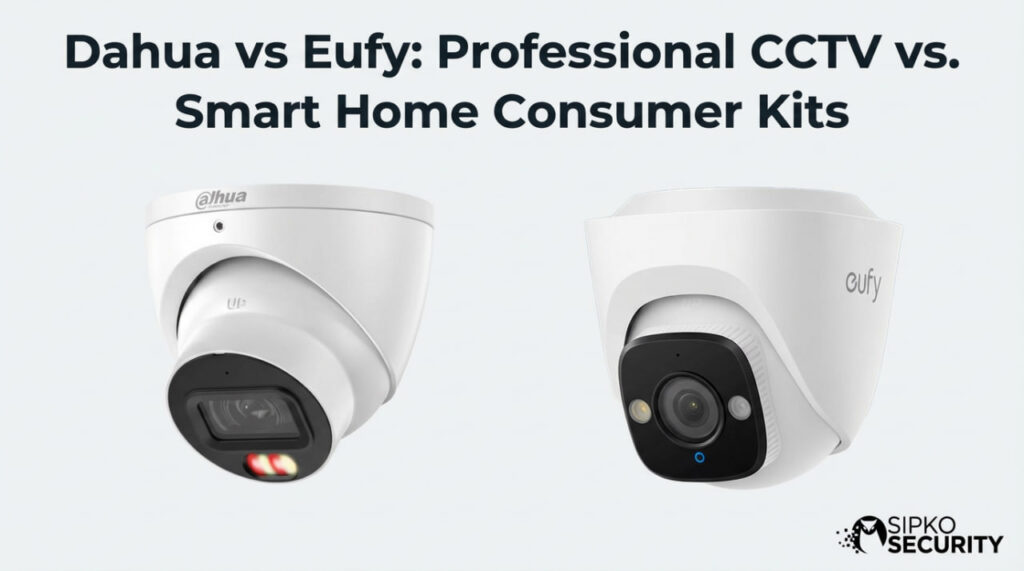
Dahua vs Eufy: Professional CCTV vs. Smart Home Consumer Kits
Thinking of securing your Melbourne property? We compare the industrial-grade precision of Dahua against the DIY accessibility of Eufy across stability, forensic clarity, and long-term ROI.
Introduction: The Dahua vs Eufy Choice
Selecting a security system in Melbourne today often comes down to one question: Do you want a consumer gadget or a security instrument? Dahua vs Eufy is the perfect illustration of this divide. While Eufy has revolutionized the market with its sleek, wire-free designs, Dahua remains the backbone of commercial security and high-end residential estates where “offline” is a catastrophic failure.
With Melbourne residential burglaries increasing by 8.2% in recent years, the visibility of your deterrent is only half the battle. The other half is the forensic integrity of the footage when the worst happens. This guide deep-dives into why professional installers rarely compromise on hardwired infrastructure.
✓ Strategic Summary
- • Stability: Dahua (Wired PoE) > Eufy (Wi-Fi)
- • Recording: 24/7 Continuous vs. Event Clips
- • Build: Alloy Cast Metal vs. UV Plastic
- • Intelligence: Perimeter AI vs. Facial Alerts
- • Storage: Local HDD vs. Cloud/HomeBase
- • Lifecycle: 12-15 Years vs. 3-5 Years
Infrastructure: Why PoE Wins in Melbourne Homes
The single biggest divider in the Dahua vs Eufy debate is connectivity. Dahua utilizes Power over Ethernet (PoE). This means a single physical cable carries uncompressed data and constant power from the recorder to the camera. It is unjammable, shielded from RF interference, and unaffected by the thick brickwork typical of Bayside homes.
Eufy relies on Wi-Fi protocols. While convenient, Wi-Fi is a shared medium. When your teenagers start streaming or a neighbor installs a powerful mesh system, the “bandwidth handshake” for your cameras can fail. We often see wireless cameras drop to a lower resolution or disconnect entirely right when movement is detected, as the “wake-up” surge overwhelms the Wi-Fi chip.
⚠️ The “Missing Seconds” Risk
Battery cameras like Eufy “sleep” to conserve power. They only wake up when a PIR sensor detects heat movement. This creates a 1.5 to 3-second delay. In 3 seconds, a running intruder can travel 15 meters. Dahua records continuously, meaning you see the moment they step onto the curb, not just when they are already at your door.
Head-to-Head Performance Comparison
| Technical Aspect | Dahua (Professional) | Eufy (Consumer) |
|---|---|---|
| Night Vision | Full-colour Starlight (No spotlights needed) | IR or Spotlight-assisted colour |
| AI Analytics | Deep-learning Perimeter Protection (WizSense) | BionicMind™ Facial Recognition |
| Hardware Shell | All-metal, IK10 Vandal-resistant | High-impact UV-stabilized Plastic |
| Cloud Reliance | 0% (Works fully offline) | High (App/Base requires cloud link) |
| Data Security | Physical access only; local HDD encryption | End-to-end encryption; cloud Base sync |
Forensic Clarity: Starlight vs. Consumer Sensors
Resolution numbers (4K, 2K) are often misleading. A 4K Eufy camera uses a small sensor with tiny pixels, which struggle in low light. Dahua’s professional range uses Full-size Starlight sensors (1/1.8″). These sensors have larger “buckets” to catch light, allowing them to maintain colour and sharp edges even in the dim street lighting of Melbourne’s suburbs.
Dahua: Forensic Identification
Optimized for court-admissible evidence. Low motion blur on moving targets at night. High contrast for reading license plates and recognizing facial features from 15+ meters.
Eufy: Smart Notification
Optimized for convenience. Facial recognition tells you when “Mum” is at the door, but detail drops off significantly beyond the 10-meter mark or in fast-action scenarios.
ROI Analysis: 10-Year Total Cost of Ownership
When comparing Dahua vs Eufy, consumers often look at the initial buy price. However, the professional view is Lifecycle Value. A battery camera system has a finite life before the internal cells degrade or the plastic housing becomes brittle under Australia’s harsh UV index.
The ROI Breakdown
Timeline: 12 – 15 Years
Maintenance: Periodic cleaning
End-of-Life: Upgrade individual cameras; keep cabling.
Timeline: 3 – 5 Years
Maintenance: Charging / Battery replacement
End-of-Life: Replace entire units when batteries fail.
Ecosystem Synergy: Dahua + Ajax Alarms
In a professional security landscape, your cameras should talk to your alarm. At Sipko Security, we often integrate Dahua NVRs with Ajax Alarm Systems. This allows for visual verification—when a window sensor trips, your Dahua camera instantly pushes the live feed to your phone. Eufy is a closed system; it works brilliantly with other Eufy devices, but lacks the industrial scalability of professional security protocols like ONVIF and RTSP.
Protect Your Property Once. Protect it Right.
Don’t wait for a missed event to realize the value of hardwired reliability. Get a permanent Dahua solution designed by Melbourne’s security experts.
+61 406 432 691📞 Speak to a Licensed Installer:Frequently Asked Questions
Is Dahua night vision truly better than Eufy?
Absolutely. Dahua’s Starlight range is engineered for industrial use. While Eufy looks good in suburban yards with porch lights, Dahua cameras can see in absolute darkness with granular detail that consumer lenses simply cannot resolve due to sensor size limitations.
Does Dahua have a monthly subscription fee like other brands?
No. When you install a Dahua system with Sipko Security, you own the storage. There are $0 monthly fees for remote viewing, AI alerts, or data storage. Eufy also offers $0 fees via its HomeBase, making both better than cloud-only brands like Arlo or Ring.
Can I view Dahua cameras on my phone?
Yes. The free DMSS App provides high-speed remote access, playback, and push notifications for human/vehicle detection. It is arguably the most stable professional CCTV app on the market.
Resources and Melbourne Security Standards
- Victoria Police CCTV Standards Official guidance on camera placement and image quality for Melbourne property owners.
- Australian Cyber Security Centre (ACSC) Best practices for securing home and business IoT devices against network intrusions.