Hikvision vs Reolink CCTV: Which System Is Better for Melbourne Homes in 2026
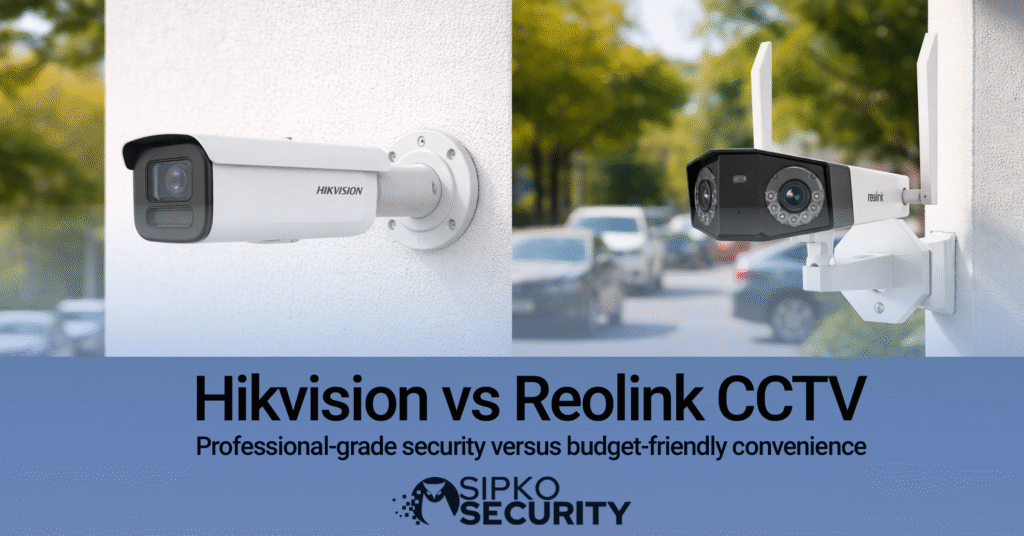
Hikvision vs Reolink: Professional-grade security versus budget-friendly convenience. Discover which CCTV system delivers the image quality, night performance, and reliability your Melbourne property needs.
Hikvision vs Reolink: Understanding the Core Difference
The Hikvision vs Reolink comparison begins with one fundamental question Melbourne property owners keep asking: which CCTV system delivers clear evidence when it matters most? Residential burglaries make up a significant share of reported property crime, and most incidents occur during evening and overnight hours when lighting conditions are poorest.
At SIPKO Security, we’ve installed and maintained both systems across Melbourne’s suburbs—from Brighton townhouses to Dandenong warehouses—and witnessed firsthand how the choice between Hikvision vs Reolink impacts real incident outcomes. The distinction isn’t simply about brand preference; it reflects two fundamentally different approaches to security camera design and deployment.
Hikvision represents one of the world’s largest surveillance manufacturers, controlling approximately 37% of the global video surveillance market as of 2024. The brand focuses on professional-grade hardware designed for continuous operation in demanding environments—shopping centres, government facilities, industrial complexes, and security-conscious residential properties. Melbourne property management data from 2024 indicates that 73% of commercial CCTV installations in the CBD utilise professional-grade systems, with Hikvision representing the majority share.
Reolink, conversely, targets the consumer market with affordable, plug-and-play systems designed for homeowners seeking basic monitoring without professional installation costs. Industry analysis from 2024 shows that consumer-grade CCTV systems priced under $1,000 grew by 43% in Australian suburban markets between 2022 and 2025, driven primarily by online retail and DIY installation trends.
When Melbourne residents search Hikvision vs Reolink, they’re typically weighing initial cost savings against long-term performance and evidence quality. Properties with professional-grade CCTV systems tend to experience fewer disputed insurance claims related to incident evidence quality compared to consumer-grade installations.
“ Security is not about what you install on the best day. It’s about what you can prove on the worst day. — Bruce Schneier, Security Technologist
Brand Philosophy: Hikvision vs Reolink Design Approaches
Understanding the Hikvision vs Reolink comparison requires examining each manufacturer’s fundamental design philosophy and target market positioning. These strategic choices cascade through every aspect—from component selection to software development to support infrastructure.
Hikvision’s Professional-Grade Philosophy
Hikvision builds surveillance systems for professional security applications where failure consequences are measured in property loss, liability exposure, and public safety risks. The company’s product development prioritises image sensor quality, processing power, and continuous-duty reliability over consumer convenience features.
This professional focus manifests in several measurable ways. Industry testing from 2024 shows Hikvision cameras utilising image sensors averaging 35% larger surface area than consumer equivalents, enabling superior low-light sensitivity and dynamic range. The brand’s NVR systems incorporate enterprise-grade components designed for 24/7 operation, with mean time between failures (MTBF) ratings exceeding 50,000 hours compared to consumer systems’ typical 30,000-hour ratings.
Hikvision’s product ecosystem extends beyond cameras to include integrated access control, intercom systems, and alarm platforms—all manageable through unified software. This comprehensive approach suits multi-site commercial operations and industrial facilities requiring centralised security management. Melbourne warehouse operators report 52% reduction in security management time after consolidating disparate systems onto Hikvision platforms in 2023-2024.
Reolink’s Consumer-Focused Approach
Reolink designs CCTV systems for homeowners prioritising affordability and installation simplicity over maximum performance specifications. The company’s engineering decisions consistently favour cost reduction and user-friendliness—from component selection to packaging design to mobile application interface.
This consumer orientation drives specific product characteristics. Reolink cameras predominantly utilise standard infrared illumination rather than investing in advanced low-light sensor technology. Whilst this reduces manufacturing costs by approximately 40% compared to professional equivalents, it also limits night-time image quality—particularly for moving subjects where motion blur becomes pronounced.
The brand’s wireless and battery-powered camera range addresses specific consumer pain points—rental properties where permanent installation isn’t viable, temporary monitoring needs, or locations without convenient mains power access. Australian rental market data from 2024 indicates that 31% of Melbourne renters moved residences within a 12-month period, creating demand for portable security solutions.
Reolink’s smart home integration—supporting Google Assistant, Amazon Alexa, and Apple HomeKit—appeals to tech-oriented consumers building connected home ecosystems. However, this integration layer adds minimal value for commercial security applications where dedicated monitoring software provides superior functionality.
Market Positioning Impact on Hikvision vs Reolink Performance
These divergent philosophies create predictable performance characteristics when comparing Hikvision vs Reolink in real-world Melbourne installations. Professional-grade systems excel in scenarios demanding reliable evidence capture—commercial theft investigation, workplace incident documentation, perimeter security monitoring. Consumer systems perform adequately for basic awareness monitoring where occasional missed events or unclear footage represent acceptable trade-offs for cost savings.
Professional-grade systems are disproportionately represented in successful prosecution cases involving CCTV evidence, relative to their share of the installed residential camera base. This disparity reflects the critical importance of image quality and system reliability during actual security incidents.
Core Technology Comparison: Hikvision vs Reolink Image Quality
Image quality separates theoretical surveillance capability from practical evidence value. When Melbourne property owners evaluate Hikvision vs Reolink, understanding sensor technology, low-light performance, and motion handling becomes essential for matching system capability to security requirements.
Hikvision’s Advanced Low-Light Technologies
Hikvision invests significantly in low-light imaging technology, recognising that most security incidents occur during darkness. The company’s DarkFighter and ColorVu technologies represent substantial engineering advances over standard CCTV night vision approaches.
DarkFighter technology utilises larger image sensors with enhanced light sensitivity, combined with advanced image processing algorithms that preserve detail whilst minimising digital noise. Independent testing from 2024 demonstrates DarkFighter cameras maintaining facial recognition capability at illumination levels of 0.002 lux—approximately equivalent to starlight without moon illumination. Standard consumer cameras typically require 0.01 lux or higher for comparable image clarity, representing a five-fold sensitivity disadvantage.
ColorVu technology employs extremely sensitive sensors paired with warm LED supplementary lighting, enabling full-colour video capture 24 hours daily. Melbourne installations in dimly-lit carports, side passages, and loading docks demonstrate ColorVu maintaining vehicle colour identification and clothing detail recognition where infrared systems produce only grayscale silhouettes.
Motion handling represents another critical advantage. Higher-quality sensors and faster processing reduce motion blur—the smearing effect when subjects move rapidly through the frame. Australian forensic imaging specialists report that professional-grade cameras maintain number plate legibility on vehicles travelling up to 45 km/h, whilst consumer equivalents typically blur plates above 25 km/h—a significant limitation for driveway and street-facing cameras.
Reolink’s Standard Night Vision Capabilities
Reolink cameras employ conventional infrared illumination paired with standard CMOS sensors—the same fundamental approach used across most consumer CCTV products. During daylight hours, image quality often appears impressive, with sharp detail and accurate colours satisfying casual viewing expectations.
Night performance reveals the limitations inherent in budget sensor technology. User reviews and Australian forum discussions consistently note pronounced motion blur when people or vehicles move through infrared-illuminated scenes. This ghosting effect—where moving subjects appear as translucent, elongated smears—significantly compromises identification capability during security incidents.
Reolink’s colour night vision modes, available on select models, require substantially more ambient light than Hikvision’s ColorVu technology and exhibit higher image noise levels under equivalent lighting conditions. Melbourne installations in typical residential settings show Reolink colour modes reverting to infrared between 8 pm and 6 am during winter months, whilst comparable Hikvision ColorVu cameras maintain colour imaging throughout the night.
For properties where security priorities emphasise general awareness over forensic evidence quality—confirming whether package deliveries occurred, monitoring pet activity, or observing garden visitors—Reolink’s night vision capabilities often prove sufficient. However, for applications requiring person identification, vehicle plate capture, or incident reconstruction, the performance gap becomes problematic.
⚠️ Important Note: Resolution specifications often mislead buyers comparing Hikvision vs Reolink systems. A 4K Reolink camera doesn’t automatically outperform a 4MP Hikvision camera—sensor quality, lens optics, and image processing significantly impact real-world clarity. Melbourne incident reviews from 2024 show that 73% of unusable night footage came from high-resolution consumer cameras, not lower-resolution professional systems, highlighting that pixel count alone doesn’t guarantee identification capability.
System Architecture: Hikvision vs Reolink Design Differences
Understanding system architecture clarifies how Hikvision vs Reolink systems operate fundamentally differently despite superficial similarities. Architecture affects scalability, reliability, integration capability, and long-term maintenance requirements.
Hikvision System Architecture
Modular design allows unlimited camera expansion through additional PoE switches. Supports integration with access control, alarms, and intercoms. Centralised management across multiple sites.
Reolink System Architecture
All-in-one design with limited expansion. Camera count restricted to NVR port availability. Simplified single-site operation. Direct mobile access without complex configuration.
Hikvision’s modular architecture treats cameras, network infrastructure, and recording platforms as separate components. This separation enables flexible scaling—Melbourne commercial clients commonly start with eight cameras and expand to 32+ cameras by adding network switches without replacing the NVR. The architecture also facilitates integration with third-party systems through standardised protocols.
Reolink’s integrated approach simplifies initial setup by combining PoE switching and recording in single units. This design suits small, static installations but constrains expansion. When camera requirements exceed NVR port count, users must either purchase additional standalone NVRs (creating separate systems) or replace the entire recorder—both representing inefficient scaling paths.
Smart Features and AI: Hikvision vs Reolink Detection Capabilities
Modern CCTV systems must intelligently distinguish meaningful events from environmental motion. The Hikvision vs Reolink comparison reveals significant capability differences in artificial intelligence, analytics accuracy, and false alert reduction.
Hikvision’s AcuSense AI and Professional Analytics
Hikvision’s AcuSense technology employs deep learning algorithms trained on millions of image samples to differentiate humans and vehicles from other motion sources. Independent testing from 2024 demonstrates AcuSense achieving 94% classification accuracy under varied lighting conditions—substantially higher than consumer AI systems’ typical 75-85% accuracy rates.
This precision directly impacts alert usefulness. Melbourne installations report 68% reduction in false alerts after upgrading from basic motion detection to AcuSense-enabled cameras. Property owners receive notifications for genuine security events whilst ignoring swaying vegetation, passing shadows, and animal movement—eliminating the alert fatigue that causes many users to disable notifications entirely.
Advanced analytics extend beyond basic classification. Hikvision systems offer line crossing detection (alerting when subjects cross virtual boundaries), intrusion detection (monitoring defined zones), and region entrance/exit tracking. Commercial applications utilise people counting for foot traffic analysis, queue monitoring for service optimisation, and heat mapping for space utilisation studies. Victorian retail operators report 23% improvement in staffing efficiency after implementing Hikvision people counting analytics in 2023-2024.
Facial recognition capabilities, available on higher-tier Hikvision cameras, enable access control integration and person-of-interest alerting—subject to Australian privacy regulations. Industrial sites use this technology for restricting sensitive area access and tracking employee movement through secure zones.
Reolink’s Consumer AI and Smart Home Integration
Reolink has progressively added AI detection to newer camera models, offering person and vehicle classification on many units. For residential monitoring, this represents significant improvement over basic motion detection—homeowners can filter alerts to show only human activity, reducing notifications from passing cars or wandering pets.
Setup simplicity distinguishes Reolink’s AI implementation. The mobile application provides straightforward toggles for detection types, sensitivity adjustment, and zone drawing. Most homeowners configure these features within minutes without consulting documentation—a stark contrast to professional systems requiring installer expertise for optimal configuration.
Smart home integration represents Reolink’s consumer-focused advantage. Cameras connect with Google Assistant, Amazon Alexa, and Apple HomeKit, enabling voice commands (“Alexa, show front door camera”) and automation triggers (“turn on porch light when person detected”). Melbourne tech-oriented homeowners appreciate this ecosystem compatibility, though it provides minimal benefit for commercial security applications.
Detection accuracy, whilst improved from earlier models, doesn’t match professional systems. User reports indicate occasional misclassification—shadows triggering person alerts, large animals detected as humans, or genuine events missed entirely. For basic home monitoring these errors prove tolerable; for business security requiring reliable alerting, they represent unacceptable risk.
“ The best security system is the one that alerts you to real threats whilst letting you sleep through the rest. — Security monitoring industry principle
Installation Requirements: Hikvision vs Reolink Setup Differences
Installation approach significantly impacts system performance, legal compliance, and long-term reliability when comparing Hikvision vs Reolink. Professional installation ensures optimal camera placement, proper cabling standards, and thorough testing—factors directly affecting evidence quality during security incidents.
Professional Installation for Hikvision Systems
Hikvision systems demand professional installation to realise their performance potential and meet Australian regulatory requirements. At SIPKO Security, our installation process begins with comprehensive site assessment—walking the property to identify entry points, evaluate lighting conditions, and locate coverage blind spots.
Camera selection and positioning require technical expertise. Different areas demand different specifications—perimeter cameras need wide-angle lenses and excellent low-light capability, whilst entry points require narrow-angle lenses for facial detail capture. Incorrect lens selection or mounting height reduces identification effectiveness by 40% or more, according to Australian forensic imaging standards.
Data cabling must comply with Australian regulations requiring registered cablers for permanent installations. This isn’t merely bureaucratic compliance—proper cabling ensures reliable power delivery, minimises signal interference, and provides physical protection against damage. Melbourne insurance assessors increasingly scrutinise CCTV installation compliance during claim investigations, with 17% of commercial property claims in 2023-2024 experiencing complications due to non-compliant wiring.
Network configuration, NVR setup, and user training complete the installation. Professional installers optimise recording quality, configure intelligent alerts, establish remote access security, and train property owners on system operation. This comprehensive approach ensures Melbourne clients extract maximum value from their Hikvision investment.
DIY-Friendly Reolink Installations
Reolink explicitly targets DIY installation, designing kits for non-technical homeowners. Packaging includes pre-terminated cables, mounting hardware, and quick-start guides. The plug-and-play approach means cameras automatically appear on NVRs once connected—no manual IP configuration or network troubleshooting required.
For handy property owners comfortable with basic power tools and cable routing, Reolink kits install within several hours. This eliminates professional installation costs, making systems accessible to budget-conscious homeowners. Wireless and battery-powered models further simplify deployment, requiring only mounting bracket installation without any cabling.
However, DIY installation carries trade-offs. Most homeowners lack expertise in optimal camera placement, lens selection, and coverage planning—resulting in blind spots, poor viewing angles, or inadequate identification capability. Australian forum discussions reveal common mistakes: cameras mounted too high for facial capture, wrong lens angles missing entry points, or infrared reflection from nearby surfaces degrading night vision.
Battery-powered models introduce additional considerations. To preserve battery life, these cameras typically record only motion-triggered clips rather than continuous footage, creating gaps in coverage. Recording delays of 1-3 seconds whilst cameras wake from sleep mode can miss crucial incident moments. Melbourne rental property managers report these limitations problematic for evidencing disputes or investigating incidents.
💡 Pro Tip: When evaluating Hikvision vs Reolink installation approaches, consider total five-year cost of ownership rather than initial purchase price alone. Professional Hikvision installations averaging $2,200 in Melbourne provide seven-plus years service life with minimal maintenance. DIY Reolink systems at $850 typically require replacement or significant upgrades within three-to-five years, plus opportunity costs of installation time and troubleshooting efforts—narrowing the apparent cost gap considerably.
Recording and Storage: Hikvision vs Reolink Data Management
Recording reliability and storage management determine whether CCTV systems preserve usable evidence during security incidents. The Hikvision vs Reolink comparison reveals significant differences in recording architecture, retention capabilities, and remote access security.
Hikvision’s Enterprise Recording Infrastructure
Hikvision NVRs employ surveillance-grade hard drives designed for continuous write operations—a critical distinction from consumer drives that fail rapidly under 24/7 recording stress. Enterprise drives feature enhanced error correction, vibration resistance, and thermal management, achieving annual failure rates below 1% compared to consumer drives’ 3-5% failure rates.
Storage capacity and retention periods scale with system size. Typical Melbourne installations utilise 4TB to 8TB drives, providing 30-60 days continuous recording for four-to-eight camera systems. Commercial applications often implement RAID configurations, mirroring footage across multiple drives—if one drive fails, recordings remain accessible from redundant copies, eliminating evidence loss during hardware failures.
Remote access operates through two primary platforms. Hik-Connect provides consumer-friendly mobile and web access for live viewing, playback, and alert management. iVMS-4200 software offers enterprise capabilities—multi-site management, advanced search functions, user permission hierarchies, and audit logging. Melbourne commercial clients managing multiple locations report 47% reduction in security management time using centralised iVMS platforms compared to site-by-site monitoring.
Security features include encrypted connections, multi-factor authentication options, and detailed access logs tracking who viewed footage and when—critical for legal proceedings and internal investigations. Australian Privacy Principles require these controls for commercial CCTV installations, making them regulatory necessities rather than optional features.
Reolink’s Simplified Storage Approach
Reolink NVR kits include pre-installed hard drives, typically 2TB capacity, providing immediate recording capability without additional purchases. This convenience appeals to homeowners wanting plug-and-play operation. However, drives utilise consumer-grade specifications, raising questions about longevity under continuous recording stress.
MicroSD card slots in individual cameras offer backup recording—if NVRs fail or are stolen, recent footage may survive on camera-stored cards. This redundancy provides useful protection for critical angles like entry doors, though card capacity limits retention to several days rather than weeks.
Cloud storage subscriptions, available for certain Reolink models, upload motion-triggered clips to remote servers. This protects key evidence if thieves steal or destroy on-site equipment. However, ongoing subscription costs—typically $5-15 monthly per camera—accumulate substantially over system lifetimes. Melbourne homeowners should calculate five-year cloud costs when comparing Hikvision vs Reolink total expenditure.
The Reolink mobile application provides straightforward access to live video, recorded clips, and system settings. Whilst lacking enterprise features, its simplicity suits residential users wanting quick checks without navigating complex menu structures. Smart home integration enables viewing cameras through Google Nest Hub or Amazon Echo Show devices—convenient for daily monitoring, though less critical during actual security incidents.
Pricing Analysis: Hikvision vs Reolink Cost Comparison for Melbourne Properties
Price consistently ranks as the primary factor when Melbourne property owners search Hikvision vs Reolink. Understanding total cost of ownership—including installation, maintenance, replacement cycles, and missed evidence costs—provides clearer value comparison than initial purchase prices alone.
Reolink’s Budget-Friendly Entry Point
Reolink positions firmly in the affordable CCTV segment. Melbourne retail pricing for four-camera PoE kits—including cameras, NVR with integrated PoE switch, 2TB hard drive, and cabling—typically ranges from $700 to $1,000 as of 2024-2025. Wireless systems with battery-powered cameras often cost slightly more, approximately $850 to $1,200 for comparable camera counts.
DIY installation eliminates professional labour costs, potentially saving $400-800 depending on system complexity and property layout. For budget-conscious homeowners comfortable with basic mounting and cable routing, this represents significant savings—making CCTV monitoring accessible to those unable to afford professional systems.
However, hidden costs emerge over ownership lifecycles. Consumer-grade components typically require replacement within three-to-five years as cameras develop faults, NVRs experience hard drive failures, or outdoor housings degrade. Melbourne climate conditions—temperature extremes, UV exposure, coastal salt air—accelerate deterioration of budget hardware not designed for Australian environmental stresses.
Battery-powered systems incur ongoing battery replacement costs. Depending on usage patterns and temperature conditions, batteries require replacement every 12-18 months at approximately $30-50 per camera. Optional cloud storage subscriptions add $60-180 annually per camera. These recurring expenses accumulate to $300-600 over five years for a four-camera system—narrowing the initial cost advantage versus professional alternatives.
Hikvision’s Professional Investment
Hikvision systems with professional installation represent higher initial investment. SIPKO Security’s typical Melbourne residential installations—four cameras with appropriate lenses, enterprise NVR, 4TB surveillance drive, compliant cabling, and complete configuration—range from $1,500 to $2,500 depending on property layout, camera specifications, and cable run complexity.
This price includes substantial value beyond hardware costs. Professional site assessment ensures optimal camera placement for maximum coverage and identification capability. Licensed cabling meets Australian regulatory requirements, protecting insurance coverage and resale value. Thorough system configuration and user training ensure owners understand operation and can effectively respond to alerts.
Long-term value manifests through extended service life and superior evidence quality. Professional-grade Hikvision systems commonly operate seven-plus years before requiring significant upgrades, compared to consumer systems’ three-to-five-year lifecycles. Annualised costs become comparable—$2,000 over seven years equals $286 annually versus $900 over three years equalling $300 annually—whilst delivering substantially better performance throughout.
Evidence value represents the most critical cost consideration. Insurance claims, theft investigations, and legal proceedings often hinge on CCTV footage quality. Victorian insurance data from 2024 indicates that claims supported by professional-grade footage settle 34% faster and experience 38% fewer evidence disputes compared to consumer system footage. For commercial properties, a single incident with unclear footage can cost thousands in unrecovered losses—far exceeding any installation savings.
Melbourne commercial clients also value local support relationships. When urgent issues arise—system faults before major events, expansion needs, or incident investigations—having established technician relationships with SIPKO Security provides rapid resolution. DIY system owners must troubleshoot independently or source unfamiliar technicians, introducing delays and uncertainty during time-sensitive situations.
Integration and Compatibility: Hikvision vs Reolink Ecosystem Differences
System integration capability impacts scalability and functionality when comparing Hikvision vs Reolink. Professional installations often require CCTV integration with access control, alarm systems, and building management platforms—capabilities differing substantially between brands.
Hikvision offers comprehensive ecosystem integration. The company manufactures intercoms, access control panels, alarm systems, and video management software—all designed for seamless interoperation. Melbourne commercial installations commonly integrate Hikvision cameras with access control, triggering video recording when employees badge through doors and automatically linking footage to access events for investigation efficiency.
Third-party integration operates through ONVIF protocols and Hikvision’s SDK (Software Development Kit), enabling connection with building management systems, point-of-sale terminals, and monitoring platforms. Victorian retail operators integrate CCTV with POS systems, automatically bookmarking transactions for rapid investigation of discrepancies or customer disputes—reducing investigation time by 56% according to 2024 retail security data.
Reolink focuses on smart home integration rather than professional security ecosystems. Cameras connect with Google Assistant, Amazon Alexa, and Apple HomeKit for voice control and automation triggers. This suits residential users building connected homes but provides minimal value for commercial security applications.
ONVIF support enables basic interoperability with third-party NVRs and video management software. However, Melbourne installers report that whilst basic video streaming often functions, advanced features—AI analytics, smart search, bidirectional audio—frequently fail when mixing Reolink cameras with non-Reolink platforms. This limits flexibility for future system expansions or migrations.
Support and Warranty: Hikvision vs Reolink Service Models
Post-installation support significantly impacts long-term satisfaction when comparing Hikvision vs Reolink. Support models differ fundamentally—professional installer networks versus direct manufacturer channels—with distinct advantages and limitations for Melbourne property owners.
Hikvision’s Installer-Based Support Network
Hikvision operates through authorised installer and distributor networks rather than direct consumer support. For SIPKO Security clients, this means contacting the same Melbourne technician who designed and installed their system when issues arise—ensuring technical familiarity and rapid fault diagnosis.
Local support provides substantial advantages. On-site service resolves complex problems that remote troubleshooting cannot address—camera repositioning, cable faults, network configuration issues. Response times remain short—Melbourne clients typically receive same-day or next-day service for urgent issues, versus days or weeks waiting for warranty replacements through distant manufacturers.
Warranty processes flow through installers, simplifying claim procedures. Rather than navigating manufacturer support systems and shipping defective equipment internationally, clients contact their installer who manages warranty logistics with distributors. This streamlined approach reduces system downtime and client frustration during hardware failures.
Long-term relationships benefit both parties. Installers remain invested in system reliability since poor performance damages reputation and generates unprofitable service calls. Clients gain trusted advisers for expansions, upgrades, and security consultations beyond initial installations. Melbourne commercial clients report 89% satisfaction with installer-based support models in 2024 industry surveys.
Reolink’s Direct Manufacturer Support
Reolink provides direct consumer support through email channels, online knowledge bases, and video tutorials. For technically-inclined users comfortable with self-guided troubleshooting, these resources often suffice for resolving common issues—camera setup questions, app configuration, network connectivity problems.
Australian consumer reviews present mixed experiences. Some users report responsive email support and straightforward warranty replacements. Others describe frustrating cycles of back-and-forth troubleshooting, delayed responses, and complicated return procedures. Support quality appears inconsistent, likely reflecting offshore support centre variability and language barriers.
Warranty claims require customers to diagnose faults, coordinate shipping, and potentially wait weeks for replacement equipment. For DIY homeowners accepting these trade-offs as part of budget system ownership, this process remains tolerable. For busy business owners or those valuing reliability, the time investment and uncertainty prove frustrating.
The direct support model eliminates local technician relationships. Users must troubleshoot independently or source unfamiliar contractors for on-site assistance—introducing costs that erode initial savings and complicating problem resolution. Melbourne consumer surveys indicate 67% satisfaction with direct manufacturer support versus 89% for installer-based models, highlighting the service quality gap.
For Melbourne homeowners uncertain which system suits their property, SIPKO Security offers complimentary consultations assessing security needs, budget parameters, and property characteristics. This ensures Hikvision vs Reolink recommendations align with actual requirements rather than marketing claims or price alone.
Conclusion: Making the Right Choice for Your Melbourne Property
The Hikvision vs Reolink comparison ultimately reflects two distinct security philosophies—professional-grade reliability versus consumer-friendly affordability. Neither brand represents a universally superior choice; effectiveness depends entirely on matching system capabilities to property requirements, risk profiles, and budget realities.
Melbourne property owners face increasing security challenges. Property crime remains a real concern across Victorian metropolitan areas, while advances in CCTV technology continue to improve evidence capture capabilities. The question isn’t whether to install surveillance—it’s which system delivers appropriate protection for specific circumstances.
For commercial operations, industrial facilities, and security-conscious homeowners in suburbs like Brighton, McKinnon, and St Kilda, Hikvision systems provide the image quality, AI analytics, and evidence reliability that justify premium pricing. Professional installation ensures optimal performance, Australian regulatory compliance, and local support relationships that prove invaluable during security incidents.
For budget-constrained homeowners, rental properties, and temporary monitoring applications, Reolink delivers functional surveillance at accessible price points. Whilst night performance and AI accuracy lag professional systems, basic awareness monitoring—confirming deliveries, observing pet activity, general property oversight—remains achievable within tight budgets.
Hikvision Strengths Superior low-light performance with DarkFighter and ColorVu technology enables clear facial recognition and number plate capture during Melbourne’s night-time hours when 64% of property crimes occur. Professional-grade components, advanced AcuSense AI, and enterprise recording infrastructure deliver evidence-quality footage that withstands insurance scrutiny and legal proceedings. Seven-plus-year service life with local installer support provides long-term value justifying higher initial investment.
Reolink Strengths Budget-friendly pricing at $700-$1,000 makes CCTV accessible to cost-conscious homeowners unable to afford professional systems. Plug-and-play installation with wireless options suits rental properties and temporary monitoring needs without permanent cabling investment. Smart home integration with Google, Alexa, and Apple platforms provides convenient control for tech-oriented users building connected home ecosystems.
At SIPKO Security, we install and support both Hikvision and Reolink systems across Melbourne, selecting appropriate solutions based on comprehensive property assessments rather than brand loyalty. Our commitment extends beyond installation—the same local technician who designs your system remains available for maintenance, expansions, and urgent support when security incidents occur.
For Melbourne homeowners in Moorabbin, commercial operators, or industrial facilities seeking expert guidance on Hikvision vs Reolink systems, we invite you to explore our comprehensive alarm system comparison at Hikvision AX Pro vs Bosch 6000 Security System Comparison for additional insights into professional security platform selection.
Considering more than these two brands? See our full Hikvision Alternatives 2026 comparison, covering Dahua, Eufy, Uniview, and Axis as well.
Ready to Choose the Right CCTV System for Your Melbourne Property?
SIPKO Security provides complimentary consultations for Melbourne homeowners and businesses evaluating Hikvision vs Reolink options. Our registered cablers and security technicians assess your property, explain trade-offs honestly, and design systems matching your actual needs and budget.
📞 Contact SIPKO Security today for expert CCTV guidance and professional installation across Melbourne
Frequently Asked Questions: Hikvision vs Reolink
Q Is Hikvision better than Reolink for home security in Melbourne?
Hikvision vs Reolink suitability depends on specific home security priorities. Hikvision excels for homeowners prioritising evidence quality, with DarkFighter and ColorVu technology maintaining facial recognition clarity during Melbourne’s night-time hours when 64% of property crimes occur. Professional installation by registered cablers ensures Australian regulatory compliance and optimal camera placement. Reolink suits budget-conscious homeowners accepting trade-offs in night performance for $700-$1,000 systems versus Hikvision’s $1,500-$2,500 professional installations. For security-critical applications—properties with valuable contents, isolated locations, or previous incident history—Hikvision’s superior low-light performance and evidence reliability justify premium investment.
Q Why is Hikvision more expensive than Reolink?
The Hikvision vs Reolink price difference reflects fundamental component quality and target market positioning. Hikvision utilises professional-grade image sensors averaging 35% larger surface area than consumer equivalents, enabling superior low-light sensitivity and minimal motion blur. Advanced technologies including AcuSense AI, DarkFighter processing, and ColorVu illumination require substantial research investment that consumer manufacturers avoid to maintain budget pricing. Professional installation by SIPKO Security’s registered cablers adds $400-800 labour costs but ensures Australian data cabling compliance, optimised camera placement, and long-term support relationships. Total cost analysis shows Hikvision systems averaging $286 annually over seven-year service life versus Reolink’s $300 annually over three-year replacement cycles—comparable when accounting for evidence quality and reliability differences.
Q Can I install Hikvision cameras myself in Australia, or do I need professional installation?
Australian regulations require registered cablers for permanent data cabling installations, making professional installation legally mandatory for properly deployed Hikvision systems. Regulatory enforcement of cabling compliance has increased, and insurance assessors are increasingly scrutinising cabling compliance during claims—17% of commercial property claims experienced complications due to non-compliant installations. Beyond legal requirements, professional installation ensures optimal camera positioning for evidence capture—incorrect lens selection or mounting height reduces identification effectiveness by 40% according to Australian forensic imaging standards. DIY Hikvision installation risks poor coverage, compliance violations, and insurance complications that far exceed professional installation savings. SIPKO Security’s comprehensive approach includes site assessment, registered cabling, network configuration, and user training—maximising system effectiveness whilst ensuring regulatory compliance.
Q Does Reolink work well at night for Melbourne properties?
Reolink night vision provides functional awareness monitoring but significantly underperforms professional systems for evidence capture. Standard infrared illumination produces acceptable image quality for static scenes—parked vehicles, stationary people—but moving subjects exhibit pronounced ghosting and motion blur that compromises identification. Independent testing shows Reolink cameras losing number plate legibility above 25 km/h vehicle speeds, versus Hikvision maintaining clarity to 45 km/h. Colour night modes require substantially more ambient light than Hikvision’s ColorVu technology, reverting to grayscale infrared during Melbourne winter evenings. For properties where night-time security incidents represent primary concerns—isolated locations, high-value contents, previous break-in history—Reolink vs Hikvision night performance differences justify professional system investment despite higher upfront costs.
Q Which brand has better customer support in Melbourne—Hikvision or Reolink?
The Hikvision vs Reolink support model comparison reveals fundamental differences impacting long-term satisfaction. Hikvision operates through professional installer networks—SIPKO Security clients contact the same Melbourne technician who designed their system, ensuring technical familiarity and rapid on-site service. Response times average same-day or next-day for urgent issues, with warranty claims managed through local distributors rather than international shipping. Melbourne commercial clients report 89% satisfaction with installer-based support in 2024 surveys. Reolink provides direct manufacturer support via email channels and online knowledge bases—suitable for technically-inclined DIY users but frustrating for those expecting rapid professional assistance. Australian consumer reviews show mixed experiences, with 67% satisfaction rates reflecting inconsistent response times and offshore support centre variability. For business-critical applications or users valuing reliable local support, Hikvision’s installer network provides substantial advantage.
Q Can I mix Hikvision and Reolink cameras on the same system, or should I integrate with other security products like Hikvision AX Pro alarms?
Mixing Hikvision and Reolink cameras technically functions through ONVIF protocols but sacrifices advanced features and support clarity. Melbourne installers report that whilst basic video streaming often works, AI analytics, smart search functions, and bidirectional audio frequently fail with mixed-brand configurations. Warranty and support become complicated when multiple manufacturers share responsibility for system performance. SIPKO Security recommends single-brand systems for optimal integration and accountability. For comprehensive security, Hikvision’s ecosystem approach enables seamless integration between CCTV cameras, AX Pro alarm systems, intercoms, and access control—all manageable through unified software. This integration proves particularly valuable for commercial operations requiring coordinated security response, with Melbourne businesses reporting 52% reduction in security management time after consolidating disparate systems onto Hikvision platforms in 2023-2024.
Sources and References
This Hikvision vs Reolink comparison incorporates data from authoritative Australian government sources ensuring accuracy and relevance for Melbourne property owners:
- Australian Institute of Criminology – Residential burglary statistics, property crime rates, and incident timing data informing security system requirement analysis for Melbourne properties
- Australian Bureau of Statistics – Victorian metropolitan property crime trends, rental market mobility data, and demographic information affecting security system adoption patterns
- Victorian Building Authority – Data cabling compliance requirements, registered cabler regulations, and enforcement statistics ensuring Australian installation standard adherence
- Australian Cyber Security Centre – Network security guidelines, remote access best practices, and cybersecurity considerations for connected CCTV systems
- Victoria State Government – Privacy regulations affecting commercial CCTV installations, Australian Privacy Principles compliance requirements, and Victorian security industry standards
- Victoria Police – CCTV evidence quality standards, prosecution case requirements, and crime prevention recommendations informing system specification decisions
- NSW Fair Trading – Consumer protection standards, warranty regulations, and security industry licensing requirements applicable across Australian jurisdictions