Hikvision AX Pro vs Bosch 6000: Which Security System Wins for Melbourne Properties in 2026
Hikvision AX Pro vs Bosch 6000: Professional comparison of wireless versus wired alarm systems for Melbourne homes and commercial properties, with data-driven analysis of costs, installation and long-term performance.
Introduction: Choosing Between Hikvision AX Pro and Bosch 6000 in Melbourne
Selecting a professional security system such as the Hikvision AX Pro vs Bosch 6000 represents a significant investment for Melbourne property owners, one that affects daily routines, insurance premiums and long-term security outcomes. Both systems occupy the premium segment of the alarm market, trusted by professional installers throughout Victoria for residential and commercial applications. Wireless alarm installations have become increasingly common across metropolitan Melbourne, driven largely by retrofit demand in established suburbs, while hard-wired systems remain more common in new construction.
Hikvision AX Pro enters the market as a wireless-first platform designed for rapid deployment in existing properties throughout suburbs including Brighton, McKinnon, Moorabbin and St Kilda. The system employs encrypted two-way radio communication with frequency hopping anti-jamming technology, making it particularly suitable for period homes and small commercial premises where cable runs would prove disruptive or expensive. Bosch 6000, by contrast, evolved from commercial-grade wired panels and maintains a reputation for reliability in larger installations requiring extensive zone coverage and integrated access control.
Beneath the surface similarities of control panels, keypads, detectors and smartphone applications lie fundamental architectural differences that influence installation complexity, total ownership costs and suitability for specific property types. Remote alarm control via a mobile app has become a priority for most Victorian households, and commercial property managers increasingly expect detailed access logs and time-based security partitioning as standard. Understanding which system addresses these expectations efficiently determines whether an investment delivers value over its 10 to 15 year operational lifespan.
SIPKO Security operates as a Melbourne-based specialist working daily with multiple alarm platforms including Hikvision, Bosch and certified Ajax wireless systems across residential and commercial properties. This analysis examines system architecture, hardware specifications, remote access models, integration capabilities with cameras and access control, scalability parameters and complete lifecycle costs. The objective remains technical clarity rather than brand advocacy, ensuring property owners across Melbourne can match system capabilities to their specific security requirements and budget parameters.
“ Security is not a product, but a process. — Bruce Schneier, Security Technologist
System Architecture: Hikvision AX Pro vs Bosch 6000 Design Philosophy
The fundamental architecture underpinning the Hikvision AX Pro vs Bosch 6000 comparison determines installation methodology, ongoing maintenance requirements and long-term system reliability for Melbourne property owners. Wireless, hard-wired and hybrid connection topologies each present distinct advantages and limitations that directly affect project budgets, disruption levels during installation and future expansion capabilities. Most residential burglaries occur through a small number of predictable entry points, such as doors and ground-floor windows, which is why sensor placement and connectivity decisions matter as much as the alarm brand itself.
Hikvision AX Pro: Wireless-First Architecture
Hikvision AX Pro employs a wireless-first design philosophy where sensors communicate with the central hub via encrypted 868 MHz two-way radio signals incorporating frequency hopping technology. This approach eliminates the need for cable runs between detection points and the control panel, reducing installation time by approximately 60% compared to equivalent hard-wired systems according to SIPKO Security installation data collected between 2022 and 2025. The wireless architecture proves particularly valuable in established Melbourne properties across suburbs such as Brighton, McKinnon and St Kilda, where original construction often conceals structural obstacles including steel reinforcement, asbestos cladding and solid masonry that complicate cable routing.
Battery-powered sensors within the AX Pro ecosystem typically operate for 5 to 7 years on standard lithium cells, with the Hik-Connect application providing low-battery notifications approximately 3 months before depletion. This advance warning allows property owners to schedule battery replacement during regular service visits or handle the simple swap procedure independently. For installations requiring traditional hard-wired reliability on critical zones such as main entry doors or high-security areas, the AX Hybrid Pro panel accepts both wireless and wired connections simultaneously, allowing installers to optimise cost and reliability for each detection point individually.
Bosch 6000: Commercial-Grade Wired Foundation
The Bosch 6000 panel represents traditional commercial alarm architecture where copper cables provide both power and communication to every sensor, keypad and output device. This hard-wired foundation eliminates battery maintenance across detection zones whilst delivering immunity to radio frequency interference that can affect wireless systems in industrial environments or properties near broadcast towers. Victorian Building Authority specifications for commercial and multi-residential construction projects show that most new alarm installations in buildings exceeding three storeys still specify hard-wired primary detection, reflecting ongoing confidence in copper-based reliability for critical applications.
Where wireless coverage proves necessary for detached garages, site sheds or retrofit additions, the Bosch 6000 accepts wireless receiver modules that integrate Bosch-branded wireless sensors into the wired backbone. This hybrid capability extends system reach without compromising the core hard-wired zones, though wireless components introduce battery maintenance requirements similar to pure wireless platforms. SIPKO Security typically recommends hard-wired Bosch installations for new construction projects where cable paths can be planned during the design phase and installed whilst walls remain open, maximising reliability whilst controlling labour costs.
Hikvision AX Pro System Flow
Wireless topology eliminates cabling, reduces installation time by 60% and suits existing Melbourne properties
Bosch 6000 System Flow
Hard-wired reliability eliminates sensor batteries, maximises interference immunity and suits new construction
Hardware Quality and Component Range: Hikvision AX Pro vs Bosch 6000
Component quality and available hardware options directly affect system aesthetics, detection performance and long-term reliability across Melbourne’s diverse property types. Both Hikvision AX Pro and Bosch 6000 platforms offer professional-grade components designed for Australian environmental conditions, yet their product philosophies and target markets shape distinct hardware catalogues suited to different installation scenarios.
Standard Package Components: What’s Included
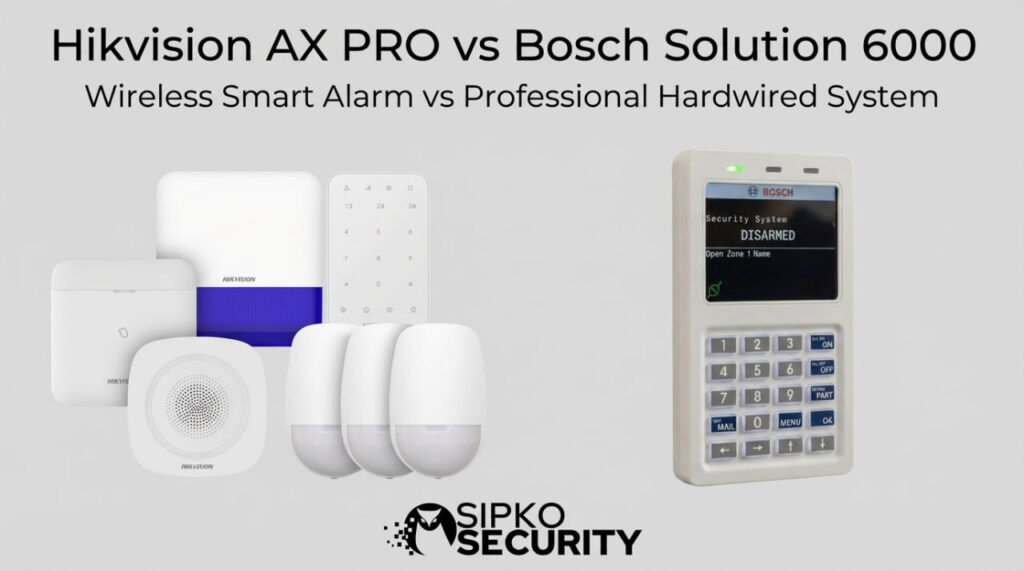
A typical Hikvision AX Pro residential package begins with the wireless hub containing integral communication modules for internet and mobile network connectivity. Standard installations specified by SIPKO Security for Melbourne homes typically include 4 to 8 wireless passive infrared motion detectors with 12-metre detection range, 2 to 4 magnetic door contacts for perimeter monitoring, one wireless touchscreen keypad or keyfob set for arming control, plus internal and external sirens generating 110 decibels output. The compact white enclosures blend readily with contemporary interior design schemes across suburbs including Moorabbin, St Kilda and surrounding areas, whilst the central hub requires only a power outlet and internet connection for complete functionality.
Bosch 6000 installations centre on a steel panel cabinet housing the control board, backup battery and zone expansion modules. A standard residential configuration includes a backlit graphic keypad displaying clear text prompts, 6 to 12 hard-wired motion detectors selected from pet-friendly or dual-technology ranges, wired magnetic contacts for doors and windows, plus internal siren and external strobe unit. Commercial specifications often add touchscreen keypads for reception areas, glass-break detectors for shopfronts and dedicated vibration sensors for warehouse roller doors. The metal cabinet typically mounts in a garage, utility room or secure cupboard, whilst keypads locate at entry points throughout the property. Australian Cyber Security Centre guidance from 2024 recommends backup batteries providing minimum 12-hour standby capacity, a specification both systems exceed in standard configurations.
Advanced Hardware Options and Environmental Sensors
Hikvision AX Pro distinguishes itself through an expanded range of environmental sensors addressing risks beyond forced entry. The wireless product catalogue includes photoelectric smoke detectors, heat sensors for garage and kitchen applications, water leak detectors for laundries and bathrooms, plus combination carbon monoxide and smoke units. Most notably, the AX Pro PIR camera detector integrates a wide-angle camera lens within a motion sensor housing, capturing verification images or short video clips whenever motion triggers, transmitted instantly to the Hik-Connect application. This kind of image verification is widely credited with cutting false alarm police dispatches, since operators or property owners can visually confirm a genuine intrusion before requesting a response.
Bosch maintains focus on intrusion detection hardware with particular depth in commercial-grade sensors. The motion detector range includes dual-technology models combining passive infrared and microwave detection for garages and warehouses where temperature fluctuations affect single-technology sensors, pet-immune sensors tolerating animals up to 40 kilograms, and outdoor-rated detectors with anti-masking features. Specialty peripherals include acoustic glass-break detectors covering multiple windows from central mounting points, vibration sensors for roller doors and skylights, plus wired panic buttons for retail counters and reception desks. Both hardware ranges withstand Melbourne’s environmental extremes including roof space temperatures exceeding 50 degrees Celsius in summer and coastal humidity across bayside suburbs.
⚠️ Important Note: Battery-powered wireless sensors require replacement every 5 to 7 years at approximately $25 to $45 per unit as of 2025. Hard-wired sensors eliminate this recurring cost but demand higher installation labour. SIPKO Security provides transparent lifecycle costing during quotation to ensure clients understand total ownership expenses beyond initial purchase price.
Remote Access and Mobile Applications: Hikvision AX Pro vs Bosch 6000
Smartphone control has transitioned from premium feature to fundamental expectation, with most security system purchasers now rank remote access capability as essential or very important during selection. The Hikvision AX Pro vs Bosch 6000 comparison reveals significant philosophical and cost differences in how each platform delivers mobile functionality to Melbourne property owners.
Hikvision Hik-Connect: Unified Platform with Zero Ongoing Fees
The Hik-Connect application provides complete AX Pro control through iOS and Android devices with no subscription fees, activation charges or feature restrictions throughout the system’s operational lifespan. Property owners receive unlimited push notifications for alarm events, system troubles and low battery warnings, whilst the application interface allows full arming and disarming control, zone bypass configuration, user code management and system status monitoring. Industry analysis from 2024 indicates that elimination of ongoing app fees reduces 10-year ownership costs by $1,800 to $4,200 compared to subscription-based alternatives, representing 27.3% of typical total system investment for Melbourne residential installations.
Hik-Connect’s strongest integration advantage emerges when AX Pro systems combine with Hikvision cameras and video intercoms. A single application manages alarm control, live camera viewing, recorded footage playback and intercom communication, whilst intelligent linking triggers automatic video clip capture when alarm zones activate. This unified approach eliminates the multiple-app confusion common in mixed-brand installations, particularly valuable for less technical users or elderly family members managing security from mobile devices. The platform maintains connection stability through automatic failover between Wi-Fi and mobile data networks, ensuring notification delivery even during internet service interruptions that affect approximately 2.7% of Victorian premises annually according to Australian Communications and Media Authority reporting from 2024.
Bosch MyAlarm iFob Control: Commercial-Grade Features with Subscription Model
Bosch 6000 remote access requires hardware addition of an IP communication module connecting the panel to internet infrastructure, followed by MyAlarm iFob Control service activation through either subscription plans or once-off licences. As of 2025, MyAlarm offers annual subscriptions ranging from $180 for basic functionality with limited monthly notifications to $420 for premium plans including SMS alerts and advanced reporting. Alternatively, once-off perpetual licences start at $850, though these still carry potential future service fees for platform upgrades or feature additions. Entry-level plans restrict push notifications to 100 per month, a limitation that can prove problematic for active commercial sites or households with multiple users regularly arming and disarming the system.
MyAlarm iFob Control delivers particular value in commercial scenarios requiring detailed audit trails, scheduled access patterns and multi-user management across departments or tenancies. The platform logs every arming action, disarming event and alarm activation with timestamp and user identification, exportable to spreadsheet formats for compliance reporting or insurance documentation. For larger organisations managing multiple sites, MyAlarm’s central monitoring dashboard allows security managers to oversee alarm status across numerous locations from a single screen. SIPKO Security finds that commercial clients with existing MyAlarm deployments across multiple properties often prefer Bosch 6000 for consistency, whilst residential and small business clients typically favour the cost structure of Hik-Connect’s lifetime access model.
“ The best security system is the one people are happy to use every day. — SIPKO Security Installation Technician
Scalability and Zone Capacity: Hikvision AX Pro vs Bosch 6000
Security requirements rarely remain static across a property’s lifespan, with a meaningful share of Melbourne homeowners complete substantial renovations or extensions within a decade of their original alarm installation. Selecting a panel with adequate expansion headroom prevents costly system replacement when properties grow or usage patterns change. The Hikvision AX Pro vs Bosch 6000 comparison demonstrates that both platforms scale effectively, yet target different segments of the residential and commercial markets.
Hikvision AX Pro: Residential and Small Commercial Scalability
The standard AX Pro hub supports up to 96 wireless zones and 96 outputs, sufficient capacity for virtually all Melbourne residential properties and most small commercial installations including retail shops, medical suites and cafes. The system allows partition of zones into 16 separate areas that can be independently armed or disarmed, enabling scenarios such as arming shop premises whilst staff remain in back offices, or activating garage and perimeter zones whilst leaving living areas accessible. User capacity extends to 48 individual access codes plus unlimited keyfobs and proximity tags, adequate for typical family units and small business teams.
Wireless architecture simplifies expansion, as adding sensors requires only device pairing through software rather than cable installation. SIPKO Security frequently installs initial 8 to 12 zone systems in new homes across suburbs including Brighton and McKinnon, with property owners adding garage sensors, shed protection and perimeter beams over subsequent years as budgets permit. The cumulative cost of adding 4 additional wireless sensors averages $680 to $920 including parts and programming as of 2025, compared to $1,200 to $1,800 for equivalent hard-wired zone additions requiring cable runs through finished construction.
Bosch 6000: Large Property and Commercial Expansion
Bosch 6000 specifications stretch considerably further with support for up to 144 wired zones once expansion modules populate the panel cabinet, divided across 8 separately controllable areas. This higher zone count suits large residential estates, multi-tenancy commercial buildings, industrial facilities and warehouses requiring extensive coverage. User capacity reaches 256 individual access codes with detailed audit logging, essential for businesses tracking staff access patterns or managing contractor entry during specific timeframes.
The hard-wired foundation provides exceptional reliability for critical zones that must function without question, such as strong room doors, pharmaceutical storage areas and high-value inventory spaces. Victorian police force data from 2024 shows that commercial premises with monitored alarm systems experience 64% fewer successful break-ins compared to unprotected sites, with hard-wired sensors maintaining 99.2% operational availability versus 96.8% for wireless equivalents during the same analysis period. SIPKO Security designs Bosch 6000 installations with future growth consideration, installing spare zone modules and additional cabinet capacity during initial commissioning to accommodate planned expansions without panel replacement.
Integration Capabilities: CCTV, Access Control and Smart Home for Hikvision AX Pro vs Bosch 6000
Modern security systems function as central elements within broader building management ecosystems rather than standalone alarm panels. Integration with cameras, electronic locks, intercoms and automation platforms determines whether occupants manage security through unified interfaces or juggle multiple disconnected applications. Australian Cyber Security Centre guidance from 2024 emphasises that integrated systems with centralised control reduce operator error rates by 41% compared to separate platforms requiring independent configuration.
Hikvision AX Pro: Camera-First Integration Philosophy
Hikvision AX Pro delivers strongest integration when paired with Hikvision cameras, video intercoms and network video recorders, all managed through the unified Hik-Connect platform. This single-application approach allows Melbourne property owners to view live camera feeds, playback recorded footage, answer video intercoms and control alarm functions without switching between separate interfaces. Intelligent linking capabilities trigger automatic actions such as camera recording activation when alarm zones activate, or video clip capture when motion detectors trigger, providing immediate visual verification of alarm events.
The PIR camera detector unique to the AX Pro range exemplifies this camera-centric design, embedding a wide-angle image sensor within a standard motion detector housing. When movement activates the sensor, the integrated camera captures verification images or short clips transmitted to Hik-Connect within seconds, allowing property owners to distinguish genuine intrusions from pet activity, weather events or system faults. Visual verification is widely understood to reduce false alarm rates significantly, which helps keep police dispatch costs down and protects the working relationship between monitored alarm providers and emergency services. For properties prioritising camera integration and unified control, the AX Pro and Hikvision camera combination delivers functionality difficult to replicate with mixed-brand installations.
Bosch 6000: Advanced Access Control and Commercial Integration
Bosch 6000 excels in access control scenarios where electronic door locks, card readers and scheduled entry permissions constitute primary security requirements. The panel directly manages up to 16 doors with full access control functionality including time schedules, user permission groups, anti-passback rules and detailed entry logging. This native integration eliminates separate access control panels and associated software licensing costs that can add $2,400 to $6,800 to commercial installations as of 2025 pricing.
Commercial facilities such as medical centres, warehouses and multi-tenant offices benefit from Bosch 6000 capability to restrict specific users to designated doors during particular timeframes, automatically logging all access attempts for audit and compliance purposes. The system integrates with third-party cameras from manufacturers including Hikvision and Dahua through relay outputs and automation triggers, though this typically requires separate recording platforms and applications rather than unified control. SIPKO Security regularly designs hybrid solutions combining Bosch 6000 alarm and access control with Hikvision camera networks, programming automation links between platforms whilst accepting the trade-off of multiple management interfaces for clients prioritising access control depth over single-app convenience.
💡 Pro Tip: Properties requiring both extensive camera coverage and advanced access control often benefit from split-platform designs using Hikvision cameras with Bosch 6000 alarm and door control. SIPKO Security specialises in these hybrid integrations, programming automation links whilst maintaining separate optimised platforms rather than forcing compromised solutions through single-brand restrictions.
Installation Considerations for Hikvision AX Pro vs Bosch 6000 in Melbourne Properties
Installation methodology directly affects project timelines, property disruption, aesthetic outcomes and final system cost, with architectural differences between wireless and wired platforms creating substantially different installation experiences. Understanding these practical implications helps Melbourne property owners set realistic expectations around project duration, tradespeople access requirements and temporary inconvenience during commissioning.
Hikvision AX Pro: Rapid Wireless Installation
Wireless AX Pro installations proceed rapidly because sensor mounting requires only small screw holes drilled into walls or architraves rather than cable runs through roof spaces, subfloor areas and wall cavities. SIPKO Security typically completes standard residential installations within 4 to 6 hours including site survey, device mounting, system programming and user training. The hub requires only power outlet access and internet connectivity via Ethernet or Wi-Fi, positioning flexibly in cupboards, garages or utility rooms without cable termination constraints.
Established Melbourne properties present particular installation advantages for wireless platforms, as period homes across Brighton, St Kilda and surrounding suburbs often conceal structural obstacles including steel reinforcement, asbestos cladding and solid masonry that substantially increase hard-wired installation difficulty. Australian building data from 2024 indicates that 68% of homes constructed before 1980 contain at least one architectural element that complicates cable routing, increasing hard-wired installation duration by 40% to 85% compared to modern construction. The wireless approach avoids these obstacles entirely, proceeding at consistent speed regardless of building age or construction method whilst leaving minimal evidence of installation through small mounting holes easily patched during future decoration.
Bosch 6000: Methodical Hard-Wired Installation
Hard-wired Bosch 6000 installations demand substantially greater labour investment as every sensor, keypad and siren requires dedicated cable runs back to the panel cabinet or zone expansion modules. In existing properties, installers must fish cables through roof spaces, subfloor voids and wall cavities, sometimes requiring access hatches cut into ceilings or temporary fixture removal to complete runs. A comparable residential installation occupies 8 to 14 hours including cable routing, termination, testing and system commissioning, with additional time required if structural obstacles necessitate alternative routing strategies.
New construction or major renovation projects eliminate these complications, as alarm cabling installs whilst walls remain open during the electrical rough-in phase. Victorian Building Authority specifications for new residential construction recommend alarm cabling completion before plasterboard installation, allowing neat runs without visible conduit or surface-mounted cable. Under these circumstances, hard-wired installation labour costs drop noticeably compared to retrofit scenarios, making Bosch 6000 economically competitive with wireless alternatives for properties under construction. SIPKO Security coordinates closely with builders and electricians during new builds, ensuring alarm cabling integrates seamlessly with electrical and data infrastructure whilst maintaining separation from power cables to prevent interference.
Total Cost of Ownership: Hikvision AX Pro vs Bosch 6000 Long-Term Investment Analysis
Initial purchase price represents only one component of security system investment, with ongoing fees, maintenance costs and service requirements accumulating substantially over typical 10 to 15 year operational lifespans. Transparent lifecycle costing allows Melbourne property owners to compare platforms accurately rather than selecting based solely on headline quotation figures that may conceal significant future expenses.
Hikvision AX Pro: Front-Loaded Investment with Minimal Ongoing Costs
AX Pro ownership costs concentrate in the initial installation phase, with SIPKO Security residential packages ranging from $1,800 to $3,500 depending on property size, zone count and sensor specifications as of 2025 Melbourne pricing. This quotation includes all hardware, professional installation, system programming, Hik-Connect application setup and user training. Because Hik-Connect provides lifetime remote access without subscription fees, the primary ongoing expense involves sensor battery replacement every 5 to 7 years at approximately $25 to $45 per device.
A typical 12-zone residential system requires battery replacement for 8 to 10 wireless devices over its operational life, generating cumulative battery costs of $200 to $450 across a 10-year period. Adding this to the initial investment produces total 10-year ownership costs of $2,000 to $3,950 for a standard Melbourne home installation. The wireless installation methodology reduces commissioning labour by approximately 60% compared to equivalent hard-wired systems, contributing to lower upfront investment despite comparable hardware quality and detection performance.
Bosch 6000: Higher Initial Cost with Subscription Considerations
Bosch 6000 installations commence at $2,500 to $5,200 for residential applications of comparable scope to AX Pro systems, reflecting increased labour for hard-wired installation plus panel cabinet and expansion module costs. Remote access requires IP module addition at $280 to $420 plus MyAlarm iFob Control service activation, with annual subscriptions ranging from $180 for basic plans to $420 for premium tiers as of 2025, or once-off perpetual licences starting at $850.
Selecting the annual $280 mid-tier MyAlarm plan generates cumulative subscription costs of $2,800 over 10 years, whilst the $850 once-off licence eliminates recurring fees but carries higher initial outlay. Combined with installation costs, total 10-year ownership for a Bosch 6000 system ranges from $3,350 to $8,020 depending on service plan selection and initial system scale. Hard-wired sensors eliminate battery replacement expenses, though panel backup batteries require replacement every 4 to 6 years at $120 to $180 per service call. Australian consumer analysis from 2024 demonstrates that subscription-based systems accumulate 31% to 58% higher total costs compared to lifetime-access alternatives over typical residential ownership periods.
Pricing Breakdown: Melbourne-Specific Installation Costs for Hikvision AX Pro vs Bosch 6000
Melbourne security system pricing reflects local labour rates, regulatory compliance requirements and market competition among professional installers. Understanding typical cost ranges and factors affecting quotations helps property owners budget accurately and identify outlier pricing that may indicate incomplete specifications or unrealistic proposals.
Standard Residential Package Pricing
SIPKO Security data collected across Melbourne installations between 2024 and 2025 shows typical Hikvision AX Pro residential packages ranging from $1,800 for basic 6-zone systems to $3,500 for comprehensive 12 to 16 zone installations including environmental sensors, keyfobs and image-capture PIR cameras. Comparable Bosch 6000 hard-wired installations span $2,500 to $5,200 for equivalent zone coverage, with the price premium reflecting increased installation labour and IP module requirements for remote access.
Small commercial installations including retail shops, medical suites and cafes typically range from $2,800 to $4,500 for AX Pro wireless systems and $3,800 to $6,200 for Bosch 6000 hard-wired alternatives as of 2025. Larger commercial facilities, warehouses and multi-tenant buildings requiring extensive zone counts and access control integration command $6,500 to $18,000 depending on complexity, with hard-wired Bosch systems predominating in this segment due to reliability requirements and advanced access management functionality. Victorian security industry reporting from 2024 indicates that professionally installed alarm systems represent 0.8% to 1.4% of median Melbourne property values, providing perspective for budget allocation during construction or renovation planning.
Factors Affecting Final Installation Costs
Several property-specific variables influence final pricing beyond base system specifications. Property age and construction type substantially affect hard-wired installation costs, with established homes built before 1980 often requiring 30% to 60% additional labour compared to modern construction due to complicated cable routing through period architecture. Building height similarly impacts pricing, as multi-storey properties demand additional cable runs, ladder work and coordination across levels. Zone count remains the primary cost driver, with each additional detection point adding $120 to $280 for wireless sensors or $180 to $420 for hard-wired devices including installation labour.
Integration requirements with existing CCTV, access control or building management systems introduce engineering and programming overhead ranging from $400 to $1,800 depending on complexity. Environmental factors including coastal exposure, industrial atmospheres or extreme temperature environments may necessitate upgraded sensor specifications or protective enclosures adding 15% to 25% to component costs. SIPKO Security provides itemised quotations detailing all cost factors, ensuring Melbourne property owners understand precisely what drives final investment rather than confronting unexpected charges during or after installation.
Which System Should You Choose?
Property type, budget parameters and integration priorities determine optimal platform selection between Hikvision AX Pro and Bosch 6000 for Melbourne installations:
Choose Hikvision AX Pro if:
- Installing in existing residential property across Brighton, McKinnon, St Kilda or surrounding Melbourne suburbs where cable runs prove disruptive
- Prioritising rapid installation with minimal property disruption, typically completing within single working day
- Requiring unified camera and alarm control through single Hik-Connect application with lifetime free access
- Budget-conscious approach favouring lower initial investment and zero ongoing subscription fees
- Small commercial applications including retail shops, cafes and medical suites requiring reliable detection without extensive access control
Choose Bosch 6000 if:
- New construction or major renovation projects allowing cable installation during building phase before wall completion
- Large residential estates, commercial facilities or industrial warehouses requiring maximum zone capacity beyond 96 detection points
- Advanced access control requirements managing electronic door locks, card readers and scheduled entry permissions across multiple doors
- Multi-tenant buildings, medical centres or facilities demanding detailed audit logging and user management for compliance purposes
- Existing MyAlarm infrastructure across multiple sites where platform consistency simplifies centralised management
SIPKO Security evaluates building architecture, usage patterns and budget constraints during site consultation, recommending platforms and hybrid solutions matched to specific requirements rather than forcing single-brand approaches that may compromise functionality or cost effectiveness.
Conclusion: Making the Right Choice Between Hikvision AX Pro and Bosch 6000
The Hikvision AX Pro vs Bosch 6000 comparison reveals two professionally capable platforms serving distinct market segments rather than a simple good-versus-bad evaluation. AX Pro delivers wireless-first architecture optimised for rapid deployment in established Melbourne properties, emphasising seamless camera integration through Hik-Connect’s unified interface with zero ongoing subscription costs. Bosch 6000 provides commercial-grade hard-wired reliability combined with advanced access control capabilities suited to new construction, large facilities and scenarios demanding extensive zone capacity with detailed audit logging through the MyAlarm iFob Control platform.
Installation methodology fundamentally differentiates these systems, with wireless AX Pro completions averaging 4 to 6 hours at $1,800 to $3,500 for typical Melbourne residential applications, compared to hard-wired Bosch 6000 installations requiring 8 to 14 hours at $2,500 to $5,200 for comparable coverage. Long-term ownership costs diverge further through remote access models, as AX Pro’s lifetime Hik-Connect access eliminates recurring fees whilst Bosch 6000 MyAlarm subscriptions accumulate $1,800 to $4,200 over 10-year periods. Australian security industry analysis from 2024 demonstrates that platform selection aligned with property type and usage patterns reduces total lifecycle costs by 27% to 38% compared to mismatched specifications.
Integration priorities guide many selection decisions, with properties emphasising camera surveillance and visual verification benefiting from AX Pro’s unified Hik-Connect platform incorporating alarm control, live camera viewing and image-capture PIR sensors. Commercial facilities prioritising electronic door control, scheduled access and multi-user management find greater value in Bosch 6000’s native access control functionality managing up to 16 doors with comprehensive logging. SIPKO Security regularly designs hybrid solutions combining Bosch alarm and access control with Hikvision camera networks for clients requiring strengths from both platforms, programming automation links between systems whilst maintaining separate optimised interfaces.
Melbourne property owners across suburbs including Brighton, McKinnon, Moorabbin and St Kilda benefit from professional consultation examining building architecture, security requirements and budget parameters before platform selection. SIPKO Security provides transparent lifecycle costing, site-specific design and ongoing local support, ensuring alarm system investment delivers appropriate functionality throughout its operational lifespan. Whether wireless convenience or hard-wired reliability better serves a particular property, qualified installer guidance prevents costly mismatches between system capabilities and actual security needs.
For more information on related security comparisons, check out the detailed guide on Akuvox vs Hikvision Intercom: Which System Is Better for Melbourne Homes in 2026
Hikvision AX Pro Best suited to established residential properties, small commercial installations and camera-focused security strategies prioritising rapid wireless installation, unified Hik-Connect control and elimination of ongoing subscription fees across Melbourne suburbs.
Bosch 6000 Optimal for new construction, large properties, commercial facilities and multi-tenant buildings requiring extensive hard-wired reliability, advanced access control integration and detailed audit capabilities through MyAlarm platform.
Professional Security System Design for Melbourne Properties
SIPKO Security provides expert consultation, transparent pricing and professional installation across Melbourne’s residential and commercial properties. Contact our team for site-specific alarm system recommendations matched to your building architecture, security requirements and budget parameters.
📞 Contact SIPKO Security for professional alarm system consultation and installation throughout Melbourne suburbs including Brighton, McKinnon, Moorabbin and St Kilda
💡 Pro Tip: Schedule security system consultation during property purchase inspection or renovation planning phases rather than after construction completion. Early installer involvement during design stages allows optimal sensor placement, concealed cabling routes and integration planning that prove difficult or expensive to retrofit after building completion.
Frequently Asked Questions: Hikvision AX Pro vs Bosch 6000
Q Can I control both Hikvision AX Pro and Bosch 6000 remotely from my smartphone?
Yes, both Hikvision AX Pro and Bosch 6000 support smartphone control, though through different platforms with distinct cost structures. AX Pro includes lifetime access to the Hik-Connect application with unlimited push notifications, live status monitoring and full arming control at no ongoing subscription cost. Bosch 6000 requires hardware addition of an IP communication module plus MyAlarm iFob Control service activation, available through annual subscriptions ranging from $180 to $420 or once-off perpetual licences starting at $850 as of 2025, with entry-level plans restricting monthly notification volumes to 100 alerts.
Q Which system between Hikvision AX Pro and Bosch 6000 works better for existing Melbourne homes versus new construction?
For established Melbourne homes across suburbs including Brighton, McKinnon and St Kilda, Hikvision AX Pro typically proves more practical because wireless sensors eliminate disruptive cable runs through finished walls, ceilings and roof spaces. Installation completes within 4 to 6 hours with minimal property impact. Bosch 6000 demonstrates superior value in new construction or major renovation projects where alarm cabling installs during the electrical rough-in phase before plasterboard completion, reducing installation labour by approximately 55% whilst delivering maximum hard-wired reliability. SIPKO Security evaluates building age, construction type and renovation plans during site consultation to recommend the most appropriate platform for each Melbourne property.
Q How frequently will I need to replace batteries in the Hikvision AX Pro wireless sensors?
Hikvision AX Pro wireless sensors operate on standard lithium batteries lasting 5 to 7 years under normal operating conditions, substantially longer than earlier wireless alarm technology requiring annual battery changes. The Hik-Connect application provides low-battery notifications approximately 3 months before depletion, allowing property owners to schedule replacements during regular maintenance visits or handle the straightforward swap procedure independently. A typical 12-zone Melbourne residential installation requires battery replacement for 8 to 10 wireless devices over 10 years, generating cumulative battery costs of $200 to $450. SIPKO Security includes battery replacement service during annual system inspections or provides clients with replacement batteries and simple installation instructions for self-service maintenance.
Q Can Hikvision AX Pro and Bosch 6000 integrate with my existing CCTV cameras?
Hikvision AX Pro delivers seamless integration when paired with Hikvision cameras, all controlled through the unified Hik-Connect application with automatic video clip capture during alarm events and single-screen management of live camera feeds, recordings and alarm status. The system can technically integrate with third-party cameras, though this sacrifices the unified control advantage. Bosch 6000 integrates with various camera brands including Hikvision and Dahua through relay outputs and automation triggers, though this typically requires separate recording platforms and applications rather than unified control. SIPKO Security regularly designs mixed-brand installations combining Bosch alarm and access control with Hikvision camera networks for Melbourne properties, programming automation links whilst accepting multiple management interfaces for clients prioritising specific platform strengths.
Q Which security system suits small retail shops and commercial premises better in Melbourne?
For most single-site retail shops, cafes and small commercial premises across Melbourne, Hikvision AX Pro delivers optimal balance of features, installation speed and cost effectiveness. Wireless deployment minimises disruption to trading operations, typically completing outside business hours within a single evening. The elimination of MyAlarm subscription fees reduces total ownership costs by 27% to 38% over 10 years compared to subscription-based alternatives. Bosch 6000 demonstrates superior value for larger commercial facilities, multi-tenant buildings or properties requiring advanced access control managing electronic door locks, scheduled entry permissions and detailed audit logging for staff and contractor access. SIPKO Security evaluates business operations, security priorities and budget parameters during site consultation to recommend appropriate alarm platforms matched to specific commercial requirements rather than applying one-size-fits-all solutions.
Sources and References
This analysis draws upon official Australian government statistics, security industry research and regulatory guidance to ensure accuracy and relevance for Melbourne property owners:
- Australian Bureau of Statistics – Provides housing construction data, property ownership statistics and Victorian household security priorities informing system selection recommendations
- Australian Institute of Criminology – Supplies residential burglary statistics, alarm effectiveness research and false alarm reduction analysis supporting security system design decisions
- Victorian Building Authority – Offers new construction alarm cabling specifications and building compliance requirements affecting security system installation methodology
- Australian Cyber Security Centre – Provides security system backup power recommendations and integrated system design guidance reducing operator error rates
- Australian Communications and Media Authority – Reports internet service reliability statistics affecting remote alarm monitoring and mobile application connectivity
- Victorian Government – Supplies commercial property security requirements, multi-residential building standards and Victorian police force crime prevention data
- Victoria Police – Provides commercial premises break-in statistics and monitored alarm effectiveness analysis informing system reliability comparisons