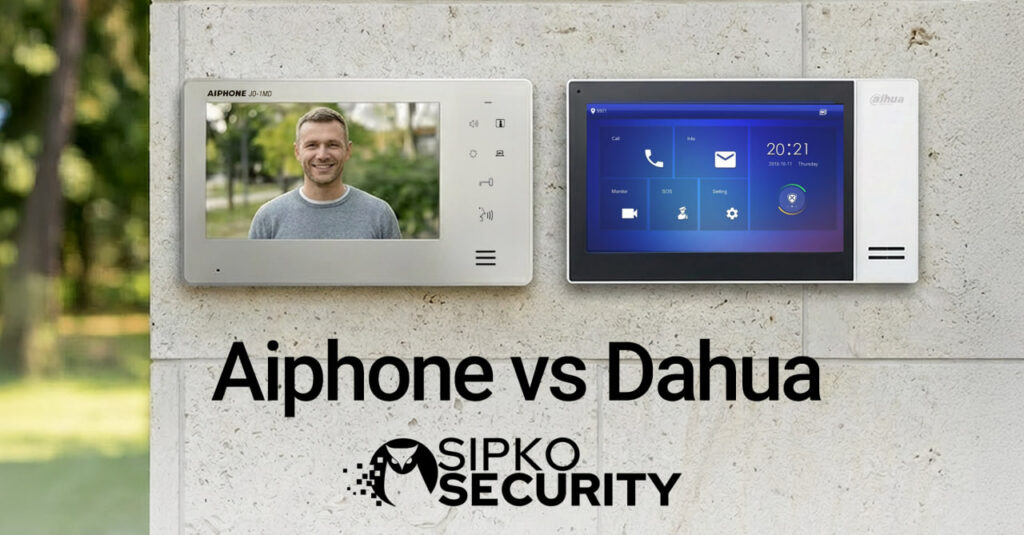
Aiphone vs Dahua Intercom Systems: The Ultimate Engineering & Feature Comparison
Aiphone vs Dahua: An exhaustive analysis comparing the Japanese legacy engineering of Aiphone against the AI-driven IP ecosystem of Dahua. We cover wiring topologies, specific model comparisons, security vulnerabilities, audio physics, and total cost of ownership for Australian homeowners and Strata bodies.
1. Introduction: The Divergent Paths of Door Security
In the world of security integration, there are few debates as heated as Aiphone vs Dahua. It splits the industry down the middle. On one side, you have the “Analog Purists” who swear by Aiphone’s refusal to fail. On the other, the “Cloud Integrators” who view the intercom as just another smart node in the Dahua ecosystem.
For the end user in Melbourne, whether you are in a terrace house in Carlton or a sprawling estate in Brighton, this choice defines your daily experience. It dictates how you answer the door, how clear the audio is during a storm, and whether your system will still be working in 2040.
The Australian Bureau of Statistics (ABS) reports an estimated 217,600 households experienced a break-in during the 2023-24 financial year. A significant percentage of thieves “knock first” to check if anyone is home. Your intercom is your first line of defence. If it fails, acts slow, or provides grainy video, your perimeter is compromised.
This guide moves beyond the glossy brochure specs. We are going to dismantle the marketing and look at the copper, the chips, and the code. We will compare the flagship models, the mid-range workhorses, and the multi-tenant systems.
2. The Philosophy of Hardware: Japan vs China
To understand the products, you must understand the countries that build them.
Aiphone: The Toyota Way (Japan)
Aiphone was founded in Nagoya, Japan, in 1948. Their philosophy follows “Kaizen” (continuous improvement) but with a heavy conservative bias. They prioritize reliability over features. If a new technology has a 1% failure rate, Aiphone will not use it.
Internal Construction: Open an Aiphone GT door station, and you see thick PCBs with wide traces. Components are spaced out for thermal management. Connectors are screw-terminals that bite hard into the wire. The plastics used are high-density and UV stabilized. This is why you still see functioning Aiphone audio systems from the 1980s in Carlton apartment blocks.
Dahua: The Silicon Velocity (China)
Dahua Technology is a powerhouse of the modern surveillance state. Based in Hangzhou, they innovate at blistering speed. Their philosophy is convergence. An intercom isn’t just a doorbell; it’s a camera, a card reader, a facial recognition node, and an alarm sensor.
Internal Construction: Inside a Dahua VTO, you find high-density multi-layer motherboards similar to a smartphone. They use surface-mount components that are tiny and efficient. However, this density creates heat. A Dahua unit running AI facial recognition generates significant thermal energy. While built to IP65 standards, the lifecycle of these high-stress components is shorter than the simpler, cooler-running Aiphone circuits.
3. Detailed Model-by-Model Battle
Generalizations are fine, but let’s compare the actual units you are likely to be quoted.
Battle 1: The Single Family Home
Contender A: Aiphone JO-1MDW vs Contender B: Dahua VTO2311R-WP
Aiphone JO-1MDW: This is a 7-inch touchscreen master station with built-in Wi-Fi. It connects to the door station via 2 wires. PROS: Instant startup. No lag. Bulletproof audio. CONS: The mobile app is “basic” at best. If the Wi-Fi drops, the app stops working, but the screen still works flawlessly.
Dahua VTO2311R-WP: A sleek, slimline Wi-Fi doorbell. PROS: 1080p video is sharper than the Aiphone. Night vision is better due to IR intensity. The app is faster to push notifications. CONS: It relies heavily on your Wi-Fi signal strength at the gate. If your router is weak, the audio will chop and stutter.
Verdict: Aiphone for reliability, Dahua for features/price.
Battle 2: The Multi-Tenant Apartment
Contender A: Aiphone GT Series vs Contender B: Dahua VTO6541 Face Rec
Aiphone GT: Uses a modular bus system. You can physically clip together modules (Keypad + Camera + Directory). It supports up to 500 tenants. The “NFC” programming allows an installer to update the directory by tapping an Android phone to the panel. It’s offline, secure, and robust.
Dahua VTO6541: A glass monolith. It looks like an iPhone embedded in a wall. It supports Facial Recognition unlocking for tenants (very convenient). However, managing the database of 500 faces requires a networked PC and strict privacy compliance. If the network switch fails, the whole building goes dark.
Verdict: Aiphone for Strata Managers who want zero hassles.
4. Wiring Infrastructure: The Hidden Cost
More than price or features, your choice is often dictated by the wires already in your walls.
The Aiphone Proprietory 2-Wire Star/Loop
Aiphone uses a frequency-modulated signal that carries Video, Audio, Data, and Power on alternating cycles over just two copper cores. It is incredibly tolerant of “noise” and “impedance.” You can use CAT5, CAT6, 18-gauge speaker wire, or old telephone wire.
Max Distance: Up to 100m on standard 0.65mm wire, or 300m with thicker gauge.
The Daisy Chain Benefit: You can jump from Monitor A to Monitor B to Monitor C in a line. This saves huge amounts of cabling labour in renovations.
The Dahua TCP/IP PoE Standard
Dahua uses standard Ethernet packets (TCP/IP). It requires 4 pairs of wires (8 cores) and RJ45 terminations. It follows the “Star Topology” exclusively. Every single monitor must run a dedicated cable back to a central PoE switch. You cannot daisy chain them reliably.
Max Distance: Strictly 100m. Beyond that, you need extenders or fibre optics.
The Cabling Reality: If you bend a CAT6 cable too sharply (kink it), a Dahua system might fail or show artifacts. An Aiphone system would likely ignore the kink and keep working.
🚧 Renovation Warning
If you are renovating a double-brick home in Melbourne, getting new CAT6 cables to the front gate is often impossible without trenching the driveway and cutting internal plaster. Choose Aiphone here. We can reuse the old doorbell wires. Choosing Dahua in this scenario often leads to ugly conduit pipes on your façade.
5. Audio Physics: Full Duplex vs Side Tone
Video is nice, but an intercom is primarily an audio device. You need to verify who is there.
Aiphone Audio: Aiphone typically uses a “Full Open Voice” (VOX) or full-duplex system. The microphone sensitivity is tuned to human voice frequencies (300Hz to 3400Hz). They use aggressive hardware-based echo cancellation. The result? You can talk over each other (interrupting) and hear perfectly. It feels like a phone call.
Dahua Audio: Dahua uses digital codecs (G.711u). Because it travels over a network, there is “packetisation delay.” It might only be 200 milliseconds, but it causes the system to sometimes switch to “Half-Duplex” mode to stop feedback loops. This means if you are shouting at the intruder, you might not hear them replying until you stop talking. It feels like a Walkie-Talkie.
6. The “Hacker’s Perspective”: Security Analysis
In 2026, we must assume everything is a target. The Australian Cyber Security Centre warns that IoT devices are the new perimeter.
Dahua Security Vector
Dahua devices run a stripped-down version of Linux. They have open ports (80, 554, 37777). If you place a Dahua outdoor station on the public internet without a firewall, it will be scanned by bots within minutes. However, Dahua has implemented “Security 2.0” protocols:
1. Forces complex passwords (no more “admin/admin”).
2. Supports HTTPS/SSL encryption for web access.
3. Video streams are encrypted (AES) when viewing via the cloud.
Aiphone Security Vector
Aiphone is “Security by Isolation.” Most systems do not even have an IP address. They are electrically isolated circuits. To hack an Aiphone JO, you need a screwdriver and physical access to the wires. There is no remote execution vulnerability because there is no remote code execution capability. For high-threat clients (Judges, Politicians, etc.), Aiphone is the default recommendation for this reason.
7. Total Cost of Ownership (15 Year Model)
The “Price” is what you pay today. The “Cost” is what you pay over time. Let’s model this for a standard home in Melbourne.
The math is clear. If you plan to stay in your home for 20 years, Aiphone is cheaper. If you plan to sell in 5 years, Dahua is cheaper (upfront) and adds “Smart Home” appeal to the listing.
8. Troubleshooting Guide: When Things Go Wrong
Every system has quirks. Here are the most common service calls we get at SIPKO Security and which brand is easier to fix.
Common Dahua Issues
- “Network Host Not Found”: This means the IP address has changed or the router rebooted. FIX: Set static IP addresses for all intercom units inside the router settings (Gateway binding).
- “No Push Notification”: Often caused by mobile phone battery optimization putting the DMSS app to sleep. FIX: Go to App Settings > Battery > Unrestricted.
- “Robotic Voice”: Packet loss. Usually a bad crimp on the CAT6 cable or a Wi-Fi signal passing through too many brick walls.
Common Aiphone Issues
- “Humming/Buzzing Noise”: Ground loop or interference from induction (e.g., the intercom wire runs parallel to a 240V power cable). FIX: Isolate the cable path or install a ground loop isolator.
- “Blue Screen / No Video”: Voltage drop. The cable is too thin for the distance. FIX: Double up the copper cores or install a supplemental power supply closer to the gate.
- Button Sticking: On 15-year-old units, dirt enters the mechanism. FIX: Physical cleaning with contact cleaner (usually sorts it for another 5 years).
9. Future Proofing: Matter, Thread, and AI
What does 2030 look like? Dahua is actively integrating “Matter” support and deeper AI analytics into their pipeline. We expect future Dahua units to detect “Loitering” (someone standing at the door without ringing) and announce it via Alexa.
Aiphone moves slower. Their future roadmap focuses on higher resolution sensors and better cloud integration, but they are resisting the “Open Ecosystem” approach. They believe a security device should essentially remain a closed silo to guarantee integrity. If you want cutting-edge AI features next year, Dahua is the vehicle that will get you there. Aiphone is the vehicle that will just keep running.
Contact SIPKO Security
Speak with a specialist about wired and wireless CCTV, Ajax alarms, and same-week installations. We respond quickly during business hours and offer after-hours call-outs for urgent security issues.
📞 0406 432 691
📍 Head Office: Brighton, Melbourne
Prefer WhatsApp? Tell us in your message — we’ll reply on your preferred channel.
Frequently Asked Questions
Can I replace my old intercom with Dahua using existing wires?
Technically, yes, using “2-Wire IP Converters” (Dahua VTNS series). However, these add cost and complexity. The converter boxes are large and often hard to fit in the wall cavity. We generally recommend Aiphone for old wires, or pulling new CAT6 if possible.
Why is the Aiphone screen smaller?
Aiphone standardizes on 7-inch screens because they are reliable and energy-efficient. Dahua offers 10-inch Android tablets. While the big screen looks impressive, the pixel density (PPI) is often similar. The reliability of the 7-inch panel is typically higher over 10 years.
Can I have multiple screens in different rooms?
Yes, both brands support this. Aiphone supports up to 8 sub-monitors (daisy-chained). Dahua supports usually up to 5-10 sub-monitors (networked). The key difference is Intercom-to-Intercom calling. Dahua allows you to “call the kitchen” from the “bedroom” more easily via the touch interface.
What about rain and weather?
Aiphone excels in this area. Their lens covers are often recessed or made of scratch-resistant polycarbonate. Dahua units often have flush glass fronts. While pretty, water droplets can sit on the lens and obscure the view. We always recommend installing a rain hood (VTM series) for Dahua units.
Sources and References
- Australian Institute of Criminology (AIC) – Comprehensive data on residential burglary methodology and CPTED principles relative to access control.
- Australian Bureau of Statistics (ABS) – Recorded Crime – Victims, Australia, 2023–24. Specific focus on unlawful entry with intent.
- Government of Western Australia – Consumer Protection – “Smart home devices: What you need to know” – consumer guarantees and longevity expectations.
- ACT Government Community Services – Factsheets on home safety audits and recommended hardware standards for community housing.
- Office of the Australian Information Commissioner (OAIC) – “Guide to data privacy” – Specific guidelines on video surveillance and data collection for residential entities.
10. Pre-Installation Checklist for Homeowners
Before you call an installer, walk out to your front gate and check these three critical factors. This will save you time and money.
Sources and References
- Australian Institute of Criminology (AIC) – Comprehensive data on residential burglary methodology and CPTED principles relative to access control.
- Australian Bureau of Statistics (ABS) – Recorded Crime – Victims, Australia, 2023–24. Specific focus on unlawful entry with intent.
- Government of Western Australia – Consumer Protection – “Smart home devices: What you need to know” – consumer guarantees and longevity expectations.
- ACT Government Community Services – Factsheets on home safety audits and recommended hardware standards for community housing.
- Office of the Australian Information Commissioner (OAIC) – “Guide to data privacy” – Specific guidelines on video surveillance and data collection for residential entities.
- Australian Competition & Consumer Commission (ACCC) – Consumer Guarantees for electronics and security hardware lifecycles.