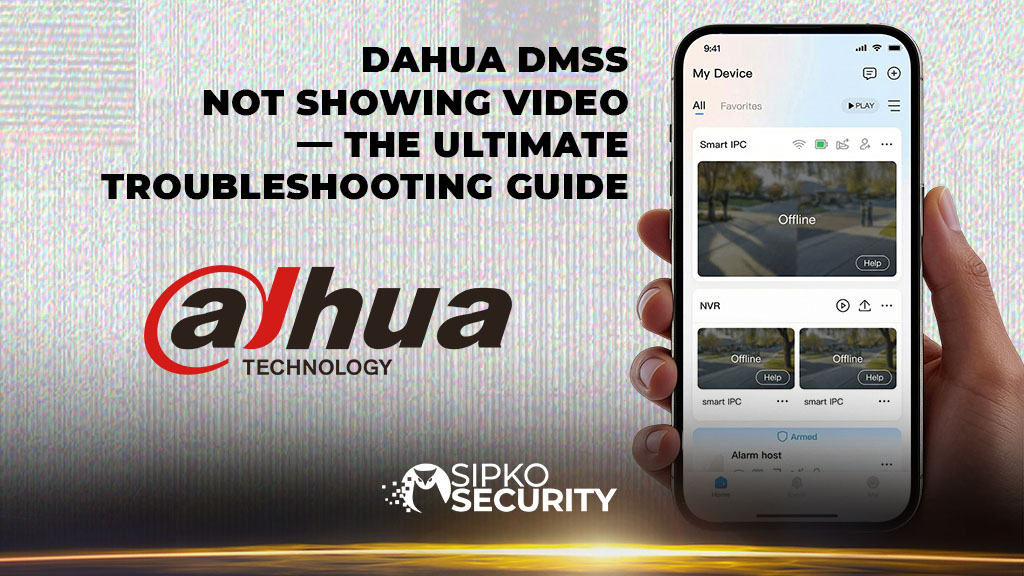
Dahua DMSS Not Showing Video — The Ultimate Troubleshooting Guide
Whether you are a homeowner seeing “Connection Failed” or a technician dealing with a “Device Bound” error, this guide covers every possible fix for Dahua NVRs.
It is the most common support call we receive at Sipko Security: “My cameras were working yesterday, but today the app just spins.”
The DMSS app (and its predecessors iDMSS/gDMSS) relies on a delicate chain of connections: your NVR, your modem, the Dahua P2P server, and your phone’s 4G/5G connection. If any single link breaks, you get the grey screen of death.
In this premium guide, we go beyond the basic “turn it off and on again”. We explore advanced diagnostics, Port Forwarding, firmware updates, and how to use the ConfigTool to salvage a “broken” system.
Phase 1: Basic Diagnostics (Start Here)
Don’t skip this. 80% of issues are resolved in this phase.
- The “Click” Test: Go to your NVR. Unplug the LAN cable and plug it back in. Listen for the click. Check if the green/orange lights on the port are flashing. No lights = No data.
- Power Cycle Sequence: Turn off NVR. Turn off Modem. Turn Modem ON (wait 3 mins). Turn NVR ON. This forces the NVR to request a fresh IP address from the router.
- Check Cable Quality: Factory-supplied cables are often cheap. If your NVR is far from the modem, ensure you are using a quality CAT6 cable. A chewed or bent cable causes intermittent packet loss.
Phase 2: Mastering P2P Status
The Peer-to-Peer (P2P) service is what allows remote viewing without static IPs.
The Golden Path to “Online”
You need a monitor connected to the NVR for this.
- Main Menu > Network > TCP/IP.
- Ensure DHCP is ticked. Click Apply. (This ensures your NVR matches your modem’s IP range, e.g., 192.168.1.xxx).
- Go to P2P / Platform Access.
- Ensure Enable is ticked.
- Status must be “Online”.
Phase 3: Solving Specific Error Messages
Error 1: “User Locked”
Cause: You (or an old phone attempting to connect) entered the wrong password 5+ times.
Fix: The NVR locks for 20-30 minutes. Rebooting the NVR clears this lock immediately. Once rebooted, update the password in DMSS settings before trying to view the live feed.
Error 2: “Device Already Bound”
Cause: The device is linked to another email account (previous owner or installer).
Fix: New firmware allows “Self-Unbinding”. Try adding the device. When the error appears, click Request Unbinding. You will need to scan the QR code on the physical NVR label (not the screen) and upload a photo of it. Approval usually takes 24 hours.
Error 3: “Failed to Subscribe” (No Notifications)
Cause: The “Linkage” between your phone and the NVR is broken.
Fix: In DMSS, go to Device Details > Notification. Toggle it OFF, Save. Toggle it ON, Save. Ensure you select “Intrusion” or “Tripwire” (IVS) rather than just “Motion Detection”.
Phase 4: The “Nuclear Option” — Port Forwarding
If P2P is constantly failing (often due to firewall restrictions or NBN provider issues like CG-NAT), Port Forwarding is the professional workaround. It connects you directly to the NVR, bypassing the Dahua cloud.
Prerequisite: Static IP
You strictly need a Public Static IP from your ISP for this to work reliably. If you don’t have one, ask your ISP or use DDNS (see Phase 5).
Step 1: Set Static IP on NVR
Go to Network > TCP/IP. Untick DHCP. Set a high IP address (e.g., 192.168.1.200) to avoid conflicts.
Step 2: Log into Router
Find your router’s gateway IP (usually 192.168.1.1 or 192.168.0.1) and log in.
Step 3: Forward These Ports
Look for “Port Forwarding” or “Virtual Server” in your router menu. Create three rules pointing to your NVR’s IP (e.g., 192.168.1.200):
2. UDP Port: 37778 (Audio/Intercom)
3. HTTP Port: 80 (Web Browser Access)
Step 4: Add via IP/Domain in DMSS
In the app, choose “IP/Domain” instead of “P2P”. Enter your Public IP address and Port 37777.
Phase 5: Firmware Updates (The Safe Way)
Running 2018 firmware is a security risk and a common cause of app failures.
Method 1: Cloud Update (Easiest)
Go to Main Menu > Maintain > Upgrade. Click “Manual Check”. If a file is found, click “System Upgrade”. The NVR will reboot automatically.
Method 2: USB Update (Safest)
- Download the specific firmware .bin file for your model from the Dahua Wiki or your supplier.
- Put it on a USB stick (formatted to FAT32).
- Plug USB into NVR. A popup will appear. Select “System Upgrade”.
Phase 6: Using ConfigTool (PC/Mac)
Can’t access the NVR monitor? You can manage everything from your laptop.
The Toolbox
Dahua ConfigTool is a free utility that scans your network for Dahua devices, even if their IP addresses are messed up.
How to Use It:
- Connect your laptop to the same Wi-Fi/Network.
- Open ConfigTool. It will list every camera and NVR found.
- Modify IP: You can batch-update IP addresses here.
- Web Access: Click the “Web” icon next to the NVR to open the browser interface (use Internet Explorer or Edge in IE Mode).
- Hard Reset: Some cameras can be factory reset via ConfigTool if you have the password.
Bonus: DDNS (Dynamic DNS)
If you don’t want to pay for a Static IP but want direct access (Port Forwarding), enable Dahua DDNS.
Go to Network > DDNS. Tick “Enable”. Select “Dahua DDNS”. Create a custom domain name (e.g., mylittlecastle.dahuaddns.com). If available, this domain will always point to your home network, even if your ISP changes your IP.
Phase 7: “No HDD” or Playback Failing
If you can connect to your Dahua NVR but cannot view past recordings, or if your NVR constantly beeps, your Hard Disk Drive (HDD) might be failing.
How to Check Storage Health:
- Go to Main Menu > Storage > Disk Manager.
- Check the Status column. It should say “Normal”.
- If it says “Error”, “Unformatted”, or is completely missing, the HDD may need formatting or replacement.
Phase 8: Consumer vs. Professional Grade (When to Upgrade)
Often, constant connectivity issues stem from using outdated or budget-tier hardware. If your current Dahua system runs perfectly but you are dealing with other random off-brand Wi-Fi cameras acting up, you might wonder how Dahua measures up to retail brands.
Are Installer-Grade Cameras Worth It?
Retail and consumer cameras from hardware stores often rely on Wi-Fi and generic cloud servers that result in massive dropouts. Dahua uses dedicated NVRs and hardwired connections, meaning true reliability.
- If you are debating whether to switch from a retail system to a professional one, read our guide on Dahua vs Swann Security Cameras: Installer Grade vs DIY Systems.
- Curious how Dahua holds up against other consumer brands? We covered the main network and performance highlights in our Dahua vs EZVIZ: Consumer vs Professional CCTV breakdown.
Phase 9: Account Recovery & Password Resets
Often, video feed issues stem from a forgotten password preventing the DMSS app from logging in. If your NVR says “User Locked” or you simply cannot remember the admin credentials, there is a strict recovery process.
How to Regain Access:
Newer Dahua NVRs allow you to reset your password via the registered email or by answering security questions on the physical monitor interface. If neither of those were set up, the hardware reset method or contacting the manufacturer is required.
- If you are completely locked out of your system, check our detailed Guide to Fast Password Resets for Dahua NVRs.
Phase 10: Hardware Issues—When It’s Not the Network
If your app won’t connect and the physical NVR feels extremely hot to the touch or sounds like a jet engine, the recorder itself may be failing to boot properly, taking your remote viewing offline.
Overheating & Fan Failures
A failing fan causes thermal throttling, which can crash the network card or hard drive inside your Dahua system. Learn how to diagnose and fix this in our guide: NVR Overheating & Loud Fan Fix.
Time for a Replacement NVR?
If your main board has failed, replacing the NVR is your only option. You don’t need to replace all your cameras. Simply upgrading your recorder restores full DMSS functionality. Browse options like the Dahua 8CH NVR with 4TB HDD to get back online.
Phase 11: Call in the Professionals
If you’ve exhausted every troubleshooting step and your system still refuses to connect to the Dahua servers, it’s time to bring in expert technicians. Intermittent internet faults, dual-NAT router issues, and damaged cabling require professional diagnosis.
Phase 12: Dahua Storage & Remote Settings
Sometimes the issue isn’t whether your cameras are online, but that there is simply no retained video when you need to view playback. It’s crucial to correctly configure recording schedules (continuous vs. motion detection) and choose the appropriate HDD size.
- Not sure how much space you need? Learn about the exact calculations in our guide: CCTV Storage Explained: How Many Days You Actually Need.
- For a deeper dive into optimizing your app settings, view our breakdown on Understanding Dahua Home Cameras: Settings, Storage, and Remote Access.
Phase 13: Unifying Dahua CCTVs with Intercoms and Alarms
Your Dahua app (DMSS) can handle more than just cameras. You can unify your entire home’s perimeter by adding Dahua intercoms to the same mobile interface, giving you a seamless “one-app” smart property experience.
Integrating Your Perimeter
If you’re thinking of expanding your front-door security, check out how intercoms compare and integrate in the Aiphone vs Dahua Intercom Guide.
Need dedicated setup? See our specialized services for Expert Dahua Intercom Repairs & Installation. If you aren’t sure whether you need an alarm to pair with your cameras, read Alarm System vs CCTV: What Protects Your Home Better?.
Phase 14: Are Your Cameras Even Looking at the Right Things?
Perfect connectivity means nothing if your camera generates false alarms on tree branches and misses human movement. Dahua AI cameras need optimal positioning to activate Smart Motion Detection accurately.
Get the positioning right the first time by consulting our CCTV Camera Placement Guide for Maximum Protection.
If you need new hardware suitable for under-eave installations, explore robust options like the Dahua 8MP 4K Dome Fixed Camera.
Phase 15: Sharing DMSS Video & Legal Compliance
If you’ve resolved your DMSS video issues and need to export footage of an incident to share with neighbours or police, ensure you understand Victoria’s specific guidelines on residential surveillance before distributing video.
Phase 16: When DMSS Fails Due to Outdated Hardware
At a certain point, endless DMSS connection drops and “grey screen” errors on a 6-year-old analog NVR cost more time than they’re worth. Modern Dahua apps require robust, modern backend hardware to stream smoothly.
Avoid the #1 mistake people make when choosing CCTV installers and browse modern NVRs guaranteed to work flawlessly with the latest DMSS app updates.
View the Full Dahua Professional CataloguePhase 17: DMSS Instability vs. Smart Home Apps
If your DMSS app constantly drops video, you might consider switching to entirely wireless, cloud-based cameras. However, users often assume smart home apps are more reliable when they are actually more prone to complete Wi-Fi drops and missing video entirely due to dead batteries.
- Considering a switch to Ring? Understand the massive difference in recording capabilities in our Ring vs Dahua: DIY Smart Home vs Professional Surveillance guide.
- Looking at premium wireless alternatives because DMSS is frustrating? Read Dahua vs Arlo Cameras: Business Grade CCTV vs Premium Wireless to see why installers still prefer fixing hardwired Dahua.
Phase 18: Swapping NVRs for DIY Budget Systems
Another common leap homeowners make when frustrated with DMSS “Offline” errors is aiming for budget wired systems. While brands like Reolink have their own apps, they lack Dahua’s advanced networking solutions that allow professional technicians to fix connection drops permanently.
Navigating the Upgrade Market
Learn exactly what app stability and AI features you sacrifice with budget-wired systems in our detailed breakdown: Dahua vs Reolink Security Cameras: Professional CCTV vs DIY Budget Systems.
Phase 19: Comparing DMSS to Other Pro-Grade Apps
If you’ve established your network but DMSS consistently refuses to show video for your specific ISP setup, it pays to look at other commercial-tier brands that offer highly stable remote viewing apps and robust P2P networking.
Read about top-tier competition and app stability in our Dahua vs Uniview: Which CCTV Brand is Better? guide.
For something specifically suited to the local market, check out our comparison on Dorani vs Dahua: Australian-Backed Reliability vs Global AI Innovation.
Phase 20: Cost of Fixing P2P Professionally
If your entire system needs an overhaul to get DMSS video working again—from fixing broken cables to configuring reliable Port Forwarding algorithms—you’re looking at a complete professional intervention.
Phase 21: Moving from DMSS to Hik-Connect
If your Dahua mainboard is entirely dead and unable to stream video to DMSS, you might consider jumping ship to Hikvision and their Hik-Connect app. The most common comparison made in the professional security world is between Dahua and Hikvision.
Before jumping to a new app ecosystem, read our definitive, unbiased installer breakdown: Hikvision vs Dahua: Which CCTV Brand is Best for Australian Homes and Businesses?
If you’re also exploring how Hikvision stacks up against DIY options, see Hikvision vs Reolink CCTV Melbourne Homes Need.
Phase 22: Tackling “Cam Offline” on Specific Channels in DMSS
If you have managed to get the main NVR connected to DMSS but individual IP cameras are still dropping out or displaying a black screen with an error like “No Video”, the problem is likely POE (Power over Ethernet) related, or an IP conflict on your local switch.
Specific Device Fixes
Dive into specific channel-drop fixes covering individual IPCs and cabling faults by checking out our targeted repair article: Dahua DMSS Camera Offline Fix Guide.
Phase 23: DMSS Alarm Integrations
A pristine DMSS video feed is reactive; it records crimes as they happen. Once you’ve stabilized your Dahua DMSS connection, you should look into integrating alarm panels via the app to ensure intrusions are prevented, not just recorded.
Phase 24: Localized DMSS Technical Support
The severity of DMSS video loading issues often correlates with local Melbourne ISP infrastructure (like FTTN vs FTTP). We troubleshoot app connectivity drops natively across the suburbs to get your feeds back online.
- Living in Brighton? Check out Why Every Brighton Home Needs CCTV in 2025.
- Need service in Kew? See our localized page: Security Camera Installation & CCTV Servicing in Kew.
- For properties in Toorak, learn about bespoke high-end setups in our Toorak Installation Guide.
Phase 25: Master Your Dahua App Knowledge
Taking the time to understand your Dahua hardware and the wider DMSS networking landscape empowers you to make smarter network decisions moving forward, preventing expensive “No Video” service calls down the line.
For the ultimate overview of our commercial and residential camera offerings, read our primary hub.
Visit the Main CCTV Surveillance HubPhase 26: TiOC Sirens Triggering Without Video in DMSS
Once you get DMSS back online, you might notice your camera’s siren or strobe light isn’t triggering properly when motion is detected—or it triggers but you receive no specific video clip. This is a common setup error with “Three-in-One Camera” (TiOC) systems failing to link alarms to video.
Mastering TiOC Features
Configuring the specific light schedules and linking video snippets to siren rules must often be done directly via the NVR interface rather than just the DMSS app.
- Explore our flagship deterrence models to understand capabilities: Dahua TiOC 8MP Full-color Camera.
- For advanced AI search tools coupled with deterrence, review the Dahua 8MP TiOC AcuPick Turret.
Phase 27: DMSS Push Notification Video Delays
Your DMSS feed might show online, but what if video alerts take 30 seconds to arrive? Notification video delay is often caused by generic wireless smart home systems routing through saturated off-shore cloud servers, unlike Dahua’s direct P2P connection.
If you’ve been evaluating a switch to solar/wireless systems like Eufy to solve DMSS delay problems, understand the differences first in Dahua vs Eufy: Professional Wired vs Smart Home Security.
Phase 28: Camera Online in DMSS, but Action Not on Video
Even with a perfect DMSS connection, you might not catch an incident on video if your cameras have intrinsic blind spots. Standard focal lenses can miss crucial corners entirely, providing video that lacks the event.
If you are struggling to capture a large area on your DMSS live feed, consider integrating a 360-degree solution like the Dahua 12MP Fisheye 360-Degree Camera directly into your existing NVR array to solve DMSS blind spots forever.
Phase 29: DMSS Playback Video is “Clunky” or Missing
One primary frustration with old DMSS versions is having to scrub aimlessly through an entire day’s timeline just to find when a parcel was dropped off. If you’ve just resolved your offline video issue, searching for specific video events can still feel incredibly dated.
Phase 30: Expert Help for DMSS Video Failures
We’ve designed this DMSS troubleshooting guide because we physically attend properties where homeowners have completely lost their video feeds across every type of property—from sprawling coastal homes losing NBN signals to dense urban storefronts facing network collisions.
We provide rapid, professional maintenance to get your Dahua DMSS app back online regardless of where you are located. Review specific regional cases:
- Coastal NBN routing: CCTV & Alarm Installation in Mornington.
- Urban network troubleshooting: CCTV Servicing in South Melbourne.
Troubleshooting Cheat Sheet
| Method | Pros | Cons | Difficulty |
|---|---|---|---|
| P2P (Cloud) | Easiest, No Static IP needed | Dependent on Dahua Servers | Low |
| Port Forwarding | Direct, Fast, Reliable | Requires Static IP, Security Config | High |
| DDNS | Free, mimics Static IP | Slightly slower DNS lookup | Medium |
Final Thoughts
Dahua systems are robust, but network complexity can bring them down. By following this guide—checking physical connections, validating P2P, and correctly configuring your router—you can achieve 99.9% uptime.
Still Offline?
If you’ve tried Port Forwarding, P2P, and Firmware updates, and the unit is still offline, it may be a hardware failure (NIC card). At this point, board-level repair or replacement is needed.
Need a Site Visit? Contact Sipko Security. We are Melbourne’s leading Dahua experts and can troubleshoot complex network environments.

Official Technical References
- Dahua Wiki – DMSS Master
Guide
Comprehensive documentation for all DMSS features.
- Dahua Wiki – ConfigTool
Download
Official download for the configuration utility.
- ACSC – IoT Security
Government guidelines on securing forwarded ports and IoT devices.
- PortForward.com – Router
Guides
Specific guides for port forwarding on thousands of router models.