The Complete Master-Guide to Temporary Construction Security in Melbourne (2026 Protocol)
The ultimate technical compendium for builders, developers, and project managers. Discover exactly how to protect high-value construction sites from sophisticated theft syndicates using fully wireless Ajax systems, immediate Police dispatch protocols, and deep environmental fortification.
1. Understanding the Epidemic of Construction Site Theft in Melbourne (2025-2026)
Alarming Construction Site Theft Statistics
- 💰 Average direct loss: $12,000 to $35,000 in tools, specialized equipment, and raw materials per incident.
- ⏳ Average delay cost: Adds approx. $45,000 in indirect costs due to schedule blowouts, trade rescheduling, and contract penalties.
- ⏰ Peak vulnerability windows: Friday nights between 11 PM and Sunday mornings 4 AM—sites sit completely unattended for 60+ hours.
- 🔧 Top targeted items: High-end Makita/Milwaukee power tools, commercial copper piping, premium structural timber, heavy machinery fuel (diesel siphoning), and laser levels.
Data aggregated from Victoria Police public reports and 500+ Sipko Security site audits.
Construction site theft represents the single largest preventable financial bleed for Melbourne builders and project managers in 2026. Organized syndicates are no longer committing crimes of opportunity. Today’s tool thieves operate with military precision. They deploy consumer drones during the day to map high-value tool drops, map out your site’s blind spots, and return at 2 AM with dual-axle trailers to entirely strip a lockup-stage home in under 14 minutes.
The transient nature of a building site is its greatest vulnerability. Unlike a finished commercial warehouse, a site under construction lacks an established perimeter, permanent power lines, reliable broadband internet, or completed structural barriers. Traditional security approaches simply collapse in these environments. A standard plug-in alarm panel fails the second a builder kills the temporary site power board for the weekend.
Why Traditional Security Fails Builders
Before the widespread adoption of specific temporary cellular alarm systems, builders essentially had three failing options:
- Doing nothing: Relying purely on insurance, resulting in skyrocketing premiums, massive excess payouts, and unrecoverable downtime.
- Static Security Guards: Costing upwards of $500 per shift. A weekend guard can drain $1,500 from a budget, and guards cannot see in the dark across a massive site layout. In many cases, guards fall asleep or sit in their vehicles unaware of silent intruders on foot.
- Cheap “Dummy” Cameras: Syndicates instantly recognize fake hardware or cheap unmonitored Wi-Fi cameras that lack a central cellular hub. They simply wear hoods, knowing no live operator is watching.
2. Theft Vulnerabilities Segmented by Construction Phase
To secure a site, you must think like the syndicates targeting it. A site’s vulnerability profile changes drastically every few weeks as the build progresses. You cannot use the exact same security setup for an empty dirt block as you do for a fully plastered mansion.
Sites have zero physical barricades beyond a chainlink fence. Target: Diesel siphoning from excavators, theft of augers, bobcat attachments, and survey equipment. Scaffolding elements are also commonly stolen during this open phase.
Plumbing rough-ins leave thousands of dollars of copper piping exposed. Reinforcing steel and timber formwork are targeted by scrappers with flatbed trucks. Copper requires targeted tracking.
Highest financial risk phase. Carpenters and electricians leave massive tool arsenals in temporary site boxes. Structural LVL beams are often lifted overnight. Thieves will kick through unfinished gyprock.
The building is enclosed, but targets shift to high-end assets: unboxed Miele ovens, custom tapware, split-system AC units, and hot water service theft. We move perimeter sensors indoors during this stage.
The Scaffolding Vulnerability
Thieves love scaffolding for two reasons: First, scaffolding components themselves are highly valuable on the black market. Second, erected scaffolding provides intruders a direct ladder to the second story of a build, allowing them to bypass ground-floor barriers entirely. We always recommend placing MotionCams explicitly pointing up at scaffolding levels.
3. The “Handover Night” Phenomenon
There is a hyper-specific trend in Melbourne construction theft known as the “Handover Night Raid”. Thieves possess uncanny knowledge of building timelines, sometimes tracking council approvals or driving past to note when skip bins are removed.
Many builders experience catastrophic theft on the exact weekend before the final handover to the client. This is when all major appliances, custom carpets, premium fittings, and hot water systems are perfectly installed but unguarded.
The Mistake Builders Make
Often, site managers disarm or physically remove the temporary security system on a Friday, planning to hand the keys to the client on Monday. That 48-hour window is when syndicates strike, tearing out $15,000 worth of ovens and causing immense structural damage. Never remove the Ajax security system until the physical handover has occurred and the permanent home alarm is activated.
4. The Ajax Wireless Revolution: Military-Grade Security for Muddy Sites
Ajax Systems did not just iterate on security; they completely solved the decentralized power and connectivity problem. Here is why the Ajax ecosystem is the undisputed king of temporary site protection.
1. The Jeweller Wireless Protocol (2,000m Range)
Unlike standard 2.4GHz Wi-Fi or Bluetooth which drops out through concrete or timber, Ajax uses an encrypted sub-1GHz radio frequency. A single Hub can communicate with a motion sensor over 1.5 kilometers away. You can cover an entire subdivision or massive commercial build from one central point without running a single millimeter of cable.
2. Complete Cellular Independence (No NBN Required)
The Ajax Hub requires a standard prepaid or plan 4G SIM card. It communicates directly with our monitoring station and your smartphone via cell towers. If the primary 4G provider drops out, the Hub can seamlessly switch to 3G or employ a dual-SIM setup to jump to a different carrier (e.g., Telstra to Optus backup).
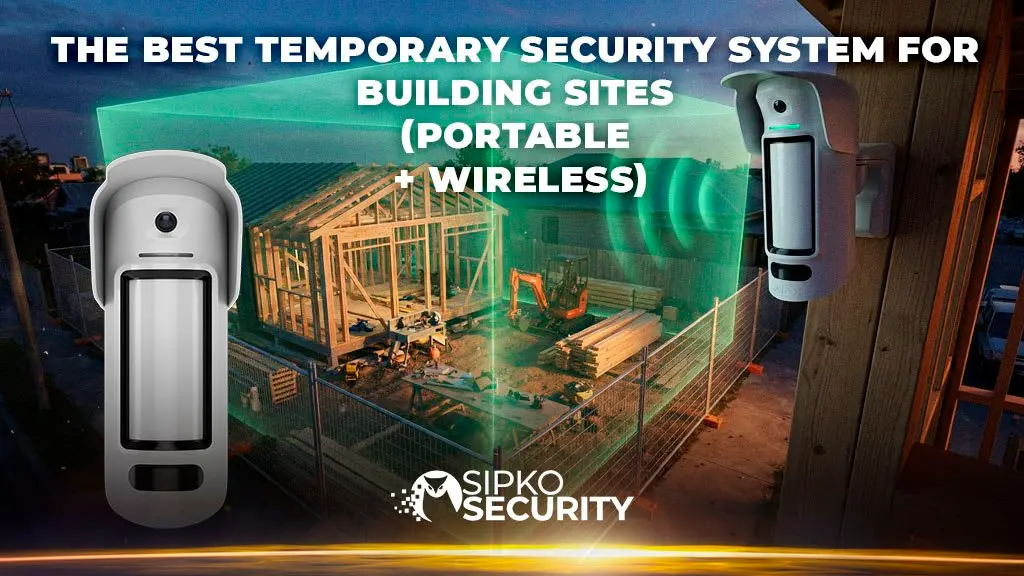
3. The MotionCam Outdoor: Visual Police Verification
Standard PIR sensors trigger blind alarms. When an Ajax MotionCam detects heat and movement, its HDR camera snaps a rapid burst of photos and transmits them to your phone and the monitoring station within 0.3 seconds.
Why this matters: Victoria Police deprioritize “blind” alarm unverified callouts due to thousands of false alarms caused by possums. When a Sipko monitoring operator sees a human in a high-vis vest cutting a lock via the MotionCam photos, they immediately dispatch police on a high-priority “Crime in Progress”.
5. The Dispatch Protocol: What Happens When the Alarm Triggers?
Having a siren is good, but having a human protocol is better. Sipko Security operates a rigorous dispatch logic when an Ajax MotionCam captures an intruder at 3 AM.
The MotionCam detects a thermal break. It immediately triggers the 113dB StreetSiren and begins rapidly uploading encrypted photos via 4G to the Control Room.
A live operator reviews the photo sequence. They confirm it is not a stray dog or blowing debris, but multiple humans with crowbars.
Because the threat is visually verified, the operator calls 000 with a “Verified Crime in Progress”. Site supervisors are simultaneously woken up via specific bypass-sleep-mode phone calls.
6. Environmental Hardening: Surviving Melbourne’s Brutal Weather
Construction sites are hostile environments. Equipment must survive 40-degree heatwaves, torrential rain, thick brick dust, and high-pressure hose-downs.
- IP55 & IP65 Rating: Ajax outdoor sensors and sirens are completely sealed against dust ingress and low-pressure water jets. They do not require secondary “hoods” or protective enclosures.
- Algorithmic False Alarm Prevention (SmartDetect): Mud, blowing tarps, and wandering site cats won’t trigger the alarm. The sensors analyze the thermal mass and movement speed to differentiate between a flapping plastic sheet and a 90kg human.
- Anti-Masking Technology: If a thief tries to be clever during the day by spraying paint over the MotionCam lens or placing a piece of cardboard over it, the sensor immediately registers an “Anti-Mask” fault and alerts the site manager before nightfall.
7. The Siren Strategy: Psychological Warfare against Thieves
A silent alarm catches thieves eventually; a deafening alarm stops them before they load the truck. The Ajax StreetSiren provides a 113-decibel assault on the senses, accompanied by a blinding LED strobe.
Dual-Zone Siren Tactics
We deploy a layered psychological approach:
- Perimeter Warning (Chime/Low Beep): If someone crosses the front boundary, the system gives a pre-warning chirp. This scares away curious teenagers or urban explorers without waking the entire neighborhood.
- The Inner Sanctum (113dB Panic): If they ignore the warning and break the perimeter of the tool-shed or lock-up structure, multiple sirens activate instantly, creating an unbearable acoustic environment that forces immediate retreat.
“We had a syndicate hit our Clyde North estate. They bypassed the camera on site A, but when they hit site B protected by Sipko’s Ajax setup, the dual StreetSirens went off. The MotionCam caught them literally dropping a $3,000 laser level in the mud and sprinting to their ute covering their ears. Not a single item was lost.”
— Site Supervisor, Tier-1 Residential Builder
8. Drones & Counter-Surveillance: How Thieves Prepare
Make no mistake: you are playing against organized professionals. The modern tool-theft syndicate operates with sophisticated surveillance.
Syndicates frequently deploy small consumer drones (like DJI Minis) during the afternoon to map large subdivisions. They fly over fences to identify where heavy plant machinery is parked, look for the bright red logos of premium power tools, and verify if any security guard cars are present.
By erecting aggressive Sipko Security Master-Warning signage at all entry points, and mounting highly visible Ajax StreetSirens and MotionCams high on temporary poles, you immediately signal to the drone operators that this site is not a soft target. They will almost always shift their focus to an unprotected builder next door.
9. Power Geometrics: Running a Security System Without Power
How do you run a high-tech smart alarm on a block of dirt?
Battery Independence
Every single sensor, keypad, remote, and siren in the Ajax ecosystem runs on its own internal long-life batteries (CR123A), lasting up to 5 years. Only the central Hub requires 12V or 240V power.
Powering the Central Hub
We offer three distinct power solutions for the Hub:
- The Deep Cycle Battery Box: A ruggedized marine battery connected via a 12V PSU board. Runs the Hub for up to 30 days without a charge. Swap it out once a month.
- Solar Integration: A 50W solar panel paired with a charge controller makes the system infinitely self-sustaining. Perfect for long-term earthworks or subdivisions.
- Temporary Site Power Board: Plug it directly into the Sparky’s temp-board. The Hub has a 16-hour internal backup battery, so if the board is switched off at 5 PM, it easily survives until the trades arrive at 6 AM the next day.
10. Subcontractor Management and Avoiding False Alarms
The most sophisticated alarm system in the world is useless if your plumbers and electricians hate using it. If your subbies constantly trigger false alarms because the keypad is too hard to use, they will simply refuse to arm it when they leave.
Key Fobs and App Control
Instead of requiring subcontractors to memorize complex 4-digit codes on a dirty keypad, we provide encrypted Ajax SpaceControl Keyfobs to trusted subbies. They press one button to disarm when they arrive, and one button to arm when they leave. Alternatively, they can use the Ajax App on their phone. If a subbie leaves the company or is removed from the project, the Site Manager can delete their digital key in 5 seconds via the app.
11. Implementing GPS Tags for Premium Tools
While the perimeter belongs to Ajax, the macro-level protection of individual tools requires defense-in-depth. We heavily advise site supervisors to drill out small cavities in their $300+ power tools and embed Apple AirTags or dedicated GPS trackers hidden by epoxy resin.
If the Ajax perimeter is breached so rapidly that the thieves manage to grab one site box before the police arrive, the embedded GPS trackers provide the exact coordinates of the syndicate’s warehouse, allowing police to raid the staging ground and recover the assets.
12. The Rapid Relocation Protocol: Reusable ROI
Traditional wired alarms are buried in the plaster and sold with the house. Ajax is a portable, owned asset for your building company.
When you finish a build in Brighton, our technicians (or your own staff, post-training) simply unclip the MotionCams from their rapid-mount brackets, pull the Hub, and drive the system to your next start in Toorak. The entire uninstallation takes 15 minutes. Installation at the new site takes roughly 45 minutes.
Volume Builder Fleet Management
If you run 20 sites simultaneously, you can manage all 20 Ajax Hubs from a single smartphone app. The Site Manager can group sites by region, instantly granting and revoking access to subcontractors (plumbers, electricians) via their phone. No more giving out physical keys to a site padlock.
13. Why Insurance Companies Demand Active Verification
Insurance payouts for construction theft are changing rapidly in 2026. Providers are hiking deductibles to $10,000+ for sites with “inadequate perimeter security”. Some underwriters are simply refusing to renew policies for builders suffering consecutive hits.
Having an Ajax system installed profoundly alters your risk profile. Because Sipko provides full historical logs—showing exactly who armed the site, what time it was breached, and photographic evidence of the perpetrators—insurance claims are processed mathematically faster. Many underwriters are beginning to offer steep premium discounts for sites protected by actively monitored, photo-verified smart systems, effectively paying back the cost of the security system over a few projects.
14. Seamless Integration: CCTV Tracking & Cloud Synergy
While Ajax MotionCams are elite, they are explicitly designed to catch short bursts of evidence. For continuous 24/7 video streaming, we integrate professional-grade Hikvision or Dahua CCTV networks directly into the Ajax app.
This allows a site manager to receive an Ajax notification (“Motion detected at Front Gate”), tap the notification, and instantly pull up a 4K live stream from the adjacent PTZ (Pan-Tilt-Zoom) camera to closely track the vehicle’s license plate as it flees the scene. This hybrid approach ensures you get the absolute best of both immediate algorithmic detection and deep forensic video recording.
15. The Black Market Dynamics: Where do the tools go?
Understanding the final destination of stolen tools helps builders realize why they are continually targeted. Stolen Makita and Milwaukee sets rarely end up at local pawn shops anymore; pawn shops are too heavily regulated and integrated with police databases.
Instead, syndicates fence stolen tools via closed Facebook Marketplace groups, interstate transport networking, or they directly sell to unscrupulous cash-in-hand tradesmen out of the back of unmarked vans at wholesale prices. Copper piping is melted down at illicit scrapyards who pay cash and do not require identification.
16. Perimeter Chainlink Vulnerabilities
Relying on standard temporary chainlink fencing is your first critical failure point. An experienced thief using a pair of $30 bolt cutters can snap the heavy padlocks on an entry gate completely silently in precisely 4 seconds.
Instead of trusting the fence to keep them out, we use the fence as the trigger point. By mounting Ajax MotionCams pointing along the interior perimeter of the fence line, the absolute micro-second a thief steps through the cut chainlink, the system is triggered. The fence is no longer a barrier; it is a giant tripwire.
17. Smoke, Arson & Smart Fire Detection
Theft is prevalent, but fire is catastrophic. Beyond electrical faults in temporary wiring, arson on construction sites (often committed by vandals or disgruntled former contractors) remains a very real threat in Melbourne.
Ajax FireProtect sensors are battery-operated and integrate directly onto the same Hub as your alarm. If a fire sparks in the lock-up timber frame at 1 AM, the system detects the rapid temperature spike or smoke, blasts the site sirens, and immediately dispatches the Fire Brigade before the fire can consume the structural beams.
18. Securing High-Volume Multi-Lot Estates
Protecting a single custom home in Toorak is completely different from protecting 45 simultaneous builds in an estate in Tarneit. Volume builders face unique challenges where syndicates simply hop from one site to the neighbor’s site within the same estate.
For volume builders, Sipko Security designs “Mesh Perimeter” architectures using the Ajax ReX 2 radio signal extender. We deploy one central master Hub in the estate sales office (or a heavily secured master-pole), and bounce the encrypted signal up to 3 kilometres away across the entire estate, creating a centralized, estate-wide exclusion zone.
19. Commercial vs Residential Builds: Shifting Risk Profiles
While residential builds suffer heavy tool and appliance theft, massive commercial sites (hospitals, schools, high-rises) suffer from coordinated “Heavy Asset” theft. This includes the theft of rented elevated work platforms (scissor lifts), vast quantities of bundled commercial copper wire, and entire pallets of specialized server racks or heavy structural steel.
For commercial sites, we integrate Dahua Thermal/Radar PTZ cameras linked to the Ajax system, providing extreme long-range detection (up to 300 meters) to protect heavy asset laydown yards.
20. Managing Access Logs & Dispute Resolution
A secondary massive benefit of the Ajax system is total transparency and auditability. The Ajax app logs every single interaction.
If the plasterers claim they “arrived at 6 AM and worked until 5 PM”, the site foreman can simply open the Ajax log and see that Plasterer_Keyfob_1 disarmed the site at 10:15 AM and armed it at 2:30 PM. The security system inherently serves as an un-hackable digital punch clock, resolving subcontractor billing disputes instantly.
21. Environmental Monitoring: Water Leaks and Freeze Protection
Water damage causes just as much financial ruin as theft, especially during the fit-out phase when premium plaster, floorboards, and electricals are installed.
If a plumber leaves a valve loose overnight, hundreds of liters of water can destroy a ground floor. By placing a wireless Ajax LeaksProtect sensor on the floor near the mains, the moment 1mm of water touches the sensor, it alerts the foreman’s phone, allowing them to rush to the site and shut off the mains before the plasterboard wicks the water and collapses.
22. The Threat of Internal Theft (Sub-on-Sub Crime)
The uncomfortable reality of site management is that not all theft comes from outside syndicates. A significant percentage of tool theft occurs during broad daylight when trades from one company steal from trades of another company on the same site.
By defining specific “Partitions” within the Ajax system, a site manager can leave the massive Tool Shed locked and armed, while the main site is disarmed for work. Only authorized personnel can walk into the specific tool shed partition during the day, drastically reducing internal theft.
23. Integration with Aggressive Security Lighting
Darkness is a thief’s primary weapon. Site lighting is often turned off at night to save power or comply with local council light pollution bylaws.
We use the Ajax WallSwitch (a wireless relay controller) to connect the Ajax system directly to massive 10,000-lumen LED floodlights. The site stays pitch black and completely dark at night to comply with regulations. However, the exact millisecond a MotionCam is tripped, the Ajax Hub instantly triggers the relays, illuminating the entire site like a football stadium, blinding the intruders and ruining their night vision.
24. Fortifying the Site Office and Demountables
The site office (the demountable or site-shed) is the brain of the construction project. It houses the builder’s local servers, sensitive architectural blueprints, laptops, and often the master keys to specialized equipment.
We treat the site office as an ultra-high security “Class A” vault. It receives an Ajax DoorProtect Plus (which detects shock, tilt, and opening) so if someone tries to jemmy the demountable door with a crowbar, or hook the demountable to a truck to steal the entire shed, the alarm triggers before the door even opens.
25. Navigating the Christmas/Holiday Industry Shutdown
The 3-4 week construction industry shutdown over late December and early January is the single most dangerous period for any builder in Melbourne. Sites are completely abandoned for weeks, and syndicates know this.
During the holiday shutdown, we shift our standard protocols to “Hyper-Vigilance Mode”. We increase the polling rate of sensors to check for tampering, we deploy secondary backup batteries to ensure the Hub survives any prolonged grid blackouts, and we double the guard patrol dispatch readiness so any verified Ajax alarm results in an immediate, heavy, and aggressive response.
26. Post-Theft Protocols: Recovering the Unrecoverable
If a syndicate does manage a smash-and-grab—crashing a stolen vehicle through the front gates and ripping tools out before the police arrive 5 minutes later—what happens next?
Because the Ajax MotionCam records all footage and stores it directly in the cloud, the evidence is preserved even if the thieves rip the physical Hub off the wall and smash it. You simply open the app, download the high-res images to your smartphone, and hand them immediately to the responding Victoria Police officers, providing clear facial features and vehicle models.
27. The Failures of Unmonitored Consumer Wi-Fi Cameras in Winter
Many builders try to save money by purchasing consumer-grade, battery-powered Wi-Fi cameras from hardware stores. This is a catastrophic error.
During a Melbourne winter, these cameras suffer from condensation blurring the lenses, their lithium batteries freeze and lose 70% of their charge in overnight 2°C temperatures, and their weak Wi-Fi antennas cannot penetrate wet timber framing. They will invariably disconnect precisely when you need them. The Ajax Jeweller protocol operates on military radio frequencies specifically designed to ignore environmental weather interference.
28. Advanced Geofencing Capabilities
Humans make mistakes. A site supervisor exhausted after a 12-hour shift might simply forget to arm the site from their phone when they lock the gates and drive home.
The Ajax app features built-in Geofencing. We simply draw a digital circle around the construction site map. If the GPS on the site supervisor’s phone registers that they have driven out of the circle, and the alarm is still disarmed, the app will ping their phone with an extremely loud notification: “You have left the site unsecured. Tap here to Arm.” It eliminates human memory failure.
29. The Future: AI Integration and Command Center Synergy
The future of construction security at Sipko involves integrating the raw data output from Ajax hardware directly into the builder’s project management software (like Procore or Buildxact).
We are actively developing architectures where AI parses the thermal signatures on site to automatically flag potential hazards before they become crimes, ensuring Melbourne’s elite builders maintain absolute sovereign control over their physical assets regardless of scale.
Secure Your Blueprint. Stop the Bleeding.
Sipko Security builds bespoke, rapid-deployment Ajax architectures for Melbourne’s elite builders. Don’t wait until you lose $30,000 worth of hardwood and tools.
- 🚀 Same-Day Deployment: Out of the box and protecting your site in under 3 hours.
- 🔋 100% Wireless Architecture: Zero infrastructure required. Own independent power and cell-comms.
- 📷 Police-Priority Response: Visual verification stops the crime; it doesn’t just record it.
- 💼 Purchase or Rent: Flexible OpEx/CapEx models for builders of all scales.
Speak to a Construction Security Expert
Skip the call center. Talk directly to technicians who understand site phases, builder voltages, and the reality of Melbourne theft syndicates.
Primary Sources & Regulations
- Victoria Police Construction Site Theft Guidance – Crime statistics mapping establishing the necessity of verified responses over standard alarms.
- WorkSafe Victoria Safety Regulations – OHS obligations regarding secure tool storage and maintaining hazard-free temporary sites.
- Standards Australia AS 2201 – Australian standards for intruder alarm systems, wireless communications, and battery backup mandates.